"Shalya Parva: The Tragic Hero of Mahabharata"
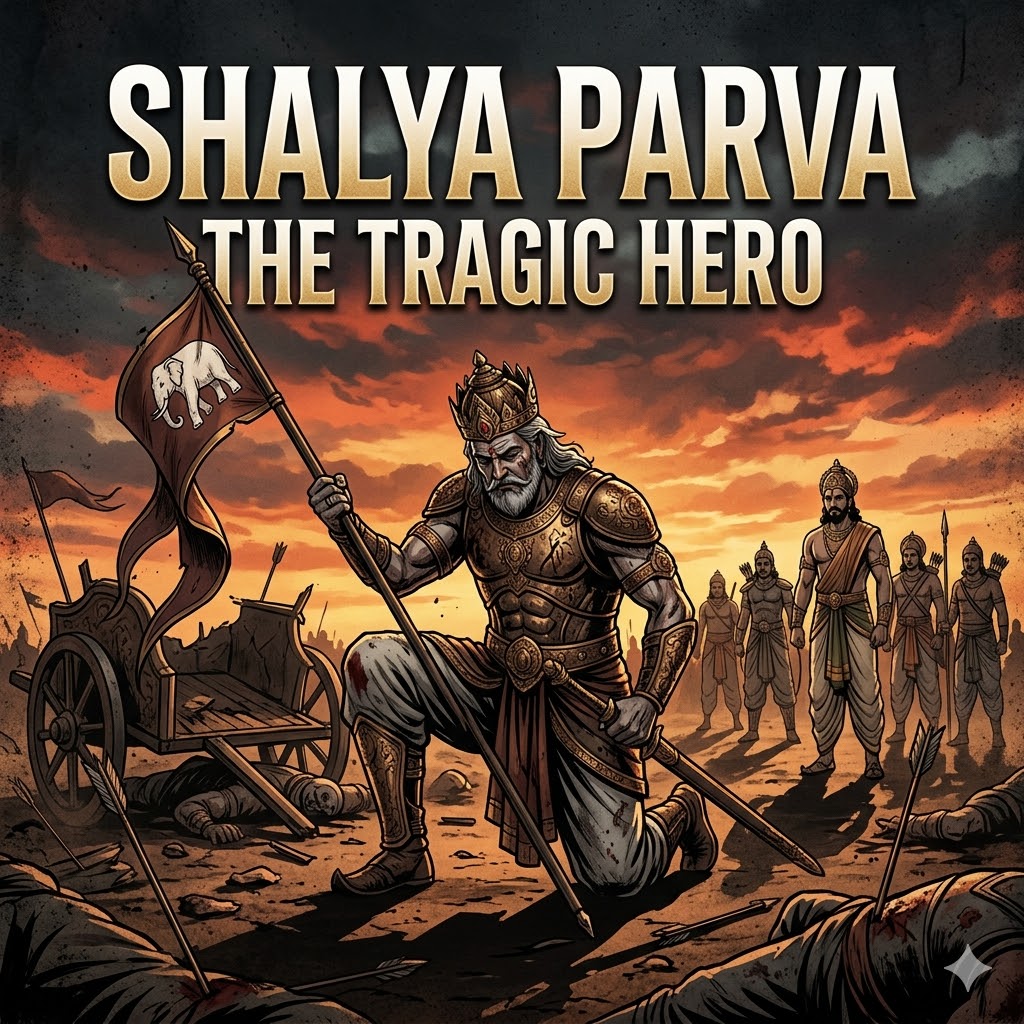
In the vast and timeless epic of the Mahabharata, few sections capture the raw interplay of duty, deception, and destiny as powerfully as Shalya Parva. As the ninth of the eighteen major parvas, Shalya Parva stands as the climactic chapter of the Kurukshetra War, unfolding entirely on its eighteenth and final day. Named after Shalya—the fourth and last commander-in-chief (Senapati) of the Kaurava forces—this parva delves deep into the tragic heroism of a warrior caught between blood ties and battlefield loyalty.
For readers searching for insights into Shalya Parva explained, the real Mahabharat Shalya, or even Shalya Parva quiz-style questions, this section of the epic offers profound lessons on dharma, generalship, and the inevitable cost of war. It builds directly on the preceding parvas—Bhishma Parva, Drona Parva, and Karna Parva—while delivering the war’s devastating conclusion. Here, we examine Shalya’s background, his reluctant yet resolute role, the key incidents of Shalya Parva, and why his story remains essential to understanding the Mahabharata’s perspective on leadership, sacrifice, and moral complexity.
Shalya, also known as the King of Madra, was no ordinary warrior. He ruled the northwestern kingdom of Madra and belonged to the Bahlika clan. As the brother of Queen Madri—second wife of King Pandu and mother of the Pandava twins Nakula and Sahadeva—Shalya was the maternal uncle (mama) to the Pandavas, particularly close to the younger brothers. His prowess with the spear and mace, combined with exceptional charioteering skills, earned him renown across the subcontinent. He was a virtuous king, learned in the Vedas, and respected for both martial excellence and wisdom.
Yet Shalya’s entry into the Kurukshetra War is one of the epic’s most poignant ironies. Initially, he marched toward the battlefield intending to support the Pandavas, his own nephews. Duryodhana, ever the master strategist, arranged lavish hospitality along Shalya’s route, deliberately making it appear as if the arrangements came from Yudhishthira. Bound by royal etiquette and his word of honor, Shalya pledged his support—and his formidable army of two akshauhinis—to the person he believed had hosted him. Upon discovering the deception at the Kaurava camp, he found himself trapped by his own promise. Though he secretly wished for the Pandavas’ victory, Shalya fulfilled his obligation to the Kauravas with unwavering integrity.
This internal conflict defines Shalya as the tragic hero of the Mahabharata. He fought not out of hatred for his nephews but from a deep sense of dharma—honor-bound duty—highlighting one of the epic’s central themes: how even the noblest souls can be ensnared by circumstance.
The Build-Up: Brief Overview of Previous Parvas and Their Importance
To fully appreciate Shalya Parva, one must understand the preceding books of the Mahabharata, which chronicle the war’s progression through the falls of successive Kaurava commanders. These parvas are not mere battle accounts; they illustrate the gradual unraveling of the Kaurava might and the inexorable march toward dharma’s triumph.
Bhishma Parva (covering days 1–10 of the war) introduces the conflict under the command of the grandsire Bhishma. As the first Senapati, Bhishma’s invincible leadership and ethical dilemmas set the tone. His eventual fall—brought down by Arjuna on a bed of arrows after he refuses to fight Shikhandi—marks the first major blow to the Kauravas. This parva is crucial because it establishes the rules of engagement, the massive scale of the armies (eleven akshauhinis for Kauravas versus seven for Pandavas), and the moral cost of war. From the Mahabharata’s perspective, Bhishma Parva underscores that even the greatest warriors are bound by personal vows and cosmic justice.
Drona Parva (days 11–15) follows with Dronacharya, the revered guru, as commander. His unmatched knowledge of warfare and celestial weapons leads to fierce battles, including the controversial killing of Abhimanyu. Drona’s death—deceived into laying down arms after false news of his son Ashwatthama’s demise—highlights themes of deception in warfare and the guru-shishya relationship’s tragedy. This parva deepens the narrative’s exploration of loyalty and loss, showing how personal attachments weaken even the strongest leaders.
Karna Parva (days 16–17) centers on Karna, the tragic son of Surya, appointed after Drona’s fall. Karna’s heroic yet doomed campaign, marked by his rivalry with Arjuna and his role as a symbol of social injustice, culminates in his death on the seventeenth day. His charioteer during this phase? None other than Shalya himself, who subtly undermined Karna’s confidence (as per a promise to Krishna) while still fighting loyally. These earlier parvas collectively build tension: each commander’s death demoralizes the Kaurava ranks further, eroding their numerical superiority and morale. They emphasize the Mahabharata’s view that true victory lies not in might but in righteousness, a perspective that reaches its zenith in Shalya Parva.
By the end of Karna Parva, the Kaurava army is shattered, and Duryodhana stands nearly alone in resolve. This sets the stage for Shalya’s elevation, transforming him from a reluctant ally into the final beacon of Kaurava resistance.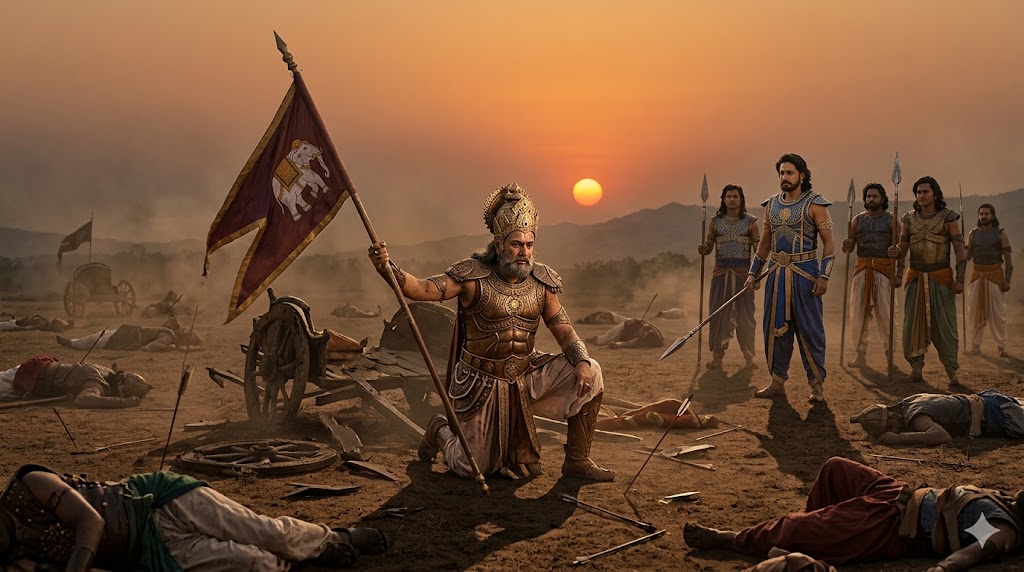
Shalya's Generalship on the Final Day
Shalya’s Appointment as Senapati: Leadership in Despair
Shalya Parva opens amid profound grief. Karna’s fall has plunged Duryodhana into despair, yet the Kaurava king refuses surrender. In a stirring address, he rallies his remaining warriors, reminding them of kshatriya duty: to fight until the last breath, lest seventeen days of sacrifice be rendered meaningless. After deliberation among the surviving leaders—including Kripa, Ashwatthama, and Kritavarma—Shalya is unanimously chosen as the fourth and final commander-in-chief.
Shalya accepts the role with characteristic dignity. He vows to slay the Pandavas or perish in the attempt, despite his secret sympathies. Krishna, ever the strategist, warns the Pandavas of Shalya’s formidable prowess, advising Yudhishthira to confront him personally. This appointment is pivotal: it represents the Kauravas’ last stand, a desperate bid to turn the tide on the war’s final day. From the Mahabharata’s lens, Shalya’s generalship exemplifies resilient leadership amid inevitable defeat, offering lessons on command under adversity.
Key Incidents and Battles in Shalya Parva: A Day of Reckoning
Shalya Parva, structured into four upa-parvas (Shalya-vadha, Shalya, Hrada-praveca, and Gadayuddha), compresses the war’s explosive conclusion into one cataclysmic day. The battlefield, already a graveyard of millions, erupts once more.
The day begins with renewed fury. Nakula, seeking vengeance, slays Karna’s sons—Chitrasena, Satyasena, and Sushena—in fierce duels, showcasing the Pandavas’ momentum. Shalya, however, dominates early, organizing the Kaurava remnants into a formidable Sarvatobhadra vyuha (a protective battle formation). He charges like a lion, showering arrows that force even the Pandava forces to retreat momentarily. His skill as a charioteer and spear-wielder shines as he engages multiple foes simultaneously.
Meanwhile, other duels rage: Duryodhana clashes with Dhrishtadyumna; Ashwatthama battles Arjuna; Bhima slays several of Duryodhana’s remaining brothers. Sahadeva and Bhima together vanquish Shakuni and his son Uluka, eliminating a key architect of the war’s deceit.
The parva’s emotional core lies in the confrontation between Shalya and Yudhishthira. True to Krishna’s counsel, the eldest Pandava leads the assault. Shalya destroys Yudhishthira’s chariot, horses, and charioteer, leaving the righteous king exposed. Undeterred, Yudhishthira invokes the divine Shakti weapon—bestowed by Lord Shiva himself. Chanting sacred hymns, he hurls the javelin. It pierces Shalya’s chest, causing blood to flow from his eyes, ears, and mouth. The mighty warrior falls from his chariot, dying as one of the bravest to grace the field. His brothers attempt revenge but meet the same fate at Yudhishthira’s hands.
Shalya’s death is not merely tactical; it is symbolic. It breaks the Kaurava spine, triggering a rout. Duryodhana, witnessing the collapse, flees to a lake, using his mystic skill of jalastambhana to hide underwater. This leads into the Hrada-praveca (lake entry) and Gadayuddha (mace duel) sections, where the Pandavas confront him. Bhima, recalling his vow, shatters Duryodhana’s thighs in a brutal yet rule-bending climax—fulfilling dharma’s demand for justice against unrighteousness.
By day’s end, the Kaurava army is annihilated. Only three warriors survive on their side: Ashwatthama, Kripa, and Kritavarma. The Pandavas emerge victorious but at an unimaginable cost, lamenting the war’s toll even in triumph.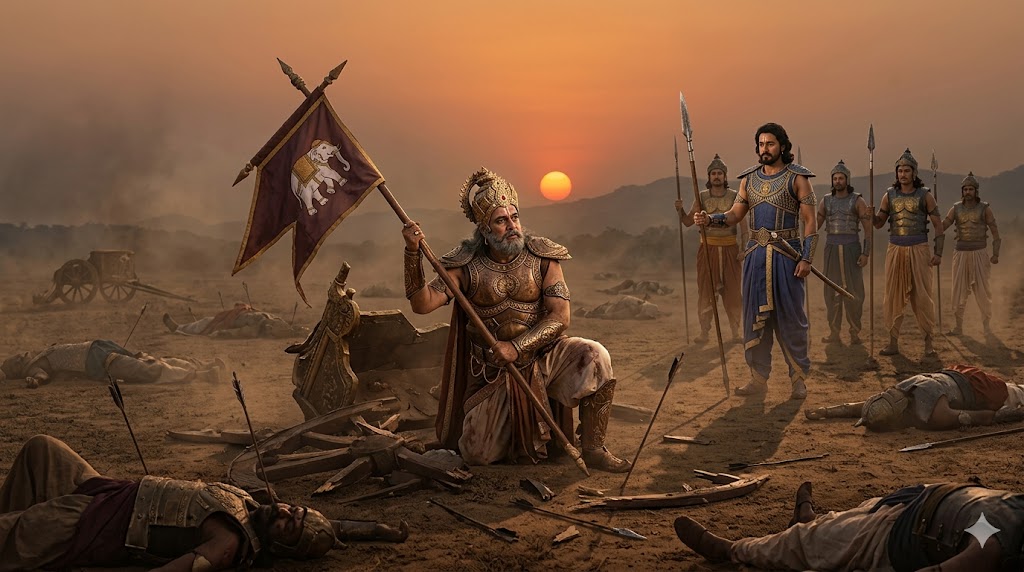
Shalya vs. Yudhishthira Duel
The Death of Shalya and Its Profound Importance in the Mahabharata
The death of Shalya, executed by his own nephew Yudhishthira, carries layers of tragedy and significance. It fulfills a prophecy of sorts—Shalya had fought knowing his likely fate—yet he dies honorably, without bitterness. In the epic’s broader perspective, his fall underscores the futility of adharma: no amount of valor can sustain a cause rooted in greed and injustice. Shalya’s generalship, though brief, demonstrates exemplary command—he rallies a demoralized force, deploys strategy effectively, and embodies resilience. Yet it also reveals the limits of individual heroism against collective destiny.
From the Mahabharata’s viewpoint, Shalya Parva reinforces core teachings: the importance of dharma in leadership, the pain of divided loyalties, and the ultimate victory of righteousness. Shalya’s story humanizes the “enemy” side, reminding readers that the Kauravas were not monolithic villains but complex individuals bound by circumstance. His tragic arc—tricked into battle, loyal despite inner conflict, slain by kin—mirrors the epic’s exploration of karma and free will. It prompts reflection: Had Shalya fought for the Pandavas as intended, how might history have shifted? Such questions make Shalya Parva essential for any deep study of the Mahabharata.
Why Shalya Parva Matters: Lessons for Today
Shalya Parva is more than battlefield narration; it encapsulates the Mahabharata’s philosophical core. In an era of moral ambiguity, Shalya’s life teaches integrity amid impossible choices. His role as Senapati highlights that true leadership demands courage, not just in victory but in facing certain defeat. The parva’s events—deception, valor, loss—echo across time, offering timeless insights into war’s human cost.
For enthusiasts exploring Shalya Parva MCQ, quizzes, or explanations, the section rewards close reading: it tests one’s grasp of character motivations, ethical dilemmas, and narrative structure. Ultimately, it affirms the epic’s message: victory without virtue is hollow, and even the mightiest fall when dharma prevails.
In the grand tapestry of the Mahabharata, Shalya Parva serves as both finale and mirror—reflecting the war’s horrors while illuminating the enduring light of righteousness. Shalya, the tragic hero, reminds us that every warrior’s tale, no matter how brief, holds eternal wisdom.