Karna Parva in Mahabharata: Karna's Command, Valor.
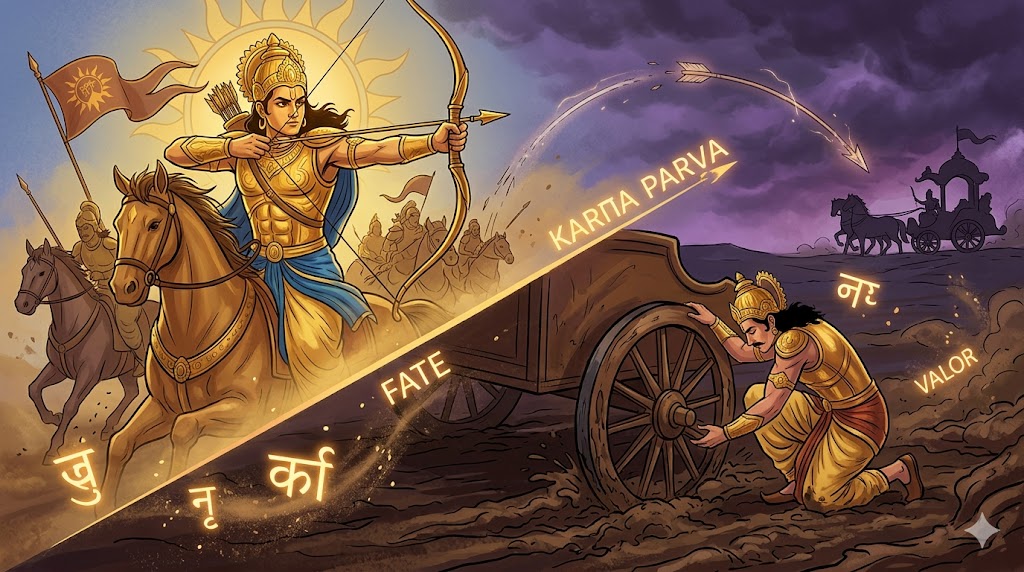
Introduction to Karna Parva in the Mahabharata
The Mahabharata, the ancient Indian epic attributed to Sage Vyasa, stands as one of humanity's greatest literary and philosophical treasures. Among its eighteen major Parvas, or books, Karna Parva holds a unique place as the eighth Parva. It unfolds over the sixteenth and seventeenth days of the eighteen-day Kurukshetra war, capturing the raw intensity of battle, the complexities of human loyalty, and the inexorable hand of destiny.
This Parva does more than narrate warfare. It delves deeply into the character of Karna—one of the most compelling and tragic figures in the entire Mahabharata. Often called Suryaputra or Radheya, Karna embodies the struggle between personal honor, social rejection, and unwavering friendship. In Karna Parva, readers witness his elevation to Senapati (commander-in-chief) of the Kaurava forces, his valiant leadership, and his ultimate confrontation with Arjuna. The narrative, drawn from verified translations such as Kisari Mohan Ganguli's English version and the Critical Edition by Bhandarkar Oriental Research Institute, offers profound educational insights into dharma (righteous duty), karma, and the consequences of choices made under pressure.
This article provides a structured, detailed exploration of **Karna Parva** for educational purposes. We begin with a concise overview of the preceding Drona Parva, then examine the events of Karna Parva itself. We analyze Karna's multifaceted personality across the epic, his role as Senapati, the revelation of his true identity as Kunti's son and the Pandavas' elder brother, and a thoughtful reflection on what might have unfolded had Lord Krishna revealed the truth earlier. All information is synthesized from primary sources to ensure accuracy and originality.
Brief Overview of the Previous Parva: Drona Parva
To appreciate Karna Parva fully, one must understand its immediate predecessor—Drona Parva, the seventh book of the Mahabharata. This Parva covers days eleven through fifteen of the Kurukshetra war, following the fall of Bhishma in Bhishma Parva.
After Bhishma's ten-day command, Drona— the revered guru of both Pandavas and Kauravas—assumes leadership of the Kaurava army at Duryodhana's request. Drona fights with unmatched ferocity, employing celestial weapons and strategic formations. Key events include the brutal night battles, the death of Abhimanyu (Arjuna's son) in the Chakravyuha formation, and the slaying of Jayadratha. The war grows increasingly ruthless, with both sides bending or breaking traditional rules of engagement.
Drona's tenure ends tragically on the fifteenth day. Misled by a strategic deception involving his son Ashwatthama's supposed death, Drona lays down his weapons. Drishtadyumna, born to kill him as per prophecy, beheads the unarmed guru. This act shocks the Kaurava forces and sets the stage for Karna Parva. Dhritarashtra, upon hearing Sanjaya's narration, is plunged into deeper grief, lamenting the escalating losses.
Drona Parva thus marks a turning point: the war shifts from chivalric combat to total war, highlighting themes of illusion, loyalty, and moral compromise. It directly leads into Karna Parva, where Karna steps into the void left by Drona.
The Events of Karna Parva: From Appointment to Climax
Karna Parva opens with the Kaurava camp in disarray after Drona's fall. Duryodhana, desperate yet resolute, turns to Karna—the one warrior he believes can match the Pandavas. On the morning of the sixteenth day, Karna is formally consecrated as the third Senapati of the Kaurava army. He arrays the troops in the Krauncha Vyuha (crane formation), positioning himself aggressively at the forefront.
The two days of Karna Parva are among the most intense in the epic. Karna displays extraordinary prowess, routing large sections of the Pandava army and instilling fear even in seasoned warriors like Bhima and Yudhishthira. He duels multiple opponents, including Nakula, Sahadeva, and Yudhishthira himself, often gaining the upper hand through skill and sheer determination. The battlefield descriptions in Vyasa's original Sanskrit are vivid: rivers of blood, mountains of corpses, and the relentless clash of celestial astras (weapons).
Yet, karna Parva is not merely a catalog of violence. It interweaves philosophical dialogues on fate (daiva) versus human effort (purushartha). Karna's charioteer, Shalya (uncle to the Pandavas), repeatedly demoralizes him with subtle taunts, fulfilling a promise to Yudhishthira. These exchanges reveal the psychological warfare layered beneath the physical conflict.
The Parva builds inexorably toward the seventeenth day's centerpiece: the legendary Karna vs Arjuna duel. This yudh (battle) is the emotional and martial heart of Karna Parva. Arjuna, guided by Krishna, faces his arch-rival in a contest of equals. Both unleash powerful astras—Brahmastra, Vaishnavastra, and more. The earth trembles; the sky darkens with arrows. Karna fights with unmatched valor, but accumulated curses, strategic interventions, and destiny converge against him.
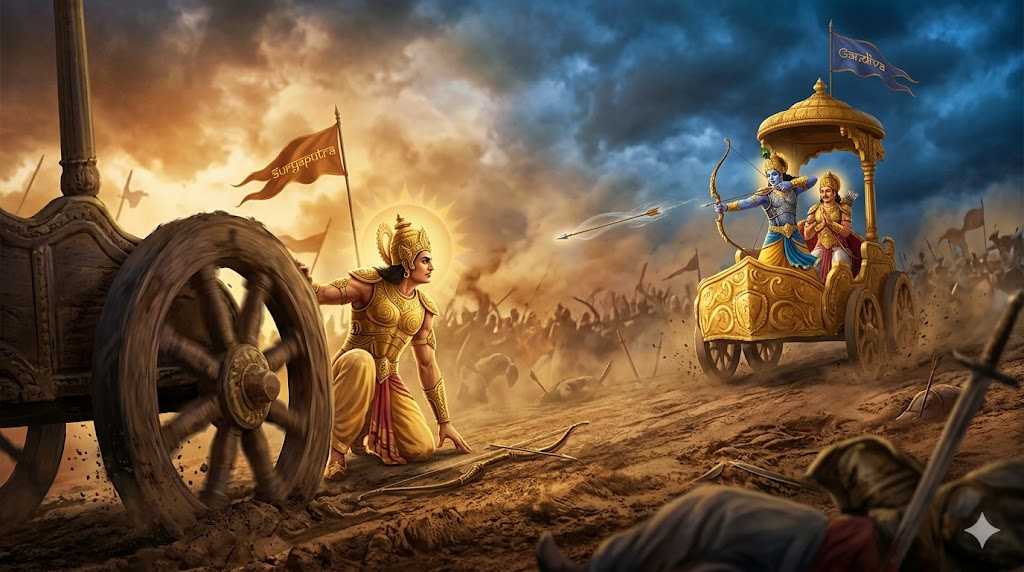
Conceptual illustration of the legendary 17th-day duel between Karna and Arjuna, where celestial weapons (astras) clash, representing a pivotal moment of cosmic dharma and tragic conflict.
Karna's Role as Senapati and His Killing in Karna Parva
Karna's appointment as Senapati in Karna Parva represents the fulfillment of a lifelong ambition tempered by tragedy. Duryodhana, who had earlier granted him the kingdom of Anga and treated him as an equal when others scorned his Suta (charioteer) birth, now entrusts him with the entire Kaurava cause. Karna accepts with characteristic dignity, vowing to slay Arjuna or die trying. His leadership galvanizes the troops, proving his strategic acumen alongside his archery mastery.
However, Karna's command lasts only two days. On the seventeenth day, as the duel with Arjuna intensifies, Karna's chariot wheel sinks into the mud— the result of a curse by the earth goddess for an earlier act of unintentional cruelty. Karna descends to free it, unarmed and vulnerable. He appeals to Arjuna's sense of kshatriya dharma, requesting a pause. Arjuna hesitates, but Krishna reminds him of the larger stakes: the protection of dharma itself demands action in this moment of crisis. Arjuna releases the Anjalika astra, severing Karna's head. A radiant light ascends from Karna's body toward the sun, symbolizing his divine parentage.
This scene of Karna vadh (Karna's killing) in Karna Parva is not portrayed as simple defeat. Vyasa emphasizes Karna's heroism even in death. The Kaurava army flees in panic, marking the beginning of their collapse. Sanjaya's narration to Dhritarashtra underscores the tragedy: a warrior of unparalleled generosity and skill undone by fate, curses, and divided loyalties.
Karna's Personality: A Complex Portrait Across the Mahabharata
Throughout the Mahabharata—not just in Karna Parva—Karna emerges as a deeply nuanced personality. Born to Kunti through the sun god Surya yet abandoned at birth, he grows up as the adopted son of charioteer Adhiratha. This social marginalization shapes his core traits: fierce pride, boundless generosity, and unshakeable loyalty.
Karna is generous to a fault, famously giving away his divine Kavacha and Kundala to Indra in disguise, knowing it weakens him. He is brave, skilled, and eloquent, yet his quick temper and sense of grievance lead him to harsh words—insulting Draupadi in the assembly hall and goading Duryodhana toward war. Modern analyses describe him as a tragic hero torn by identity crisis: a Kshatriya by birth living as a Suta, craving respect while rejecting compromise.
In Karna Parva, these traits shine brightest. His loyalty to Duryodhana overrides even the call of blood. He fights not for conquest but for gratitude and friendship. Yet he remains dharmic in private moments—sparing the Pandavas per his promise to Kunti. Karna's personality teaches that greatness lies not in flawless victory but in integrity amid suffering. His story humanizes the epic, showing how societal prejudice and personal choices can derail even the noblest soul.
The Revelation: Karna as Son of Kunti and Brother of the Pandavas
A pivotal element influencing Karna Parva is Karna's knowledge of his true heritage. Before the war begins (detailed in Udyoga Parva), Kunti approaches Karna secretly at night. She reveals he is her firstborn son, conceived through Surya's divine grace. Overwhelmed, Karna learns he is the elder brother of the Pandavas.
Kunti pleads with him to join his brothers and claim his rightful place. Karna refuses, citing his debt to Duryodhana, who stood by him when the world did not. He promises not to kill Yudhishthira, Bhima, Nakula, or Sahadeva—only Arjuna, preserving the duel as a fair contest. This Kunti Karna samvad (dialogue) is one of the epic's most poignant scenes, blending maternal love with filial duty. Karna requests Kunti keep the secret until his death, underscoring his dignity.
Lord Krishna also visits Karna, confirming the truth and urging him toward the Pandava side. Yet Karna's sense of honor prevails. In Karna Parva, this knowledge adds layers of inner conflict to his battles. He fights his brothers while protecting them subtly, embodying the tragedy of divided loyalties.
A Thoughtful Reflection: What If Lord Krishna Had Revealed the Truth Earlier?
The Mahabharata invites reflection on "what if" scenarios, and Karna Parva prompts one particularly compelling question: How might events have differed if Lord Krishna had disclosed Karna's parentage much earlier—perhaps during his youth or training under Parashurama?
Had Krishna intervened early, Karna might have grown up aware of his Kshatriya roots, avoiding the humiliation at Draupadi's swayamvara and the resentment that fueled his alliance with Duryodhana. Recognition by the Pandavas could have healed his identity wounds, channeling his genius toward dharma rather than adharma. The Kaurava-Pandava rift might have narrowed, potentially averting or shortening the war.
Yet the epic's philosophy suggests destiny (daiva) works through human flaws. Karna's early ignorance forged his unparalleled resilience and generosity—qualities that define his legacy. An early revelation might have diminished these very traits that make his story educational. Krishna, as the upholder of cosmic order, acts at the precise moment when choices matter most. This hypothetical underscores a key Mahabharata lesson: truth revealed at the right time tests character; premature knowledge might alter fate but not the soul's journey.
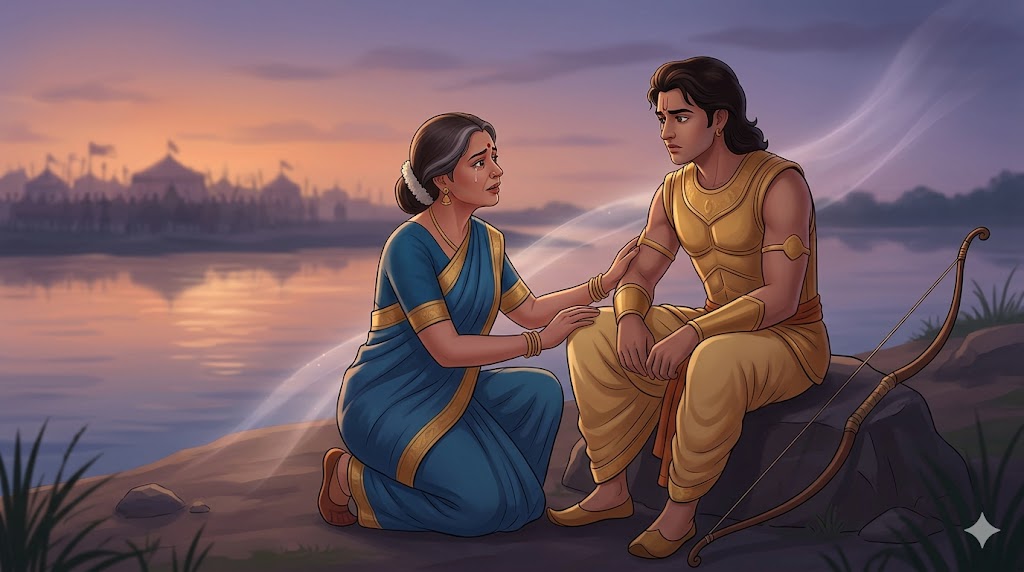
Conceptual illustration of the Kunti and Karna samvad, where the mother reveals the secret of her firstborn son's royal heritage on the riverbank, a scene that adds tragic depth to Karna’s commitment to the war.
Conclusion: Enduring Lessons from Karna Parva
Karna Parva concludes the arc of one of the Mahabharata's most beloved yet misunderstood warriors. It leaves readers with reflections on loyalty's limits, the cost of social injustice, and the triumph of dharma over personal glory. Karna's death does not diminish his stature; it elevates the narrative to universal truths about forgiveness, identity, and redemption.
For students, scholars, and enthusiasts, Karna Parva remains a masterclass in ethical complexity. It reminds us that even in epic conflict, human emotions—love, betrayal, honor—drive history. By studying this Parva alongside the full Mahabharata, we gain wisdom applicable to modern dilemmas of belonging, duty, and resilience.