Mahabharat' s Bhishma Parva: Dawn of Kurukshetra War
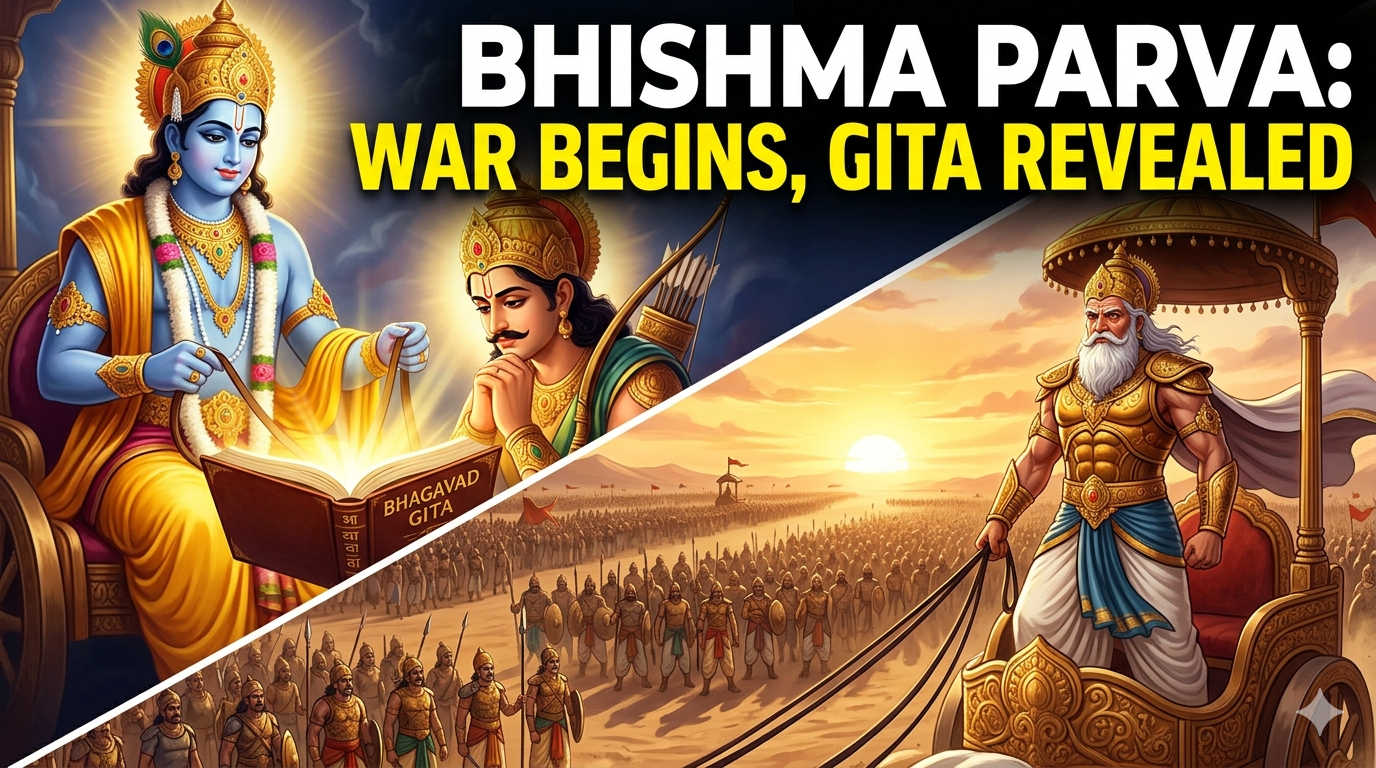
The Mahabharata, one of humanity’s greatest epics, unfolds across eighteen parvas that chronicle the rise and fall of the Kuru dynasty. Each parva builds tension, deepens character, and explores the eternal conflict between dharma and adharma. Before we step into the thunderous pages of Bhishma Parva, it is essential to understand the groundwork laid by the preceding books. These earlier parvas set the stage for the inevitable clash on the fields of Kurukshetra, transforming personal grievances into a cosmic battle for righteousness.
The story begins in Adi Parva, the Book of the Beginning. Here, the sage Vyasa weaves the origins of the Bharata race, the birth of the Pandavas and Kauravas, and the intricate web of destiny that binds them. We meet the noble King Shantanu, his son Bhishma—the embodiment of vow and sacrifice—and the complex family tree that will one day fracture the kingdom. Adi Parva introduces the seeds of jealousy, the tragic circumstances of the Pandavas’ early life, and the divine interventions that shape their fates.
Sabha Parva, the Book of the Assembly Hall, escalates the drama. Yudhishthira performs the Rajasuya sacrifice, asserting his supremacy, only for the Kauravas—led by the envious Duryodhana—to plot his downfall. The infamous game of dice unfolds, where Shakuni’s cunning strips the Pandavas of their kingdom, honor, and dignity. Draupadi’s humiliation in the assembly hall becomes the turning point that ignites unquenchable rage. The Pandavas are exiled for thirteen years—twelve in the forest and one in disguise—setting the clock toward war.
Aranya Parva, also known as Vana Parva or the Book of the Forest (often called Vanaparvah in regional retellings), forms the emotional and philosophical heart of the exile years. Forced into the wilderness after the dice game, the Pandavas endure hardship, loss, and profound introspection. This parva is rich with sub-stories: the tales of Nala and Damayanti, the Ramayana’s influence through Markandeya’s narratives, and Arjuna’s quest for divine weapons on Mount Kailash. It is here that the brothers confront their inner demons, strengthen their bonds, and receive blessings from sages and gods alike. Aranya Parva humanizes the heroes, showing their vulnerabilities while reinforcing the theme that true strength lies in patience and moral resolve. The forest exile is not mere punishment; it is preparation—forging the Pandavas into warriors ready to uphold dharma against overwhelming odds.
Virata Parva follows, shifting the tone to one of strategy and disguise. The thirteenth year of exile must be spent incognito. The Pandavas serve in the court of King Virata, each adopting humble roles: Yudhishthira as a dice master, Bhima as a cook, Arjuna as the eunuch Brihannala, and so on. Draupadi, too, serves as a maid. This parva tests their humility and ingenuity. When the Kauravas raid Virata’s kingdom, the Pandavas—still in disguise—reveal their prowess subtly, defeating the invaders without exposing their identities. Virata Parva bridges the gap between exile and open conflict, proving that the Pandavas have not lost their skill or unity.
Finally, Udyoga Parva, the Book of Effort, brings the narrative to the brink of war. Peace missions fail spectacularly. Krishna himself travels as an emissary to Hastinapura, only to be insulted. Both sides summon vast armies from across the subcontinent. Allies are chosen, strategies debated, and the stage is set on the sacred plain of Kurukshetra. Udyoga Parva captures the frantic preparations, the moral dilemmas of kings, and the growing realization that bloodshed is unavoidable. It is against this meticulously built backdrop that Bhishma Parva erupts—the sixth and pivotal parva where philosophy meets the battlefield.
The Arrival at Kurukshetra: How Bhishma Parva Becomes the Heart of the War
Bhishma Parva opens with the armies arrayed like two oceans ready to collide. The Kauravas, numbering eleven akshauhinis, choose the revered Bhishma as their commander-in-chief. Granduncle to both sides, Bhishma accepts the role out of duty, though his heart leans toward the Pandavas. His appointment signals the war’s formal beginning. On the opposing side, the Pandavas, with seven akshauhinis, place Dhrishtadyumna in command, following Krishna’s counsel.
The parva wastes no time in grandeur. Sanjaya, granted divine vision by Vyasa, narrates every detail to the blind King Dhritarashtra in Hastinapura. This narrative device allows readers to witness the war’s fury while exploring the psychological toll on both camps. Bhishma Parva does not merely describe battles; it elevates the conflict to a moral crossroads. Bhishma’s leadership becomes the trending focal point—the unbreakable pillar of the Kaurava forces and the very symbol of the war’s tragic inevitability.
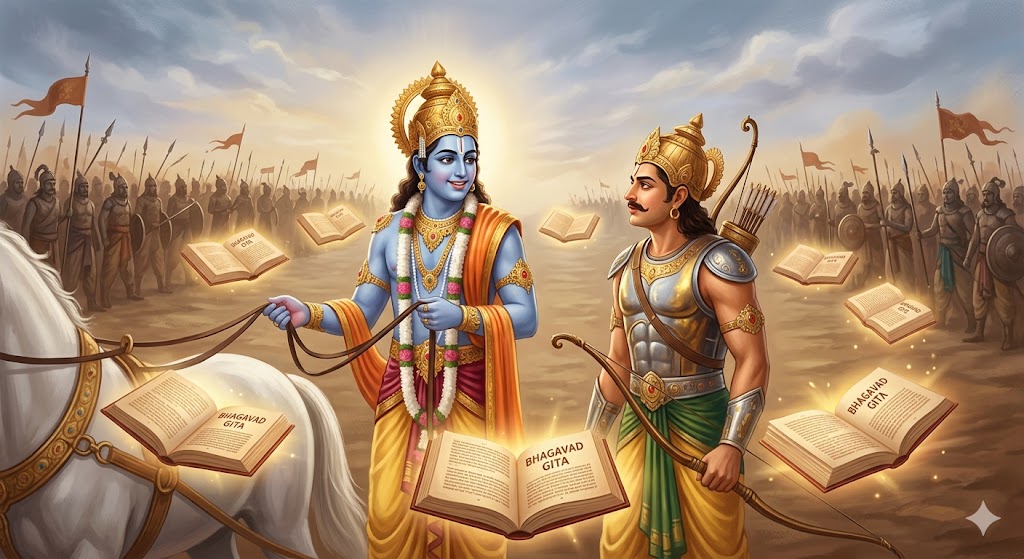
Krishna, the divine strategist and charioteer, delivering the Bhagavad Gita's timeless teachings on dharma and karma yoga to a contemplative Arjuna on the field of Kurukshetra.
The Bhagavad Gita: Krishna’s Timeless Discourse to Arjuna
As the conch shells sound and arrows darken the sky, a profound moment unfolds in Bhishma Parva. Arjuna, the greatest archer, surveys the battlefield and sees his teachers, uncles, cousins, and friends arrayed against him. Overwhelmed by grief and doubt, he drops his bow. “How can I fight my own blood?” he asks Krishna, his charioteer.
This is the birth of the Bhagavad Gita, the crown jewel embedded within Bhishma Parva. Krishna, the Supreme Lord incarnate, does not offer empty consolation. He becomes Arjuna’s guide, transforming despair into resolve through 700 verses of divine wisdom. The Gita is not a call to war for war’s sake; it is a manual for living with purpose.
Krishna explains the immortality of the soul: “You grieve for those who are not worthy of grief,” he says. The body perishes, but the atman endures. He teaches the three paths—Karma Yoga (selfless action), Jnana Yoga (knowledge), and Bhakti Yoga (devotion)—as routes to liberation. Most crucially for the immediate crisis, Krishna emphasizes svadharma: a Kshatriya’s duty is to fight for justice. Family ties, however sacred, cannot override dharma when adharma reigns.
The lesson resonates deeply: dharma stands above blood relations. If your own kin pursue greed, injustice, or harm to the innocent, you must take a stand. Arjuna’s hesitation mirrors every human dilemma—loyalty versus righteousness. Krishna’s words cut through: “Better to die performing one’s duty than to live abandoning it.” He reminds Arjuna that inaction itself becomes a sin when evil must be confronted.
Throughout the Gita, Krishna reveals his cosmic form, the Vishvarupa, leaving Arjuna awestruck. Yet the teaching remains practical: act without attachment to results. Fight because it is right, not for victory or vengeance. This message—that dharma, guided by deeds and destiny, supersedes personal bonds—becomes the philosophical engine driving the entire Kurukshetra war. Bhishma Parva thus transforms from a war chronicle into a spiritual treatise that has inspired millions across centuries.
Krishna as Charioteer: The Divine Strategist Steering Destiny
Krishna’s role as Arjuna’s charioteer is no mere logistical choice; it is symbolic of divine guidance amid human chaos. In Bhishma Parva, Krishna repeatedly intervenes—not to fight, but to counsel, protect, and illuminate. When Arjuna falters, Krishna steers the chariot with precision, positioning Arjuna for shots that would otherwise be impossible. More importantly, he steers Arjuna’s mind.
The Gita’s teachings flow directly from this intimate partnership. Krishna does not command obedience; he awakens understanding. He teaches that true victory lies in aligning personal action with cosmic order. Arjuna learns that even the Kauravas are instruments of destiny, yet each warrior remains responsible for his choices. The emphasis on deeds over blood ties is explicit: when family members uphold adharma—cheating in the dice game, humiliating Draupadi, denying rightful inheritance—they forfeit the protection of kinship. One must oppose them, not out of hatred, but out of duty to the greater good.
This principle echoes through later events in Bhishma Parva. Krishna’s calm presence amid flying arrows reassures the Pandavas that righteousness, however difficult, will prevail.
The Ten Days of Fury: Bhishma’s Command and the War’s Early Days
With the Gita’s echoes still ringing, the actual combat begins. Bhishma Parva details the first ten days with meticulous intensity. Bhishma, armed with celestial weapons and unmatched experience, leads the Kaurava charge. He forms invincible vyuhas (battle formations) and slays thousands daily. His valor is legendary; even the Pandavas admire his prowess while fighting him.
Day after day, the field runs red. Heroes fall—Uttara on the first day, countless others thereafter. Bhishma’s arrows rain like death itself. Yet he fights with restraint, refusing to kill the Pandavas outright out of affection. The Kaurava camp grows frustrated; Duryodhana accuses his grandsire of partiality. Bhishma remains unyielding, bound by his vow to protect the throne he once renounced.
The Pandavas, guided by Krishna, adapt. They probe weaknesses, regroup, and press forward. Arjuna, now spiritually fortified, matches Bhishma blow for blow on several occasions. The war’s brutality is unflinching—chariots clash, maces crush, and the air fills with the cries of the dying. Bhishma Parva captures every strategic shift, every heroic duel, underscoring that this is no ordinary conflict but a purifying fire for dharma.
The Fall of Bhishma: A Hero’s Tragic End on the Bed of Arrows
The tenth day marks the turning point that cements Bhishma Parva as the emotional core of the epic. Bhishma, aware of his destined end, fights with full glory. But destiny has prepared a unique vulnerability: Shikhandi, born a woman in a previous life as Amba, stands before him. Bhishma, bound by his vow never to strike a woman or one who was once a woman, lays down his weapons.
Arjuna, with Krishna’s guidance, seizes the moment. Using Shikhandi as a shield, he unleashes a barrage of arrows that pierce Bhishma’s armor and body. The grandsire falls—not to the ground, but onto a bed of arrows crafted by Arjuna’s skill. He remains suspended, conscious, choosing the moment of his death according to the boon granted by his father. Celestial beings shower flowers; the earth trembles. Bhishma’s fall is not defeat but fulfillment—a warrior’s exit on his own terms.
In the hours that follow, both armies pause in reverence. The Pandavas approach their fallen grandsire. Bhishma, lying on that arrow bed, offers final counsel on kingship, dharma, and statecraft—teachings that will continue into later parvas. His body, riddled with shafts, becomes a living testament to sacrifice. Bhishma Parva closes with this poignant image, leaving readers with the knowledge that even the mightiest must yield to dharma’s wheel.
Eternal Lessons from Bhishma Parva: Dharma Above All
Bhishma Parva distills the Mahabharata’s core message: dharma is supreme. Krishna’s teachings to Arjuna hammer this home—family, blood, and personal affection cannot justify adharma. When loved ones inflict harm, deny justice, or pursue greed, one must oppose them. Not with malice, but with detached duty. Arjuna’s transformation from reluctant warrior to resolute fighter exemplifies this truth.
The parva also reminds us that destiny and deeds intertwine. Bhishma’s life of vows, his command, and his fall were written long before the first arrow flew. Yet each choice mattered. Krishna’s role as charioteer shows that divine wisdom illuminates the path; human effort walks it.
These lessons transcend the battlefield. In everyday life, they urge us to choose righteousness over convenience, justice over loyalty when the two conflict. Bhishma Parva teaches that standing against wrong—even when it wears the face of family—is the highest form of love for the world.
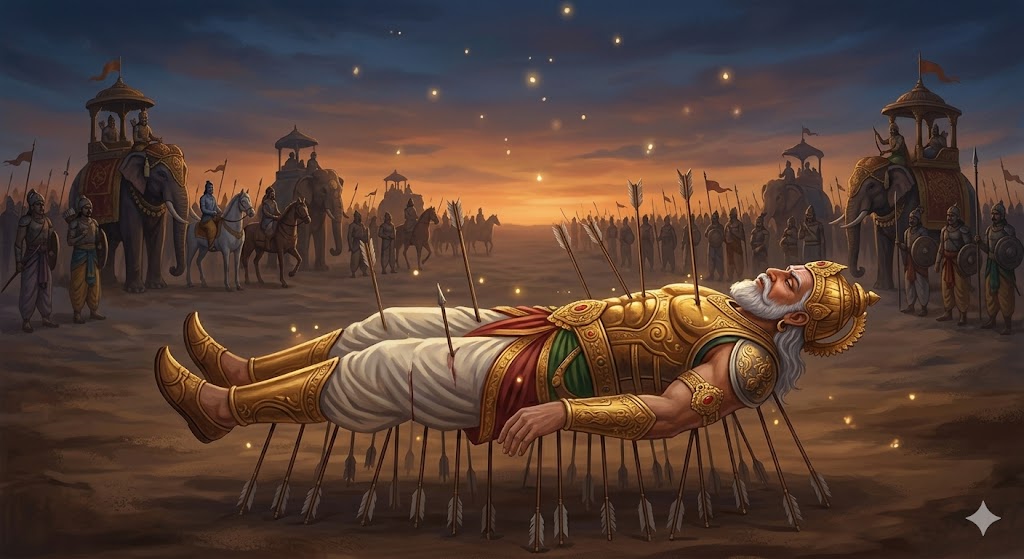
The emotional core of Bhishma Parva: The grandsire, Bhishma, rests on the bed of arrows crafted by Arjuna, suspended between earth and sky while awaiting the auspicious moment of his departure.
The Enduring Legacy of Bhishma Parva
As the sun sets on the tenth day, Bhishma Parva concludes, but its impact echoes through the remaining books of the Mahabharata. The war will rage for eight more days under different commanders. Yet the philosophical foundation laid here—the Gita’s wisdom, Bhishma’s sacrifice, Krishna’s guidance—remains the moral compass for the entire epic.
Readers return to Bhishma Parva not merely for its thrilling battles but for its profound insights into life, duty, and the soul. In Telugu retellings and scholarly discourses alike, its verses continue to inspire. The parva’s blend of action, philosophy, and tragedy ensures its place as the beating heart of the Mahabharata.
In the grand tapestry of the epic, Bhishma Parva stands as the moment when personal stories merge into universal truth. It reminds every generation that dharma, though difficult, is the only path worth walking—above family, above comfort, and aligned with the eternal order of the universe.