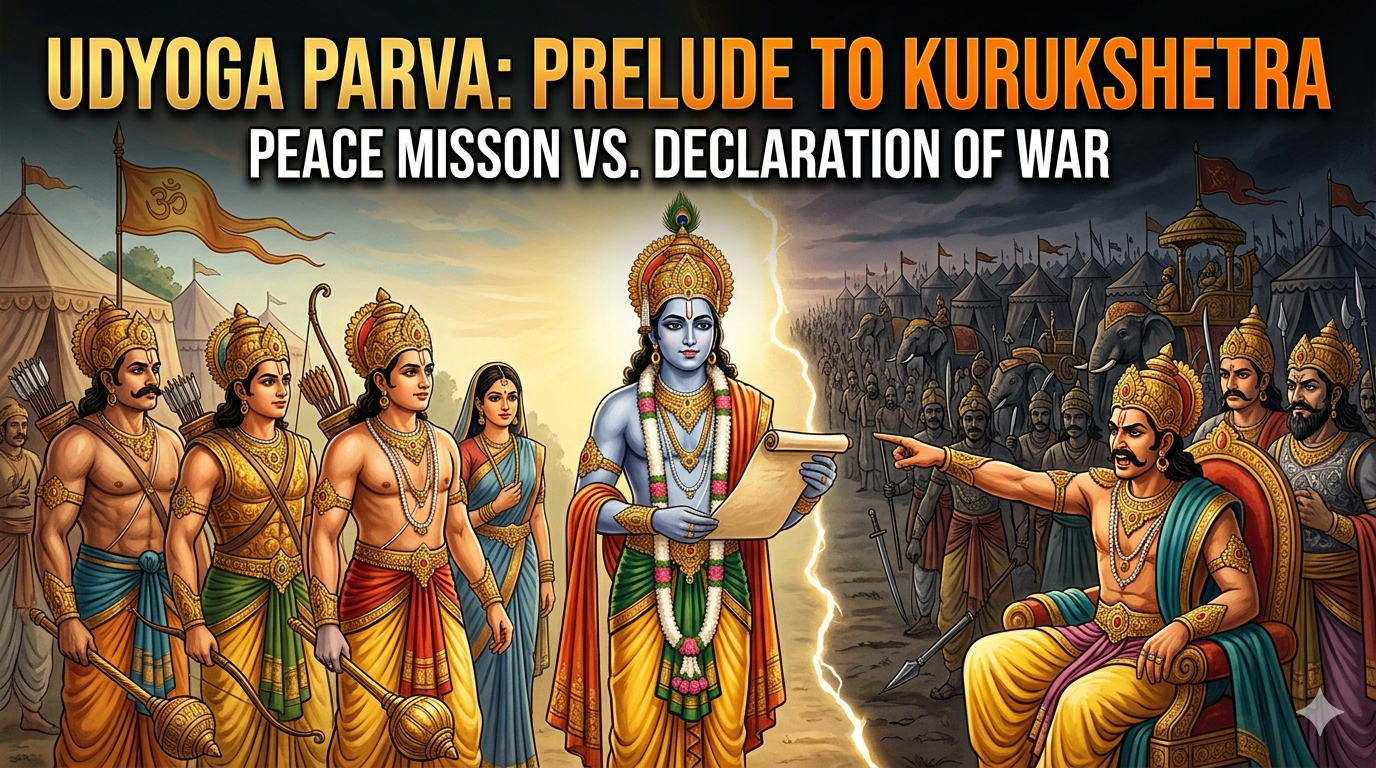
Before the events of Udyoga Parva unfold, the central characters of the Mahabharata carry deep personal histories shaped by dharma, rivalry, and destiny. These brief backgrounds set the stage for the high-stakes diplomacy and war preparations that define this pivotal book.
Yudhishthira, the eldest Pandava, embodies righteousness yet bears the scars of his gambling addiction. After losing the kingdom in the rigged dice game and enduring 13 years of exile (12 in the forest and one incognito), he returns with quiet resolve. His commitment to truth and justice now clashes with the need to reclaim what is rightfully his, testing his dharma under pressure.
Bhima, the second Pandava, is a man of immense physical strength and unyielding loyalty. Humiliated alongside his brothers and wife during the dice game, he harbors deep resentment toward Duryodhana and Duhshasana. His vow to drink the blood of the latter fuels his warrior spirit as the Pandavas emerge from hiding.
Arjuna, the peerless archer and Krishna’s closest friend, has spent the exile honing his skills and receiving divine weapons. His bond with Krishna and his role as the family’s foremost fighter position him as the strategic heart of the Pandava side, ready for whatever the future demands.
Draupadi, the fiery queen and wife to the five Pandavas, carries the deepest wounds from the public disrobing in the Kaurava court. Her unquenched thirst for justice and her sharp intellect make her a vocal advocate for reclaiming the kingdom, refusing any compromise that dishonors her dignity.
Duryodhana, the eldest Kaurava, is consumed by envy and ambition. Having enjoyed unchallenged rule during the Pandavas’ absence, he views the kingdom as entirely his own. His refusal to share even a fraction of the land stems from a lifetime of rivalry and the influence of his close advisors.
Dhritarashtra, the blind Kaurava king, is torn between paternal love and political reality. Though he senses the coming destruction, his indulgence toward Duryodhana has weakened his authority, leaving him unable to enforce peace despite wise counsel from elders like Vidura and Bhishma.
Krishna, the divine charioteer and cousin to both sides, acts as the moral compass of the epic. Having guided the Pandavas through exile, he now volunteers as peace emissary, fully aware that war may be inevitable yet determined to exhaust every avenue for dharma.
Bhishma and Drona, the revered grandsire and guru respectively, remain bound by their vows to the Kaurava throne. Their wisdom urges restraint, but their loyalty to Hastinapura forces them to prepare for battle against their beloved Pandavas.
These figures enter Udyoga Parva not as blank slates but as individuals forged by years of suffering, oaths, and ambition—setting the stage for the dramatic clash of peace and war that follows.
Udyoga Parva
Udyoga Parva, the fifth book of the Mahabharata, also known as the Book of Effort or Preparation, stands as one of the most tension-filled sections of the epic. Spanning roughly 199 chapters in traditional editions, it bridges the Pandavas’ return from 13 years of exile and the outbreak of the Kurukshetra war. This parva is not merely a narrative of political maneuvering; it is a profound exploration of dharma, diplomacy, human ego, and the tragic inevitability of conflict when greed overrides righteousness.
In Udyoga Parva, Vyasa masterfully depicts how even the most earnest attempts at peace can crumble under the weight of pride and past grievances. The parva captures the raw emotions of kings, warriors, and sages as they grapple with the choice between harmony and annihilation. For readers seeking a Udyoga Parva summary or Udyoga Parva explained in depth, this chapter reveals why the great war became unavoidable despite repeated warnings from the wise.
The Return from Exile and the Demand for the Kingdom
As Udyoga Parva opens, the Pandavas have just completed their 13-year exile. The terms of the dice game stipulated that after 12 years in the forest and one year incognito (successfully spent in King Virata’s court), they could reclaim their share of the kingdom. Yudhishthira, ever the embodiment of dharma, sends a measured message to Hastinapura: the Pandavas seek only their rightful half—Indraprastha—or at the very least, five villages to sustain themselves and their followers.
This demand is reasonable, even humble. The Pandavas do not ask for the entire Hastinapura throne; they simply want the land promised to them by their father Pandu. Yet Duryodhana, who has ruled unchallenged and grown accustomed to absolute power, rejects the plea outright. Influenced by Karna and Shakuni, he declares that he will not yield “even a needle-point of territory.” This famous refusal, often cited in Udyoga Parva summaries, encapsulates the Kaurava intransigence that propels the epic toward war.
The rejection is not merely political; it is personal. Duryodhana views the Pandavas as existential threats to his supremacy. His mother Gandhari and father Dhritarashtra sense the danger, but Duryodhana’s arrogance drowns out their counsel. In the royal assembly, elders like Bhishma and Drona plead for compromise, warning that denying the Pandavas their due will invite total destruction. Vidura, the voice of wisdom, openly rebukes Duryodhana, yet to no avail. This initial standoff marks the true beginning of Udyoga Parva’s central conflict.
Inside the ornate assembly hall of Hastinapura, Lord Krishna, acting as a peace emissary, delivers a profound appeal for dharma and logic to the Kuru court. Despite the wisdom of elders like Bhishma, a defiant Duryodhana refuses, setting the stage for conflict.
Early Peace Efforts and the Role of Emissaries
Recognizing the gravity of the situation, both sides engage in diplomatic overtures. The Pandavas, advised by Krishna, first dispatch Drupada’s priest as an emissary to Hastinapura. The priest delivers a calm, reasoned appeal rooted in dharma: the Kauravas must return the Pandavas’ share or face the consequences of adharma.
Duryodhana remains unmoved. He counters with defiance, boasting of his superior alliances and military strength. Meanwhile, Dhritarashtra sends Sanjaya as his own messenger to the Pandavas’ camp at Upaplavya. Sanjaya’s detailed report—rich with descriptions of the Pandavas’ resolve—highlights Yudhishthira’s preference for peace but also his unyielding commitment to justice.
These early exchanges form a critical part of any Udyoga Parva explained narrative. They illustrate the epic’s recurring theme: dharma demands that every peaceful option be exhausted before war. Krishna, ever the strategist, observes the proceedings with divine foresight. He knows war looms but insists on one final, personal effort.
Krishna’s Historic Peace Mission to Hastinapura
The most celebrated episode in Udyoga Parva is Krishna’s voluntary journey as the Pandavas’ peace messenger. Krishna travels to Hastinapura not as a warrior but as an ambassador of goodwill. His mission is simple yet profound: secure peace by any honorable means, even if it means the Pandavas accept just five villages.
Upon arrival, Krishna is received with mixed hospitality. Dhritarashtra offers lavish gifts, but Krishna refuses, staying instead with the righteous Vidura. In private meetings, he urges Dhritarashtra to restrain Duryodhana, painting a vivid picture of the impending catastrophe. Vidura echoes the plea, warning the blind king that his son’s folly will consume the entire Kuru clan.
The climax occurs in the grand assembly hall. Krishna addresses the court with eloquence and authority. He recounts the injustices suffered by the Pandavas—the rigged dice game, the exile, the humiliation of Draupadi—yet emphasizes that the Pandavas still desire peace. “Return their rightful share,” he implores, “or even five villages will suffice to avert war.”
Duryodhana’s response is chilling. He declares, “Not even land equal to the tip of a needle shall be given to the Pandavas.” This blunt insult, delivered in open court, becomes one of the most quoted lines in Udyoga Parva full story retellings. Karna, Shakuni, and Duhshasana support him with mocking laughter. The Kauravas even plot to arrest Krishna, believing that capturing the Yadava leader will cripple the Pandavas.
In a moment of divine revelation, Krishna displays his Vishwaroopa—the universal form—leaving the court awestruck and terrified. The attempt to bind him fails miraculously; Krishna departs unharmed, his mission of peace having failed but his warning clear: war is now certain.
This episode is central to every Udyoga Parva summary. It showcases Krishna’s unmatched wisdom, the limits of diplomacy, and the destructive power of unchecked ego. The insult dialogue between Krishna and Duryodhana reverberates as a timeless lesson in hubris.
War Preparations Accelerate on Both Sides
With peace shattered by the Kaurava rejection, Udyoga Parva shifts focus to mobilization. Both armies begin assembling vast forces. The Kauravas gather 11 akshauhinis (massive divisions each comprising 21,870 chariots, 21,870 elephants, 65,610 cavalry, and 109,350 infantry). They secure alliances with kings from across the subcontinent, including those loyal through marriage or fear.
The Pandavas muster 7 akshauhinis, drawing strength from allies like King Virata, Drupada, and the Yadavas (minus the portion Krishna offers to Duryodhana). In a pivotal moment, Krishna offers himself unarmed to one side and his vast Narayana army to the other. Arjuna wisely chooses Krishna as his charioteer, while Duryodhana eagerly accepts the army—another fateful decision chronicled in Udyoga Parva.
Warriors are classified: Bhishma is named commander-in-chief of the Kaurava forces, while Dhrishtadyumna leads the Pandavas. Detailed lists of rathas (chariot warriors) and maharathas (great warriors) are recited, underscoring the scale of the coming conflict. Kunti also reveals Karna’s true parentage in a private meeting, urging him to join his brothers, but Karna’s loyalty to Duryodhana prevails—another heart-wrenching moment in the parva.
These preparations are not mere logistics; they are laden with moral dilemmas. Elders like Bhishma and Drona fight with heavy hearts, knowing they face their own disciples. The parva ends with both sides poised on the brink of Kurukshetra, their armies arrayed and their fates sealed by Duryodhana’s refusal.
Lessons and Timeless Relevance of Udyoga Parva
Udyoga Parva offers profound lessons that transcend its ancient setting. First, it teaches the sanctity of dharma in governance: a king who denies justice invites ruin. Duryodhana’s rejection illustrates how personal greed can doom an entire lineage. Second, Krishna’s mission exemplifies selfless leadership—pursuing peace even when failure is likely. Third, the parva warns against ignoring wise counsel; Dhritarashtra’s weakness and Duryodhana’s arrogance serve as cautionary tales for leaders today.
In an era of political polarization, Udyoga Parva reminds us that dialogue must precede conflict, yet righteousness sometimes demands standing firm. The parva’s detailed exploration of human psychology—ambition, loyalty, resentment—makes it essential reading for anyone studying the Mahabharata’s hidden truths.
Conclusion: The Inevitable March to Kurukshetra
Udyoga Parva transforms the Mahabharata from a tale of exile into an epic of destiny. After the Pandavas’ return, their just demand for the kingdom meets Kaurava rejection. Krishna’s peace mission, though noble, ends in insult and divine revelation. War preparations follow swiftly, driven by Duryodhana’s stubbornness and the Kauravas’ refusal to yield even a needle’s point of land.
This parva does not glorify war; it mourns its necessity. It leaves readers with a sobering truth: when dharma is trampled, even gods must prepare for battle. As the armies converge on Kurukshetra in the subsequent Bhishma Parva, the events of Udyoga Parva echo as the moral foundation of the entire war.
Frequently Asked Questions
What is the primary significance of Udyoga Parva: Prelude to Kurukshetra in Mahabharata?
Key Figures Before Udyoga ParvaBefore the events of Udyoga Parva unfold, the central characters of the Mahabharata carry deep personal histories shaped by dharma, rivalry, and destiny. These brief backgrounds set the stage for the high-stakes diplomacy and war preparations that define this pivotal book.Yudhishthira, the eldest Pandava, embodies righteousness yet bears the scars of his gambling addiction.
How does this development impact Dharma?
After losing the kingdom in the rigged dice game and enduring 13 years of exile (12 in the forest and one incognito), he returns with quiet resolve. His commitment to truth and justice now clashes with the need to reclaim what is rightfully his, testing his dharma under pressure.Bhima, the second Pandava, is a man of immense physical strength and unyielding loyalty.
What are the key future projections to monitor?
Humiliated alongside his brothers and wife during the dice game, he harbors deep resentment toward Duryodhana and Duhshasana.