Virata Parva: Pandavas' 13th Year Exile in Mahabharata
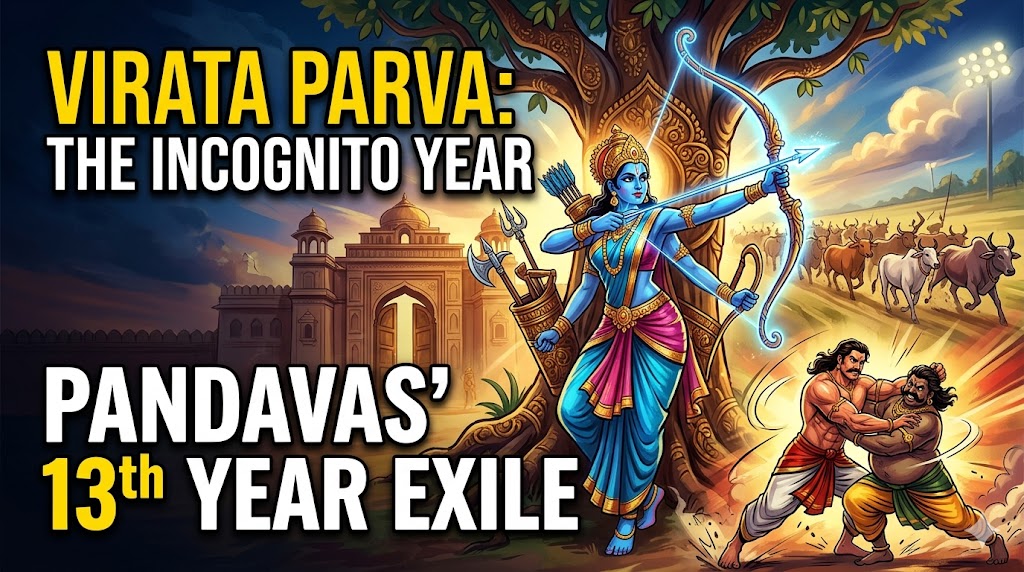
A Pivotal Chapter in the Epic Tale
The Mahabharata, one of Hinduism’s greatest Itihasas, unfolds across eighteen Parvas, each weaving layers of dharma, duty, and destiny. Before diving into Virata Parva, it is essential to understand the preceding events that set the stage. In Adi Parva, the foundations of the Kuru dynasty are laid, introducing the Pandavas and Kauravas as cousins locked in rivalry from birth. Sabha Parva escalates the conflict through the infamous game of dice, where Yudhishthira loses the kingdom of Indraprastha, leading to the Pandavas’ exile along with Draupadi.
Vana Parva then chronicles their twelve grueling years in the forest, filled with trials, divine encounters, and spiritual growth. The terms of the exile were clear: thirteen years total—twelve in the open forest and the thirteenth in complete anonymity, known as ajanatavasa or incognito exile. Any detection during this final year would reset the clock, forcing another twelve years of banishment. It is here that Virata Parva begins, marking the transition from forest hardship to a year of calculated disguise in the kingdom of Matsya, ruled by the righteous King Virata.
This Parva, the fourth book of the Mahabharata (traditionally comprising four sub-sections or upaparvas and around 67-72 chapters depending on the edition), is far more than a simple interlude. It tests the Pandavas’ patience, unity, and strategic wisdom while quietly preparing the ground for the inevitable Kurukshetra War. Through verified accounts from classical translations, such as those by Kisari Mohan Ganguli and the Bhandarkar Oriental Research Institute’s critical edition, Virata Parva stands as a masterclass in dharma under duress.
As Vana Parva draws to a close, the Pandavas—having endured forest life, encounters with rakshasas, and profound teachings from sages—face a new challenge. The dice game’s stipulation demanded not just physical exile but absolute secrecy in the thirteenth year. Recognition by the Kauravas would nullify their claim to the kingdom forever.
Yudhishthira, ever the embodiment of dharma, gathers his brothers and Draupadi to deliberate their next move. They choose the prosperous Matsya kingdom, ruled by Virata, a monarch known for his virtue, generosity, and subtle allegiance to the Pandavas. The choice is strategic: Virata’s court is distant enough from Hastinapura to minimize immediate suspicion, yet powerful enough to offer cover.
This decision underscores a key theme in Virata Parva: humility and foresight. The once-mighty rulers of Indraprastha must now assume menial roles, shedding royal pride to survive. Their successful navigation of this year not only fulfills the exile but also builds quiet alliances and reveals individual strengths that will prove decisive in the great war ahead.
The Disguises: A Masterful Strategy of Survival
Central to Virata Parva is the ingenious disguises adopted by the Pandavas and Draupadi. Each sibling selects a role that aligns with their skills while concealing their true identities:
Yudhishthira becomes Kanka, a Brahmin skilled in dice and statecraft, serving as Virata’s courtier and advisor.
Bhima takes the name Ballava (or Vallabha), working as the royal cook and wrestler, leveraging his immense strength in the kitchens and arena.
Arjuna, the peerless archer, transforms into Brihannala, a eunuch who teaches dance and music to Princess Uttara. He stores his divine weapons in a Sami tree outside the city.
Nakula assumes the identity of Granthika, the keeper of horses.
Sahadeva becomes Tantripala, the overseer of cows.
Draupadi, ever resilient, enters as Sairandhri (or Malini), a skilled maidservant attending Queen Sudeshna.
These disguises are not mere costumes; they reflect profound self-control. The Pandavas live for nearly a year without slipping, performing duties with excellence yet maintaining secrecy. This phase of Virata Parva highlights themes of adaptability and ego transcendence—qualities revered in Hindu philosophy.
Daily Life in Virata’s Court: Harmony Amidst Hidden Tension
For most of the year, life in the Matsya capital flows smoothly. The Pandavas serve loyally, earning Virata’s trust. Yudhishthira’s counsel in dice and governance proves invaluable. Bhima’s culinary prowess and wrestling victories entertain the court. Arjuna, as Brihannala, delights the royal women with artistic talents honed during his earlier celestial training. Nakula and Sahadeva manage the royal stables and herds with unmatched expertise. Draupadi attends the queen with grace, though her beauty draws unwanted attention.
This period in Virata Parva tests their endurance. They witness Virata’s just rule while subtly gathering intelligence on regional politics. The court becomes a microcosm of dharma in action—service without expectation, humility without resentment. Yet underlying tensions simmer, foreshadowing the Parva’s dramatic turning points.
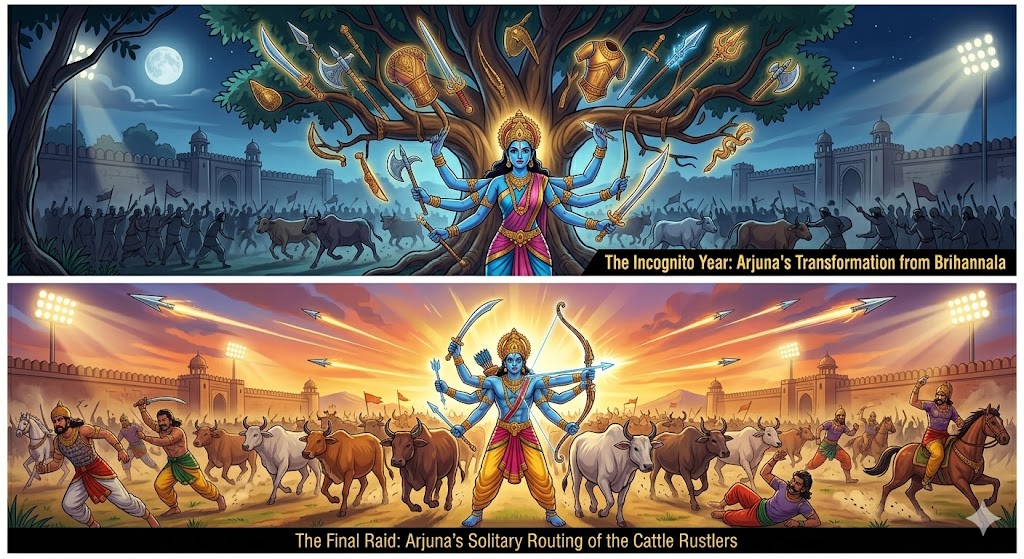
The Incognito Year: The Sami Tree's Transformation – From this single image, Arjuna the warrior emerges, multi-armed and illuminated by powerful floodlights, casting off the dance form of Brihannala to meet the coming war.
The Keechaka Episode: Upholding Honor Through Sacrifice
One of the most intense and emotionally charged sections of Virata Parva is the Kichakavadha (slaying of Keechaka). Keechaka, the queen’s powerful brother-in-law and commander of Virata’s army, becomes obsessed with Draupadi (Sairandhri). Despite her repeated refusals and warnings of her “Gandharva husbands,” Keechaka’s lust turns violent.
In a harrowing public assault before the royal assembly, Keechaka drags and kicks Draupadi. Yudhishthira, bound by the need for secrecy, restrains his fury. Draupadi turns to Bhima, who, under cover of night in the empty dancing hall, lures Keechaka into a fatal trap. Bhima crushes the tyrant into a shapeless mass with his bare hands, delivering swift justice.
The aftermath is equally gripping: Keechaka’s kinsmen attempt to burn Draupadi alive, only to be slain by Bhima in a display of raw protective power. This episode in Virata Parva is not gratuitous violence but a profound statement on dharma—protecting the vulnerable, especially women, when institutional authority fails. It echoes Draupadi’s earlier humiliation in the dice hall and reinforces the Pandavas’ vow of vengeance against adharma.
The Cattle Raid and the Virata War: Arjuna’s Glorious Return
As the year nears its end, external threats escalate. King Susharman of Trigarta, allied with the Kauravas, launches a cattle raid from the north, capturing Virata. The Pandavas (minus Arjuna initially) repel the attack, rescuing the king.
Simultaneously, Duryodhana, suspecting the Pandavas’ presence, orchestrates a larger southern raid with Bhishma, Drona, Karna, and others. Prince Uttara, Virata’s young son, rides out boastfully with Brihannala as charioteer. When danger looms, Arjuna reveals his true identity to Uttara, retrieves his weapons from the Sami tree, and single-handedly routs the Kaurava forces. Using celestial astras, he renders the enemy warriors unconscious without killing them, recovers the cattle, and returns triumphantly.
This “Virata War” in Virata Parva is a masterstroke. It demonstrates Arjuna’s unmatched prowess while preserving the incognito cover until the final moments. Uttara keeps the secret, and the year concludes undetected. The Pandavas reveal themselves to Virata, who, impressed and grateful, pledges alliance—foreshadowing his role in the Kurukshetra War.
The Significance of Virata Parva: A Bridge to Kurukshetra
Virata Parva is indispensable to the Mahabharata’s architecture. Its successful completion validates the Pandavas’ claim to the kingdom, paving the way for Udyoga Parva’s diplomatic efforts and the eventual war. Without this year of flawless disguise, the epic’s momentum toward dharma’s final reckoning would collapse.
Strategically, it serves as a major preparation for Kurukshetra. The Pandavas hone humility and teamwork. Arjuna’s solo victory previews his battlefield dominance, while the alliance with Virata adds crucial military support (though Virata’s sons Uttara and Sweta later fall early in the great war). The Parva also gathers subtle intelligence and tests resolve, ensuring the Pandavas enter negotiations from strength rather than desperation.
In the broader narrative, Virata Parva illustrates that dharma triumphs not through brute force alone but through patience, intellect, and moral courage.
Virata Parva’s Place in Hinduism: Dharma, Itihasa, and Eternal Truths
Within Hinduism, the Mahabharata is revered as Itihasa—history with divine lessons. Virata Parva exemplifies niti (ethical conduct) in adversity. Yudhishthira’s restraint teaches kshama (forgiveness) and sahana (endurance). Bhima’s protection of Draupadi upholds rakshana (guardianship) of the weak. Arjuna’s disciplined anonymity reflects tapasya (austerity).
The Parva reinforces core Hindu values: karma (action without attachment to results), the sanctity of vows, and the protection of women as a societal pillar. Scholars across centuries, from ancient commentators to modern Telugu exponents like Chaganti Koteswara Rao in his popular discourses, emphasize how Virata Parva mirrors life’s hidden struggles. It reminds devotees that true victory lies in aligning with cosmic order, even when the path demands invisibility.
Timeless Lessons for the Modern Era
Though set in antiquity, Virata Parva resonates powerfully today. In an age of corporate intrigue and personal crises, the Pandavas’ disguises teach strategic humility—sometimes the greatest leaders operate unseen, building influence quietly. Professionals facing workplace harassment find echoes in Keechaka’s downfall: justice, though delayed, is inevitable when rooted in dharma.
The Parva’s emphasis on resilience offers solace in uncertain times—whether economic hardship, identity challenges, or global conflicts. It encourages maintaining integrity when stripped of status, fostering family unity under pressure, and valuing inner strength over outward glory. Leaders today can draw parallels: ethical decision-making under scrutiny, protecting the vulnerable, and preparing long-term while navigating short-term adversity.
In education and culture, Virata Parva inspires discussions on gender respect, patience as power, and the blurred lines between appearance and reality. Its message remains urgent: dharma is not abstract philosophy but lived action, relevant from boardrooms to battlefields of daily life.
Conclusion: The Enduring Legacy of Virata Parva
Virata Parva is no mere transitional chapter in the Mahabharata. It is a profound exploration of human endurance, strategic wisdom, and unwavering commitment to dharma. From the clever disguises and Keechaka’s dramatic end to Arjuna’s cattle-raid triumph, every event propels the epic toward its climactic war while imparting lessons that transcend time.
By completing their incognito exile undetected, the Pandavas not only earn their rightful place but also illuminate the path of righteousness for generations. In Hinduism, this Parva stands as a beacon of hope: even in the darkest year of hiding, light prevails for those who uphold truth. For readers today, it offers a blueprint for navigating life’s exiles—personal or professional—with grace, courage, and unyielding moral compass.
As the Mahabharata itself declares through its timeless verses, the path of dharma may twist through forests and hidden courts, yet it always leads toward victory for the just. Virata Parva invites us all to walk that path with open eyes and steadfast hearts.