In the vast ocean of Hindu scriptures, few texts have shaped thought, law, and culture as profoundly as Manusmriti. Often called the Laws of Manu or Manava Dharmashastra, this ancient Smriti stands as one of the most comprehensive guides to righteous living, or dharma. For centuries, scholars, lawmakers, and spiritual seekers have turned to Manusmriti for insights into ethics, social order, and personal conduct. Yet today, it sparks heated debate. Many approach it with partial knowledge or preconceived notions, leading to widespread misunderstanding.
This article offers a clear, educational perspective on Manusmriti. We examine its writer, its place among the great Smritis of Hinduism, its authentic teachings, and the reasons behind its controversies. Far from the simplistic labels it sometimes receives, Manusmriti emerges as a remarkable effort by ancient sages to codify harmonious living in a complex society. When read completely and in context, it reveals a vision rooted in duty, karma, and cosmic order – not blind discrimination. Leaders like Smriti Irani have highlighted the value of such ancient wisdom in modern education, urging us to study these texts with open minds and cultural pride.
Who Wrote Manusmriti? The Sage Behind the Great Book
Manusmriti is traditionally attributed to Manu, the legendary progenitor of humanity and first lawgiver in Hindu cosmology. According to the text itself, Brahma, the creator, revealed the eternal principles of dharma to Manu (Svayambhuva Manu). Manu then transmitted this knowledge to the sage Bhrigu, who compiled it into the metrical verses we know today. The first 58 shlokas are presented as Manu’s direct words, with the rest coming through Bhrigu’s discourse to assembled rishis.
Modern scholarship views Manusmriti as a composite work, likely compiled by multiple Brahmin scholars in northern India between the 2nd century BCE and 2nd century CE. It is not the product of a single historical figure writing in isolation but a collective effort to preserve and organize Vedic principles for everyday life. This collaborative origin reflects the living nature of Smriti literature – adaptable to time, place, and societal needs, unlike the eternal Shruti (Vedas).
Despite its layered authorship, the text’s voice remains unified under the revered name of Manu. This attribution underscores its authority: Manu is seen as the father of mankind, the first king, and the embodiment of righteous rule. Manusmriti thus represents not one man’s opinion but a profound attempt by ancient seers to create a blueprint for a just and prosperous society. Far from being a rigid legal code, it is a reflective treatise (smriti) means “that which is remembered”) designed to guide humanity toward fulfillment of the four purusharthas – dharma, artha, kama, and moksha.
Understanding Manusmriti: Structure, Content, and Purpose
Manusmriti consists of approximately 2,685 shlokas arranged in 12 chapters. It covers an astonishing range of topics: the creation of the universe, sources of dharma, duties of the four varnas and ashramas, rules for kings, marriage and family life, dietary laws, purification rites, judicial procedures, karma, rebirth, and ultimate liberation.
Its purpose is educational and practical. The text repeatedly emphasizes that dharma is not one-size-fits-all but varies according to one’s varna, stage of life, and personal circumstances. It presents dharma as the foundation of a stable society where each individual performs their assigned role with sincerity. Universal virtues – truthfulness, non-violence, compassion, and self-control – apply to everyone, regardless of status.
Crucially, Manusmriti does not promote arbitrary discrimination. It describes social organization based on varna, which the text links to both birth and the qualities (gunas) and deeds (karma) accumulated over lifetimes. A person’s birth reflects past actions, while present deeds shape future destiny. This karmic framework offers a dynamic view: varna is not a prison but a starting point for spiritual growth. The text devotes significant space to the highest duties of Brahmins (learning and teaching) and Kshatriyas (protection and justice), but it also outlines clear responsibilities for Vaishyas and Shudras, emphasizing service, honesty, and contribution to society.
When read in full, Manusmriti emerges as a holistic manual for ethical living rather than a tool of oppression. Its shlokas on hospitality, charity, and respect for elders show a deeply humanistic core.
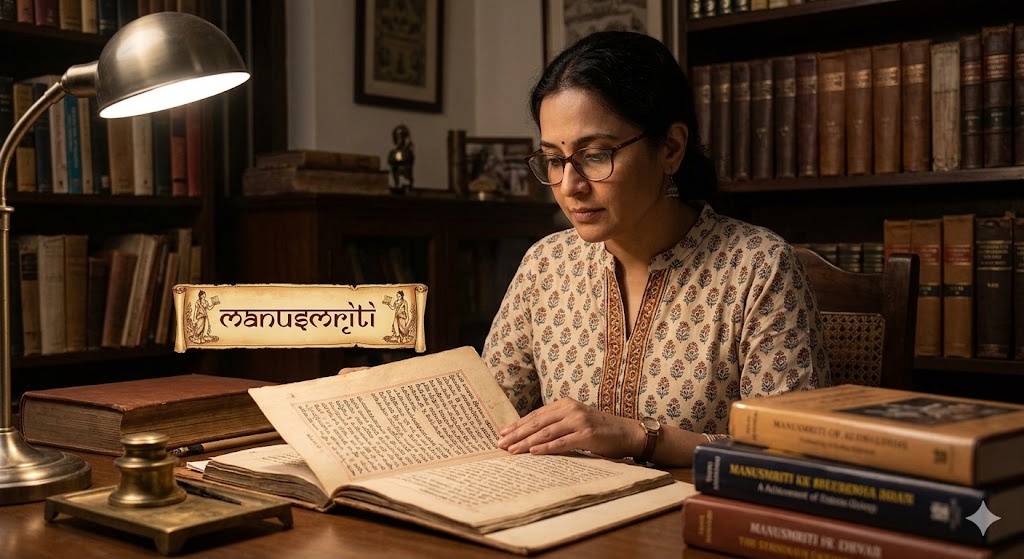
A modern scholar examines an ancient manuscript of the Manusmriti, bridging the gap between historical wisdom and contemporary understanding
Manusmriti Among the Smritis: Why It Stands as a Great Historical Book
Hinduism recognizes numerous Smritis – remembered texts that interpret eternal Vedic truths for practical application. Traditionally, 18 major Dharmashastras exist, including Yajnavalkya Smriti, Narada Smriti, Parashara Smriti, Vishnu Smriti, and others. Among these, Manusmriti has long been regarded as the foremost and most authoritative.
Its comprehensive scope and systematic structure earned its pride of place. Ancient commentators like Medhatithi and Kulluka Bhatta wrote extensive glosses on it. During the medieval period and even under early British colonial administration, Manusmriti influenced Hindu personal law. Sir William Jones translated it into English in 1794, calling it a foundational legal text.
What makes Manusmriti great? It bridges the spiritual and the secular. It integrates cosmology with daily conduct, karma with governance, and individual duty with cosmic harmony. Other Smritis often build upon or refine its principles. Yajnavalkya Smriti, for instance, became prominent later for its more concise style, yet it frequently references Manu. In this sense, Manusmriti is the foundational pillar of the Smriti tradition – a great historical book that has guided Hindu civilization for over two millennia.
Its connection to Hinduism runs deep. Manusmriti embodies the varnashrama dharma system at the heart of classical Hindu social thought. It draws directly from Vedic concepts while adapting them to post-Vedic society. By emphasizing that all actions must align with cosmic order (riat), it reinforces Hinduism’s core belief in an interconnected universe where duty leads to liberation.
Manusmriti on Society, Varna, and Women: Context Over Misinterpretation
A careful reading shows Manusmriti prescribes duties tailored to varna and gender, but always within a framework of mutual responsibility and karmic justice. Varna is presented as a natural division based on inherent qualities developed through birth and deeds. The text acknowledges that in times of distress (apad dharma), roles can adapt. It does not advocate hatred or exploitation; rather, it seeks social stability so that every individual can pursue spiritual growth.
Regarding women, Manusmriti contains both protective and respectful verses. The famous shloka 3.56 declares: “Where women are honored, there the gods are pleased.” It stresses that women should be protected and cherished by fathers, husbands, and sons – not as a sign of inferiority but as recognition of their vital role in preserving dharma and family lineage. Marriage is portrayed as a sacred union, and the text condemns crimes against women harshly. While some passages reflect the patriarchal norms of ancient times, they must be understood in historical context, not as eternal mandates for discrimination. Many scholars note that the text’s overarching message promotes harmony and mutual support between genders.
Critics often isolate specific shlokas without reading the entire work. Partial knowledge leads to the false depiction of Manusmriti as a “wrong book.” In reality, its rules for different varnas and roles reflect an attempt to assign responsibilities according to capacity and past karma – a system that, when practiced with wisdom, fosters order rather than division.
The Manusmriti Controversy: Why It Hits Hard and How Misunderstandings Persist
No discussion of Manusmriti is complete without addressing its controversies. In 1927, Dr. B.R. Ambedkar famously led the burning of copies during the Mahad Satyagraha – an event still commemorated as “Manusmriti Dahan Divas” by some groups. Ambedkar and others saw the text as symbolic of caste rigidity and social inequality that had persisted for centuries.
The controversy hits hard because Manusmriti becomes associated with later rigid interpretations of the caste system and gender norms. Colonial scholars and reformers sometimes used selective translations to critique Hindu society. Modern activists, focusing on isolated verses about varna duties or women’s roles, portray the entire text as regressive.
Yet these critiques often stem from incomplete reading. People take wrong messages when they approach Manusmriti with little knowledge or preconceived bias. High-profile writers and reformers have criticized it sharply, but many professional scholars – both Indian and Western – argue that such judgments ignore historical context, interpolations over centuries, and the text’s deeper ethical layers. Manusmriti was never meant as a static constitution but as a guide adaptable to changing times, as all Smritis are.
Prominent voices in contemporary India, including Union Minister Smriti Irani, have championed the study of ancient texts like Manusmriti in education. Irani has repeatedly advocated integrating India’s classical knowledge systems into curricula to build cultural confidence and holistic understanding. Her positive outlook reflects a broader movement to reclaim and contextualize these treasures rather than reject them outright.
Manusmriti’s Enduring Relevance: An Educational Perspective
Today, Manusmriti offers timeless lessons for anyone seeking ethical clarity. Its teachings on karma remind us that actions shape destiny. Its emphasis on duty over rights encourages personal responsibility. Even its social prescriptions highlight the importance of structured harmony – a concept relevant in our fragmented world.
For UPSC aspirants, students of history, or spiritual seekers, Manusmriti remains essential reading. Available in Hindi translations and original Sanskrit with commentaries, it rewards careful study. Rather than dismissing it as outdated, we should engage with it critically yet respectfully – exactly as ancient sages intended.
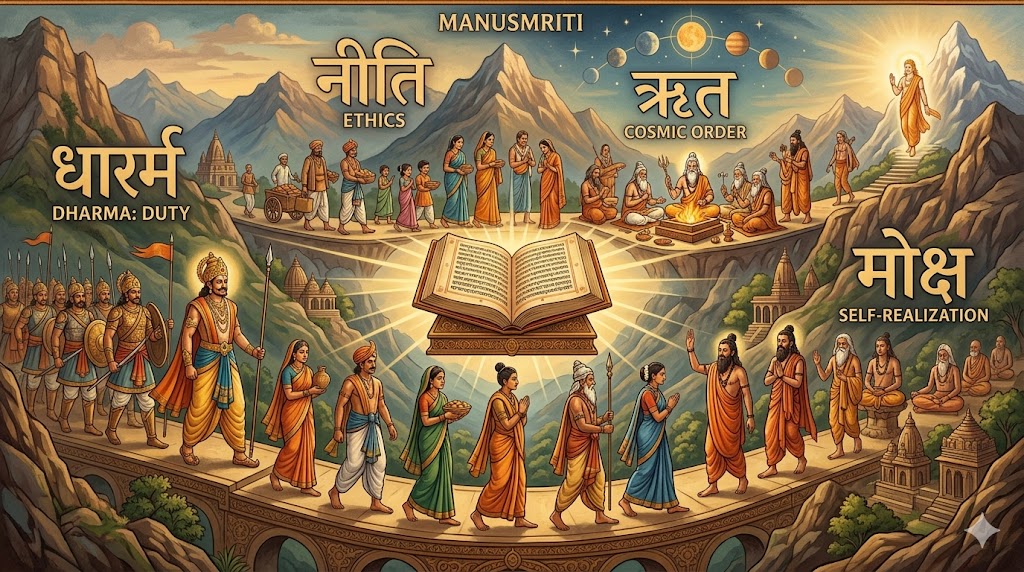
A visual representation of the foundational pillars of Dharma—duty, ethics, cosmic order, and self-realization—as outlined in the teachings of the Manusmriti.
Conclusion: Embracing Manusmriti as Hinduism’s Great Book
Manusmriti is far more than a historical artifact. It is a monumental effort by Manu and the sages to articulate dharma for humanity’s benefit. Its connection to Hinduism lies in its faithful transmission of Vedic wisdom into practical life. While controversies have arisen – often from partial readings or selective interpretations – a complete, contextual study reveals a text of profound wisdom, not discrimination.
As Smriti Irani and other thought leaders remind us, ancient Indian texts like Manusmriti hold the key to understanding our civilizational roots. Let us approach this great book with the curiosity and respect it deserves. In doing so, we honor not only the past but also the timeless principles that can guide a better future.
By studying Manusmriti fully – in Hindi, English, or Sanskrit – we move beyond controversy toward genuine insight. This is its true educational value: a mirror to society’s ideals and a roadmap for righteous living.
Frequently Asked Questions
What is the primary significance of "The Manusmriti: Timeless Dharma Guide in Hinduism"?
Manusmriti: Timeless Dharma Guide in HinduismIn the vast ocean of Hindu scriptures, few texts have shaped thought, law, and culture as profoundly as Manusmriti. Often called the Laws of Manu or Manava Dharmashastra, this ancient Smriti stands as one of the most comprehensive guides to righteous living, or dharma.
How does this development impact Dharma?
For centuries, scholars, lawmakers, and spiritual seekers have turned to Manusmriti for insights into ethics, social order, and personal conduct. Yet today, it sparks heated debate.
What are the key future projections to monitor?
Many approach it with partial knowledge or preconceived notions, leading to widespread misunderstanding.This article offers a clear, educational perspective on Manusmriti.