The Mahabharata Vanvas Parva, also revered as the Aranyak Parva or Book of the Forest, stands as one of the most profound and introspective sections of the ancient Indian epic. This parva captures the transformative phase in the lives of the Pandavas following their devastating loss in the Sabha Parva. It is here that the five brothers—Yudhishthira, Bhima, Arjuna, Nakula, and Sahadeva—and their devoted wife Draupadi leave behind the opulence of Indraprastha to embrace 12 years of vanvas (forest exile) and one additional year of guptavas (incognito exile). Far from a mere tale of hardship, the Mahabharata Vanvas Parva delves into themes of dharma, resilience, human frailty, and divine intervention, offering timeless lessons on endurance amid adversity.
To fully appreciate the depth of the Mahabharata Vanvas Parva, it is essential to briefly revisit the foundational events of the preceding parvas. These set the stage for the exile that would test the Pandavas' character and prepare them for the eventual Kurukshetra war.
The Adi Parva, or Book of the Beginning, lays the groundwork for the entire Mahabharata narrative. It opens with the recitation of the epic by Ugrashrava Sauti to the sages in the Naimisha forest, tracing the lineage of the Kuru dynasty from ancient kings like Shantanu and Bhishma. The parva introduces the birth of the Pandavas through divine intervention—Kunti's invocation of gods and Madri's role—contrasting with the Kauravas, born to the blind King Dhritarashtra and Gandhari.
Key events include the early rivalries: Duryodhana's jealousy leads to assassination attempts, such as poisoning Bhima and the infamous lac house conspiracy at Varanavata. The Pandavas escape with Vidura's help, slay demons like Hidimba and Baka, and win Draupadi at her swayamvara in Panchala. Their return to Hastinapura results in the kingdom's division, with the Pandavas establishing the magnificent city of Indraprastha. Arjuna's temporary exile for violating the brothers' marital protocol with Draupadi leads to his adventures, including the burning of the Khandava forest with Krishna's aid, where he receives the Gandiva bow from Agni.
By the end of the Adi Parva, the Pandavas have risen to glory, their lavish life marked by palaces, alliances (including Arjuna's marriage to Subhadra), and prosperity. Yet seeds of discord—rooted in Duryodhana's envy—are sown, paving the way for the conflicts in Sabha Parva. This parva not only establishes the characters' origins and moral dilemmas but also underscores the epic's core tension between dharma and adharma.
Sabha Parva: The Fall from Grace and the Spark of Exile
The Sabha Parva, known as the Book of the Assembly Hall, shifts from origins to political intrigue and moral collapse. Maya Danava constructs a celestial assembly hall for the Pandavas in Indraprastha, a marvel of architecture that dazzles visitors and fuels Duryodhana's resentment during his visit. Yudhishthira, advised by sages and Krishna, performs the grand Rajasuya yajna, conquering directions through his brothers' campaigns. Victories include Bhima slaying Jarasandha and Arjuna beheading the arrogant Shishupala in the sacrificial hall.
However, prosperity breeds hubris. Duryodhana, humiliated by illusions in the hall (mistaking water for floor and vice versa), conspires with Shakuni. Invited for a dice game in Hastinapura, Yudhishthira—bound by kshatriya dharma and his weakness for gambling—loses repeatedly. He stakes his kingdom, brothers, himself, and finally Draupadi. The Pandavas are reduced to slaves.
The climax is Draupadi's public humiliation. Dragged by her hair into the sabha by Duhshasana while in her menstrual period and clad in a single garment, she questions the elders—Bhishma, Drona, and Dhritarashtra—about dharma. Duryodhana and Karna insult her viciously. Duhshasana attempts to disrobe her, but Krishna's divine intervention extends her sari infinitely, preserving her dignity. Enraged yet composed, Draupadi vows revenge.
In the ensuing chaos, Dhritarashtra grants boons under pressure, but Duryodhana insists on a final dice throw. The terms are harsh: the losers must endure 12 years of vanvas in the forest, followed by one year of guptavas incognito. If discovered during the 13th year, they face another 12 years of exile. The Pandavas accept, departing for the forest, their lavish kingdom life—servants, riches, and power—exchanged for survival in the wilderness. This marks the transition into the Mahabharata Vanvas Parva, where exile becomes a crucible for growth.
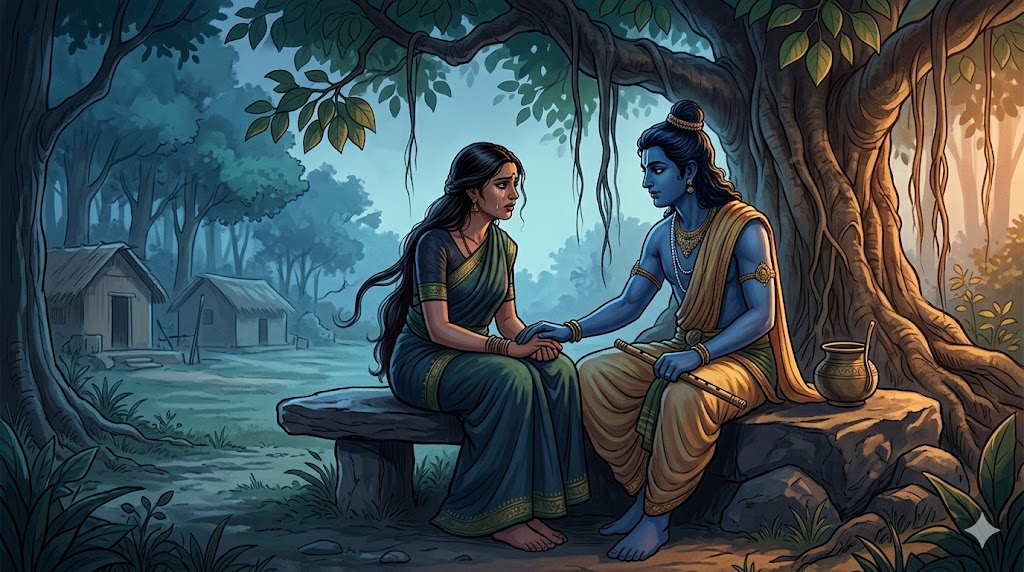
Krishna comforting Draupadi in the forest is a powerful scene depicting Krishna's deep compassion and empathy. As Draupadi sits in anguish, tears streaming down her face, Krishna's presence provides solace and strength.
The Mahabharata Vanvas Parva: Entering the Forest Exile
The Mahabharata Vanvas Parva opens with the Pandavas' poignant departure from Hastinapura. Citizens weep and wish to accompany them, but Yudhishthira, ever the embodiment of dharma, persuades most to return, emphasizing self-reliance. A small group of loyal brahmins and followers joins them. They spend their first night under a banyan tree by the Ganga, reflecting on their fall from Indraprastha's splendor—marble halls and royal feasts now replaced by simple shelters and foraged meals.
Surya, the sun god, appears to Yudhishthira and gifts the Akshaya Patra, a divine vessel that provides unlimited food until Draupadi eats her share. This boon sustains them and their entourage through the 12 years, symbolizing divine grace amid hardship. The Pandavas wander through forests like Kamyaka and Dvaitavana, facing wild animals, harsh weather, and internal strife. Their reaction to vanvas varies deeply, revealing individual strengths and flaws.
Yudhishthira, though remorseful for the dice loss, consoles his brothers with discourses on dharma, patience, and karma. He views the exile as purification, urging acceptance. Bhima, the strongest, fumes with rage, repeatedly vowing to crush Duryodhana and Duhshasana. His impatience contrasts Yudhishthira's calm, often requiring restraint. Arjuna focuses on preparation, while the twins Nakula and Sahadeva remain supportive and dutiful. Draupadi, the most vocal, channels her Sabha Parva trauma into fierce resolve, frequently reminding her husbands of the insults and pushing for action. Leaving their kingdom's lavish life—silken robes, gourmet feasts, and royal comforts—proves agonizing, yet it fosters humility and unity.
Krishna's Visit and Draupadi's Heartfelt Conversation in the Mahabharata Vanvas Parva
A pivotal moment in the Mahabharata Vanvas Parva occurs when Krishna visits the Pandavas in the forest. Amid their grief, Draupadi pours out her heart in a deeply emotional conversation with her friend and protector. She recounts the Sabha Parva humiliation: "O Krishna, how could one like me—the wife of Pritha's sons, sister of Dhrishtadyumna, and your dear friend—be dragged into the assembly hall? Stained with blood during my season, clad in a single garment, trembling and weeping, I was humiliated before all the Kurus."
Draupadi questions fate and dharma: Why must she, virtuous and connected to the greatest warriors, endure such shame? She highlights the Kauravas' cruelty and her husbands' silence in the sabha, wondering if their dharma binds them too rigidly. Krishna listens with compassion, affirming her innocence and promising that the wrongdoers will face justice. He reminds her of cosmic balance—Karma ensures retribution—and vows his support in the coming war. This dialogue not only consoles Draupadi but strengthens the Pandavas' resolve, blending personal anguish with philosophical depth. It humanizes the epic, showing vulnerability even among heroes.
Daily Life, Challenges, and Growth During the 12-Year Vanvas
Life in the Mahabharata Vanvas Parva is no idyll. The Pandavas hunt for sustenance (supplemented by the Akshaya Patra), build makeshift homes, and perform austerities. They undertake tirtha yatras (pilgrimages) to holy sites, guided by sages like Dhaumya, gaining spiritual wisdom. Key adventures include Bhima slaying the demon Kirmira, who attacks them near the forest's edge. Jayadratha, Duryodhana's brother-in-law, attempts to abduct Draupadi but is thwarted and humiliated, further stoking enmities.
The parva interweaves numerous sub-stories that enrich the narrative and teach dharma. Yudhishthira learns from the serpent Nahusha (a cursed king) about true kingship and humility. The tale of Nala and Damayanti mirrors the Pandavas' gambling woes and separation anxieties. Savitri's devotion to Satyavan inspires Draupadi on wifely loyalty and cleverness against death. These embedded narratives—recited by visiting rishis—provide respite and moral instruction, contrasting the Pandavas' real struggles.
Arjuna's journey forms a cornerstone of the Mahabharata Vanvas Parva. Urged by his brothers and Draupadi, he performs intense penance in the Himalayas. Shiva, disguised as a hunter, tests him in the Kirata episode before granting the Pashupatastra. Arjuna then ascends to Indra's heaven, acquiring celestial weapons and training, though he faces a curse that later aids his incognito disguise. His absence heightens the family's longing, yet equips them for future battles.
Philosophical discourses dominate: debates on dharma versus kshatriya duty, the nature of anger (Bhima's vs. Yudhishthira's restraint), and women's honor. The Pandavas react to exile's rigors with growth—Yudhishthira matures in leadership, Bhima channels fury productively, and Draupadi evolves from victim to strategist. Abandoning lavish kingdom indulgences teaches self-sufficiency; simple forest meals replace royal banquets, fostering gratitude and resilience.
The Transition to Guptavas: The 13th Year of Incognito Exile
As the 12 years of vanvas near completion in the Mahabharata Vanvas Parva's later sections, preparations shift to guptavas. The Pandavas must live undetected for one year or restart the cycle. They choose the Matsya kingdom ruled by Virata, disguising themselves cleverly:
Yudhishthira as Kanka, a dice expert and royal advisor.
Bhima as Ballava, the royal cook, showcasing his strength subtly.
Arjuna as Brihannala, a eunuch dance and music teacher to Princess Uttara—his heavenly curse proving fortuitous.
Nakula as Granthika, tending horses.
Sahadeva as Tantipala, herding cows.
Draupadi as Sairandhri, the queen's maid, enduring fresh risks to her dignity.
This phase, detailed in Virata Parva but integral to the exile narrative, tests their secrecy. Challenges include Kichaka's lustful harassment of Draupadi (whom Bhima slays in disguise) and a cattle raid by Kaurava forces. Arjuna, as Brihannala, reveals his prowess to defeat them without fully exposing the group, preserving the incognito status. The year ends triumphantly with Abhimanyu's marriage to Uttara, signaling hope.
Throughout, the Pandavas reflect on their lost kingdom life. Letters and secret meetings with allies like Krishna maintain morale. The Mahabharata Vanvas Parva and its extension underscore how exile forges unbreakable bonds and strategic wisdom.
Legacy and Lessons from the Mahabharata Vanvas Parva
The Mahabharata Vanvas Parva concludes the exile era, bridging to Udyoga Parva's war preparations. The Pandavas emerge wiser, their dharma refined through suffering. Draupadi's conversation with Krishna exemplifies how personal pain fuels collective justice. By contrasting Indraprastha's luxuries with forest austerity, the parva illustrates impermanence and inner strength.
In essence, this section of the Mahabharata transcends a simple exile tale. It invites reflection on life's trials, the cost of dharma, and the redemptive power of patience and devotion. Readers of the Mahabharata Vanvas Parva find inspiration in the Pandavas' journey—from humiliated royals to battle-ready warriors—reminding us that true victory lies in character, not circumstance.
Frequently Asked Questions
What is the primary significance of "Mahabharata Vanvas Parva: Pandavas' 13-Year Exile"?
The Mahabharata Vanvas Parva, also revered as the Aranyak Parva or Book of the Forest, stands as one of the most profound and introspective sections of the ancient Indian epic. This parva captures the transformative phase in the lives of the Pandavas following their devastating loss in the Sabha Parva.
How does this development impact Dharma?
It is here that the five brothers—Yudhishthira, Bhima, Arjuna, Nakula, and Sahadeva—and their devoted wife Draupadi leave behind the opulence of Indraprastha to embrace 12 years of vanvas (forest exile) and one additional year of guptavas (incognito exile). Far from a mere tale of hardship, the Mahabharata Vanvas Parva delves into themes of dharma, resilience, human frailty, and divine intervention, offering timeless lessons on endurance amid adversity.To fully appreciate the depth of the Mahabharata Vanvas Parva, it is essential to briefly revisit the foundational events of the preceding parvas.
What are the key future projections to monitor?
These set the stage for the exile that would test the Pandavas' character and prepare them for the eventual Kurukshetra war.A Brief Overview of Adi Parva: The Foundations of the EpicThe Adi Parva, or Book of the Beginning, lays the groundwork for the entire Mahabharata narrative.