Nehru vs Modi: Comparing India's Iconic Prime Ministers
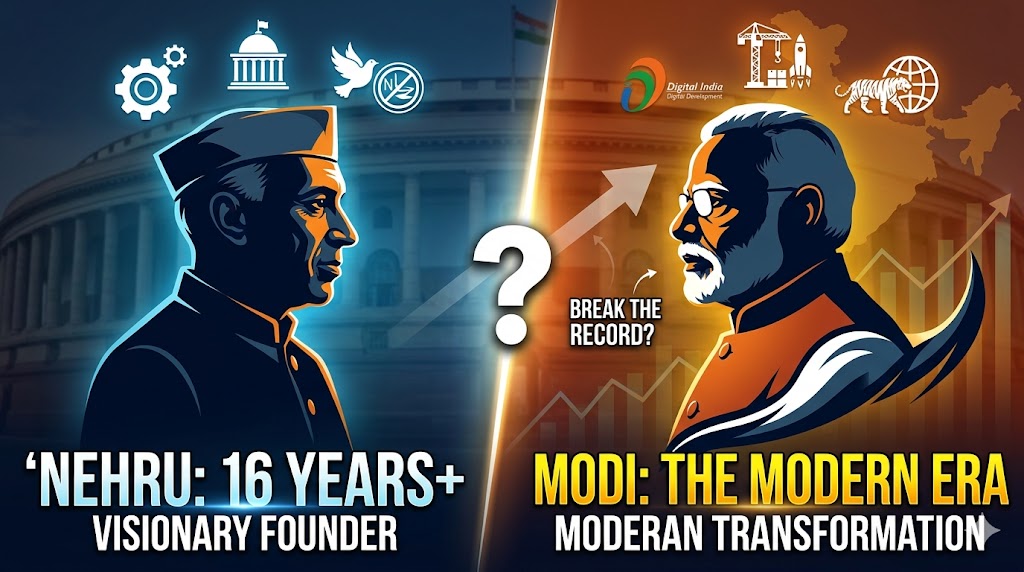
In the rich tapestry of Indian democracy, few leaders have left as indelible a mark as Pandit Jawaharlal Nehru and Narendra Modi. Nehru, the architect of modern India, steered the nation through its formative years after Independence, serving as Prime Minister for a record 16 years and 286 days until his passing in 1964. His vision shaped institutions, foreign policy, and the democratic ethos that defines the country today.
Decades later, Narendra Modi has emerged as one of the most dominant political figures, completing three terms as Prime Minister since 2014. As of 2026, he has already surpassed several milestones, including becoming the second-longest serving PM in consecutive terms after overtaking Indira Gandhi. Public discourse often draws parallels between the two, especially regarding their long tenures, mass appeal, charismatic personalities, wisdom in governance, and decisive leadership.
Many observers and supporters speculate whether Modi, with his strong following, could challenge or even break Nehru's all-time record if he secures another full term. This article examines these comparisons in a professional, balanced manner, reflecting how Indians across the spectrum view these two towering personalities. While their eras, challenges, and approaches differ significantly, the fascination with juxtaposing them underscores their shared status as immensely popular leaders who have defined distinct phases of India's journey.
Jawaharlal Nehru: The Visionary Founder
Born on November 14, 1889, in Allahabad (now Prayagraj), Jawaharlal Nehru was a central figure in India's freedom struggle. Educated at Harrow and Cambridge, he brought a cosmopolitan outlook blended with deep nationalist commitment. As a close associate of Mahatma Gandhi, Nehru played a pivotal role in the Indian National Congress and the independence movement.
Upon Independence on August 15, 1947, Nehru became India's first Prime Minister. His tenure lasted until May 27, 1964, making him the longest-serving PM in the country's history. During these 16-plus years, he laid the foundations of parliamentary democracy, secularism, and planned economic development. Nehru championed non-alignment in foreign policy, scientific temper, and industrialization through five-year plans. Institutions like IITs, IIMs, and public sector undertakings bear his imprint.
Nehru's leadership style was characterized by intellectual depth, consensus-building, and a focus on institution-building in a newly independent nation facing partition's scars, poverty, and external threats. His eloquent speeches, including the iconic "Tryst with Destiny" address, inspired millions. He was widely admired for his personal integrity, literary contributions (such as "The Discovery of India"), and efforts to promote unity in diversity.
However, his era also saw challenges, including the 1962 China border conflict and criticisms regarding economic policies and handling of certain internal issues. Despite this, Nehru remains a revered figure for establishing the democratic framework that has endured.
Narendra Modi: The Transformative Leader
Narendra Damodardas Modi, born on September 17, 1950, in Vadnagar, Gujarat, rose from humble beginnings as a tea seller to become a prominent RSS pracharak and later Chief Minister of Gujarat for over 13 years (2001-2014). He assumed office as Prime Minister on May 26, 2014, and led the country through three consecutive terms following decisive electoral mandates in 2014, 2019, and 2024.
By 2026, Modi's combined executive experience (as CM and PM) has crossed significant milestones, with his PM tenure alone making him the second-longest serving in consecutive terms. His governance emphasizes development, digital innovation, infrastructure push (roads, airports, housing), welfare schemes reaching millions, and an assertive foreign policy positioning India as a global player.
Modi's style is often described as energetic, technology-driven, and people-centric, with direct communication through Mann Ki Baat, social media, and large public rallies. He focuses on self-reliance (Atmanirbhar Bharat), cultural pride, and decisive action on issues like national security and economic reforms. Supporters credit him with enhancing India's global stature, streamlining governance, and delivering tangible benefits to the common citizen.
Critics raise points about centralization of power, handling of social polarization, and certain policy implementations, but his electoral success reflects strong popularity among vast sections of the populace.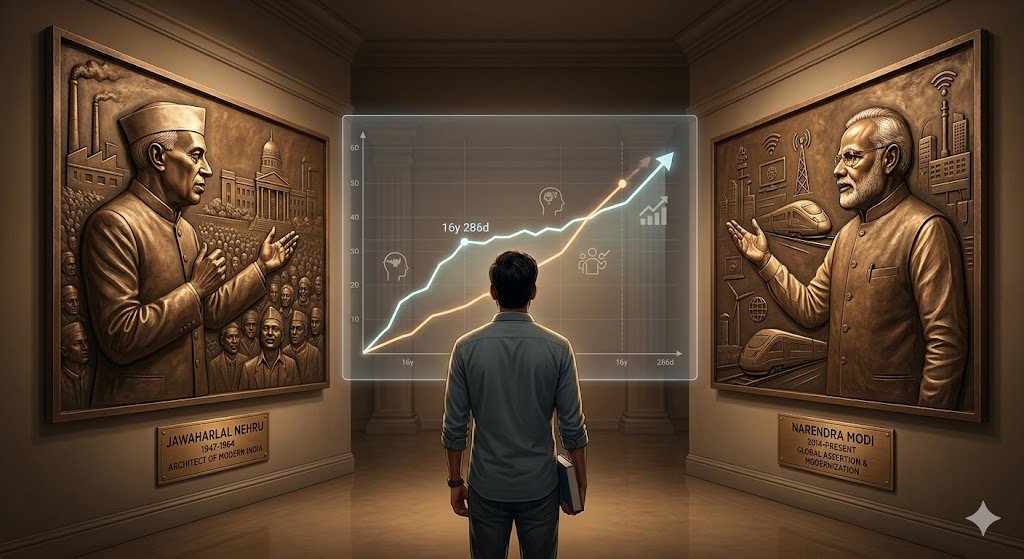
A grand exhibition room featuring large bronze relief sculptures of Nehru (left, 'Architect of Modern India' plaque) and Modi (right, 'Global Assertion & Modernization' plaque).
Tenure and Record: Nehru's Legacy and Modi's Trajectory
Nehru's uninterrupted 16 years and 286 days in office from 1947 to 1964 set a benchmark. He won three general elections (1952, 1957, 1962) with overwhelming majorities, reflecting the trust reposed in him during India's nascent years.
Modi, having completed three full terms by 2024-2029 (assuming continuity), has already matched Nehru in the number of consecutive terms won. In 2025, he surpassed Indira Gandhi's record for consecutive days in office as PM. Public discussions frequently speculate on whether a potential fourth term could allow him to approach or surpass Nehru's total tenure. Some political voices express hope that Modi's continued leadership and public support could enable him to set new records, symbolizing stability and progress in a mature democracy.
While Nehru built the system from scratch in a post-colonial context, Modi operates in a vastly transformed India with greater economic heft and global integration. Comparisons of tenure often highlight not just duration but the context: Nehru navigated partition and nation-building; Modi focuses on 21st-century challenges like technology, climate, and geopolitics.
Charisma and Personality: Shared Appeal Across Eras
Both leaders are frequently described as charismatic figures who command immense personal loyalty. Nehru's charm lay in his aristocratic elegance, intellectual prowess, and oratory that blended idealism with pragmatism. He was seen as a statesman of global repute, rubbing shoulders with world leaders and embodying the aspirations of a free India.
Modi, on the other hand, exudes a different yet equally compelling charisma—rooted in relatability, dynamism, and a strongman image. His background as a self-made leader resonates with millions aspiring for upward mobility. His speeches are energetic, motivational, and laced with cultural references that connect deeply with the masses. Supporters often note how both leaders transcend party structures, becoming larger-than-life personalities who inspire "waves" of support during elections.
Public perception draws parallels in their ability to mobilize crowds and shape national narratives. Nehru's popularity was near-universal in the early decades with limited opposition; Modi's remains exceptionally high in contemporary polls, with many voters citing personal identification with his vision. This shared trait of being "popular personalities" makes them stand out in India's political history, where few leaders achieve such sustained mass following.
Wisdom and Decision-Making: Contrasting Yet Admired Approaches
Wisdom in leadership manifests differently in their contexts. Nehru's wisdom was rooted in liberal democratic ideals, emphasis on deliberation, and long-term institution-building. He prioritized scientific outlook, education, and cautious foreign policy to shield a vulnerable nation. His decisions, such as establishing planning commissions or adopting non-alignment, reflected deep foresight amid uncertainty.
Modi's decision-making is often portrayed as bold, swift, and outcome-oriented. Initiatives like demonetization, GST implementation, abrogation of Article 370, or rapid infrastructure rollout demonstrate a preference for decisive action over prolonged consensus in some cases. Supporters argue this reflects practical wisdom suited to a fast-paced globalized world, focusing on results, digital governance, and national security.
Comparisons highlight Nehru's consensus-driven style versus Modi's executive efficiency. Both are credited with visionary thinking—Nehru for laying democratic foundations, Modi for accelerating modernization and self-reliance. Public debates acknowledge that while their methods differ due to era-specific challenges, each exhibits a form of wisdom that has guided India through critical phases. Nehru's intellectual depth and Modi's administrative acumen represent complementary facets of effective leadership in Indian eyes.
Popularity and Public Perception: Enduring Icons
Popularity remains a key point of comparison. Nehru enjoyed near-mythical status in his time, with his image synonymous with the young republic. Even today, his birthday (Children's Day) and legacy are celebrated nationally.
Modi has cultivated one of the most extensive personal brands in global politics, leveraging technology for direct outreach. Surveys and election outcomes consistently show high approval ratings, with many attributing development gains and national pride to his leadership. Discussions often note how both have been polarizing yet unifying figures—Nehru criticized by some for certain policies, Modi debated on social issues, yet both command loyalty that cuts across regions and demographics.
The hope expressed by some that Modi could emulate or exceed Nehru's record stems from this popularity. With strong voter bases and organizational strength, supporters envision continued mandates enabling longer service, potentially rewriting records while building on Nehru's foundational legacy in new ways.
Analysts point out that direct comparisons must account for contextual differences: Nehru led a newly sovereign, resource-scarce nation; Modi governs an aspirational economic powerhouse. Yet, the emotional connect both evoke as "people's leaders" keeps the discourse alive.
Broader Implications: Two Eras, Shared National Pride
The Nehru-Modi comparison reflects India's evolving political maturity. Nehru symbolized the idealistic birth of the republic; Modi represents its assertive coming-of-age. Their personalities—charismatic, popular, and backed by perceived wisdom—highlight how leadership styles adapt to the times while addressing core aspirations of stability, progress, and identity.
Public conversations, whether in media, social platforms, or everyday discussions, often celebrate both for their contributions rather than pitting them in zero-sum contests. The speculation around Modi potentially breaking tenure records if he serves another term underscores optimism about political continuity and effective governance.
Ultimately, both leaders embody the democratic spirit where people decide through ballots. Nehru's long service helped consolidate freedom; Modi's ongoing journey aims to realize its full potential. Their legacies continue to inspire debates on what makes a great Prime Minister—vision, decisiveness, popularity, or a blend that serves India's diverse needs.
Iconic Charisma and Mobilization
Conclusion
Pandit Jawaharlal Nehru and Narendra Modi stand as two of India's most significant Prime Ministers, each shaping the nation in profound ways. Nehru's record tenure of over 16 years established the bedrock of democracy and modernity. Modi's three terms and rising milestones have fueled hopes among supporters that sustained public trust could see him challenge that record in future.
In terms of charisma, both exhibit magnetic personalities that foster deep connections with citizens. Their popularity transcends routine politics, positioning them as defining figures of their respective eras. On wisdom and decision-making, Nehru's thoughtful, institution-focused approach contrasts with Modi's action-oriented, reform-driven style—yet both are respected for navigating complex challenges with foresight suited to their times.
These comparisons, while inevitable, reveal more about India's vibrant democracy than rivalry. They celebrate two leaders who, despite ideological and stylistic differences, have been immensely popular and influential. As India progresses, the legacies of Nehru and Modi will continue to be studied, debated, and appreciated for contributing to the world's largest democracy's remarkable story.
Whether viewing Nehru as the foundational leader or Modi as the transformative one, their shared ability to inspire millions underscores a common thread: the power of visionary, people-centric leadership in building a stronger India.