The geopolitical landscape of the Persian Gulf has been irrevocably altered as the calendar turns to 'March 30, 2026'. What began as a series of localized skirmishes and long-standing maritime disagreements has spiraled into a full-scale regional conflagration. At the heart of this storm lies the "Iran-Kuwait war", a conflict that is no longer confined to the shadows of proxy warfare but has emerged as a direct, state-to-state confrontation with global implications.
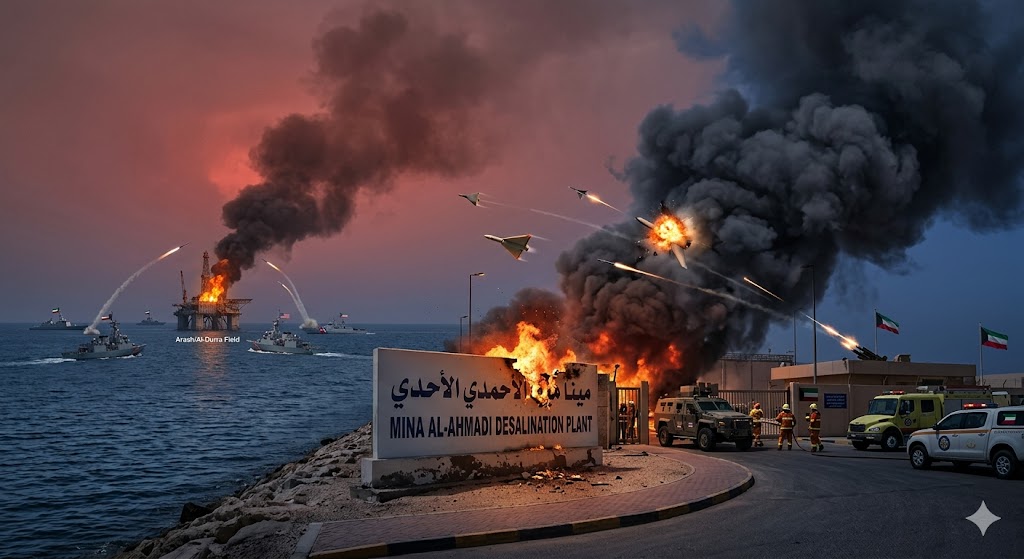
As of today, the conflict has reached a critical fever pitch. Just yesterday, a brutal Iranian strike targeted a major power and water desalination plant in Kuwait. This attack resulted in the tragic death of an Indian national and significant damage to essential service buildings. This incident is not an isolated one; it is part of a systemic campaign by the Islamic Republic to dismantle the infrastructure that sustains the Gulf Cooperation Council (GCC) states.
Kuwait, traditionally known for its diplomatic neutrality and "bridge-building" foreign policy, now finds itself on the front lines. The Kuwait National Guard has reported downing five drones in the last 24 hours alone, yet the sheer volume of Iranian projectiles—estimated to exceed 5,400 across the region since the start of the year—is straining even the most advanced air defense systems.
I. Today’s Escalation – The March 30 Strike
The current state of affairs in Kuwait City and across the northern Gulf is one of high-tension resilience. On this Monday, March 30, 2026, the Ministry of Electricity, Water, and Renewable Energy confirmed that while the "brutal attack" on the desalination plant caused a fatality and structural damage, technical teams have managed to maintain the overall integrity of the grid. However, the psychological toll is mounting.
The Urban Battlefield
The Iran-Kuwait war has moved from the high seas into the heart of Kuwaiti population centers. Residents of Al Jahra and Kuwait City are now accustomed to the sight of Patriot missile trails streaking across the night sky. The destruction is palpable:
Desalination Facility: A service building at a major plant was severely damaged yesterday evening, resulting in the eighth Indian fatality of the broader West Asia conflict.
Kuwait International Airport: Struck by multiple drones over the weekend, causing "significant" damage to radar systems and fuel tanks.
Mina Al-Ahmadi Refinery: Hit twice in March, leading to force majeure declarations and global supply shocks.
Iran’s justification for these escalatory moves is rooted in its claim that Kuwaiti soil is being used as a "launchpad" for U.S. and Israeli operations—part of the broader "Operation Epic Fury" launched by the Trump administration on February 28, 2026.
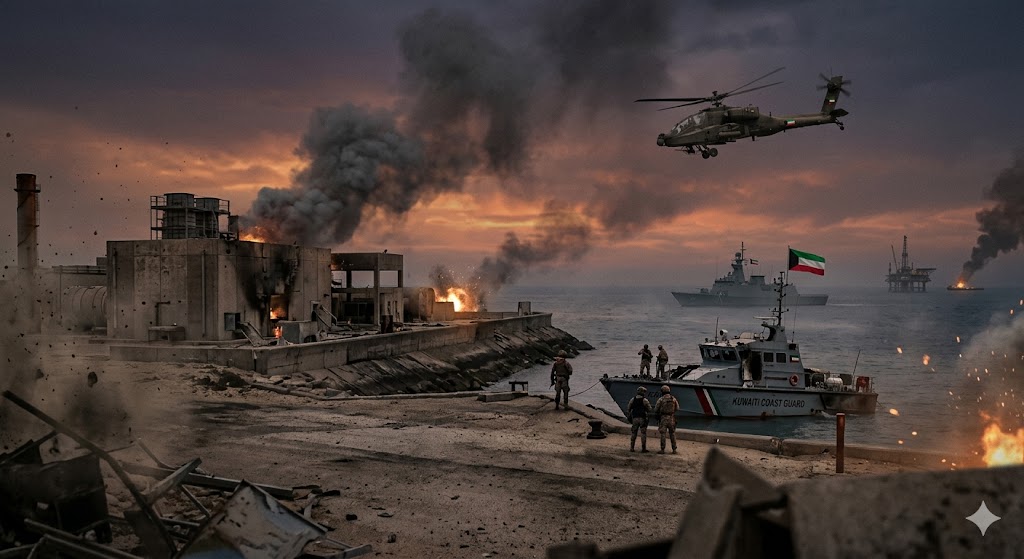
coast guard operation near the Al-Durra gas field amid the conflict between Iran and Kuwait
Chapter II: The Al-Durra Gas Field – The Submerged Catalyst
To understand why Iran is focusing its high power tactics on Kuwait, one must look beneath the waves. The Al-Durra gas field (known as Arash in Iran) has been the primary bone of contention. Holding an estimated 20 trillion cubic feet of gas, the field is a crown jewel of energy reserves.
A Legacy of Dispute
The dispute dates back to 1967, but it reached a breaking point in February 2026 when Kuwait and Saudi Arabia launched joint tenders for the field’s development. This move was intended to impose a "new reality" on the ground, bypassing years of stalled negotiations. Iran viewed this as a violation of its sovereign "historical rights," leading to warnings that Gulf steps amounted to crossing "red lines."
By attempting to possess high power through military leverage, Tehran seeks to force a renegotiation of maritime boundaries that would grant it a significant share of the field’s wealth. In the Iran-Kuwait war, the Al-Durra field is not just a resource; it is the ultimate prize in a battle for regional energy dominance.
Chapter III: Iran’s Doctrine of "High Power"
Iran’s current military posture is a calculated attempt to assert itself as the dominant high power in the Middle East. This high power is not merely about conventional strength; it is about the ability to disrupt the global order until Tehran's demands are met.
The Three Pillars of High Power Strategy
1. Asymmetric Attrition: By targeting desalination plants and power grids, Iran demonstrates that no amount of Western military protection can fully insulate the Gulf states from civil disruption.
2. Technological Saturation: The use of "Operation True Promise 4" tactics—coordinated swarms of low-cost Shahed-series drones and high-precision ballistic missiles—is designed to saturate air defenses. Kuwait’s Ministry of Defense reported dealing with 14 ballistic missiles and 12 hostile drones in the last 24 hours alone.
3. Horizontal Escalation: Iran has expanded the war’s geography. By involving Kuwait, Qatar, and the UAE, Iran ensures that the "pain" of the war is felt by every ally of the United States.
Chapter IV: The Military Toll – The Fog of War
The Iran-Kuwait war has seen some of the most complex aerial combat in history.
The March 2nd Friendly Fire Incident
One of the most sobering moments occurred on March 2, 2026. During an intense Iranian barrage, Kuwaiti air defense units—operating under extreme pressure—mistakenly identified three American F-15E Strike Eagles as hostile. The U.S. jets were engaged by Kuwaiti-manned missiles, and while the crew survived, the incident highlighted the critical lack of coordination in the current regional security architecture.
Chapter V: The Humanitarian and Economic Fallout
The death of an Indian worker on March 30 has sent shockwaves through the expatriate community. With eight Indian nationals now confirmed dead across the region, the Indian Embassy is in a state of permanent crisis management.
"The Global Energy Shock"
Oil Prices: Brent crude has surged to over $116 per barrel
The Strait of Hormuz: Iran has effectively turned the Strait into a military zone, reportedly imposing $1 million transit fees for vessels.
Chapter VI: The History of the Al-Durra Conflict (1967–2026)
To provide context for the current Iran-Kuwait war, we must examine the 50-year timeline of the Al-Durra (Arash) field.
1967: The field is discovered in the offshore neutral zone shared by Kuwait and Saudi Arabia. Iran immediately contests the boundaries.
2001: Iran begins drilling in the area, leading Kuwait and Saudi Arabia to sign a maritime border agreement that excludes Tehran.
2011: Tensions peak as Kuwait announces plans to begin production; Iran threatens "proportionate action."
February 2026: Kuwait and Saudi Arabia invite international oil majors to develop the field. Iran declares this an act of economic war and mobilizes the IRGC Navy.
March 2026: The transition from diplomatic protests to kinetic strikes on Kuwaiti mainland infrastructure begins.
Iran-Kuwait Conflict 2026: Geopolitical Power Play
Chapter VII: Technical Appendix – The "High Power" Arsenal
The Iran-Kuwait war is characterized by the use of specific technologies designed to overwhelm modern defenses.
1. The Shahed-136B (Upgraded)
The 2026 variant features a turbojet engine and satellite-link guidance, allowing for mid-flight target re-prioritization. These were the primary tools used in the March 30 strike on the desalination plant.
2. Fattah-2 Hypersonic Missiles
Reportedly used for the first time against the Shuwaikh Port, these missiles travel at speeds exceeding Mach 5, leaving Kuwaiti Patriot batteries less than 45 seconds to react from launch to impact.
3. Sea-Mining Drones
Small, autonomous submersibles have been deployed near Kuwait’s oil terminals, creating a "soft blockade" that has paralyzed commercial shipping.
Chapter VIII: Operation Epic Fury – The Allied Counter-Strike
As part of the broader Iran-Kuwait war, the United States and its partners have launched Operation Epic Fury. This campaign focuses on "decapitating" the IRGC’s ability to launch missiles.
Surgical Neutralization
U.S. B-21 Raider stealth bombers have conducted deep-penetration strikes on the Yazd Missile Base, an underground "missile city" believed to be the source of the drones hitting Kuwait. Despite these strikes, Iran’s decentralized command structure has allowed mobile launchers to continue the offensive.
Chapter IX: The Geopolitical Realignment
The Iran-Kuwait war has forced a dramatic shift in Gulf alliances. Kuwait, once the mediator, is now seeking a formal defense pact with the United Kingdom and France to supplement the U.S. presence.
The China Factor
China, a major buyer of both Kuwaiti and Iranian oil, has remained notably silent, calling for "restraint" while quietly negotiating a "peace for oil" deal. This silence is seen by some as a tacit endorsement of Iran’s attempt to possess high power and push Western influence out of the Gulf.
Conclusion: Resilience in the Face of Aggression
The Iran-Kuwait war of 2026 is a testament to the fragile nature of regional stability. Iran’s attempt to possess high power through the destruction of civilian infrastructure has successfully disrupted the global economy, but it has also unified its neighbors in a way previously thought impossible.
As of today, March 30, the situation remains a stalemate of high-tech violence. The high power of the Iranian missile is being met by the high power of Kuwaiti and Allied resilience. Whether this leads to a settlement or total war depends on the diplomacy of the coming weeks. For the people of Kuwait, the goal remains clear: the restoration of sovereignty and the protection of the vital resources that power the world.
Frequently Asked Questions
What is the primary significance of Iran-Kuwait Conflict 2026: Geopolitical Power Play?
The 2026 gulf crisis :A Region Redefined by FireThe geopolitical landscape of the Persian Gulf has been irrevocably altered as the calendar turns to 'March 30, 2026'. What began as a series of localized skirmishes and long-standing maritime disagreements has spiraled into a full-scale regional conflagration.
How does this development impact International Affairs?
At the heart of this storm lies the "Iran-Kuwait war", a conflict that is no longer confined to the shadows of proxy warfare but has emerged as a direct, state-to-state confrontation with global implications.As of today, the conflict has reached a critical fever pitch. Just yesterday, a brutal Iranian strike targeted a major power and water desalination plant in Kuwait.
What are the key future projections to monitor?
This attack resulted in the tragic death of an Indian national and significant damage to essential service buildings.
.jpeg)
 Iran-Kuwait Conflict 2026: Geopolitical Power Play