Israel Leaflets Warn Tyre Villages: Hezbollah plans
These leaflets accuse the Iran-backed group of using civilian homes, hospitals, and public spaces for military purposes, including rocket launches and command operations. Israeli officials insist that such tactics endanger local populations and leave the military with little choice but to conduct operations to neutralize threats. The warnings come as a fragile ceasefire, extended by three weeks following U.S.-brokered talks, faces ongoing violations from both sides.
The human cost of the interconnected conflicts remains staggering. In Gaza, the death toll since October 2023 has climbed toward or exceeded 78,000 when accounting for direct violence, indirect deaths, and those still missing under rubble, according to various health ministry figures and independent estimates. In Lebanon, over 2,000 deaths have been reported since the escalation, with thousands more injured and displaced.
This latest phase of leaflet drops and strikes underscores the persistent challenges in achieving lasting de-escalation. While diplomatic channels in Washington push for longer-term agreements, on-the-ground realities in Tyre and southern villages paint a picture of continued uncertainty and hardship for civilians caught in the crossfire.
The current round of hostilities traces back to the October 7, 2023, Hamas-led attacks on Israel, which triggered a devastating war in Gaza. In solidarity, Hezbollah began launching rockets and drones across the Israel-Lebanon border, prompting Israeli responses that escalated into full-scale operations in southern Lebanon by 2025 and early 2026.
Hezbollah, designated a terrorist organization by Israel, the United States, and several other countries, maintains a significant arsenal and operates with strong political influence in Lebanon. Israel argues that the group has systematically militarized civilian areas over decades, embedding launchers, tunnels, and command posts within villages to shield its activities.
Southern Lebanon, particularly the area south of the Litani River, has long been a focal point. Villages in the Tyre district — including Rashidieh, Qlaileh, Maarakeh, and others — have repeatedly featured in Israeli targeting due to their proximity to the border and alleged militant presence. Israeli forces have conducted airstrikes, artillery shelling, drone attacks, and limited ground operations aimed at degrading Hezbollah's capabilities, especially its elite Radwan Force.
A U.S.-mediated ceasefire took effect in mid-April 2026, initially for ten days, and was later extended by three weeks following talks involving Israeli and Lebanese representatives. President Donald Trump announced the extension, emphasizing the need for good-faith negotiations toward a comprehensive security agreement. However, both sides have accused each other of violations, with Israel citing ongoing Hezbollah rocket fire and attempts to reposition fighters, while Hezbollah points to continued Israeli strikes and demolitions in southern villages.
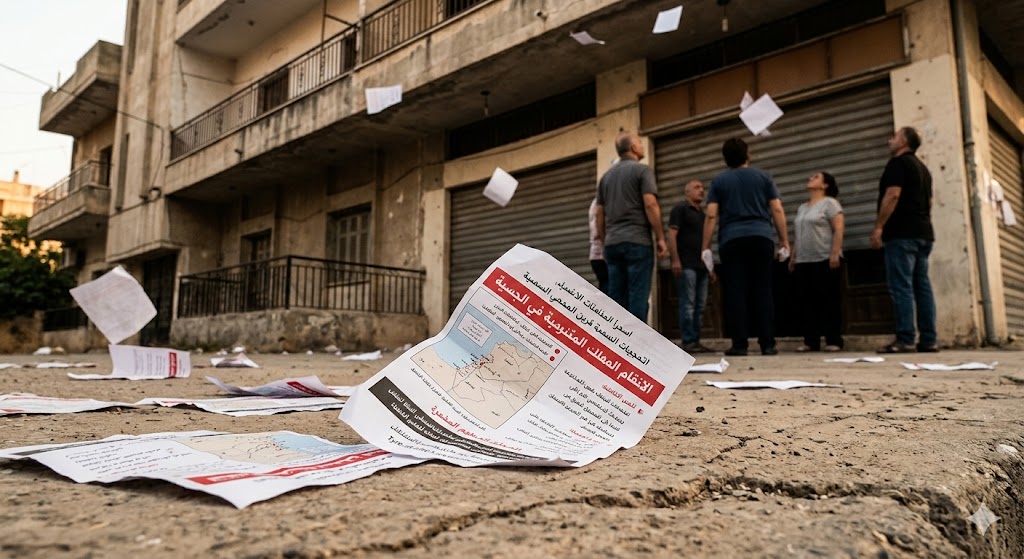
Scattered generic Arabic-language leaflets cover a sidewalk in Tyre, Lebanon. A crumpled leaflet with bold red headlines is prominent in the foreground, as civilians in the background look upward with concern while more warning papers drift down.
The Leaflet Campaign: Warnings and Accusations
In March and April 2026, Israeli forces intensified the use of leaflets as a tool of psychological operations. Dropped from drones and aircraft over Tyre and multiple villages, these Arabic-language flyers carry stark messages. They warn residents to distance themselves from Hezbollah positions and, in some cases, urge full evacuation to safer areas north of designated lines.
One recurring theme is the claim that Hezbollah has turned civilian infrastructure into military assets. Leaflets have referenced specific activities such as rocket storage in homes, command centers in residential buildings, and the use of hospitals or schools for operational support. Israeli military spokespersons, including Arabic-language spokesman Col. Avichay Adraee, have amplified these warnings via social media, posting maps and evacuation orders.
In Tyre itself, leaflets targeted districts near the Rashidieh refugee camp and coastal roads, signaling potential strikes on alleged launch sites. Similar drops occurred over Beirut's southern suburbs, calling on Lebanese civilians to pressure Hezbollah to disarm and restore national sovereignty. Some leaflets even drew parallels to operations in Gaza, suggesting that failure to separate from militants could lead to similar levels of destruction.
These tactics are not new but have gained intensity amid the ceasefire period. Israel maintains that leaflets minimize civilian harm by providing advance notice, allowing time for evacuation. Critics, including Lebanese officials and humanitarian groups, argue that the warnings create widespread fear, disrupt daily life, and sometimes precede strikes that still cause collateral damage in densely populated areas.
Evacuation Orders and Civilian Challenges in Tyre Villages
Accompanying the leaflets are repeated evacuation directives for dozens of villages across southern Lebanon. Israel has published maps showing a "red line" or "yellow line" roughly 10 kilometers from the border, advising residents not to return to over 50 villages or approach the Litani River area. Specific communities in the Tyre district, such as Deir Aames, have received urgent calls to move at least 1,000 meters away due to imminent operations.
For many residents, compliance is difficult. Over a million Lebanese were displaced at the height of the fighting, and many have nowhere else to go. Tyre, historically a relatively safer coastal hub, became a refuge for thousands of fleeing border villages. Yet even here, evacuation warnings have emptied streets, closed markets, and heightened anxiety.
Families often weigh the risks of staying against the hardships of repeated displacement. Some return during lulls only to face new alerts. Reports describe scenes of residents sheltering in theaters, schools, or with relatives while Israeli jets circle overhead. In one incident near Tyre, a drone strike hit a vehicle close to the city center, killing a young woman and underscoring the unpredictability.
Humanitarian organizations have raised alarms about the scale of displacement and restricted access to aid. Damaged roads, bridges like the one near Qasmieh, and power shortages complicate movement and delivery of essentials. The Lebanese government and Hezbollah officials have urged residents to remain cautious but also criticized the Israeli presence as an occupation that prevents normal returns.
Continued Strikes Despite Ceasefire Extensions
Despite the April 2026 ceasefire and its extension, Israeli strikes have persisted in southern Lebanon. On April 25, 2026, Lebanese state media reported four deaths from strikes in multiple locations, including the Tyre and Nabatieh districts. The Israeli military stated it targeted loaded rocket launchers and Hezbollah fighters, including facilities linked to the Radwan Force.
Other incidents include strikes near hospitals, such as damage reported at facilities in Tyre where medical staff were injured. In early April, attacks in the Tyre area killed children and wounded dozens, with one wave hitting buildings and a port area. Israeli sources describe these as responses to Hezbollah ceasefire violations, such as rocket launches or attempts to rearm.
Hezbollah has responded with limited rocket and drone fire, claiming self-defense against Israeli incursions and demolitions. The group has dismissed the ceasefire as "meaningless" while Israeli operations continue. UN observers have noted potential breaches of international law by both sides, highlighting challenges in distinguishing military targets from civilian spaces.
In Tyre, the cumulative impact includes shattered buildings, rubble-filled streets, and families mourning losses. One tragic case involved a family of 13 killed in a strike just before an earlier ceasefire took effect. Such stories illustrate the fragile nature of any pause in hostilities.
Gaza Death Toll: A Grim Parallel
The situation in Lebanon cannot be viewed in isolation from the ongoing repercussions of the Gaza conflict. Since October 7, 2023, Palestinian health authorities report over 72,000 direct deaths, with independent analyses and studies pushing violent death estimates to around 75,200 by early 2025, and cumulative figures approaching or surpassing 78,000 when including indirect causes, disease, malnutrition, and unrecovered bodies as of April 2026.
These numbers encompass a high proportion of women, children, and elderly civilians. Israel maintains that it targets Hamas infrastructure and accuses the group of using human shields, a claim echoed in its justifications for operations against Hezbollah in Lebanon.
The Gaza toll has fueled regional anger and complicated diplomatic efforts. Humanitarian conditions in Gaza remain dire, with reconstruction stalled and access to aid limited. The parallel crises underscore broader questions about proportionality, civilian protection, and the cycle of violence involving Iran-backed proxies.
Humanitarian Crisis and International Concerns
The leaflet drops and sustained military pressure have exacerbated Lebanon's humanitarian challenges. Displacement figures remain high, with many families facing food insecurity, healthcare shortages, and psychological trauma. Aid groups call for unimpeded access and an end to actions that endanger civilians.
Internationally, the United Nations and human rights experts have condemned aspects of the operations, citing risks of indiscriminate attacks and the destruction of civilian infrastructure. Calls for full implementation of UN Resolution 1701 — which seeks Hezbollah's withdrawal from the border area and Israeli respect for Lebanese sovereignty — have grown louder.
At the same time, Israel emphasizes its right to self-defense against persistent threats. The presence of Israeli forces in parts of southern Lebanon during the ceasefire period, justified as necessary to counter "ongoing terrorist activities," remains a point of contention in negotiations.
Strategic and Political Dimensions
From Israel's perspective, the operations aim to create a secure buffer zone, degrade Hezbollah's military infrastructure, and prevent future attacks on northern Israeli communities. Demolitions of certain buildings and maintenance of positions reflect a determination to alter the status quo that allowed Hezbollah to build up capabilities over years.
For Lebanon, the conflict has strained state institutions, deepened economic woes, and highlighted the challenges of a weak central government coexisting with a powerful non-state actor like Hezbollah. Political voices in Beirut push for diplomacy while navigating domestic divisions.
U.S. mediation, including direct talks hosted in Washington, seeks to bridge these gaps toward a more permanent agreement. However, the exclusion of Hezbollah from some negotiations and mutual accusations of bad faith complicate progress.
Personal Stories from the Ground
Behind the statistics lie human experiences. Residents of Tyre describe nights interrupted by explosions, days spent checking damage to homes, and constant fear for loved ones. One mother in a shelter spoke of pleading with photos of her children while awaiting news of strikes near a hospital. Fishermen in the port area have seen boats damaged, disrupting livelihoods.
In villages warned via leaflets, families debate whether to risk staying or join the flow of displaced people northward. These stories reveal resilience amid despair, as communities attempt to maintain normalcy — schools reopening sporadically, markets operating cautiously — against a backdrop of uncertainty.
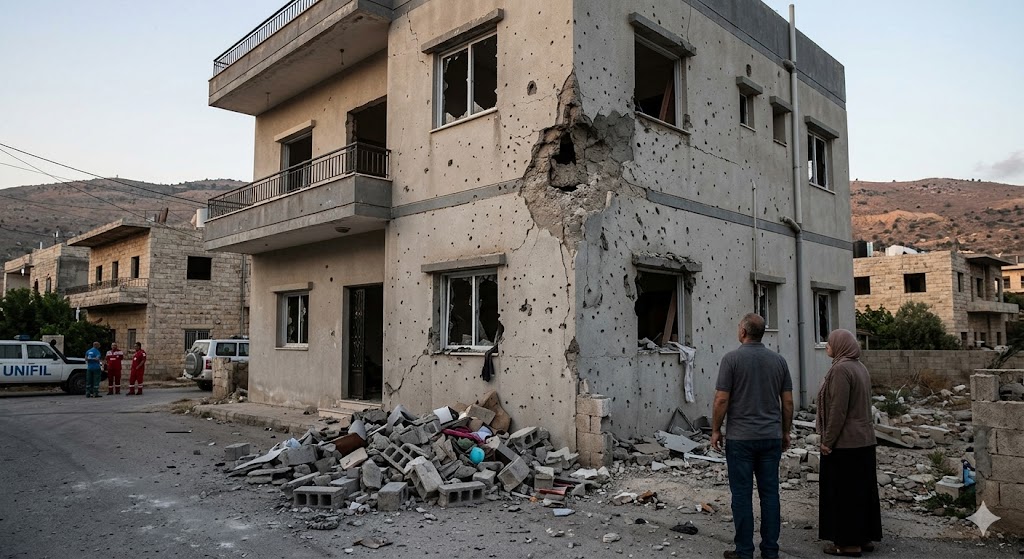
The damaged facade of a three-story residential building in a Tyre, Lebanon village after a recent strike. Rubble and shattered windows illustrate the destruction, as two generic civilians somberly survey the damage at dusk.
Looking Ahead: Prospects for De-escalation
As the extended ceasefire period continues into May 2026, the path forward remains uncertain. Success depends on verifiable steps toward disarmament in the south, security guarantees for Israel, and reconstruction support for Lebanon. Any durable solution must address root causes, including Iran's regional influence and the need for strengthened Lebanese state authority.
International actors, including the United States and European partners, continue to engage, but breakthroughs require compromise from all sides. In the meantime, leaflet warnings and targeted strikes serve as reminders that the conflict is far from resolved.
For the people of Tyre and southern Lebanon villages, daily life hangs in a delicate balance. The hope for peace persists, yet the reality of ongoing military activities and humanitarian strain tests that optimism. Sustained diplomatic momentum, coupled with genuine adherence to ceasefire terms, offers the best chance to prevent further escalation and begin the long process of recovery.