The Eternal Legacy: History of Ancient Egypt Civilization
The Eternal Legacy: A Comprehensive History of Ancient Egyptian Civilization
The story of the Ancient Egyptian civilization is not merely a chronicle of a lost world; it is the foundational narrative of human progress. For over three millennia, the banks of the Nile hosted a culture so advanced, so stable, and so spiritually complex that its echoes still resonate in our modern architecture, mathematics, and philosophy. To understand the Nile Valley civilization is to understand the very blueprint of organized society.
The Cradle of the Nile: Origins of the Nile Valley Civilization
The development of the Egyptian civilization was inextricably linked to its geography. Unlike other ancient civilizations that struggled against unpredictable environments, Egypt was "the gift of the Nile," as described by the Greek historian Herodotus.
Between 5000 and 3100 BCE, the Predynastic period saw scattered nomadic tribes settling along the riverbanks. These early settlers transitioned from hunter-gatherers to sophisticated farmers, mastering the "inundation"—the annual
flooding of the Nile that deposited nutrient-rich silt onto the land. This agricultural surplus allowed for population growth, labor specialization, and the eventual civilization development that would lead to the construction of the pyramids.
The Nile was more than just a water source; it was the highway of the Ancient Egyptian civilization. It facilitated trade, communication, and military transport, allowing a vast territory to remain unified under a single administrative system. The predictability of the river fostered a worldview of stability and cyclical rebirth, which became the cornerstone of religion in Ancient Egypt.
The Unification of Egypt: The Birth of a Superpower
One of the most pivotal moments in human history was the unification of Egypt around 3100 BCE. Before this, the region was divided into Upper Egypt (the south) and Lower Egypt (the north). According to historical records and the famous Narmer Palette, King Narmer (often identified as Menes) succeeded in
bringing these two distinct cultures under a single crown.
This unification was not merely political; it was a religious and symbolic event. The Pharaoh became the "Lord of the Two Lands," wearing the Pschent—a double crown representing both regions. This centralization of power allowed the Ancient Egyptian civilization to mobilize resources on a scale never before seen, leading to the Early Dynastic Period and the subsequent Old Kingdom. The unification of Egypt established the Pharaonic tradition, where the ruler was seen as a living god, a mediator between the people and the divine.
The Old Kingdom: The Age of the Pyramids
The Old Kingdom (c. 2686–2181 BCE) is often synonymous with the "Age of the Pyramids." This era represented the first peak of Egyptian civilization maturity. It was during this time that Pharaohs like Djoser, Khufu, and Khafre commissioned the massive stone structures that still dominate the Giza plateau.
The Great Pyramid of Giza remains a testament to the advanced engineering and organizational skills of the Nile Valley civilization. Far from being the work of slaves, modern ancient Egypt exploration suggests these monuments were built by a highly organized workforce of skilled laborers who viewed their contribution as a form of religious service to the living god—the Pharaoh. The Old Kingdom also saw the perfection of hieroglyphic writing and the establishment of a complex bureaucracy that managed everything from grain storage to justice.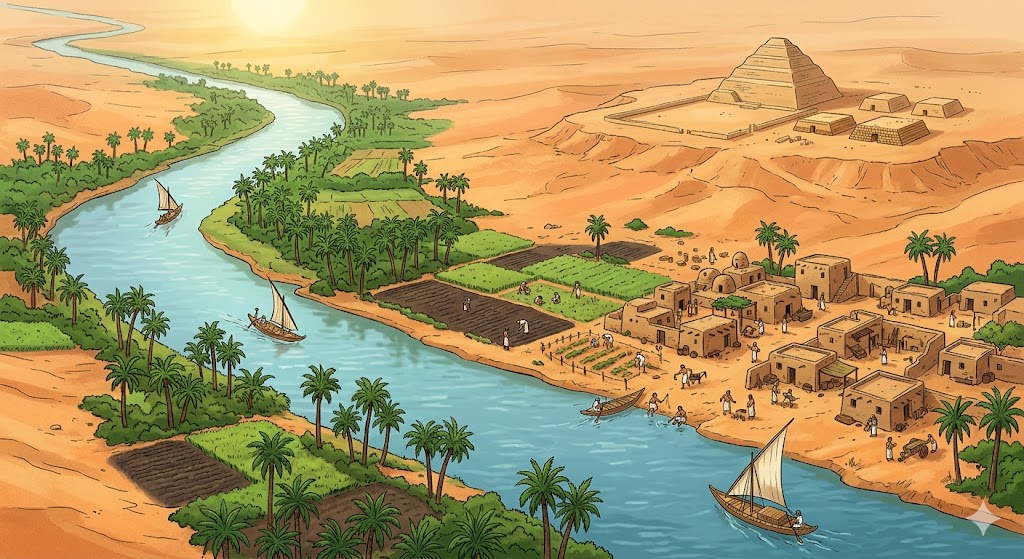
The Gift of the Nile: Development of Civilization
The First Intermediate Period and the Middle Kingdom Renaissance
Following the collapse of the Old Kingdom due to famine and weakened central authority, Egypt entered the First Intermediate Period—a time of chaos and civil war. However, the Ancient Egyptian civilization proved its resilience. The
Middle Kingdom (c. 2055–1650 BCE) emerged as a "Classical Age."
During this period, the Pharaohs of the 11th and 12th Dynasties shifted their
focus from monumental pyramid building to public works and literature. They
drained the Fayum oasis for agriculture and expanded trade into the Levant.
Ancient Egypt life during the Middle Kingdom saw a rise in the "democratization of the afterlife," where even non-royals could hope for a blessed existence after death through the use of Coffin Texts. This era solidified the civilization development by creating a more robust middle class of scribes and artisans.
Religion in Ancient Egypt: The Pulse of a Civilization
To discuss the history of Ancient Egypt without a deep dive into spirituality is impossible. Religion in Ancient Egypt was not a separate facet of life; it was life itself. The Egyptians believed Ma’at—a concept of universal balance, truth, and justice.
The pantheon of gods was vast and varied:
Ra: The sun god and creator, who traveled across the sky in a solar barque.
Osiris: The god of the afterlife, representing the cycle of death and rebirth.
Isis: The protective goddess, whose cult eventually spread across the Roman Empire.
Anubis: The jackal-headed god who oversaw the weighing of the heart.
The belief in the afterlife drove much of the civilization’s economic and artistic output. The elaborate process of mummification and the construction of
"Houses of Eternity" (tombs) were designed to ensure the soul (Ka and Ba) could recognize its body and thrive in the Fields of Reeds. This focus on the "lost worlds" and the transition to the next life makes Egypt unique among ancient civilizations. Religion Egypt was the glue that held the social hierarchy
together, as the Pharaoh’s primary duty was to maintain Ma'at through ritual and law.
The New Kingdom (c. 1550–1070 BCE) is frequently referred to as the Golden Age of Egyptian civilization. This was an era of unprecedented wealth, military
expansion, and artistic flourishing. Icons like Hatshepsut, Thutmose III, Akhenaten, Tutankhamun, and Ramesses the Great emerged during this period.
Under the New Kingdom, Egypt became an empire. Its borders reached deep into Nubia to the south and as far as modern day Syria to the north. This was the era of the "Lost Worlds: The Golden Age of Egyptian Civilization," where the capital of Thebes became the most magnificent city on Earth, and the Valley of the Kings became the silent guardian of royal treasures.
The ancient Egypt exploration of the 19th and 20th centuries, most notably the discovery of Tutankhamun’s tomb by Howard Carter in 1922, provided the world with a glimpse into this Golden Age. The sheer volume of gold, lapis lazuli, and fine craftsmanship revealed a level of sophistication that few lost
civilizations have ever matched.
The Amarna Heresy: A Religious Revolution
One of the most fascinating chapters in the history of Ancient Egypt is the reign of Akhenaten. He attempted to replace the traditional pantheon with the worship of a single god, the Aten (the sun disk). This radical shift in religion in Ancient Egypt led to a unique style of art—more naturalistic and fluid—but it also caused internal strife. After his death, his son Tutankhamun restored the old gods, and Akhenaten’s name was nearly erased from history, making his reign a true "lost world" within the civilization.
Daily Life in Ancient Egypt: Beyond the Pharaohs
While the Pharaohs and gods dominate the headlines, Ancient Egypt life for the common citizen was remarkably structured. The social pyramid was clear: at the top was the Pharaoh, followed by viziers, priests, scribes, craftsmen, and finally, the farmers who made up the majority of the population.
The Role of Women
Remarkably, compared to other ancient civilizations, women in Egypt enjoyed significant legal rights. They could own property, enter into contracts, and initiate divorce. Some women, like Hatshepsut and Nefertiti, even wielded supreme political power, showcasing a progressive social structure for the time.
Egypt contributed to the early concepts of gender equality in ways that were centuries ahead of its contemporaries.
Education and Scribes
Literacy was the key to social mobility. Scribes were highly respected members of society, responsible for keeping records in hieroglyphics—a complex system of "sacred carvings." Their work in the "House of Life" (libraries and scriptoriums) ensured that the knowledge of the Nile Valley civilization was preserved for millennia.
Scientific and Cultural Contributions
The ancient civilizations' legacy is visible in every corner of modern science.
The Egyptians were pioneers in:
1. Mathematics: They developed a decimal system and were masters of geometry,essential for surveying land after Nile floods.
2. Medicine: Papyrus scrolls reveal that Egyptian doctors performed surgery, treated fractures, and had a sophisticated understanding of the circulatory system.
3. Astronomy: They created a 365-day calendar based on the movements of the star Sirius, which remains the basis for our modern calendar.
4. Architecture: The use of columns, lintels, and massive stonework influenced Greek and Roman styles, which in turn shaped Western architecture.
Egypt contributed significantly to the development of paper through the use of papyrus, a plant that grew abundantly along the Nile. This innovation allowed for the easy storage and transmission of knowledge, a precursor to the modern information age.
The Late Period and the Influence of Foreign Powers
As the New Kingdom waned, the Ancient Egyptian civilization entered the Third Intermediate Period and the Late Period. This was a time of shifting power dynamics where Egypt was ruled by Libyan, Nubian (the "Black Pharaohs"), and Persian dynasties. Despite foreign rule, the core of Egyptian civilization remained intact. The foreign rulers often adopted Egyptian customs, titles, and religion to legitimize their rule.
The final chapter of independent ancient Egypt began with the conquest by Alexander the Great in 332 BCE. This ushered in the Ptolemaic Dynasty, a fusion of Greek and Egyptian cultures. The city of Alexandria became the intellectual capital of the world, housing the Great Library and the Pharos Lighthouse. However, the death of Cleopatra VII in 30 BCE led to Egypt becoming a province of the Roman Empire, marking the formal end of the Pharaonic era.
Ancient Egypt Exploration: Unlocking the Secrets
The modern world’s obsession with Egypt began in earnest with Napoleon Bonaparte’s expedition in 1798. His team of scholars documented the monuments, leading to the discovery of the Rosetta Stone. This artifact was the key to deciphering hieroglyphs, allowing historians to finally read the history of Ancient Egypt in the Egyptians' own words.
Today, ancient Egypt exploration has moved into the digital age. Using satellite imagery, ground-penetrating radar, and DNA analysis, archaeologists are discovering "lost" cities andidentifying the mummies of famous queens and
kings. These discoveries continue to reshape our understanding of how this
ancient civilization lived, breathed, and eventually fell.
The Enduring Legacy of Ancient Egypt
The ancient civilizations' legacy is most profound in Egypt. We see it in our fascination with the occult, our architectural aesthetics, and our fundamental desire to leave a mark on the world that outlasts our physical presence. The concept of a soul, the judgment after death, and the importance of ethical living (Ma'at) have deeply influenced Judeo-Christian and Islamic traditions.
The Egyptian civilization taught humanity that with order, vision, and a deep respect for both the natural and spiritual worlds, it is possible to build something eternal. They did not just build monuments; they built a framework for human thought. From the columns of the Parthenon to the obelisks in Washington D.C., the civilisation of the Nile continues to cast a long shadow over the modern world.
The Mechanics of an Empire: Economy and Trade
The economic strength of the Nile Valley civilization was rooted in its agricultural abundance, but its reach was global. Egypt was a hub for trade, importing cedar from Lebanon, lapis lazuli from Afghanistan, and incense and gold from the Land of Punt (likely modern-day Ethiopia or Somalia).
The state controlled the economy through a system of redistribution. Farmers paid taxes in the form of grain, which was stored in massive granaries and used to pay laborers, soldiers, and officials. This "grain-based economy" provided a
safety net during years of poor harvests, ensuring the stability of the Ancient Egyptian civilization for centuries.
Art and Aesthetics: The Language of the Divine
Egyptian art was never intended to be "art for art's sake." It was functional and symbolic. In the history of Ancient Egypt, statues were seen as physical vessels for the spirits of gods or the deceased. The rigid, frontal poses of statues were meant to convey eternity and stillness.
Wall paintings in tombs were not just decorations; they were magical "blueprints" for the afterlife. By depicting the decease enjoying banquets, hunting in the marshes, or worshipping gods, the artists ensured these activities would continue in the next world. This deep connection between art and religion in Ancient Egypt created a visual language that remained remarkably consistent for 3,000 years.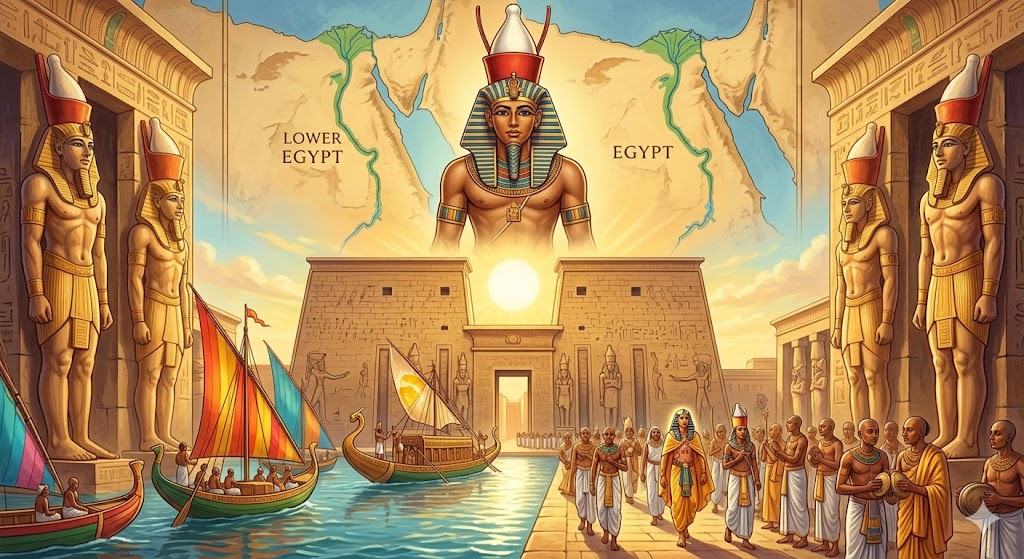
Unification and the Golden Age Empire
Conclusion
The history of Ancient Egyptian civilization is a journey through the heights of human potential. From the first unification of Egypt to the sprawling temples of the Golden Age, this Nile Valley civilization remains a beacon of cultural achievement. As we continue to uncover the secrets of this "lost world," we find
that we are not just looking at the past; we are looking at the ancestors of our own modern identity.
The sands of Egypt may cover the stones, but the spirit of Egypt remains unyielding. Whether through the study of religion Egypt, the exploration of its "lost worlds," or the appreciation of its scientific contributions, the Ancient Egyptian civilization continues to inspire awe and wonder. It is a testament to the "Golden Age" that never truly ended, living on in the very fabric of human civilisation.