William Shakespeare: Life, Works & Enduring Legacy
News• April 23, 2026• Global Edition
Few figures in literary history command the universal recognition and admiration afforded to William Shakespeare. Often hailed as England's national poet and the greatest playwright of all time, his words have shaped the English language, influenced countless artists, and resonated across cultures for over four centuries. From the tragic depths of Hamlet to the romantic heights of Romeo and Juliet, Shakespeare's works capture the full spectrum of human emotion with unmatched insight and poetic brilliance.
Born in the market town of Stratford-upon-Avon around April 23, 1564, William Shakespeare rose from modest beginnings to become a central figure in London's vibrant theater scene during the Elizabethan and Jacobean eras. His life story blends documented facts with intriguing gaps that continue to spark curiosity and debate. Scholars and enthusiasts alike pore over his biography seeking to understand the man behind the masterpieces.
This article offers a comprehensive exploration of William Shakespeare's life, from his early years and family to his prolific career and lasting impact. We examine his major plays and sonnets, share memorable quotes that still speak to modern audiences, and address the enduring authorship theories that question traditional accounts. Whether you seek an introduction to who is William Shakespeare or deeper insights into his works, this overview illuminates why his legacy endures.
William Shakespeare was baptized on April 26, 1564, at Holy Trinity Church in Stratford-upon-Avon, Warwickshire. Tradition holds that he was born on April 23—St. George's Day—which conveniently aligns with the date of his death in 1616. He was the third of eight children born to John Shakespeare and Mary Arden, though only four survived to adulthood. John, a successful glover and businessman who held various civic positions, provided a respectable middle-class upbringing despite later financial difficulties.
Young William likely attended the local King Edward VI Grammar School, where the curriculum emphasized Latin classics, rhetoric, and literature. Such an education would have exposed him to ancient Roman and Greek authors whose influences appear throughout his plays. No direct records of his schooling survive, but the depth of classical knowledge in his works suggests a solid foundation.
In November 1582, at the age of 18, Shakespeare married Anne Hathaway, a farmer's daughter from nearby Shottery who was eight years his senior. The union, documented through a marriage license and bond, appears to have been hastened by Anne's pregnancy. Their first child, Susanna, was baptized in May 1583. Twins Hamnet and Judith followed in February 1585. Tragically, Hamnet—the couple's only son—died at age 11 in 1596, an event some scholars link to themes of grief in later works.
William Shakespeare wife Anne Hathaway outlived her husband, passing away in 1623. She remained in Stratford while William pursued his career in London, a common arrangement for theater professionals of the era. Their marriage has sometimes been portrayed as distant, yet historical context and the "second best bed" bequest in Shakespeare's will suggest a more nuanced domestic life than popular myths imply.
These early years in Stratford formed the foundation of Shakespeare's worldview, blending rural English life with the intellectual rigor of grammar school training. The "lost years" between 1585 and 1592 remain mysterious, with theories ranging from teaching to traveling with theater troupes. By the early 1590s, however, he had clearly established himself in London's theatrical world.
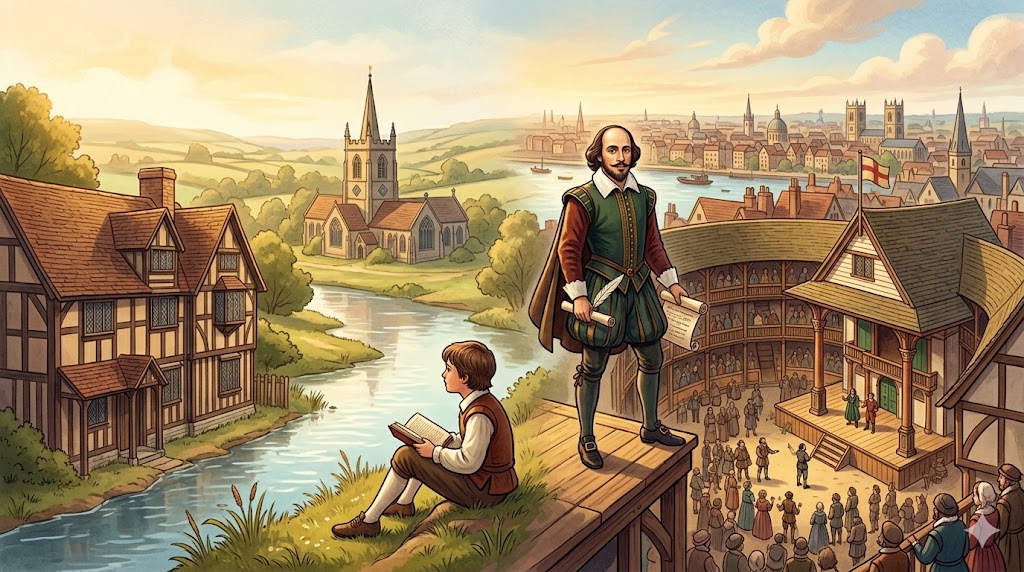
Shakespeare’s World – Stratford and London
Rise in London's Theater Scene
The late 1580s and early 1590s marked Shakespeare's entry into the competitive world of Elizabethan theater. London offered opportunity amid a flourishing cultural scene supported by Queen Elizabeth I and, later, King James I. Shakespeare joined acting companies, eventually becoming a shareholder in the Lord Chamberlain's Men (later the King's Men), one of the premier troupes of the day.
His early successes included history plays and comedies that demonstrated a keen understanding of dramatic structure and character development. By 1594, Romeo and Juliet had captivated audiences with its passionate tragedy. Shakespeare balanced acting, writing, and business interests, investing in the Globe Theatre, which opened in 1599 and became iconic for performances of his works.
The plague years forced theater closures, during which Shakespeare turned more to poetry. His two narrative poems, Venus and Adonis.(1593) and The Rape of Lucrece (1594), gained popularity and helped solidify his reputation beyond the stage. These efforts, combined with patronage from figures like the Earl of Southampton, provided financial stability and creative freedom.
William Shakespeare facts reveal a pragmatic businessman alongside the artistic genius. He acquired property in Stratford and London, demonstrating financial acumen that allowed him to retire comfortably. His ability to navigate the complexities of court politics and public taste contributed to his sustained success across decades.
Major Works: Plays That Defined an Era
William Shakespeare plays number approximately 37, divided into comedies, tragedies, histories, and romances (late plays). This body of work revolutionized English drama by blending genres, exploring psychological depth, and employing rich, inventive language.
Among the comedies, A Midsummer Night's Dream delights with its fairy-tale magic and mistaken identities, while Twelfth Night explores themes of disguise, love, and social order with witty dialogue. The Merchant of Venice grapples with justice, mercy, and prejudice in a complex courtroom drama.
The tragedies stand as pillars of Western literature. Hamlet delves into existential questions through the Danish prince's indecision and revenge quest. Macbeth examines ambition and guilt, its Scottish setting laced with supernatural elements. Othello probes jealousy and manipulation, while King Lear confronts aging, power, and familial betrayal with devastating emotional force.
History plays, such as Henry IV (Parts 1 and 2) and Richard III, chronicle England's past with vivid characters and political intrigue, often reflecting contemporary concerns about monarchy and stability. Late romances like The Tempest and The Winter's Tale introduce elements of forgiveness, reconciliation, and wonder, showcasing Shakespeare's evolving style toward the end of his career.
His language remains a hallmark—coining or popularizing thousands of words and phrases still in everyday use. Through soliloquies, metaphors, and rhythmic verse, Shakespeare made the stage a mirror for humanity's virtues and flaws.
The Sonnets: Intimate Poetic Masterpieces
In addition to his dramatic output, William Shakespeare composed 154 sonnets, published in 1609. These lyrical poems explore themes of love, beauty, time, mortality, and artistic immortality. Written in the traditional English sonnet form—three quatrains and a couplet—they display technical mastery and emotional range.
Sonnet 18 ("Shall I compare thee to a summer's day?") celebrates enduring beauty through poetry. Sonnet 116 defines ideal love as "an ever-fixed mark" that withstands tempests. Darker sequences address jealousy, betrayal, and the passage of time, adding layers of complexity that invite ongoing interpretation.
Many readers find personal resonance in these works, whether viewing them as autobiographical reflections or universal meditations. The dedication to "Mr. W.H." and references to a "Dark Lady" and "Fair Youth" have fueled speculation about Shakespeare's personal relationships, though definitive answers remain elusive.
William Shakespeare sonnets complement his plays, revealing a more introspective voice. Together, they demonstrate his versatility as both public dramatist and private poet.
Memorable Quotes and Their Timeless Relevance
William Shakespeare quotes continue to enrich language and thought centuries later. Their universality explains why they appear in everyday conversation, literature, film, and public discourse.
From Hamlet: "To be, or not to be: that is the question" captures the agony of decision-making. Polonius advises, "This above all: to thine own self be true." In As You Like It, Jaques observes, "All the world's a stage, and all the men and women merely players."
Love and relationships feature prominently. Romeo and Juliet offers, "What's in a name? That which we call a rose by any other name would smell as sweet." Sonnet 116 declares, "Love is not love which alters when it alteration finds."
Other enduring lines include "Some are born great, some achieve greatness, and some have greatness thrust upon them" (Twelfth Night) and "Cowards die many times before their deaths; the valiant never taste of death but once" (Julius Caesar).
These quotes distill profound insights into concise, memorable form. They address ambition, jealousy, forgiveness, and the human condition with clarity that transcends their Elizabethan origins.
Authorship Theories and Scholarly Debate
While the vast majority of scholars accept William Shakespeare of Stratford as the author, alternative theories have persisted since the 19th century. Doubters, sometimes called anti-Stratfordians, question whether a man of modest education and background could produce such sophisticated works. Proposed candidates include Edward de Vere (Earl of Oxford), Francis Bacon, and Christopher Marlowe, among others.
Arguments often cite the limited surviving records of Shakespeare's life, perceived gaps in his formal education, and the aristocratic knowledge evident in the plays. Proponents suggest a noble author used Shakespeare as a front to avoid social stigma or political risk.
Mainstream scholarship counters with contemporary evidence: title pages, performance records, and references by fellow writers like Ben Jonson all attribute the works to Shakespeare. Legal and business documents link him to the theater world. The absence of contradictory proof during his lifetime or immediately after supports the traditional view.
The Shakespeare theory debate enriches appreciation rather than diminishing it. It highlights the works' genius and the enduring fascination with their creator. Most experts maintain that the man from Stratford, with his talent, experience, and collaborative environment, remains the most plausible author.
Later Years, Death, and Legacy
Around 1610, Shakespeare appears to have reduced his involvement in London theater, retiring gradually to Stratford. He revised his will in March 1616, leaving the bulk of his estate to daughter Susanna, with provisions for his wife and others. He died on April 23, 1616, at age 52. The cause remains unknown, though a later account mentions a merry meeting with fellow writers that led to a fatal fever.
Shakespeare was buried in Holy Trinity Church, Stratford, where a monument and grave inscription preserve his memory. His wife Anne and daughters are also interred nearby.
The First Folio, published in 1623 by colleagues John Heminges and Henry Condell, collected 36 plays and ensured their survival. Ben Jonson's tribute in the volume hailed Shakespeare as "not of an age, but for all time"—a prophecy fulfilled many times over.
William Shakespeare's influence spans literature, theater, film, education, and popular culture. His works have been translated into every major language, adapted endlessly, and studied worldwide. Phrases he popularized—such as "break the ice," "wild-goose chase," and "heart of gold"—remain part of everyday English.
Beyond language, Shakespeare shaped psychological understanding and dramatic conventions. His characters feel vividly human, their struggles mirroring our own. In an era of division, his exploration of empathy, power, and forgiveness offers continued relevance.
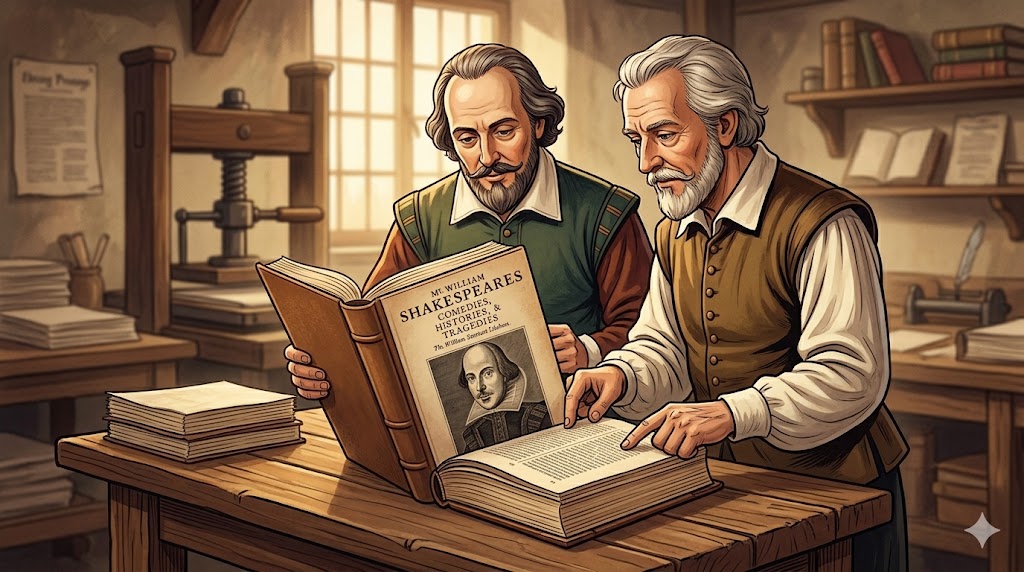
The Enduring legacy: First folio -This image focuses on the publication of the 1623 First Folio, which preserved 36 of Shakespeare's plays. It captures the moment John Heminges and Henry Condell review the proofs, ensuring his work would be "not of an age, but for all time."
Conclusion
William Shakespeare stands as a towering figure whose biography, though partially veiled by time, reveals a man of extraordinary talent and ambition. From his Stratford roots and marriage to Anne Hathaway through his London triumphs and reflective sonnets, his life story intertwines with an unparalleled body of works.
His plays and sonnets explore the human heart with unmatched depth, while his quotes distill wisdom that speaks across generations. Even the authorship theories underscore the enduring power and mystery of his creations.
As we reflect on the history of William Shakespeare, we recognize not merely a historical author but a living presence in global culture. His words invite us to laugh, weep, question, and wonder—to see ourselves and others more clearly.
On any April 23, or indeed any day, turning to Shakespeare offers connection to the profound and the poetic. In celebrating his legacy, we affirm the timeless value of storytelling and the enduring capacity of language to illuminate the human experience.
Frequently Asked Questions
What is the primary significance of William Shakespeare: Life, Works & Enduring Legacy?
Few figures in literary history command the universal recognition and admiration afforded to William Shakespeare. Often hailed as England's national poet and the greatest playwright of all time, his words have shaped the English language, influenced countless artists, and resonated across cultures for over four centuries.
How does this development impact News?
From the tragic depths of Hamlet to the romantic heights of Romeo and Juliet, Shakespeare's works capture the full spectrum of human emotion with unmatched insight and poetic brilliance.Born in the market town of Stratford-upon-Avon around April 23, 1564, William Shakespeare rose from modest beginnings to become a central figure in London's vibrant theater scene during the Elizabethan and Jacobean eras. His life story blends documented facts with intriguing gaps that continue to spark curiosity and debate.
What are the key future projections to monitor?
Scholars and enthusiasts alike pore over his biography seeking to understand the man behind the masterpieces.This article offers a comprehensive exploration of William Shakespeare's life, from his early years and family to his prolific career and lasting impact.