Sardar Vallabhbhai Patel stands as one of the most towering figures in modern Indian history. Often hailed as the Iron Man of India, he played a pivotal role in transforming a fragmented nation into a unified republic. His unwavering determination, strategic vision, and deep commitment to national integrity shaped the very foundation of independent India. From his humble beginnings in a small Gujarat village to his instrumental efforts in integrating hundreds of princely states, Sardar Vallabhbhai Patel’s life offers timeless lessons in leadership, sacrifice, and unity.
In this detailed exploration of Sardar Vallabhbhai Patel’s biography, we delve into every aspect of his remarkable journey. Whether you seek insights into Sardar Vallabhbhai Patel’s age at key milestones, his family life, or his lasting legacy through the Statue of Unity and National Unity Day, this article provides a complete, authoritative resource. His story is not just one of political achievement but of a man who embodied resilience and foresight at a time when India’s future hung in the balance.
Born on 31 October 1875 in Nadiad, then part of the Bombay Presidency and now in Gujarat, Sardar Vallabhbhai Patel grew up in a modest farming family. He was the fourth of six children to Jhaverbhai Patel and Ladba Patel, belonging to the Leva Patidar community. Life in rural Gujarat during British rule was far from easy, yet young Vallabhbhai displayed remarkable self-reliance and stoicism from an early age.
Sardar Vallabhbhai Patel completed his early schooling in Nadiad, Petlad, and Borsad. Unlike many of his peers, he was largely self-taught, relying on borrowed books and personal discipline. He passed his matriculation examination at the relatively late age of 22, a testament to his perseverance amid family responsibilities and limited resources. Even as a student, Sardar Vallabhbhai Patel showed leadership qualities, organizing peers against unfair practices by teachers.
His thirst for knowledge led him to study law privately. He cleared the necessary examinations and began practicing as a district pleader. This phase laid the groundwork for what would become a highly successful legal career, one that would later fund his deeper involvement in public life. The early years of Sardar Vallabhbhai Patel shaped a man of quiet strength, far removed from the flamboyant revolutionaries of his time yet equally determined to serve his people.
Personal Life: Family, Wife, and Age Milestones
Sardar Vallabhbhai Patel’s personal life was marked by both profound love and early tragedy. At the age of 16, in 1893, he married Jhaverben Patel, also known as Zaverbai. The couple had two children: a daughter, Maniben Patel (born around 1903), and a son, Dahyabhai Patel (born around 1905). Jhaverben supported the family during Sardar Vallabhbhai Patel’s early struggles, but her health deteriorated. In 1909, she passed away following complications from an abdominal ailment and surgery in Bombay. Sardar Vallabhbhai Patel was in court arguing a case when he received the news; true to his iron will, he continued cross-examining the witness without showing emotion until the proceedings ended.
At just 34 years old at the time of his wife’s death, Sardar Vallabhbhai Patel chose never to remarry. He single-handedly raised his children with the help of extended family, ensuring they received a modern education. Maniben and Dahyabhai later became active in public life, with Maniben serving in Parliament and preserving her father’s legacy through a memorial trust.
Sardar Vallabhbhai Patel lived to the age of 75. His life spanned critical decades—from the height of British colonial rule to the birth of a free India. He faced personal hardships, including a bout with bubonic plague that he overcame through sheer willpower, yet these experiences only strengthened his resolve. The family life of Sardar Vallabhbhai Patel reflected his core values: duty, discipline, and quiet sacrifice.
The Integration of Princely States
Legal Career and Path to Public Service
Before entering the freedom struggle, Sardar Vallabhbhai Patel built a thriving legal practice. He started in Godhra, then moved to Borsad and Anand, earning a reputation as a fierce and skilled advocate. His success allowed him to support his brother Vithalbhai’s political ambitions while managing family finances in Karamsad.
In 1910, at the age of 35, Sardar Vallabhbhai Patel traveled to London to study at the Middle Temple. Remarkably, he completed the 36-month barrister course in just 30 months and topped his class, despite lacking prior college education. Upon returning in 1913, he settled in Ahmedabad and quickly became one of the city’s leading barristers. He dressed in European attire, enjoyed bridge, and seemed destined for a comfortable professional life.
Yet, a chance meeting with Mahatma Gandhi in 1917 at the Gujarat Political Conference changed everything. Inspired by Gandhi’s call for service, Sardar Vallabhbhai Patel abandoned his ambitions for wealth. He burned his foreign clothes, adopted khadi, and dedicated himself fully to the national cause. This transformation marked the true beginning of Sardar Vallabhbhai Patel’s public journey.
Sardar Vallabhbhai Patel in the Freedom Struggle
Sardar Vallabhbhai Patel emerged as a key leader in India’s independence movement through disciplined, non-violent action. In 1918, he led the Kheda Satyagraha alongside Gandhi, organizing peasants against unjust tax demands during a famine. The campaign succeeded when the British suspended revenue collection, establishing Sardar Vallabhbhai Patel as a hero in Gujarat.
His greatest pre-independence triumph came in 1928 with the Bardoli Satyagraha. Facing a 30 percent tax hike amid crop failure, farmers turned to Sardar Vallabhbhai Patel for leadership. He mobilized 87,000 peasants in a peaceful no-tax campaign, enduring arrests, property seizures, and hardships without violence. The British eventually relented, reducing the tax and restoring confiscated lands. It was here that the title “Sardar”—meaning leader—was affectionately bestowed upon him by the people of Bardoli.
Sardar Vallabhbhai Patel played crucial roles in other movements, including the Nagpur Flag Satyagraha of 1923 and the Salt Satyagraha of 1930. He was imprisoned multiple times, including during the Quit India Movement of 1942, where he spent over three years in Ahmednagar Fort. As Congress President in 1931, he presided over the Karachi session and helped ratify the Gandhi-Irwin Pact.
Throughout these years, Sardar Vallabhbhai Patel’s organizational genius shone. He raised funds, recruited members, and maintained party discipline. His pragmatic approach complemented Gandhi’s idealism, creating a powerful synergy that advanced the freedom struggle.
Post-Independence Contributions and Integration of Princely States
When India gained independence on 15 August 1947, Sardar Vallabhbhai Patel became the country’s first Deputy Prime Minister and Home Minister. He also handled the portfolios of States and Information and Broadcasting. The immediate challenge was integrating over 565 princely states into the new Union.
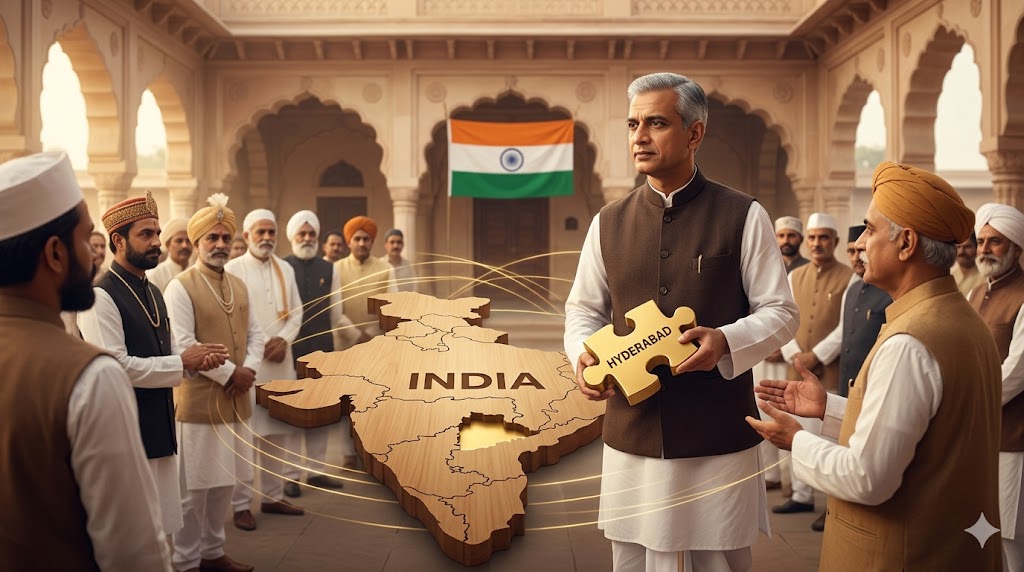
Working closely with V.P. Menon, Sardar Vallabhbhai Patel employed diplomacy, persuasion, and firmness. By 15 August 1947, most states had acceded in matters of defense, foreign affairs, and communications. Complex cases like Junagadh (resolved through plebiscite) and Hyderabad (integrated after police action in 1948) tested his resolve. His efforts prevented the Balkanization of India, earning him the title “Unifier of India.”
Sardar Vallabhbhai Patel also established the All India Services, describing them as the “Steel Frame” of administration. He tackled refugee crises following Partition, rebuilt infrastructure, and promoted cooperative movements like the precursor to Amul. His tenure laid the administrative bedrock of modern India.
Death of Sardar Vallabhbhai Patel and Immediate Legacy
Sardar Vallabhbhai Patel’s health began declining in 1949 due to overwork. On 15 December 1950, at the age of 75, he suffered a massive heart attack at Birla House in Bombay (now Mumbai) and passed away. His cremation at Sonapur drew over a million mourners, including Prime Minister Jawaharlal Nehru. A week of national mourning was declared.
The death of Sardar Vallabhbhai Patel left a void, but his contributions endured. He received the Bharat Ratna posthumously in 1991. Today, institutions, dams, airports, and universities bear his name, honoring a leader who prioritized national unity above all.
Statue of Unity: A Monument to Sardar Vallabhbhai Patel
On 31 October 2018, the Statue of Unity was unveiled near the Narmada Dam in Gujarat. Standing at 182 meters (597 feet), it is the world’s tallest statue and a fitting tribute to Sardar Vallabhbhai Patel. Constructed at a cost of around $420 million, it symbolizes the Iron Man’s vision of a united India. Visitors from across the country flock to the site, reinforcing his message of integrity and strength.
Sardar Vallabhbhai Patel Jayanti and National Unity Day
Since 2014, 31 October—the birth anniversary of Sardar Vallabhbhai Patel—has been observed as Rashtriya Ekta Diwas or National Unity Day. The day promotes national integration through events like the Run for Unity and pledges of solidarity. It serves as an annual reminder of Sardar Vallabhbhai Patel’s role in forging one nation from diverse princely states.
Famous Speeches and Writings of Sardar Vallabhbhai Patel
Sardar Vallabhbhai Patel was known for his direct, inspiring oratory. In his 1942 Gowalia Tank speech, he urged mass participation in the Quit India Movement with the words emphasizing complete freedom. Post-independence addresses stressed unity, warning against division and calling for disciplined nation-building. His speeches, though firm, always carried a message of hope and collective responsibility.
Cultural Representations: Movie, Songs, Essays, and Drawings
The life of Sardar Vallabhbhai Patel has inspired numerous cultural works. The 1993 biographical film Sardar, directed by Ketan Mehta and starring Paresh Rawal, offers a compelling portrayal of his political journey. Other documentaries and films have highlighted his contributions as the Iron Man of India.
Patriotic songs pay tribute as well. Tracks like “Tu Sardar Kehlata,” “Iron Man of India” by Anu Malik, and anthems performed at the Statue of Unity celebrate his legacy through music. These songs resonate especially during National Unity Day celebrations.
Schoolchildren often engage with Sardar Vallabhbhai Patel through essays and drawings. A typical essay on Sardar Vallabhbhai Patel highlights his unification efforts, while drawings depict him with the Indian flag or the Statue of Unity. These activities keep his story alive for new generations, fostering patriotism and appreciation for his sacrifice.
A Monument to National Integrity. A striking photographic view capturing the world's tallest statue, the Statue of Unity, standing majestically over the Narmada River and dam. It emphasizes the immensity of the structure as a modern tribute to Sardar Patel's unifying legacy.
The Enduring Story and Lessons from Sardar Vallabhbhai Patel
The story of Sardar Vallabhbhai Patel is one of transformation—from a successful lawyer to the architect of modern India. His biography reveals a man who balanced pragmatism with idealism, personal loss with public duty. In an era of division, he championed unity; in times of uncertainty, he provided decisive leadership.
Today, as India faces new challenges, the principles of Sardar Vallabhbhai Patel remain relevant. His emphasis on administrative integrity, national cohesion, and selfless service offers guidance for citizens and leaders alike. Whether through the Statue of Unity, National Unity Day observances, or everyday acts of patriotism, his legacy continues to inspire.
Sardar Vallabhbhai Patel did not seek the spotlight, yet history has placed him among India’s greatest sons. His life reminds us that true strength lies in unity, and that one individual’s resolve can shape the destiny of a nation.
Frequently Asked Questions
What is the primary significance of "Sardar Vallabhbhai Patel: The Iron Man of India"?
Sardar Vallabhbhai Patel stands as one of the most towering figures in modern Indian history. Often hailed as the Iron Man of India, he played a pivotal role in transforming a fragmented nation into a unified republic.
How does this development impact News?
His unwavering determination, strategic vision, and deep commitment to national integrity shaped the very foundation of independent India. From his humble beginnings in a small Gujarat village to his instrumental efforts in integrating hundreds of princely states, Sardar Vallabhbhai Patel’s life offers timeless lessons in leadership, sacrifice, and unity.In this detailed exploration of Sardar Vallabhbhai Patel’s biography, we delve into every aspect of his remarkable journey.
What are the key future projections to monitor?
Whether you seek insights into Sardar Vallabhbhai Patel’s age at key milestones, his family life, or his lasting legacy through the Statue of Unity and National Unity Day, this article provides a complete, authoritative resource.

.jpeg)