Bikaji Foods: Legacy, Growth & Impact of Agarwal's Passing
News• April 23, 2026• Global Edition
Bikaji Foods International Limited has emerged as a powerhouse in India's organized snacks and ethnic foods sector, blending traditional Rajasthan flavors with modern manufacturing and distribution. Founded in the late 1980s in Bikaner, the company transformed regional specialties like Bikaneri bhujia into nationally and internationally recognized brands.
As of April 2026, Bikaji stands as the third-largest ethnic snacks company in India, boasting a diverse portfolio of over 250 products across bhujia, namkeen, packaged sweets, papad, and western snacks. Its journey reflects the broader evolution of the Indian FMCG industry, driven by rising demand for convenient, hygienic, and flavorful packaged foods.
The sudden passing of founder, chairman, and managing director Shiv Ratan Agarwal on April 23, 2026, marks a poignant moment. While the company has built a robust professional structure, questions arise about leadership transition and its ripple effects on the wider snacks industry. This article examines Bikaji's history, strategic development, financial milestones, and the potential industry-wide implications of this loss.
Bikaji Foods traces its origins to the rich culinary heritage of Bikaner, Rajasthan—a region famous for its crispy, spiced snacks. Shiv Ratan Agarwal, hailing from a family with deep roots in traditional snack-making (linked to the lineage of Haldiram's founder Gangabishan Agarwal), established the business in 1986 as Shivdeep Food Products, a partnership firm.
The Bikaji brand was formally launched in 1993. Agarwal's vision was clear: deliver authentic Indian ethnic snacks with consistent quality, hygiene, and wider accessibility. Starting with Bikaneri bhujia—the company's flagship product—Bikaji quickly gained recognition as the largest manufacturer of this specialty, producing over 35,000 tonnes annually in recent years.
Early expansion focused on domestic markets, particularly in northern and western India. By the mid-1990s, the company ventured into exports, shipping products to the United Arab Emirates in 1994 and Australia in 1996. This international footprint laid the foundation for future growth.
Over the decades, Bikaji invested heavily in modern manufacturing facilities, quality control, and brand building. The company emphasized innovation—giving classic recipes a contemporary twist while preserving regional flavors—to appeal to evolving consumer preferences across urban and semi-urban India.
Major Milestones: From Private Entity to Public Listing
Bikaji's corporate journey accelerated in the 2010s. Originally incorporated as Shivdeep Industries Limited in 1995, it was renamed Bikaji Foods International Limited in 2011.
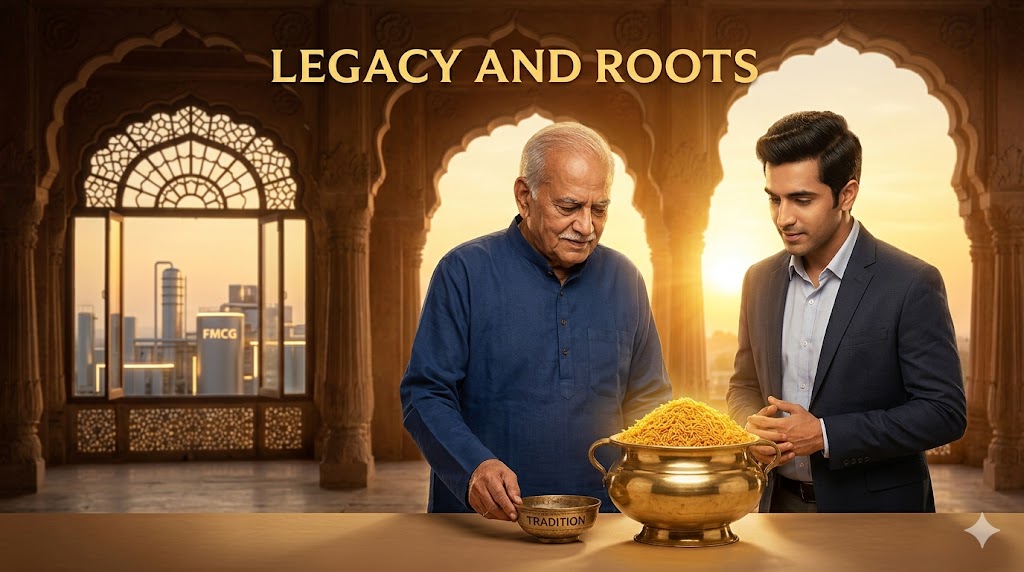
Founding Legacy and Roots. A conceptual photograph visualizes the blend of Bikaner tradition and modern scale. An elder, representing Shiv Ratan Agarwal, places a symbolic 'TRADITION' bowl next to glowing Bikaneri bhujia, while a younger professional looks toward the illuminated future of FMCG manufacturing.
Key milestones include:
Portfolio Expansion: Growing to six principal categories—bhujia, namkeen, packaged sweets, papad, western snacks, and gift packs/frozen foods. The family pack segment now accounts for a significant portion of sales.
Geographic Reach: Operations spanning 22 states and three union territories in India, with a strong presence in modern retail and traditional trade channels.
Strategic Acquisitions: In recent years, Bikaji pursued a "House of Brands" strategy. Notable moves include the acquisition of stakes in Ariba Foods, Hazelnut Factory Food Products (for QSR and bakery expansion), and integration of entities like Petunt Food Processors and Hanuman Agrofood. These steps diversified the portfolio beyond core ethnic snacks into adjacent categories.
The 2022 IPO: Bikaji went public in November 2022 through an Offer for Sale (OFS) raising approximately ₹881 crore. The IPO, priced between ₹285-300 per share, was well-received, enhancing visibility and providing liquidity to early investors. Post-listing, the stock has shown resilience, trading in a range that reflects strong investor confidence in the ethnic snacks segment.
These developments positioned Bikaji as the second-fastest-growing company in the organized Indian snacks market during key periods, with a reported revenue CAGR of over 21% in earlier years.
Financial Performance and Profit Growth
Bikaji has delivered consistent revenue and profit growth, fueled by volume expansion, favorable raw material cycles, and export momentum.
Recent highlights (as of FY26 data):
Revenue: The company reported steady increases, with Q3 FY26 revenue reaching around ₹790 crore, reflecting approximately 10-11% year-on-year growth. Volume growth contributed around 8%, supported by pricing actions and cost efficiencies.
Profitability: EBITDA margins improved significantly in recent quarters, reaching 12.5% in Q3 FY26 (up substantially year-on-year) due to benign input costs. Profit After Tax (PAT) showed robust gains, with Q3 FY26 PAT rising over 122% YoY to approximately ₹62 crore.
Exports: A key growth driver, with exports surging 39% in Q3 and nearly 59% in the first nine months of FY26, aided by wider international distribution.
Market Position: As a market leader in family packs and Bikaneri bhujia, Bikaji benefits from strong brand recall in the ethnic category, which continues to outpace some western snacks segments.
Analysts note Bikaji's focus on cost optimization, selective price hikes, and capacity utilization as factors sustaining margins amid inflationary pressures. The upcoming Q4 and full-year FY26 results, scheduled for May 2026, will provide further clarity on annual performance.
Overall, the company's financial trajectory underscores successful scaling from a regional player to a national FMCG brand with international ambitions.
Business Strategy and Development in India's Snacks Industry
Bikaji's strategy centers on three pillars: innovation, distribution strength, and diversification.
Product Innovation: The company continuously introduces variants and new items that balance tradition with contemporary tastes, targeting health-conscious consumers and festive gifting segments.
Distribution and Reach: A robust network covering modern trade, general trade, and e-commerce has enabled deeper penetration. Investments in subsidiaries and international arms (e.g., Bikaji Foods USA) support global expansion.
Acquisitions and House of Brands: Recent deals in bakery, QSR, and processed foods aim to reduce reliance on core snacks while leveraging synergies in manufacturing and supply chains.
Sustainability and Quality: Emphasis on superior raw materials, advanced processing, and brand goodwill has helped Bikaji differentiate in a competitive landscape dominated by both organized and unorganized players.
In the broader Indian snacks industry—valued in billions and growing rapidly due to urbanization, rising disposable incomes, and demand for ready-to-eat options—Bikaji has contributed significantly. It has professionalized ethnic snacks manufacturing, raised quality benchmarks, and demonstrated that regional flavors can achieve pan-India and global success. The company's growth has encouraged consolidation and investment in the sector, benefiting suppliers, distributors, and consumers alike.
The Passing of Shiv Ratan Agarwal: Immediate Context and Leadership Legacy
On April 23, 2026, Shiv Ratan Agarwal, aged around 74-75, passed away in Chennai after suffering a heart attack while attending to his wife. As the guiding force since inception, Agarwal was widely respected for his pioneering role in the Indian snack industry, spanning over three decades.
His leadership transformed a family-oriented business into a professionally managed listed entity with strong governance. Agarwal's hands-on approach, emphasis on quality, and strategic foresight were instrumental in building consumer trust and scaling operations.
The company promptly informed stock exchanges, describing him as the "guiding force." While day-to-day operations involve a professional team—including family members with operational roles—the founder's vision and personal relationships with trade partners and stakeholders were unique.
Potential Impact on Bikaji Foods and the Wider Snacks Industry
The sudden demise of a promoter-chairman like Agarwal inevitably raises questions about succession, stability, and strategic continuity.
For Bikaji Foods:
Short-term: Markets may experience volatility as investors assess transition risks. However, with a strong balance sheet, experienced management, and institutional backing (from the IPO era), operational disruption is likely minimal. The board and executive team are expected to ensure seamless continuity.
Long-term: Success will depend on how the next generation or professional leaders uphold the founder's values while pursuing aggressive growth targets (e.g., 15%+ annual revenue growth). Existing strategies around acquisitions and exports provide a solid runway.
Governance: As a listed company with significant promoter holding, transparent succession planning will be critical to maintain investor confidence.
For the Indian Snacks Industry:
Agarwal's passing highlights the role of visionary entrepreneurs in shaping categories. His contributions helped elevate ethnic snacks from unorganized cottage industries to a structured, branded segment.
Positive Ripple Effects: Bikaji's continued growth could inspire further investments in modernization, R&D, and exports across the sector. Competitors may accelerate their own professionalization efforts.
Challenges: Any perceived leadership vacuum at Bikaji could temporarily slow industry momentum if it affects supply chains or innovation pace. Conversely, a smooth transition would reinforce confidence in the sector's resilience.
Broader Context: The ethnic snacks space benefits from tailwinds like premiumization and health-focused variants. Bikaji's model of blending heritage with scale has influenced many players, and the industry as a whole is poised for consolidation and higher organized market share.
Industry observers note that while founder-led companies often face emotional transitions, well-governed entities like Bikaji tend to emerge stronger by institutionalizing processes.
Future Outlook and Strategic Path Ahead
Bikaji Foods is well-positioned for sustained growth. Key focus areas include:
- Deepening export markets and exploring new geographies.
- Leveraging acquisitions to enter adjacent categories like bakery and QSR.
- Enhancing margins through operational efficiencies and premium product mixes.
- Capitalizing on festive and gifting demand in the domestic market.
With Q4 FY26 results approaching, stakeholders will watch for updates on guidance and dividend recommendations. Long-term, the company's ability to maintain its edge in a competitive FMCG landscape—facing players in both ethnic and western snacks—will define its trajectory.
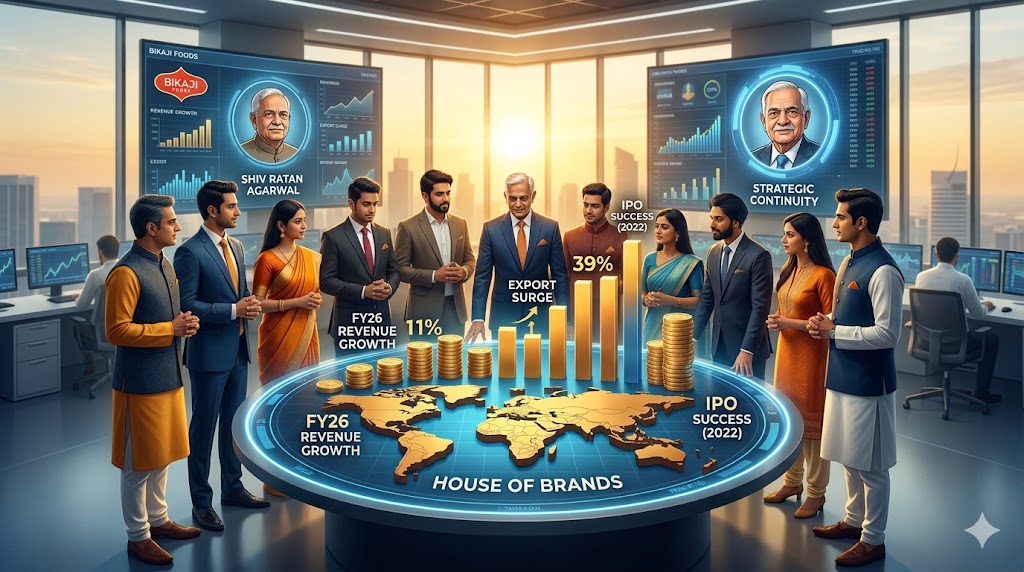
Visualizing Growth and Continuity. A conceptual photograph illustrates Bikaji Foods' business trajectory and transition. Executives discuss a 3D 'House of Brands' map and the 2022 IPO success, while a digital screen subtly halos the late founder's portrait with 'STRATEGIC CONTINUITY'.
Conclusion
Bikaji Foods International exemplifies the success story of Indian entrepreneurship rooted in tradition yet embracing modernity. From humble beginnings in Bikaner to a listed entity with multi-billion rupee operations, the company has significantly contributed to the development and professionalization of the ethnic snacks industry.
Shiv Ratan Agarwal's legacy as a pioneer will endure through the brand he built. While his passing is a profound loss, Bikaji's robust foundation, clear strategy, and dedicated team provide strong grounds for continuity and future growth. The Indian snacks sector, too, stands to benefit from the resilience demonstrated by such enterprises.
As the company navigates this transition, its journey offers valuable lessons in scaling heritage businesses while adapting to changing consumer and market dynamics. For investors, partners, and consumers, Bikaji remains a compelling name in India's vibrant FMCG space.
Frequently Asked Questions
What is the primary significance of Bikaji Foods: Legacy, Growth & Impact of Agarwal's Passing?
Bikaji Foods International Limited has emerged as a powerhouse in India's organized snacks and ethnic foods sector, blending traditional Rajasthan flavors with modern manufacturing and distribution. Founded in the late 1980s in Bikaner, the company transformed regional specialties like Bikaneri bhujia into nationally and internationally recognized brands.As of April 2026, Bikaji stands as the third-largest ethnic snacks company in India, boasting a diverse portfolio of over 250 products across bhujia, namkeen, packaged sweets, papad, and western snacks.
How does this development impact News?
Its journey reflects the broader evolution of the Indian FMCG industry, driven by rising demand for convenient, hygienic, and flavorful packaged foods.The sudden passing of founder, chairman, and managing director Shiv Ratan Agarwal on April 23, 2026, marks a poignant moment. While the company has built a robust professional structure, questions arise about leadership transition and its ripple effects on the wider snacks industry.
What are the key future projections to monitor?
This article examines Bikaji's history, strategic development, financial milestones, and the potential industry-wide implications of this loss.The Founding Story and Early Development of Bikaji FoodsBikaji Foods traces its origins to the rich culinary heritage of Bikaner, Rajasthan—a region famous for its crispy, spiced snacks.