Digital Payments & India's Growth: Manufacturing vs Services
Current Affairs• April 23, 2026• Global Edition
India's economy in 2026 stands at a critical juncture, recording resilient growth rates around 6.5-7.3% amid global uncertainties. At the heart of this momentum lies the explosive rise of digital payments, particularly the Unified Payments Interface (UPI), which has transformed everyday transactions and contributed to greater economic transparency and efficiency.
Yet, persistent debates question the optimal path forward: should India prioritize manufacturing-led growth for job creation or continue leveraging its strengths in services? Compounding these discussions are everyday concerns in the business sector—high fuel prices, income tax burdens, and the rapid shift to digital payments like UPI.
This article examines the interplay between digital payments and broader economic growth, while addressing current economic and social issues. It offers a balanced view on how these elements shape India's development trajectory, drawing on recent trends and policy responses.
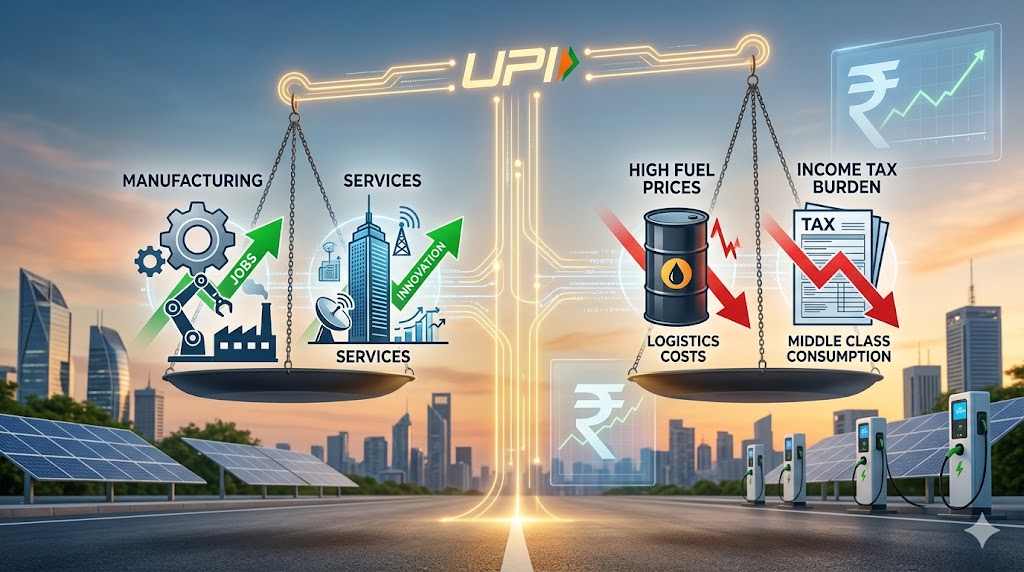
A central economic debate in India revolves around the relative emphasis on manufacturing and services for sustained, inclusive growth.
Services currently dominate, contributing over 50-55% to GDP and nearly half of exports. Sectors like IT, business process outsourcing, healthcare, tourism, and the digital economy have driven consistent expansion. Proponents argue that services, especially high-skill tradable ones, align with India's demographic strengths and require less capital-intensive infrastructure than heavy manufacturing.
However, critics highlight limitations. Services often generate fewer indirect jobs compared to manufacturing—one manufacturing job can create over two additional roles in the broader economy, while services yield less than one. Manufacturing's share in GDP has stagnated or declined slightly to around 13-17% in recent years, raising concerns about "premature deindustrialization" and inadequate absorption of low-skilled labor from rural areas.
Government policy reflects a hybrid approach. The Union Budget 2026-27 emphasizes capital expenditure, production-linked incentive (PLI) schemes, and reforms in labor codes to boost manufacturing in electronics, textiles, specialty chemicals, and defense. At the same time, it positions services—particularly technology-driven segments—as a core pillar, aiming for a larger global share by 2047.
Recent data shows both sectors contributing to growth. In the first half of FY26, manufacturing GVA grew around 9%, while services surged similarly, led by financial and professional segments. Projections for FY26-27 hover between 6.6-6.9%, with domestic demand and public investment as key supports.
The debate is not binary. Experts suggest India needs a balanced strategy: leveraging services for high-value exports and innovation while scaling manufacturing for employment and supply chain resilience. Global factors, including trade tensions and supply chain diversification away from China, offer opportunities for both.
Digital Payments as a Catalyst for Economic Growth
Few innovations have impacted India's economy as profoundly as digital payments, especially UPI. Launched in 2016, UPI has evolved into the world's largest real-time payment system by volume.
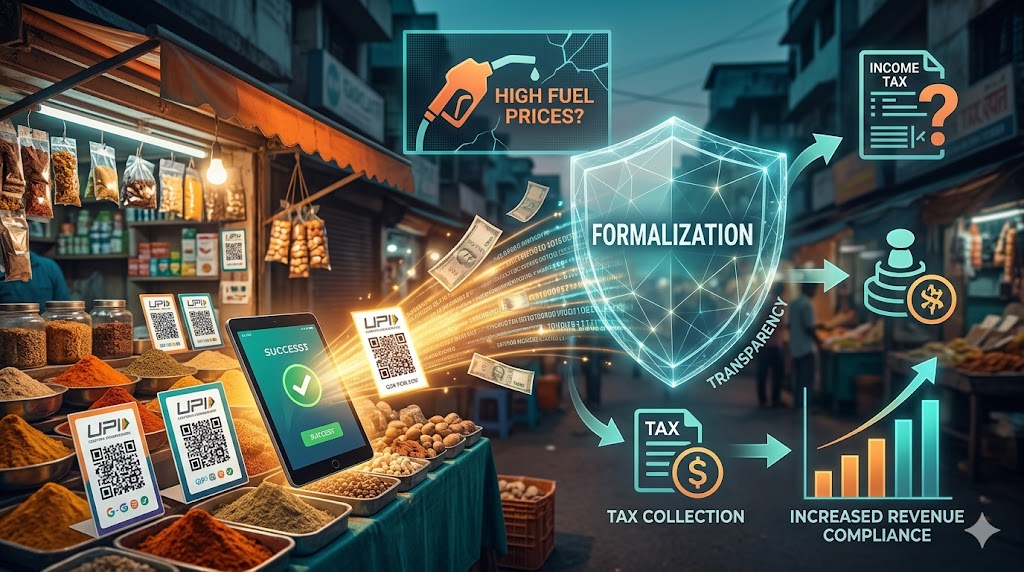
In March 2026 alone, UPI recorded over 22.64 billion transactions worth nearly ₹30 lakh crore. For the full FY26, volumes exceeded 241 billion with a value surpassing ₹314 trillion, reflecting 21-30% year-on-year growth. UPI now accounts for about 81% of retail digital payments, handling everything from Street vendor sales.
The Formalization and Transparency of UPI
This explosion drives multiple economic benefits:
Financial Inclusion and Accessibility: UPI has bridged gaps for millions, including in rural and semi-urban areas, through simple mobile-based transfers. Features like UPI 123PAY extend reach to feature phones, promoting broader participation in the formal economy.
Formalization and Transparency: By reducing cash dependency, digital payments create auditable trails that curb black money, improve tax compliance, and minimize leakages in welfare schemes. Estimates suggest the informal economy's share has declined significantly, partly due to such digital shifts, with positive effects on GST collections and overall revenue buoyancy.
Efficiency and Velocity of Money: Instant, low-cost transactions lower business costs, speed up supply chains, and increase money circulation. This supports MSMEs by enabling quicker payments, better credit access through digital footprints, and reduced operational frictions.
Innovation and Ecosystem Growth: UPI has spurred fintech innovation, integrating with credit lines, investments, and cross-border pilots. Projections indicate the broader digital payments market could approach multi-trillion-dollar scales, with merchant payments growing substantially.
Overall, digital payments act as foundational infrastructure, complementing both manufacturing and services. In manufacturing, they streamline supplier payments and inventory management. In services, they enhance consumer experiences and enable scalable digital delivery models. The digital economy itself is estimated to contribute around 10-20% to GDP, with potential for further expansion.
Challenges remain, including cybersecurity risks, the digital divide in remote areas, and the need for continued literacy efforts. Nevertheless, the positive multiplier effects on growth, inclusion, and governance are evident.
Current Economic Issues: Fuel Prices, Income Tax, and Business Concerns
Amid these structural shifts, businesses grapple with immediate pressures.
High Fuel Prices have emerged as a major concern, exacerbated by global events such as tensions in West Asia. In early 2026, rising crude oil costs threatened to push retail petrol and diesel prices higher, potentially fueling inflation and widening the current account deficit. The government responded by slashing central excise duties—reducing petrol duty significantly and eliminating it on diesel for domestic use—absorbing a substantial fiscal hit estimated in lakhs of crores annually to shield consumers and control inflation.
While this cushioned short-term impacts (with CPI inflation remaining moderate around 3-4%), prolonged high global prices could strain subsidies, corporate margins, and logistics costs, indirectly affecting both manufacturing competitiveness and services profitability. Economists warn that sustained $100+ per barrel oil could trim GDP growth by 0.5-1 percentage point and elevate inflation risks.
Income Tax issues also feature prominently. Recent direct tax exemptions for the middle class aimed to boost disposable incomes and revive consumption. However, businesses and salaried individuals continue to voice concerns over compliance burdens and the overall tax structure, especially as the government balances fiscal consolidation with welfare spending. Lower tax revenues from fuel duty cuts add pressure on the budget, potentially influencing future policy on capital expenditure or social schemes.
These issues intersect with the digital payments shift. While UPI reduces cash handling costs for businesses, volatile fuel prices raise operational expenses for logistics-dependent sectors. At the same time, greater digital adoption aids tax authorities in tracking transactions, contributing to higher compliance but also raising privacy and data security discussions.
Social dimensions add complexity. Uneven job creation—strong in high-skill services but lagging in labor-intensive manufacturing—fuels debates on inequality and youth employment. Public investment in infrastructure and skills development remains crucial to address these gaps.
Interplay: How Digital Payments Influence Growth Amid Economic Challenges
Digital payments do not operate in isolation; they amplify resilience against current issues.
In the face of fuel price volatility, efficient digital transactions help businesses optimize cash flow and reduce overheads. Formalization driven by UPI supports better revenue collection, partially offsetting fiscal pressures from duty cuts or subsidies.
The manufacturing-services debate benefits from this digital backbone. Manufacturing gains from seamless vendor financing and supply chain visibility, while services—particularly fintech, e-commerce, and IT—thrive on the instant payment ecosystem.
Longer-term, sustained UPI growth could enhance economic velocity, supporting domestic demand even when global headwinds arise. However, realizing full potential requires addressing infrastructure gaps, ensuring cybersecurity, and integrating credit and insurance products into the payments layer.
Policy continuity, including labor reforms and PLI extensions, will determine whether India achieves balanced growth. The 2026 budget's focus on both capex and services innovation signals recognition of this need.
The Road Ahead: Balancing Opportunities and Risks
India's economy demonstrates remarkable resilience, underpinned by strong domestic demand, digital public infrastructure, and policy agility. Digital payments have proven a powerful enabler, fostering inclusion, transparency, and efficiency that complement both manufacturing and services ambitions.
Current challenges—fuel price management, tax dynamics, and the structural growth debate—demand nuanced responses. A hybrid model that strengthens manufacturing for jobs while nurturing high-value services, all supported by robust digital systems, offers the most promising path.
Stakeholders across government, business, and civil society must collaborate to bridge regional and skill divides, invest in human capital, and maintain macroeconomic stability. As India aims for its ambitious growth targets, the role of inclusive digital tools like UPI will only grow in significance.
Balancing Growth with Economic Challenges
Conclusion
The synergy between digital payments and overall economic growth highlights India's unique development model. UPI's transformative impact on formalization and efficiency provides a strong foundation, even as debates on manufacturing versus services and immediate issues like fuel prices and income tax continue to shape policy discourse.
By addressing these interconnected challenges thoughtfully, India can sustain its trajectory as one of the world's fastest-growing major economies. The coming years will test the ability to convert digital strengths into broad-based, equitable progress for all citizens.
Frequently Asked Questions
What is the primary significance of Digital Payments & India's Growth: Manufacturing vs Services?
India's economy in 2026 stands at a critical juncture, recording resilient growth rates around 6.5-7.3% amid global uncertainties. At the heart of this momentum lies the explosive rise of digital payments, particularly the Unified Payments Interface (UPI), which has transformed everyday transactions and contributed to greater economic transparency and efficiency.Yet, persistent debates question the optimal path forward: should India prioritize manufacturing-led growth for job creation or continue leveraging its strengths in services?
How does this development impact Current Affairs?
Compounding these discussions are everyday concerns in the business sector—high fuel prices, income tax burdens, and the rapid shift to digital payments like UPI.This article examines the interplay between digital payments and broader economic growth, while addressing current economic and social issues. It offers a balanced view on how these elements shape India's development trajectory, drawing on recent trends and policy responses.The Manufacturing vs Services-Led Growth DebateA central economic debate in India revolves around the relative emphasis on manufacturing and services for sustained, inclusive growth.Services currently dominate, contributing over 50-55% to GDP and nearly half of exports.
What are the key future projections to monitor?
Sectors like IT, business process outsourcing, healthcare, tourism, and the digital economy have driven consistent expansion.