India Eyes $10-12 Bn US Tariff Refund: current updates
International Affairs• April 23, 2026• Global Edition
In a significant development for bilateral trade relations, the United States has opened the door to one of the largest tariff refund exercises in recent history. US Customs and Border Protection (CBP) launched its CAPE portal on April 20, 2026, allowing importers to file claims for over $166 billion in duties collected under the Trump administration's reciprocal tariff regime.
According to a report by the Global Trade Research Initiative (GTRI), approximately $10-12 billion of this massive refund pool is linked to Indian goods exported to the US market. This figure has sparked cautious optimism among Indian businesses, particularly in sectors like textiles, apparel, engineering goods, and chemicals that bore the brunt of escalating duties.
However, the opportunity comes with important caveats. The refunds will flow directly to US-based importers who paid the tariffs, not to Indian exporters or the Indian government. This means any financial relief for Indian companies will depend on proactive commercial negotiations rather than automatic payouts.
This article explores the background of the tariff saga, the mechanics of the refund process, sector-wise implications for India, and practical strategies for exporters to maximize potential gains. As India strengthens its position as a key player in global supply chains, understanding how to deal with such tariff issues remains critical for sustaining export momentum.
The story begins in early 2025 when the second Trump administration introduced a broad reciprocal tariff framework aimed at addressing perceived trade imbalances. Starting April 2, 2025, a baseline 10% tariff was applied to imports from most countries, including India.
Tensions escalated quickly. By August 7, 2025, duties on Indian goods rose to 25%, and further to 50% by August 28, partly linked to India's continued imports of Russian oil amid global energy dynamics. These measures remained in place until early February 2026, when negotiations led to a temporary reduction to 18%.
The tariff regime affected a wide range of Indian exports. Textiles and apparel, engineering products, chemicals, gems and jewelry, and even certain agricultural items faced heightened costs, disrupting pricing strategies and squeezing margins for many exporters.
Indian shipments to the US, which account for a substantial portion of the country's total exports, saw significant pressure. Estimates suggest that over 50% of India's US-bound exports were exposed to these additional duties at their peak.
The turning point came in late February 2026 when the US Supreme Court ruled the entire tariff framework under the International Emergency Economic Powers Act (IEEPA) unconstitutional. This landmark decision effectively nullified the duties retroactively, opening the path for refunds with interest.
The ruling was not limited to India-specific measures but covered the broader reciprocal tariffs imposed across multiple trading partners. As a result, US importers who had absorbed or passed on these costs now stand to reclaim substantial sums.
Understanding the US Tariff Refund Process
US Customs and Border Protection has introduced a structured claims process through the newly launched CAPE portal. Importers and their brokers can submit detailed declarations including shipment information, tariff classifications, and proof of payment.
Key features of the process include:
Eligibility: Limited strictly to US-based importers or businesses that originally paid the duties. Exporters, whether Indian or otherwise, have no direct legal standing to file claims.
Timeline: Approved refunds, including applicable interest, are expected within 60 to 90 days of claim submission. Processing will occur in phases, prioritizing more recent payments.
Scale: Over 330,000 importers and 53 million shipments are involved in the $166 billion pool, making this a complex logistical undertaking.
Documentation: Claimants must provide precise data to avoid delays or rejections.
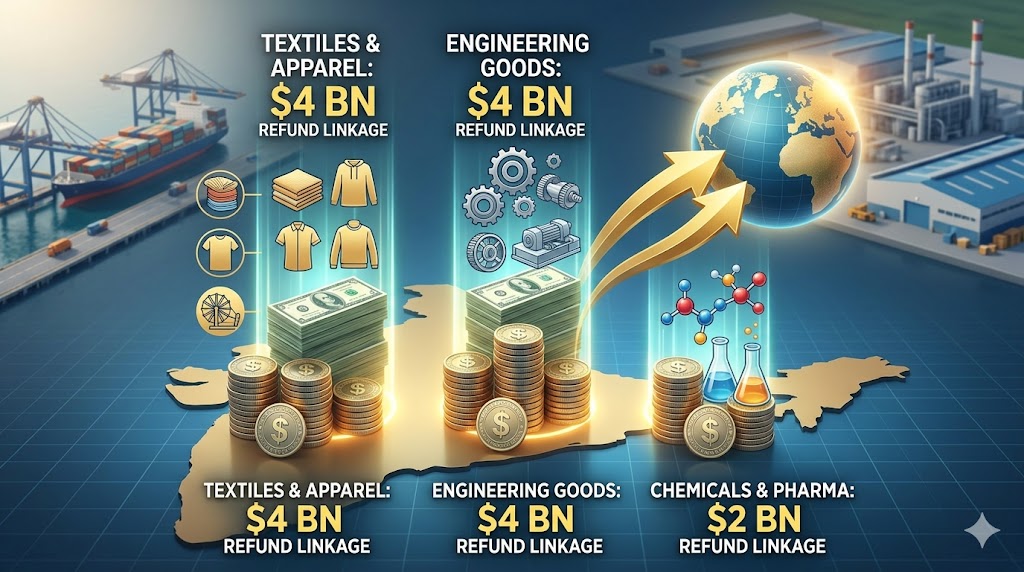
For Indian-linked refunds, the GTRI estimates place the figure between $10 billion and $12 billion. Of this, textiles and apparel are projected to account for around $4 billion, engineering goods a similar amount, chemicals approximately $2 billion, with the remainder spread across other categories like gems, jewelry, and shrimp feed-related products.
While the numbers sound promising, the indirect nature of the benefit means Indian firms must act strategically to capture value.
Negotiating Indirect Tariff Relief. An Indian textile exporter presents data on the $166 Billion refund pool to a US importer in a Mumbai office, illustrating how commercial negotiations and rebate-sharing are the key mechanism for securing a portion of the $10-12 Billion linked to Indian goods
Sector-Wise Impact on Indian Exporters
Different industries experienced the tariffs in unique ways, and their potential recovery paths will vary accordingly.
Textiles and Apparel
This sector was among the hardest hit, with duties significantly affecting competitiveness against alternatives from Vietnam, Bangladesh, and others. Major players such as Gokaldas Exports, Pearl Global, Indo Count Industries, and Welspun Living saw pressure on margins and order books. The estimated $4 billion refund linkage offers a lifeline, but only if US buyers agree to share proceeds through revised contracts or rebates.
Engineering Goods
Machinery components, auto parts, and general engineering products faced similar challenges. With a comparable refund share, this sector—often characterized by longer-term contracts—may find it easier to renegotiate terms where tariff costs were built into pricing.
Chemicals and Pharmaceuticals
Companies like Aarti Industries, Gujarat Fluorochemicals, and Navin Fluorine could see benefits in the $2 billion category. However, regulatory nuances and supply chain complexities may require more nuanced discussions.
Other Sectors
Gems and jewelry, as well as certain food processing and marine products, also stand to gain indirectly. Smaller exporters, in particular, may need support from industry associations to level the playing field in negotiations.
Across sectors, many Indian firms had already absorbed part of the tariff burden through discounts or lower margins to retain US clients. The refund process now provides an opportunity to revisit those arrangements.
How Indian Exporters Can Deal with the Tariff Refund Issue
The core challenge is clear: Indian exporters lack a direct claim route. Success hinges on commercial engagement with American importers. Here are practical steps recommended by experts, including GTRI:
1. Reopen and Review Contracts
Exporters should examine existing agreements to identify clauses related to tariffs, force majeure, or cost adjustments. Where tariffs were factored into pricing, parties can negotiate rebate-sharing mechanisms or credit notes.
2. Initiate Targeted Discussions
Proactive outreach is essential. Sharing detailed shipment data, tariff payment records, and impact analyses can strengthen the case for a fair share of refunds. Stronger bargaining power—often held by established suppliers in textiles and engineering—can lead to better outcomes.
3. Incorporate Future Safeguards
New contracts should include explicit provisions for tariff-related adjustments, sharing of government refunds, or price revision triggers. This forward-looking approach can protect against similar uncertainties.
4. Leverage Industry Bodies
Organizations such as the Apparel Export Promotion Council (AEPC), Engineering Export Promotion Council (EEPC), and Chemexcil can provide guidance, facilitate buyer-seller meets, and offer sector-specific templates for renegotiations.
5. Monitor Cash Flow and Pricing
Even partial recovery can improve liquidity. Exporters might consider adjusting future pricing strategies to reflect any shared refunds, thereby enhancing competitiveness.
Ajay Srivastava, founder of GTRI, emphasizes that while there is no legal entitlement, "exporters with stronger relationships and data-backed arguments are likely to secure meaningful concessions."
Small and medium enterprises (SMEs), which form the backbone of many export sectors, may require additional handholding. Government schemes or export promotion agencies could play a supportive role in capacity building for negotiations.
Broader Implications for India-US Trade Relations
This refund episode occurs against the backdrop of an evolving India-US trade framework. Earlier in 2026, both countries announced an interim trade agreement that reduced certain reciprocal tariffs and committed to greater market access in industrial goods, agriculture, and other areas.
The Supreme Court ruling has further reset the dynamics by removing the contested tariff layers. For India, the focus now shifts toward deepening bilateral ties while pursuing diversification to reduce over-reliance on any single market.
The episode also highlights the importance of robust domestic reforms. Initiatives to enhance manufacturing competitiveness, streamline logistics, and invest in quality standards will help Indian exporters withstand future external shocks.
From a macroeconomic perspective, any successful recovery of even a portion of the $10-12 billion could provide a welcome boost to export earnings and support job creation in labor-intensive sectors.
Challenges and Risks Ahead
Not all refunds will materialize smoothly. Processing delays, documentation issues, or disputes over eligibility could extend timelines. Moreover, US importers may prioritize their own margins or use refunds to offset other costs rather than pass benefits downstream.
Currency fluctuations, changing global demand, and potential new trade measures under evolving US policy add layers of uncertainty.
Indian exporters must also guard against over-optimism. The refunds represent a one-time opportunity rather than a permanent shift in trade costs. Building resilience through product diversification, technological upgrades, and exploration of alternative markets (such as Europe, ASEAN, and the Middle East) remains essential.
Strategies for Long-Term Tariff Resilience
To deal effectively with tariff issues in the future, Indian policymakers and businesses can consider the following:
Accelerate FTA Negotiations: Concluding comprehensive free trade agreements with key partners can provide preferential access and reduce vulnerability to unilateral measures.
Strengthen Supply Chain Integration: Positioning India as a reliable alternative in global value chains requires continued focus on ease of doing business and infrastructure.
Invest in Data and Analytics: Detailed export tracking and tariff impact modeling can empower negotiators in both commercial and diplomatic spheres.
Policy Support: Targeted incentives for affected sectors, skill development, and credit facilities can help bridge short-term gaps.
By treating this refund process as a learning opportunity, India can emerge with stronger negotiation frameworks for international trade.
Key Sector Impacts and Recovery
Conclusion
The unfolding US tariff refund process represents a complex yet potentially rewarding chapter in India-US economic relations. With $10-12 billion linked to Indian exports out of a $166 billion pool, the stakes are high for key manufacturing sectors.
While direct refunds are off the table for Indian companies, strategic engagement with US buyers offers a realistic path to shared benefits. Success will depend on preparation, data-driven advocacy, and collaborative problem-solving.
As the claims window progresses, Indian exporters, industry associations, and policymakers must work in tandem to convert this opportunity into tangible gains. Beyond immediate refunds, the episode underscores the need for diversified, resilient trade strategies in an increasingly unpredictable global environment.
In the long run, mutual respect for each other's economic priorities and a commitment to balanced, reciprocal trade will serve both nations best. For Indian businesses, the message is clear: act decisively on negotiations today while building stronger foundations for tomorrow.
Frequently Asked Questions
What is the primary significance of India Eyes $10-12 Bn US Tariff Refund: current updates?
In a significant development for bilateral trade relations, the United States has opened the door to one of the largest tariff refund exercises in recent history. US Customs and Border Protection (CBP) launched its CAPE portal on April 20, 2026, allowing importers to file claims for over $166 billion in duties collected under the Trump administration's reciprocal tariff regime.According to a report by the Global Trade Research Initiative (GTRI), approximately $10-12 billion of this massive refund pool is linked to Indian goods exported to the US market.
How does this development impact International Affairs?
This figure has sparked cautious optimism among Indian businesses, particularly in sectors like textiles, apparel, engineering goods, and chemicals that bore the brunt of escalating duties.However, the opportunity comes with important caveats. The refunds will flow directly to US-based importers who paid the tariffs, not to Indian exporters or the Indian government.
What are the key future projections to monitor?
This means any financial relief for Indian companies will depend on proactive commercial negotiations rather than automatic payouts.This article explores the background of the tariff saga, the mechanics of the refund process, sector-wise implications for India, and practical strategies for exporters to maximize potential gains.