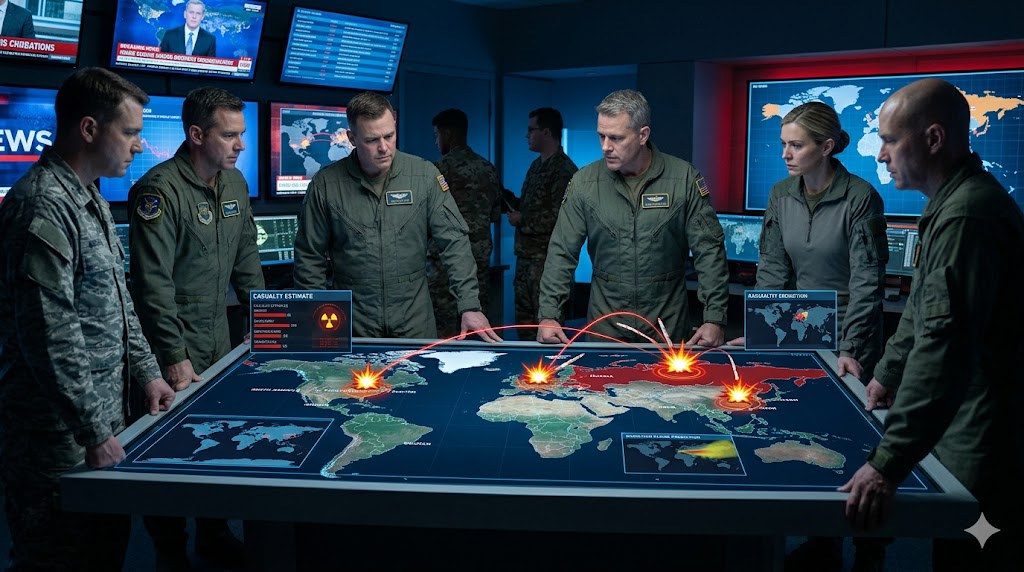
"Dangerous Nuclear War Risks in future World War 3"
International Affairs• April 21, 2026• Global Edition
The specter of nuclear war looms larger today than at any point since the Cold War. With rising geopolitical tensions—particularly the ongoing conflict between Russia and Ukraine—many experts warn that a conventional clash could rapidly spiral into a global nuclear exchange. If World War 3 erupts and draws in major powers, the consequences would be unimaginable. This article examines what nuclear war would truly entail, how recent wars could ignite it, the likely sequence of events, and practical steps for preparedness. While no one wants to contemplate such a grim future, understanding the realities of nuclear war is essential for informed global discourse and personal readiness.
Nuclear war represents the ultimate escalation of human conflict, where weapons of mass destruction unleash destruction on a planetary scale. Unlike conventional warfare, a nuclear exchange would not only devastate battlefields but also threaten the very habitability of Earth. Recent years have seen heightened rhetoric and near-misses that underscore how fragile the balance of deterrence truly is. By analyzing credible scenarios drawn from scientific simulations and historical precedents, we can better grasp the stakes involved in any potential World War 3.
At its core, nuclear war involves the use of nuclear weapons, which derive their explosive power from fission or fusion reactions. A single modern warhead can release energy equivalent to hundreds of thousands of tons of TNT—far surpassing the atomic bombs dropped on Hiroshima and Nagasaki in 1945. Today’s arsenals include intercontinental ballistic missiles (ICBMs), submarine-launched missiles, and tactical weapons designed for battlefield use.
According to estimates from the Federation of American Scientists around 2025-2026, the world holds approximately 12,300 nuclear warheads. Russia possesses the largest stockpile at roughly 5,459, followed closely by the United States with about 5,177. Other nuclear-armed states include China (around 600), France (290), the United Kingdom (225), India (180), Pakistan (170), Israel (90), and North Korea (50). These figures highlight a precarious global balance, where even a limited exchange could trigger mutual assured destruction.
The effects of a nuclear detonation extend far beyond the blast radius. An initial fireball vaporizes everything nearby, followed by a shockwave that levels structures for miles. Thermal radiation causes widespread fires, while electromagnetic pulses (EMPs) disable electronics across vast areas. Radioactive fallout then contaminates soil, water, and air for generations. In a full-scale nuclear war, these localized horrors multiply exponentially.
Historical Near-Misses: Lessons from the Brink
Humanity has flirted with nuclear war multiple times, often due to miscalculation rather than intent. The 1962 Cuban Missile Crisis remains the most famous example, when the United States and Soviet Union stood days away from catastrophe. Submarine commanders nearly launched torpedoes, and false alarms nearly prompted retaliatory strikes. Other close calls include false radar detections in the 1980s and accidental drops of nuclear devices during routine operations.
These incidents reveal a sobering truth: nuclear war could begin not from deliberate aggression but from human error, technical glitches, or rapid escalation. In the context of today’s tensions, such as those surrounding the Russia-Ukraine conflict, similar dynamics persist. Rhetoric involving nuclear threats has intensified, reminding policymakers and citizens alike that deterrence relies on clear communication and restraint.
Current Geopolitical Tensions and the Path to World War 3
The Russia-Ukraine war, now in its extended phase as of 2026, exemplifies how regional conflicts can draw in superpowers. Nuclear saber-rattling has accompanied conventional fighting, with concerns over escalation into direct NATO involvement. If Russia perceives an existential threat—such as deeper Western intervention—doctrine allows for tactical nuclear use, potentially pulling the United States and allies into the fray.
China’s growing arsenal and assertiveness in the Indo-Pacific add another layer. A Taiwan crisis or South China Sea confrontation could intersect with European theater events, creating a multi-front World War 3. India-Pakistan rivalries or North Korean provocations further complicate the picture. In such a scenario, what begins as a limited nuclear war—perhaps a handful of tactical strikes—could rapidly escalate as alliances activate and retaliation spirals.
Analysts modeling these pathways note that early warning systems, while sophisticated, leave little room for error. A single misinterpreted launch could prompt a counterstrike within minutes, compressing decision timelines to the point where automation or pre-delegated authority becomes decisive. The involvement of all major nuclear powers would transform isolated battles into a planet-wide catastrophe.
A sweeping landscape photograph depicting the long-term environmental catastrophe. A dark ash cloud obscures the sun over a devastated, skeletal city, symbolizing the onset of nuclear winter and global famine.
Hypothetical Nuclear War Scenario: From Spark to Global Inferno
Imagine a plausible escalation. Tensions in Ukraine boil over when a conventional strike hits a sensitive Russian target. Moscow responds with a low-yield nuclear weapon on a battlefield, aiming to signal resolve without full commitment. NATO interprets this as the threshold crossed and launches retaliatory strikes. Within hours, strategic forces activate.
Simulations like Princeton University’s PLAN A illustrate the horrifying speed. In a U.S.-Russia exchange, the first phase targets military installations, killing tens of millions through blast and radiation. Subsequent waves hit population centers and infrastructure. Total immediate casualties could exceed 90 million, with hundreds of millions more succumbing to injuries and fallout in the following weeks.
If China or other states join, the exchange grows. Delivery systems—ICBMs traveling at Mach 20, stealth bombers, and submarine fleets—ensure mutual devastation. Cities like New York, Moscow, Beijing, and London vanish in fireballs. EMPs black out power grids across continents, halting emergency services and communications.
Immediate and Long-Term Effects of Nuclear War
The immediate aftermath of nuclear war would be apocalyptic. Blast waves flatten urban centers, while fires merge into firestorms consuming oxygen and generating toxic smoke. Survivors face acute radiation sickness, with symptoms including vomiting, hair loss, and organ failure. Medical systems collapse under the weight of casualties.
Longer-term, nuclear winter emerges as the greatest threat. Soot from burning cities rises into the stratosphere, blocking sunlight for years. Studies using modern climate models predict global temperature drops of 5–10°C or more, with regional extremes up to 30°C in some areas. Agriculture fails as growing seasons shorten and precipitation patterns shift. Famine could claim billions, far outstripping direct blast deaths. Ozone depletion increases ultraviolet radiation, harming ecosystems and human health. Oceans acidify and fisheries collapse, compounding food shortages.
Even a “limited” regional nuclear war—say, between India and Pakistan—could inject enough soot to cause global cooling and crop failures lasting a decade. A full World War 3 exchange involving the United States, Russia, and others would render large swaths of the Northern Hemisphere uninhabitable for generations. Southern regions might fare marginally better but still face refugee crises, economic collapse, and societal breakdown.
Nuclear War Survival: Preparedness in an Uncertain World
Surviving nuclear war demands proactive measures at individual, community, and national levels. Governments maintain civil defense programs, but personal preparedness remains vital. Key steps include:
Shelter Construction or Selection: Seek or build fallout shelters with thick barriers against radiation. Basements or underground structures offer protection if stocked with supplies for at least two weeks.
Stockpiling Essentials: Maintain non-perishable food, water (one gallon per person daily), medical kits, radiation detectors, and potassium iodide tablets to block thyroid uptake of radioactive iodine.
Knowledge and Skills: Learn basic first aid, radiation decontamination, and off-grid living. Community networks enhance resilience through shared resources and information.
Evacuation Planning: Identify routes away from likely targets—military bases, cities, and infrastructure hubs.
Public education campaigns emphasize that while no one is fully safe, informed actions improve odds. International efforts toward disarmament and risk reduction, such as arms control treaties, represent the ultimate prevention strategy.
Safest Countries in a Nuclear War Scenario
No location escapes the global effects of nuclear war entirely, but some fare better due to geography, climate, and low strategic value. Southern Hemisphere nations often rank highest because prevailing winds limit fallout transport and agricultural self-sufficiency buffers famine.
Countries like New Zealand, Australia (particularly the southeast), Argentina, and parts of Brazil and Uruguay appear relatively advantaged. Their isolation reduces direct targeting, while temperate climates and fertile lands support food production even under cooler conditions. Iceland and certain Pacific islands also feature in assessments for similar reasons. However, these advantages assume limited escalation; a true all-out exchange would still bring widespread climate disruption and societal strain everywhere.
Myths of Ancient or Prehistoric Nuclear War
Some online discussions reference speculative theories of ancient nuclear war or prehistoric nuclear war, citing vitrified ruins or texts like the Mahabharata. Scientific consensus dismisses these as misinterpretations of natural phenomena or conventional destruction. No archaeological or geological evidence supports nuclear technology in antiquity. Focusing on verifiable modern risks provides a more grounded perspective than unsubstantiated historical claims.
Conclusion: A Call for Vigilance and Diplomacy
The possibility of nuclear war in a World War 3 scenario underscores humanity’s shared vulnerability. From the Russia-Ukraine conflict’s nuclear shadows to broader great-power rivalries, the path to escalation remains perilously short. Yet awareness fosters prevention. Strengthening diplomatic channels, reviving arms control, and investing in early-warning transparency can reduce risks.
Ultimately, the only true safeguard against nuclear war lies in collective resolve to avoid it. By preparing realistically while advocating for peace, societies can navigate an era of heightened danger. The future depends not on fatalism but on informed action—before the unthinkable becomes reality.
Frequently Asked Questions
What is the primary significance of "Dangerous Nuclear War Risks in future World War 3"?
The specter of nuclear war looms larger today than at any point since the Cold War. With rising geopolitical tensions—particularly the ongoing conflict between Russia and Ukraine—many experts warn that a conventional clash could rapidly spiral into a global nuclear exchange.
How does this development impact International Affairs?
If World War 3 erupts and draws in major powers, the consequences would be unimaginable. This article examines what nuclear war would truly entail, how recent wars could ignite it, the likely sequence of events, and practical steps for preparedness.
What are the key future projections to monitor?
While no one wants to contemplate such a grim future, understanding the realities of nuclear war is essential for informed global discourse and personal readiness.Nuclear war represents the ultimate escalation of human conflict, where weapons of mass destruction unleash destruction on a planetary scale.