Rani Lakshmi Bai: The Real Warrior Queen of Jhansi,
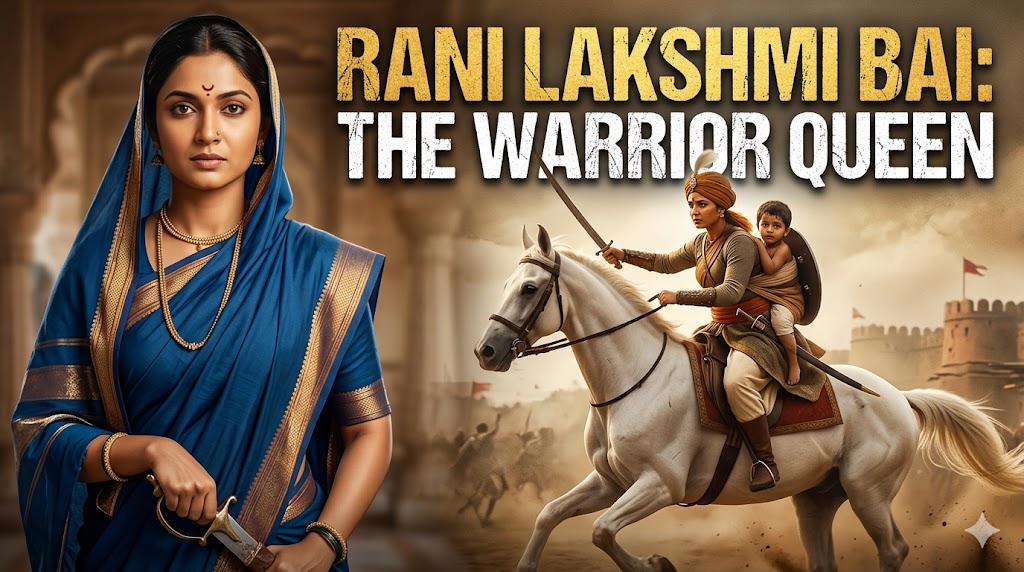
In the annals of Indian history, few figures command the same reverence as Rani Lakshmi Bai. Known across the nation as Jhansi Ki Rani, this extraordinary woman transformed from a young queen into a legendary warrior who defied the might of the British Empire during the Indian Rebellion of 1857. Her story is not merely one of resistance; it embodies the unyielding spirit of patriotism, courage, and sacrifice that continues to inspire generations. Rani Lakshmi Bai life stands as a testament to how one individual’s resolve can ignite a movement, challenging colonial oppression at its peak. From her humble beginnings in Varanasi to her final stand on the battlefield, the Rani of Jhansi remains an enduring symbol of India’s first war of independence.
This comprehensive article delves deep into Rani Lakshmi Bai history, offering a detailed exploration suitable for students, researchers, and history enthusiasts. Whether you seek an essay on Rani Lakshmi Bai, 10 lines on Rani Lakshmi Bai, or insights into her cultural impact, every aspect of her remarkable journey is presented here with historical accuracy and professional insight.
Early Life and Formative Years of Rani Lakshmi Bai
Rani Lakshmi Bai was born as Manikarnika Tambe on November 19, 1828, in the sacred city of Varanasi, also known as Kashi. Her father, Moropant Tambe, served as an adviser to the Peshwa Baji Rao II, while her mother, Bhagirathi Sapre, passed away when young Manikarnika was just four years old. Raised in a progressive Maratha Brahmin household, she received an education far beyond the norms for girls of her era. Instead of being confined to traditional domestic roles, she was trained in martial arts, horse riding, sword fighting, and archery alongside boys at the Peshwa’s court.
Her companions included future revolutionaries such as Nana Sahib and Tantia Tope, forging bonds that would later prove significant. This unconventional upbringing equipped Rani Lakshmi Bai with physical prowess and strategic acumen that set her apart. Historians often highlight how these early experiences shaped her fearless character. In an age when purdah and societal restrictions limited women’s public roles, young Manikarnika—affectionately called Manu—rode horses with confidence and wielded weapons with precision. These formative years in Rani Lakshmi Bai life laid the foundation for her future as a military leader, proving that destiny often prepares individuals long before their greatest trials arise.
Marriage, Queenship, and the Challenges of Rani Lakshmi Bai Life
At the age of 14, in 1842, Manikarnika married Maharaja Gangadhar Rao Newalkar, the ruler of the princely state of Jhansi. Upon marriage, she adopted the name Lakshmi Bai, becoming the Rani of Jhansi. The union brought her into the heart of Bundelkhand’s political landscape, where she quickly adapted to royal responsibilities while maintaining her martial interests. As queen, Rani Lakshmi Bai challenged prevailing social norms by refusing to observe strict purdah and continuing her practice of riding and swordplay.
The couple faced personal tragedy when their biological son died in infancy around 1851. In 1853, shortly before the Maharaja’s death from illness, they adopted a five-year-old relative named Anand Rao, who was renamed Damodar Rao. This adoption followed Hindu tradition to ensure succession. However, the British East India Company, under Governor-General Lord Dalhousie, refused to recognize the adopted heir. Invoking the controversial Doctrine of Lapse, the British annexed Jhansi in 1854, offering Rani Lakshmi Bai a meager pension instead of sovereignty. Her famous response—“I will not surrender my Jhansi!”—echoed her unyielding determination and marked the beginning of her open defiance.
This period of Rani Lakshmi Bai history reveals the intersection of personal loss and political injustice. Stripped of power yet refusing to fade into obscurity, she petitioned British authorities vigorously, demonstrating diplomatic skill alongside her warrior spirit. The annexation not only deprived her of her kingdom but also fueled widespread resentment against colonial policies across northern India.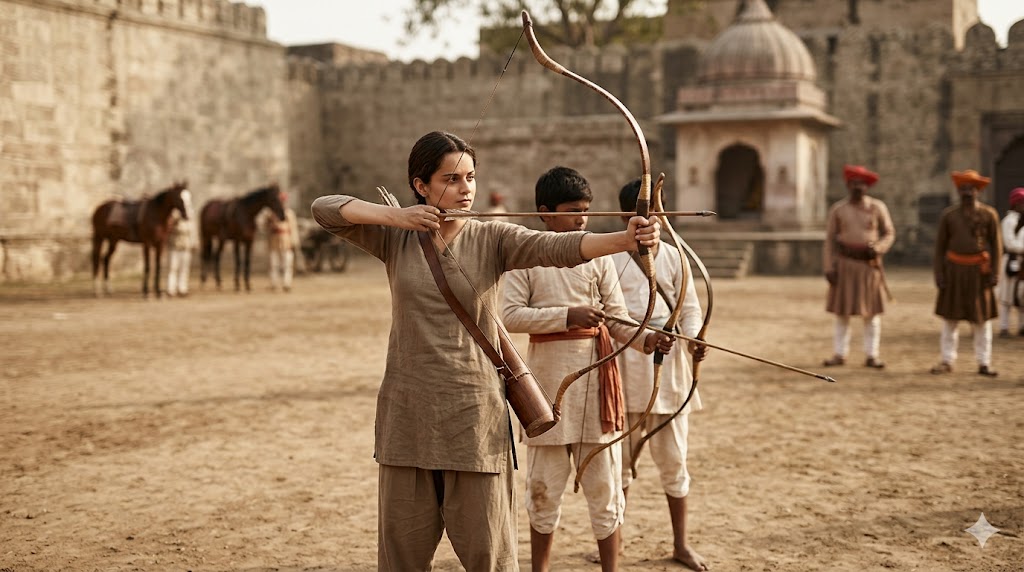
This photograph recreates a rare moment from the formative years of young Manikarnika (later Rani Lakshmi Bai) in Varanasi. Raised progressively in the Peshwa’s court, she is seen here confidently practicing archery with a traditional composite bow.
The Spark of the 1857 Indian Rebellion and Rani Lakshmi Bai’s Emergence
The Indian Rebellion of 1857, often regarded as India’s First War of Independence, erupted in Meerut in May 1857 and rapidly spread. Discontent over issues like the greased cartridges, economic exploitation, and annexations under the Doctrine of Lapse created a powder keg. When the revolt reached Jhansi in June 1857, local sepoys massacred the British residents. Rani Lakshmi Bai was proclaimed regent on behalf of her minor adopted son and quickly assumed leadership of the rebels in the Bundelkhand region.
Far from being a passive participant, Rani Lakshmi Bai organized troops, fortified defenses, and rallied both men and women to the cause. She sought alliances with neighboring rulers and maintained order amid chaos. Her strategic foresight allowed Jhansi to become a stronghold of resistance. For students writing an essay on Rani Lakshmi Bai, this phase underscores how personal grievance merged with national awakening, elevating Jhansi Ki Rani from regional queen to national icon.
Military Leadership and Key Battles in Rani Lakshmi Bai History
Rani Lakshmi Bai’s military campaigns remain legendary for their bravery and tactical brilliance. When British forces under Sir Hugh Rose laid siege to Jhansi in March 1858, the Rani of Jhansi orchestrated a heroic defense lasting nearly two weeks. Despite being outnumbered and outgunned, her forces inflicted heavy casualties. Contemporary British accounts praised her valor, noting how she fought dressed as a soldier, inspiring her troops with personal example.
When Jhansi fell, Rani Lakshmi Bai refused surrender. According to popular accounts, she escaped with her adopted son Damodar Rao tied securely to her back, riding through enemy lines under cover of night. She joined forces with Tantia Tope and Rao Sahib at Kalpi, then advanced to capture the strategically vital Gwalior Fort in June 1858. This bold maneuver demonstrated exceptional leadership and turned the tide temporarily in favor of the rebels.
Her final battle occurred at Kotah-ki-Serai near Gwalior on June 17-18, 1858. Fighting fiercely, Rani Lakshmi Bai sustained fatal wounds and died at the age of approximately 29. Legend holds that she continued battling even after being injured, sword in hand, until her last breath. The British commander reportedly remarked on her exceptional courage, acknowledging that the Rani of Jhansi was “the best and bravest” among the rebels.
These events in Rani Lakshmi Bai history highlight not only her battlefield prowess but also her ability to unite diverse factions. She trained women warriors, managed logistics, and employed guerrilla tactics—achievements that were extraordinary for any leader, let alone a young widow in 19th-century India.
Martyrdom and Immediate Aftermath
The death of Rani Lakshmi Bai did not end the rebellion immediately, but it dealt a severe blow to rebel morale. British forces recaptured Gwalior shortly after. Yet her sacrifice transformed her into a martyr whose memory fueled future independence movements. Damodar Rao survived and later received a pension, though he lived in relative obscurity. Rani Lakshmi Bai’s refusal to compromise, even in defeat, cemented her place as a beacon of resistance.
Enduring Legacy of Rani Lakshmi Bai in Modern India
More than 165 years after her passing, Rani Lakshmi Bai’s legacy resonates powerfully. She symbolizes women’s empowerment, national pride, and anti-colonial struggle. Statues of the Rani of Jhansi astride her horse grace public squares in Jhansi, Gwalior, and cities across India. Annual commemorations on her death anniversary and during Independence Day celebrations honor her contributions.
In education, her story forms an essential part of school curricula. Teachers frequently assign 10 lines on Rani Lakshmi Bai or full essays on Rani Lakshmi Bai to instill values of courage and patriotism. Her life demonstrates that leadership transcends gender and status, inspiring countless women to pursue roles in defense, politics, and public service.
Cultural Representations: From Literature to Fancy Dress and Art
Rani Lakshmi Bai’s image has permeated Indian popular culture in myriad ways. The iconic 1930 poem Jhansi Ki Rani by Subhadra Kumari Chauhan immortalized her with the lines: “Khoob ladi mardani, woh to Jhansi wali rani thi” (She fought valiantly like a warrior; she was the Rani of Jhansi). Novels, such as Vrindavan Lal Verma’s 1946 work, further popularized her tale.
Cinema has played a significant role too. The 1953 Technicolor film Jhansi Ki Rani, directed by Sohrab Modi, brought her story to the silver screen, followed by numerous television serials and modern adaptations. These portrayals keep Rani Lakshmi Bai history alive for new generations.
For students and cultural enthusiasts, Rani Lakshmi Bai inspires creative expressions. School fancy dress competitions frequently feature Jhansi Rani Lakshmi Bai getups, complete with traditional attire, sword, and shield. Children create Rani Lakshmi Bai drawings and even engage in jansi rani lakshmi bai making with clay models during art projects. These activities not only teach history but also foster admiration for her bravery. Rani Lakshmi Bai essay in English assignments often highlight how her story bridges past and present, encouraging artistic interpretations that range from realistic portraits to symbolic sculptures.
10 Key Points on Rani Lakshmi Bai
1. Rani Lakshmi Bai was born Manikarnika Tambe in 1828 in Varanasi.
2. She received martial training from a young age, mastering sword fighting and horse riding.
3. Married Maharaja Gangadhar Rao in 1842, she became the Rani of Jhansi.
4. After her husband’s death in 1853, the British annexed Jhansi under the Doctrine of Lapse.
5. She adopted Damodar Rao to secure succession but was denied recognition by the British.
6. Rani Lakshmi Bai emerged as a leader during the 1857 Indian Rebellion.
7. She defended Jhansi valiantly during the British siege in 1858.
8. Escaping Jhansi, she captured Gwalior before her final battle.
9. She died fighting on June 18, 1858, at Kotah-ki-Serai near Gwalior.
10. Today, Rani Lakshmi Bai remains a national heroine and symbol of women’s empowerment.
10 Lines on Rani Lakshmi Bai
1. Rani Lakshmi Bai was a brave queen known as Jhansi Ki Rani.
2. Born in Varanasi, she trained in martial arts from childhood.
3. She fought against British rule during the 1857 Revolt.
4. Rani Lakshmi Bai refused to surrender her kingdom of Jhansi.
5. She led her army with courage and strategic brilliance.
6. Her famous escape from Jhansi with her son is legendary.
7. She died a martyr in battle near Gwalior in 1858.
8. Rani Lakshmi Bai inspired India’s freedom struggle.
9. Her story teaches us the value of patriotism and sacrifice.
10. Every Indian remembers her as a true warrior queen.
Essay on Rani Lakshmi Bai: A Symbol of Courage and Patriotism
In any essay on Rani Lakshmi Bai, one cannot overlook the profound impact she had on India’s collective consciousness. Rani Lakshmi Bai essay in English often begins with her extraordinary life journey—from a spirited girl in Varanasi to the indomitable Rani of Jhansi. Her refusal to accept the Doctrine of Lapse was not merely personal; it represented the broader Indian resistance against unjust colonial policies. Through her leadership in the 1857 Rebellion, Rani Lakshmi Bai demonstrated that courage knows no gender. She mobilized resources, commanded troops, and fought alongside seasoned warriors, all while protecting her adopted son and her people. Even in defeat, her dignity and valor earned respect from adversaries. The Rani of Jhansi’s sacrifice reminds us that true freedom is won through perseverance and unity. Her legacy continues to motivate modern India, proving that one woman’s determination can echo through centuries.
Conclusion: The Immortal Flame of Jhansi Ki Rani
Rani Lakshmi Bai’s life, though tragically short, burned with an intensity that illuminates Indian history. From her early training to her final battlefield stand, every chapter of Rani Lakshmi Bai life reflects resilience against overwhelming odds. As Jhansi Ki Rani, she did not merely fight for a kingdom—she fought for dignity, justice, and the soul of a nation. Today, whether through Rani Lakshmi Bai 10 points in classrooms, elaborate fancy dress reenactments, or scholarly essays, her story endures. The warrior queen of Jhansi remains a timeless inspiration, reminding every generation that bravery and patriotism can triumph over tyranny. In honoring Rani Lakshmi Bai, we honor the indomitable spirit of India itself.