"Prithviraj Chauhan: Rajput Warrio Glorious Legacy"
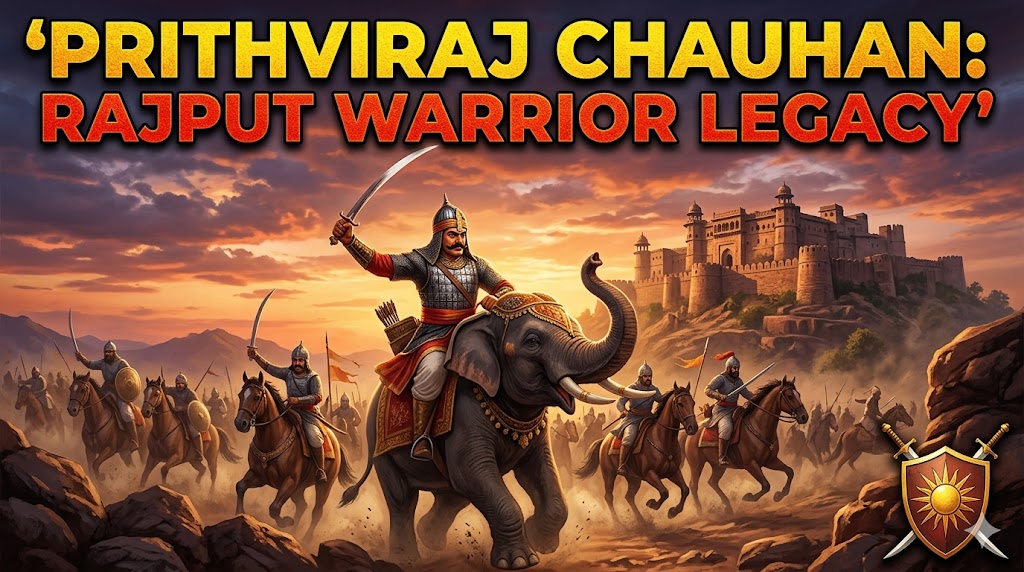
Prithviraj Chauhan stands as one of the most celebrated figures in Indian history, remembered as a courageous Rajput warrior king who embodied the spirit of resistance during a pivotal era of change. Ruling in the late 12th century from the heart of Rajasthan, Prithviraj Chauhan belonged to the illustrious Chauhan dynasty and governed the Sapadalaksha region with Ajmer as its capital. His reign, though brief, left an indelible mark on the political landscape of northern India.
Historical accounts portray Prithviraj Chauhan as a skilled military leader who expanded his kingdom through strategic campaigns and forged alliances among Rajput clans. Yet, his legacy extends beyond warfare. He is often hailed as one of the greatest warriors of Rajasthan, a defender against external threats, and a ruler who upheld Rajput ideals of honor, bravery, and duty. While popular folklore has romanticized certain aspects of his life, verified sources from inscriptions, contemporary Sanskrit poems, and medieval chronicles provide a grounded understanding of his achievements and challenges.
This article examines the life of Prithviraj Chauhan based on established historical evidence. It explores his rise to power, military confrontations with invaders like Muhammad Ghori, the development of his kingdom, the legendary elements surrounding his personal life, and the circumstances of his defeat and death. By focusing on verified records, we gain insight into why Prithviraj Chauhan continues to inspire as a glorious Rajput ruler of the Chauhan dynasty.
Early Life and Ascension to the Throne
Prithviraj Chauhan was born on 28 May 1166 in Gujarat, where his father, Someshvara, the king of the Chauhan dynasty, had connections through maternal relatives at the Chaulukya court. His mother, Karpuradevi, came from a prominent lineage, linking the family to broader Rajput networks. Prithviraj Chauhan and his younger brother Hariraja spent their formative years immersed in the martial traditions of the Rajputs, receiving rigorous training in warfare, archery, and statecraft.
The Chauhan dynasty, also known as the Chahamanas of Shakambhari, traced its roots to ancient Rajasthan and had established a strong presence in the region. By the time of Prithviraj Chauhan’s birth, the kingdom controlled territories stretching from Thanesar in the north to parts of Mewar in the south, encompassing much of present-day Rajasthan along with areas in Haryana and Uttar Pradesh.
Someshvara died around 1177 when Prithviraj Chauhan was just 11 years old. As a minor, he ascended the throne under the regency of his mother, Karpuradevi, supported by a council of ministers. This early phase tested the young ruler’s mettle. Chief among his advisors was Kadambavasa (also referred to as Kaimasa), a capable administrator and general who helped stabilize the kingdom. Another key figure, Bhuvanaikamalla, assisted in military matters.
By around 1180, Prithviraj Chauhan assumed direct control of administration. His early reign focused on consolidating power within the Chauhan dynasty’s traditional lands. One of his first notable actions was suppressing a rebellion by his cousin Nagarjuna, who challenged his claim to the throne. The revolt was swiftly crushed, demonstrating Prithviraj Chauhan’s resolve to maintain unity in the face of internal threats. These formative experiences shaped him into a decisive leader committed to the security and prosperity of his realm in Rajasthan.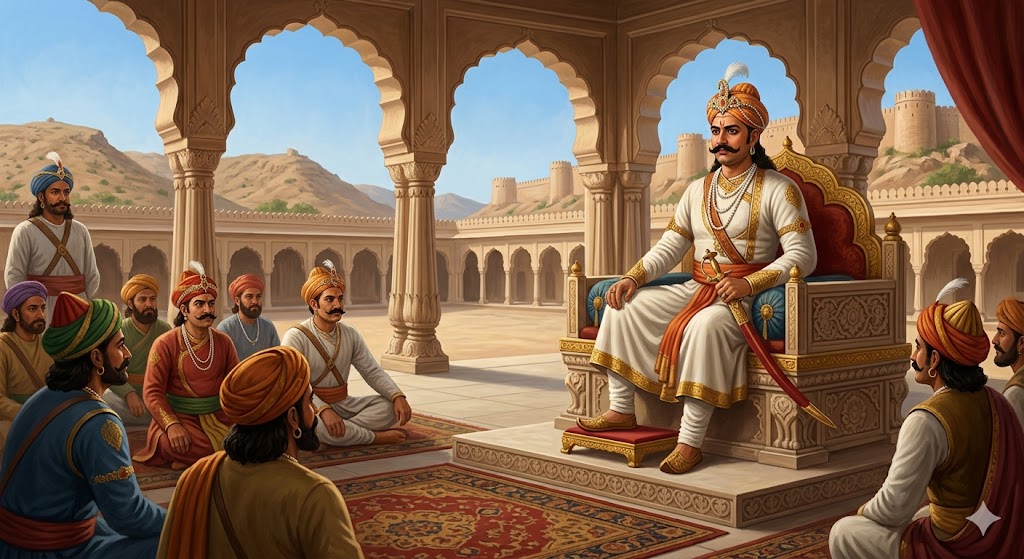
King Prithviraj Chauhan of the Chauhan dynasty presiding over his war council in the palace of Ajmer, 1185.
Building the Kingdom: Military Campaigns and Territorial Expansion
As king, Prithviraj Chauhan pursued an ambitious policy of expansion to strengthen the Chauhan dynasty’s position amid rival Rajput kingdoms and emerging external pressures. His military campaigns targeted neighboring powers that posed threats or offered opportunities for growth. These efforts transformed the Sapadalaksha kingdom into one of the strongest in Rajasthan during the 12th century.
Early victories included the defeat of the Bhadanakas, a group that had long troubled the Delhi region under Chauhan influence. By neutralizing this threat before 1182, Prithviraj Chauhan secured his western and northern flanks. In 1182, he launched a significant campaign against the Chandela ruler Paramardi Deva of Jejakabhukti (present-day Bundelkhand). Inscriptions from Madanpur record that Prithviraj Chauhan “laid waste” to the region, sacking key centers like Mahoba. While the campaign enhanced his reputation as a warrior, it did not result in permanent annexation, as the Chandelas retained control afterward. Still, it showcased the military prowess of the Chauhan forces.
Prithviraj Chauhan also engaged with the Chaulukyas (Solankis) of Gujarat, leading to a prolonged conflict that ended in a peace treaty by 1187. These interactions, though not always yielding territorial gains, helped define the boundaries of his influence. Relations with the Gahadavalas of Kannauj under Jayachandra remained tense, driven by competition for regional dominance rather than personal vendettas recorded in contemporary sources.
Through these campaigns, Prithviraj Chauhan expanded the kingdom’s reach, controlling vital trade routes and agricultural lands across Rajasthan and adjacent areas. He maintained a network of feudatories and allies, fostering a confederacy that bolstered Rajput solidarity. Infrastructure developments under his rule appear limited in records, but the construction or fortification of defensive structures, including elements associated with Delhi’s early fortifications (later known in legends as Qila Rai Pithora), supported administrative control. His court also patronized scholars and poets, creating an environment where arts and learning flourished alongside military strength. This balanced approach helped develop the kingdom economically and culturally, reinforcing the Chauhan dynasty’s stature.
The Epic Battles Against Muslim Rulers: Confronting Muhammad Ghori
Prithviraj Chauhan’s most defining moments came in his confrontations with Muhammad of Ghor, the Ghurid ruler seeking to expand into northern India. These clashes, known as the Battles of Tarain, highlighted Prithviraj Chauhan’s role as a defender against foreign invasions and cemented his reputation as one of Rajasthan’s greatest warriors.
The First Battle of Tarain occurred on 14 January 1191 near Taraori in present-day Haryana. Muhammad Ghori had captured the fort of Tabarhindah (Bhatinda), prompting Prithviraj Chauhan to lead a coalition of Rajput forces, including allies like Govindaraja of Delhi. The Rajput army, with its superior numbers and traditional tactics involving elephants and cavalry, decisively defeated the Ghurid forces. Muhammad Ghori was wounded and forced to retreat to Ghazni, while Prithviraj Chauhan’s troops besieged and eventually recaptured Tabarhindah after a 13-month effort. This victory boosted morale across Rajput kingdoms and delayed Ghurid ambitions.
Emboldened but cautious, Muhammad Ghori returned in 1192 with a reorganized army of approximately 120,000 men, emphasizing mobile Turkish mounted archers. The Second Battle of Tarain unfolded on the same battlefield. Ghori employed clever tactics, including feigned retreats and diplomatic overtures to induce complacency among the Rajputs. Prithviraj Chauhan’s larger force, though valiant, suffered from exhaustion after pursuing the lighter Ghurid cavalry. The Ghurids’ superior mobility and archery overwhelmed the Rajput lines, leading to a rout.
Prithviraj Chauhan escaped initially but was captured near the Sarasvati river. These battles underscored the tactical differences between the heavy Rajput armies and the agile Ghurid horsemen. While Prithviraj Chauhan achieved initial success through unity and bravery, the second engagement marked a turning point in medieval Indian history, paving the way for Ghurid influence in the north.
The Legendary Love Story with Sanyogita: Folklore and Historical Perspective
One of the most enduring aspects of Prithviraj Chauhan’s narrative is his supposed love story with Sanyogita (also spelled Samyukta), the daughter of Jayachandra of Kannauj. This tale, popularized in later literature, depicts a dramatic elopement from her swayamvara, where Sanyogita garlanded Prithviraj Chauhan’s statue in defiance of her father. The story symbolizes passion, defiance, and Rajput chivalry.
However, historians emphasize that this romance originates primarily from the Prithviraj Raso, an epic poem attributed to Chand Bardai but composed centuries later in the 15th or 16th century. Contemporary sources, such as the Prithviraja Vijaya—a Sanskrit poem written during Prithviraj Chauhan’s lifetime by Jayanaka—make no mention of Sanyogita or any such personal rivalry with Jayachandra. Inscriptions and other records from the era also remain silent on the matter. Scholars view the story as a later literary embellishment that captured popular imagination, blending historical figures with romantic ideals to inspire generations.
While the love story of Prithviraj Chauhan and Sanyogita adds color to his legacy, it serves best as cultural folklore rather than verified history. It reflects the values of honor and romance cherished in Rajput traditions, even as it highlights how legends can shape perceptions of real leaders.
Defeat, Myths of Betrayal, and the Tragic Death of Prithviraj Chauhan
Following the Second Battle of Tarain, Prithviraj Chauhan’s capture led to a grim fate. Muhammad Ghori initially considered reinstating him as a vassal in Ajmer but ultimately executed him for alleged treason after reports of rebellion. Accounts vary slightly across sources: some describe execution by beheading or other means in early 1192, when Prithviraj Chauhan was about 25 years old. He died in or near Ajmer, bringing an end to his direct rule.
Popular legends, again drawn from the Prithviraj Raso and later texts, claim he was blinded in captivity and, with the help of his loyal poet Chand Bardai, used a “sound-guided arrow” (shabd-bhedi baan) to slay Ghori in revenge before being killed himself. These dramatic elements, along with tales of betrayal by Jayachandra or internal disloyalty among his own people, lack support in contemporary records. Historians note that the defeat stemmed from military and strategic factors rather than confirmed internal sabotage. No verified evidence points to widespread betrayal by Rajput allies or kin; instead, the loss reflected the challenges of coordinating large confederacies against a determined, tactically innovative foe.
The death of Prithviraj Chauhan marked the decline of independent Chauhan power in Delhi and Ajmer. His brother Hariraja briefly resisted, and a son was installed as a puppet ruler before Ghurid forces consolidated control. This transition ushered in significant changes across northern India.
Contributions to the Kingdom and Role as a Glorious Rajput Ruler
Despite the brevity of his reign, Prithviraj Chauhan contributed meaningfully to the Chauhan dynasty and the broader Rajput ethos. He strengthened administrative structures through capable ministers and maintained a court that supported poets and scholars. The Prithviraja Vijaya itself stands as a testament to this patronage, offering one of the few contemporary glimpses into his life and achievements.
As a ruler, Prithviraj Chauhan focused on justice, military preparedness, and alliances that preserved Rajput autonomy for as long as possible. His kingdom’s development emphasized security and cultural vitality, helping Rajasthan remain a bastion of Hindu rule amid shifting powers. He is remembered not for flawless victories but for his courageous stand, which delayed larger incursions and inspired later resistance.
In the context of the Chauhan dynasty, Prithviraj Chauhan represented the pinnacle of its glory in Rajasthan. His efforts to unite Rajput forces against a common threat exemplified leadership, even if ultimate success eluded him. Modern historians recognize him as a transitional figure whose defeat highlighted both the strengths and vulnerabilities of medieval Indian polities.
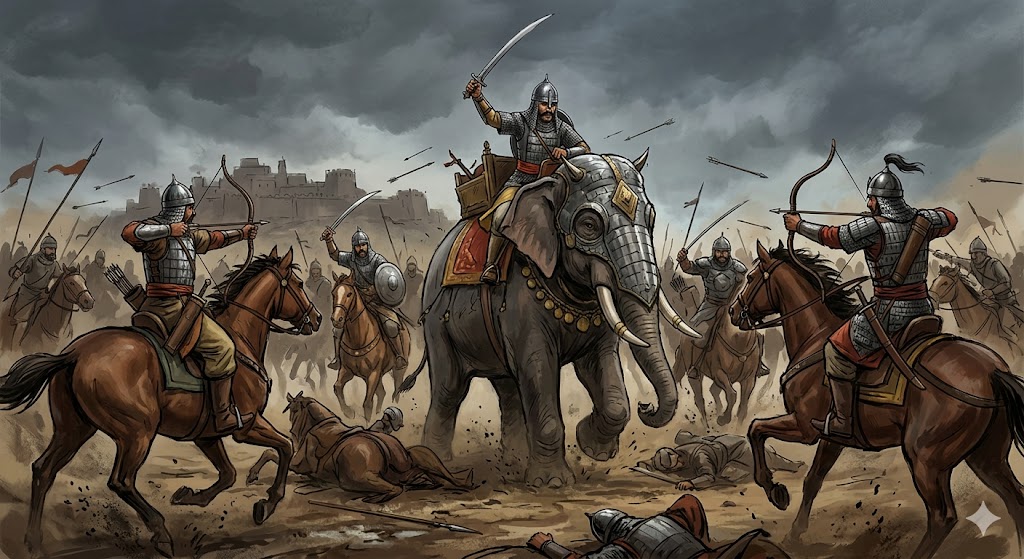
The critical moment of the Second Battle of Tarain in 1192, where Ghurid mounted archers engaged the Rajput forces led by Prithviraj Chauhan on his elephant.
Conclusion: The Enduring Legacy of Prithviraj Chauhan
Prithviraj Chauhan’s story, grounded in historical facts yet enriched by legend, continues to resonate across Rajasthan and India. From his early consolidation of the Chauhan dynasty’s power to his valiant battles at Tarain, he exemplified the warrior-king ideal. Though defeated in 1192, his resistance against Muhammad Ghori delayed foreign dominance and preserved a spirit of defiance that echoes in Rajput pride today.
The love story with Sanyogita, while folkloric, humanizes the ruler, while myths of betrayal remind us to separate romance from reality. Ultimately, Prithviraj Chauhan’s legacy lies in his role as one of Rajasthan’s greatest warriors and a glorious figure of the Chauhan dynasty. His life teaches lessons in courage, unity, and resilience—values that remain relevant in understanding India’s rich medieval past.
For students of history and admirers of Rajput heritage, Prithviraj Chauhan remains a beacon of inspiration, reminding us that true greatness often lies in the fight itself, not just the outcome.