Rabindranath Tagore: Life, Works & Shantiniketan Vision
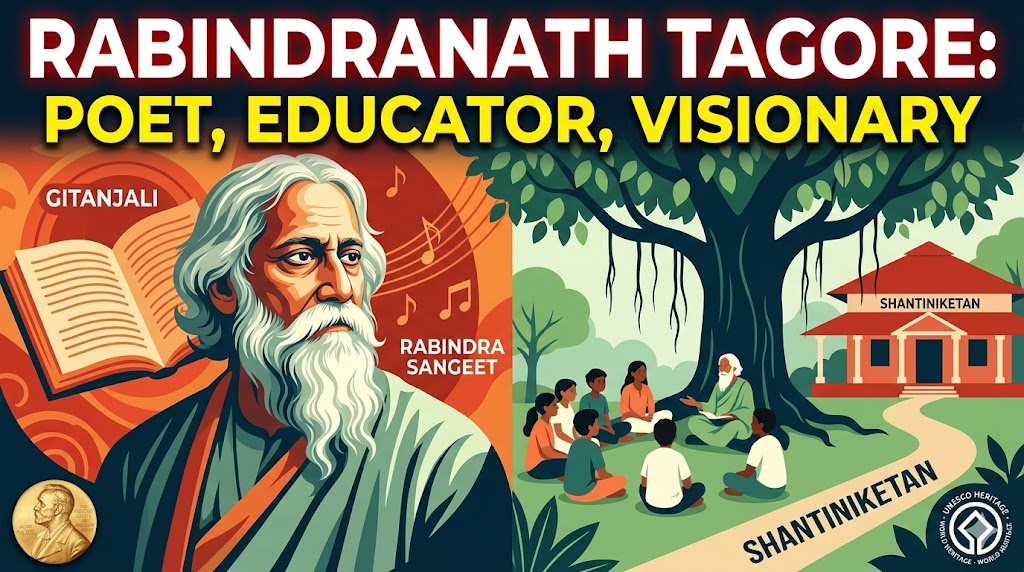
Rabindranath Tagore stands as one of the most luminous figures in modern Indian history—a poet, philosopher, musician, painter, and educator whose influence continues to resonate across continents more than eight decades after his passing. Born in 1861 amid the intellectual ferment of Bengal’s Renaissance, Rabindranath Tagore transformed Bengali literature, challenged colonial education systems, and envisioned a harmonious world where learning embraced nature, creativity, and universal brotherhood. His founding of Shantiniketan and its evolution into Visva-Bharati University embodied a radical departure from rote memorization, prioritizing instead the holistic growth of the human spirit.
Yet Rabindranath Tagore’s story extends far beyond the classroom or the written page. His close yet intellectually spirited relationship with Mahatma Gandhi highlighted complementary visions for India’s freedom—Gandhi’s emphasis on political action and Tagore’s focus on cultural and educational self-reliance. Through timeless works like *Gitanjali*, over 2,000 songs known as Rabindra Sangeet, and profound essays, Rabindranath Tagore bridged Eastern spirituality with Western thought, earning him the distinction of the first non-European Nobel laureate in Literature in 1913.
This article delves into the multifaceted life of Rabindranath Tagore, tracing his journey from a privileged yet unconventional childhood to his pioneering educational experiments at Shantiniketan. It examines his literary genius, his dynamic partnership with Mahatma Gandhi, and his enduring legacy as a writer and thinker dedicated to human unity. Drawing from verified educational sources including Britannica, the Nobel Foundation, UNESCO World Heritage documentation, and Visva-Bharati’s official records, this piece offers a comprehensive, accurate resource for students, researchers, and admirers seeking deeper insight into one of India’s greatest minds.
Early Life and Formative Years
Rabindranath Tagore entered the world on May 7, 1861, in Calcutta (now Kolkata), the youngest of fourteen children born to Debendranath Tagore and Sarada Devi. His family belonged to the illustrious Jorasanko Thakur Bari, a hub of cultural and reformist activity during the Bengal Renaissance. Debendranath, a leader of the Brahmo Samaj, instilled in his son a deep reverence for the Upanishads and a rejection of ritualistic orthodoxy in favor of monistic spirituality.
Unlike conventional schooling, young Rabindranath Tagore received most of his early education at home under private tutors. He displayed poetic talent from an astonishingly young age, publishing his first verses at thirteen under the pseudonym Bhanusimha. A brief stint in England at seventeen to study law proved short-lived; he returned after eighteen months, drawn more to literature and music than formal academics. This aversion to rigid classroom structures would later shape his revolutionary views on education.
In 1890, Rabindranath Tagore assumed responsibility for managing his family’s estates in East Bengal (present-day Bangladesh). Living aboard a houseboat on the Padma River, he immersed himself in rural life, witnessing the struggles of villagers firsthand. This decade profoundly influenced his writing, infusing it with empathy for ordinary people and a critique of social inequalities. By the 1890s, Rabindranath Tagore had already authored notable poetry collections such as Manasi (1890) and Sonar Tari (1894), alongside plays like Chitrangada (1892). His marriage to Mrinalini Devi in 1883 and the birth of five children added personal depth to his reflections on family and society, though tragedy struck with the early deaths of his wife and several children.
These formative experiences—rooted in nature, rural realities, and spiritual inquiry—laid the groundwork for Rabindranath Tagore’s lifelong mission: to harmonize tradition with modernity and individual freedom with collective well-being.
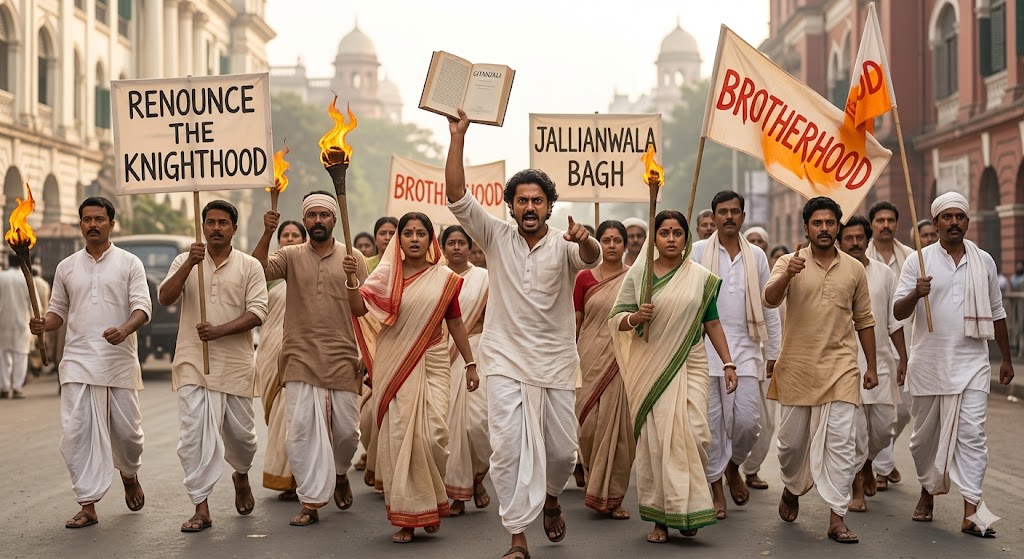
The original resistance: This conceptual photograph captures a Swadeshi movement protest, generically representing the anti-colonial movement around 1919, where countles Bengalis mobilized against British divide-and-rule tactics, directly linked to the descriptions for Rabindranath Tagore's knighthood renunciation.
Rabindranath Tagore’s literary output was staggering—nearly sixty volumes of poetry, numerous novels, short stories, plays, essays, and over 2,000 songs. He revolutionized Bengali literature by introducing colloquial language, innovative verse forms, and themes drawn from everyday life, breaking free from Sanskrit classical constraints.
Among his masterpieces, Gitanjali (Song Offerings, 1910 in Bengali; English translation 1912) remains iconic. A collection of devotional lyrics blending mysticism and humanism, it earned international acclaim. W.B. Yeats praised its “profoundly sensitive, fresh and beautiful verse,” while the Nobel Committee lauded its role in making Tagore’s poetic thought part of Western literature. Other seminal poetry includes Gitimalya (1914) and
Balaka (1916).
As a novelist, Rabindranath Tagore explored complex social issues. *Gora* (1910) examines identity, nationalism, and religious tolerance through the story of an Irish orphan raised as a Hindu. Ghare-Baire (The Home and the World, 1916) critiques the Swadeshi movement and personal versus political commitments. His short stories, often set in rural Bengal, capture “humble lives and their small miseries” with poignant irony and compassion.
Rabindranath Tagore’s musical genius shines in Rabindra Sangeet—songs that fuse classical ragas, folk melodies, and his own compositions. Many remain staples in Bengali culture today. He also penned dance-dramas and plays such as Raja (1910) and Raktakaravi (1926), blending literature with performance.
Later in life, Rabindranath Tagore turned to painting, producing thousands of works that earned him recognition among India’s foremost modern artists. His writings consistently championed humanism, urging readers to seek unity amid diversity. As he reflected, “The highest education is that which does not merely give us information, but makes our life in harmony with all existence.” This philosophy permeated every genre he touched, making Rabindranath Tagore not merely a writer but a cultural force.
The Nobel Prize and Global Acclaim
In 1913, Rabindranath Tagore achieved a historic milestone: he became the first non-European—and the first lyricist—to win the Nobel Prize in Literature. The award recognized Gitanjali, whose English prose translations introduced Eastern spirituality to the West in an accessible, lyrical form. The Swedish Academy highlighted his “profoundly sensitive, fresh and beautiful verse.”
This recognition catapulted Rabindranath Tagore onto the world stage. He embarked on lecture tours across Europe, the Americas, and East Asia, acting as an eloquent advocate for Indian independence and cultural exchange. In 1915, the British government knighted him, but he renounced the honor in 1919 following the Jallianwala Bagh massacre, demonstrating his principled stand against colonial atrocities.
Rabindranath Tagore’s global influence extended beyond literature. He authored the lyrics for India’s national anthem, “Jana Gana Mana,” and Bangladesh’s “Amar Sonar Bangla,” cementing his role as a bridge between nations. His travels and friendships with figures like Einstein and Romain Rolland underscored his commitment to universal humanism.
Educational Philosophy: A Vision Beyond Books
Rabindranath Tagore viewed conventional education as stifling, likening it to a “factory” that produced clerks rather than creative individuals. He advocated for a system rooted in nature, freedom, and holistic development—physical, intellectual, emotional, and spiritual. Influenced by ancient Indian gurukuls and the Upanishads, he believed true learning occurred through direct experience and harmony with the environment.
Key principles included mother-tongue instruction, activity-based learning, and cultivation of all senses. Rabindranath Tagore emphasized self-realization, intellectual curiosity, and global citizenship, famously stating that education should foster “the unity of truth” and prepare individuals to become “makers of their own world.” Discipline, in his view, arose naturally from freedom rather than coercion; teachers served as guides and fellow learners rather than taskmasters.
These ideas found practical expression in his experimental school, where open-air classes under trees replaced rigid desks, and arts, music, and rural engagement formed the core curriculum.
The Formation of Shantiniketan
The story of Shantiniketan—“Abode of Peace”—began in 1863 when Debendranath Tagore acquired 20 acres of barren land in rural Birbhum, West Bengal, transforming it into a meditative ashram. Rabindranath Tagore first visited as a teenager and later chose it for his educational experiment.
In 1901, with just a handful of students, Rabindranath Tagore established a residential school at Shantiniketan. Rejecting urban distractions and colonial models, he created an environment where children learned amid nature’s rhythms. Classes convened beneath chhatim trees; festivals celebrated seasonal cycles; and community service linked education to rural upliftment.
By 1921, the institution had grown into Visva-Bharati University, a “world university” embodying Tagore’s motto: Yatra visvam bhavatyekanidam —“Where the whole world meets in a single nest.” It welcomed scholars from across Asia and beyond, integrating Indian traditions with global knowledge. UNESCO recognized Santiniketan as a World Heritage Site in 2023 for its pioneering model of progressive education, art, and communal living that influenced the Indian freedom movement and pan-Asian modernism.
Rabindranath Tagore poured his life’s savings and creative energy into Shantiniketan and the adjacent Sriniketan (for rural reconstruction), viewing it as the vessel carrying “the cargo of my life’s best treasure.”
Tagore’s Venture with Mahatma Gandhi: Mutual Respect Amid Differences
Rabindranath Tagore and Mahatma Gandhi first met in 1915 at Shantiniketan, forging a profound friendship marked by deep mutual admiration. Tagore bestowed the title “Mahatma” upon Gandhi, while Gandhi addressed him reverently as “Gurudev.” Both championed India’s self-reliance—atmashakti—yet their approaches diverged thoughtfully.
During the 1921 Non-Cooperation Movement, Rabindranath Tagore voiced reservations about aspects like the boycott of educational institutions and burning of foreign cloth, fearing they might foster narrow nationalism over constructive cultural growth. Gandhi, in turn, appreciated Tagore’s critique, publishing their exchange in *Young India* and *Modern Review*. Their public yet respectful debate exemplified intellectual honesty.
Despite differences, they collaborated on social reforms. Gandhi drew inspiration from Shantiniketan’s craft-based education for his own Nai Talim system. Rabindranath Tagore supported Gandhi’s causes while urging a broader vision that included internationalism and artistic expression. Their correspondence, spanning 1915 to 1941, reveals two complementary architects of modern India—one the political leader, the other the poetic visionary—united in love for humanity.
Broader Contributions: Art, Music, and Social Reform
Beyond literature and education, Rabindranath Tagore excelled as a composer, painter, and reformer. His Rabindra Sangeet enriched Bengali cultural life, while his late-life paintings explored abstract forms and emotions. He championed women’s rights, opposed untouchability, and promoted rural development through Sriniketan’s initiatives in agriculture, health, and crafts.
Rabindranath Tagore’s essays and travelogues offered incisive commentary on nationalism, science, and spirituality, always advocating for a world free from prejudice.
Lasting Legacy
Rabindranath Tagore passed away on August 7, 1941, in the same Jorasanko home where he was born. His legacy endures through Visva-Bharati University, countless translations of his works, and the annual celebration of Rabindra Jayanti. Institutions worldwide study his philosophy, while UNESCO’s recognition affirms Shantiniketan’s global significance.
In an era of division, Rabindranath Tagore’s message of unity—“the world in a single nest”—remains profoundly relevant. As a writer, he gifted humanity verses of exquisite beauty; as an educator, he modeled learning as liberation; and as a thinker, he inspired generations to imagine a more harmonious future.
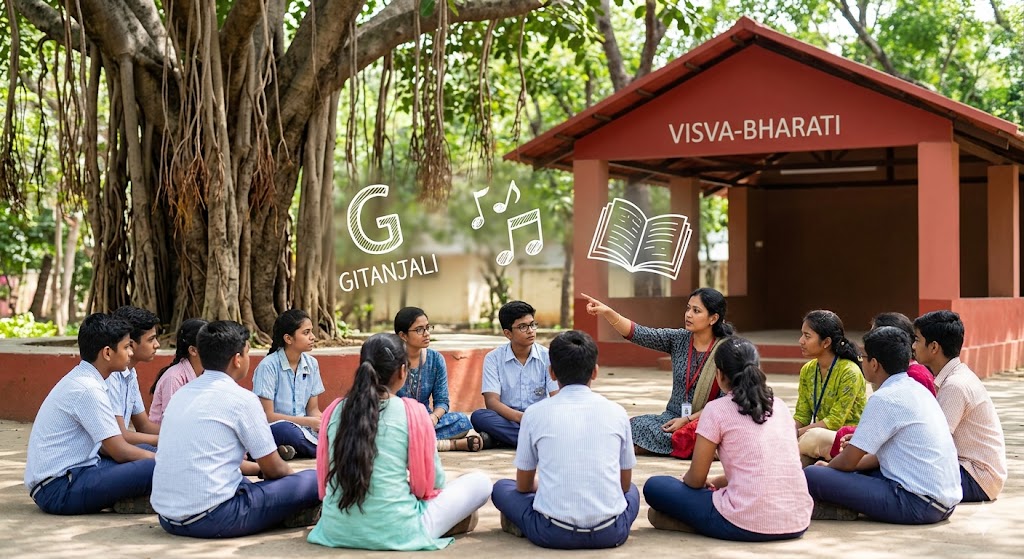
An educational vision conceptualized: This dynamic scene visualizes the living pedagogical model generic to Shantiniketan, where diverse generic students engage generic collaborative effort generic, directly generic representing Rabindranath Tagore's groundbreaking work that emphasized holistic development in harmony with nature
Conclusion
The life of Rabindranath Tagore exemplifies the transformative power of creativity, compassion, and conviction. From his poetic masterpieces and Nobel-winning *Gitanjali* to the living laboratory of Shantiniketan, he redefined what it means to learn, create, and lead. His partnership with Mahatma Gandhi underscored the strength found in respectful dialogue, while his educational ideals continue to challenge modern systems toward greater humanity.
For anyone seeking inspiration—whether through Rabindranath Tagore poems, stories, or quotes—his works invite reflection on our shared humanity. As India and the world navigate the 21st century, the visionary legacy of Rabindranath Tagore offers timeless guidance: educate not just the mind, but the soul in harmony with all existence.