Partition of Bengal: 1905 Legacy & 2026 Election Parallels
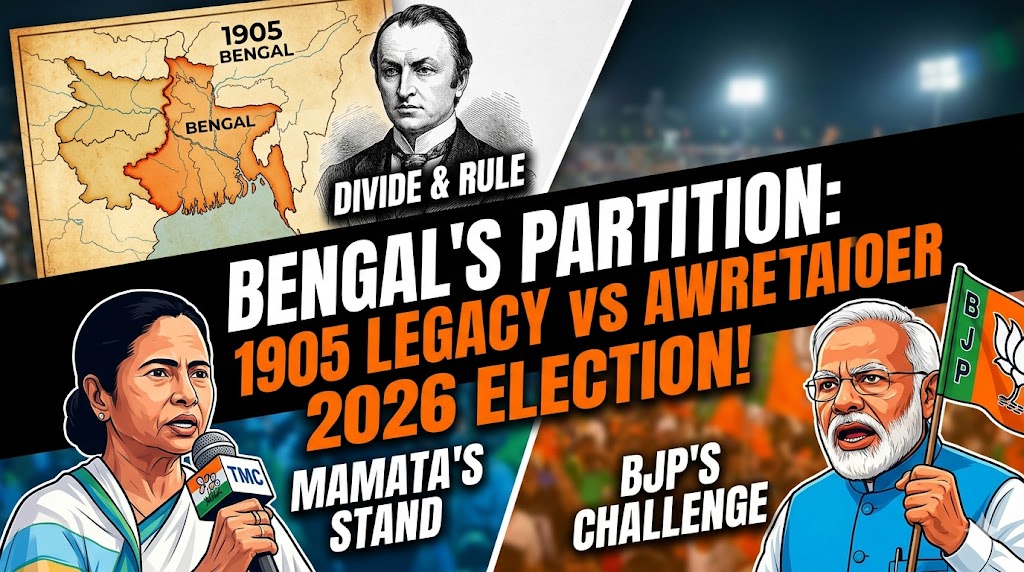
The Partition of Bengal stands as one of the most defining and controversial episodes in modern Indian history. Announced in 1905 by British Viceroy Lord Curzon and annulled just six years later in 1911, it was ostensibly an administrative reform but widely perceived as a classic “divide and rule” strategy. Its ripples extended far beyond colonial bureaucracy, igniting the Swadeshi movement, accelerating the freedom struggle, and sowing seeds of communal polarization that culminated in the 1947 Partition of India.
Fast-forward to April 2026. West Bengal stands on the cusp of its Legislative Assembly elections, scheduled in two phases on 23 and 29 April, with results due on 4 May. As voters prepare to decide the fate of the incumbent All India Trinamool Congress (TMC) government led by Mamata Banerjee against a resurgent Bharatiya Janata Party (BJP) and a struggling Left-Congress alliance, political analysts are drawing striking parallels with the past. Could this election represent a modern, democratic “partition” of Bengal’s political landscape—one that reshapes not just the state but India’s federal balance, cultural identity, and economic trajectory?
This article examines the Partition of Bengal in its historical entirety—from the 1905 experiment and its swift reversal, through the traumatic 1947 division and post-Independence decades, to the 2026 electoral crossroads. Written for educational purposes, it draws on verified historical records and contemporary developments to offer a professional, balanced perspective suitable for students, researchers, and general readers preparing for UPSC, CSS, or competitive exams.
In 1905, the Bengal Presidency was the largest and most populous province in British India, encompassing present-day West Bengal, Bangladesh, Bihar, Odisha, and parts of Jharkhand and Assam. Administrative overload was the official justification cited by Lord Curzon. The eastern districts, largely Muslim and agrarian, suffered from neglect, poor communication, and isolation from the commercial hub of Calcutta (now Kolkata).
On 16 October 1905, the province was bifurcated:
East Bengal and Assam (capital: Dhaka) – Muslim-majority, population ~31 million.
West Bengal (including Bihar and Odisha, capital: Calcutta) – Hindu-majority.
Though maps of the partition of Bengal 1905 clearly showed geographic logic, contemporaries immediately recognized the religious fault lines. Eastern Bengal’s Muslim peasants welcomed the move, hoping for better governance and reduced Hindu landlord dominance. Western Hindus saw it as a deliberate assault on Bengali unity and the nascent nationalist movement centered in Calcutta.
The backlash was swift and fierce. The date of Bengal partition—16 October—became a day of mourning. Rakhi Bandhan was observed across communities as a symbol of unbreakable unity. Boycotts of British goods, bonfires of foreign cloth, and promotion of indigenous industries marked the birth of the Swadeshi movement. Extremist factions within the Indian National Congress gained prominence, while moderate leaders like Surendranath Banerjee mobilized mass protests.
Economically and socially, the partition disrupted centuries-old trade networks. Culturally, it threatened the syncretic Bengali identity forged during the 19th-century Renaissance. By 1906–07, the agitation had spread nationwide, transforming Congress from an elite debating club into a mass organization. 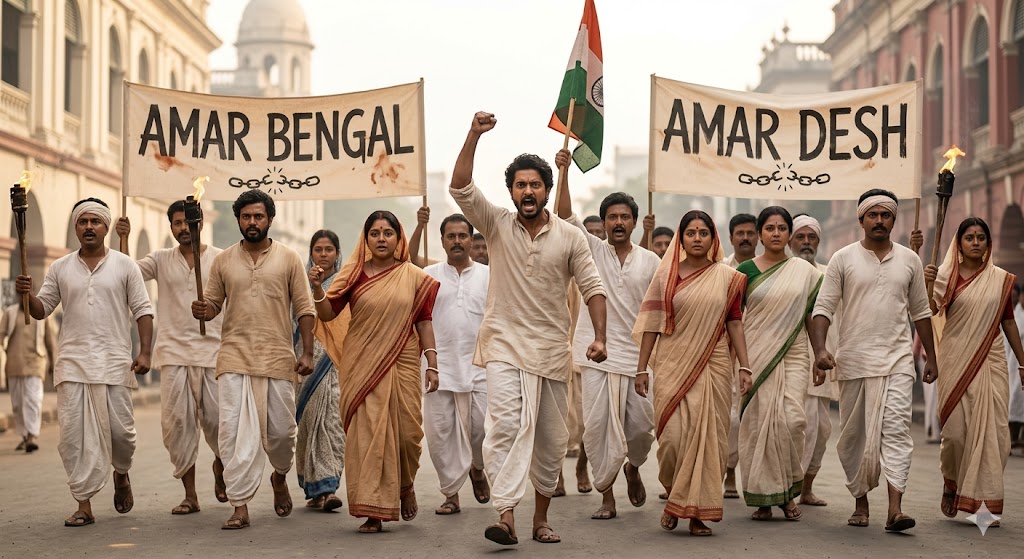
The original resistance: This conceptual photograph captures a massive Swadeshi movement protest generically representing the popular agitation around 1905, where countless Bengalis mobilized against British divide-and-rule tactics and forced the 1911 annulment.
The Swadeshi Movement, Annulment in 1911, and Long-term Repercussions
The intensity of opposition surprised the British. Riots, strikes, and revolutionary terrorism (including attempts on officials’ lives) made the partition politically unsustainable. In 1911, at the Delhi Durbar, King George V announced its annulment. Bengal was reunited under a single governor, while Bihar and Odisha became a separate province and Assam a chief commissioner’s province. The capital of British India shifted from Calcutta to Delhi.
The annulment of the partition of Bengal was a rare victory for Indian public opinion. Yet it came at a cost. Muslims, who had initially benefited from the new province, felt betrayed. The episode accelerated the formation of the All-India Muslim League in 1906 and deepened communal consciousness. Historians note that while the 1905 partition failed as an administrative tool, it succeeded in fracturing the anti-colonial front along religious lines—a fracture that would widen dramatically by 1947.
For UPSC and CSS aspirants, the partition of Bengal 1905 remains a staple topic illustrating British divide-and-rule tactics, the rise of economic nationalism via Swadeshi, and the shift from moderate to extremist politics within Congress.
From Annulment to 1947: The Road to the Second Partition
The years between 1911 and 1947 witnessed Bengal’s central role in the freedom struggle—from the Non-Cooperation Movement to the Quit India Movement. Yet communal tensions simmered. The 1946 Calcutta riots and Noakhali violence exposed the fragility of Hindu-Muslim coexistence.
When the Indian Independence Act 1947 was passed, Bengal was partitioned once more. This time the division was permanent and far more traumatic. West Bengal (Hindu-majority) joined the Indian Union; East Bengal became East Pakistan (later Bangladesh in 1971). The Radcliffe Line, drawn hastily by a British lawyer who had never visited the region, split families, villages, and economies.
The 1947 partition of Bengal triggered one of history’s largest migrations. Millions of Hindu refugees poured into West Bengal, straining its limited resources. Jute mills stayed in West Bengal while raw jute fields went to East Pakistan, crippling the economy. Food shortages, refugee colonies (bustees), and social upheaval defined the early post-Independence decades.
Post-Independence West Bengal: Crisis, Left Rule, and TMC Ascendancy
The first two decades after 1947 were marked by Congress rule under leaders like Bidhan Chandra Roy. Rehabilitation of refugees, establishment of refugee colonies, and early industrialization offered hope, yet central government policies often favored other states, leading to accusations of step-motherly treatment.
By the late 1960s, food crises, Naxalite unrest, and industrial decline fueled discontent. In 1977, the Left Front, led by the Communist Party of India (Marxist), swept to power and ruled uninterrupted for 34 years (1977–2011). Landmark reforms like Operation Barga secured tenancy rights for sharecroppers, but militant trade unionism drove capital flight. West Bengal’s share of national industrial output plummeted.
In 2011, Mamata Banerjee’s Trinamool Congress ended Left dominance with a promise of “Poriborton” (change). Successive victories in 2016 and 2021 consolidated TMC rule through welfare schemes—Kanyashree, Lakshmir Bhandar, and Duare Sarkar. Critics, however, point to rising political violence, syndicate culture, and alleged minority appeasement. The BJP, meanwhile, has steadily expanded its footprint, winning 77 assembly segments in the 2019 Lok Sabha polls and mounting a strong challenge in 2021.
The 2026 West Bengal Elections: A Democratic Watershed?
As polling begins on 23 April 2026, the state’s 294 assembly seats are fiercely contested. TMC has released a full list of 294 candidates, with Mamata Banerjee contesting from Bhawanipur against Suvendu Adhikari. BJP has intensified campaigns around infiltration, law and order, and central schemes. Opinion polls show TMC retaining an edge, yet BJP gaining ground, particularly in border districts and among certain refugee communities. The Left Front is fighting for relevance after its 2021 rout.
Key issues—7 lakh new voters, demands for dearness allowance (DA), Supreme Court scrutiny of electoral rolls, and central force deployment—underscore the high stakes. Violence in Malda and poll-eve raids highlight persistent challenges.
Parallels: Historical Partitions and the 2026 Political Shift
The 1905 partition was imposed top-down and reversed by mass agitation. The 1947 partition was irreversible and humanly devastating. The 2026 election, by contrast, is a bottom-up democratic exercise. Yet echoes abound:
Division of Bengal’s political soul: Just as 1905 sought to split Bengali unity, today’s contest pits regionalist TMC (emphasizing Bengali pride and federal autonomy) against national BJP (integrating Bengal into Hindutva and central governance frameworks).
Communal and cultural fault lines: Refugee rehabilitation, Matua community mobilization, and debates over “infiltrators” mirror early 20th-century communal arithmetic.
People’s power: Swadeshi boycotts forced annulment in 1911; today’s voters hold similar agency to reshape governance.
A decisive TMC victory would reaffirm regional exceptionalism. A BJP breakthrough could signal a historic realignment—greater alignment with national policies, accelerated development, and potential shifts in minority politics and Centre-State relations. Either outcome will mark a major shift in India’s political history, comparable in long-term significance to the partitions of the past.
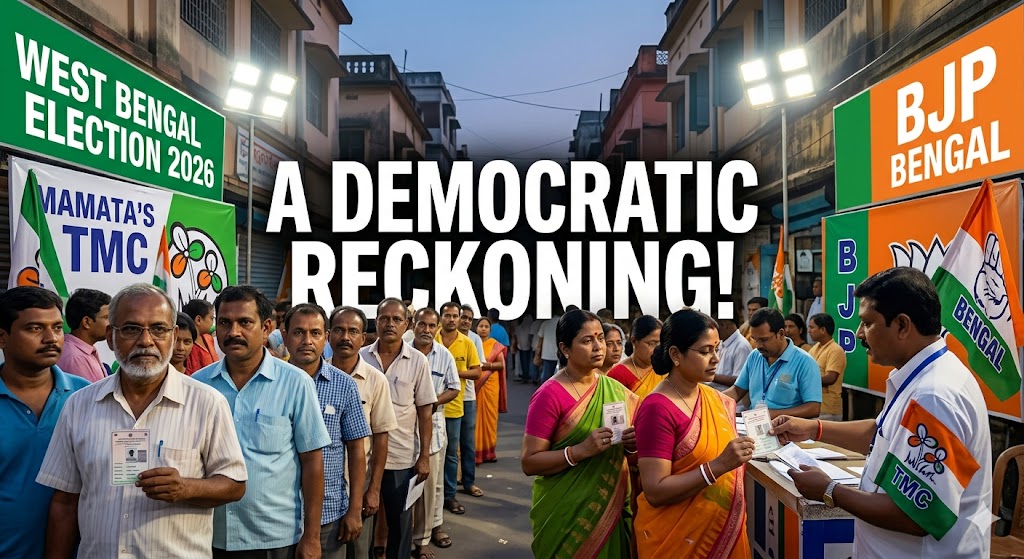
A modern watershed: This photograph, generically representing the West Bengal Legislative Assembly elections scheduled for April 2026, visualizes a bottom-up democratic watershed where voters hold the agency to redefine the state’s political soul, federal balance, and cultural identity.
Future Implications for Bengal and India
If power shifts in 2026, expect accelerated infrastructure under central schemes, possible industrial revival, and recalibrated minority welfare models. A TMC retention might intensify federal assertions, cultural protectionism, and welfare populism.
In either scenario, West Bengal’s role as India’s cultural and economic bridge to the east will evolve. Bengali identity—forged through resistance to the 1905 partition—will continue to shape national discourse on language, secularism, and pluralism.
The partition of Bengal was never merely a map exercise; it was a catalyst for awakening. The 2026 West Bengal election, too, is more than a state poll. It represents a democratic reckoning with history—testing whether Bengal’s voters will choose continuity, change, or a new synthesis.
As results unfold in May 2026, historians and citizens alike will watch closely. The lessons of 1905 and 1947 remind us that divisions—whether colonial, communal, or political—ultimately yield to the will of the people. In that spirit, the upcoming election stands as a living chapter in India’s ongoing democratic saga.