"Maharana Pratap: Fearless Hero of Mewar(kumbhalgarh)"
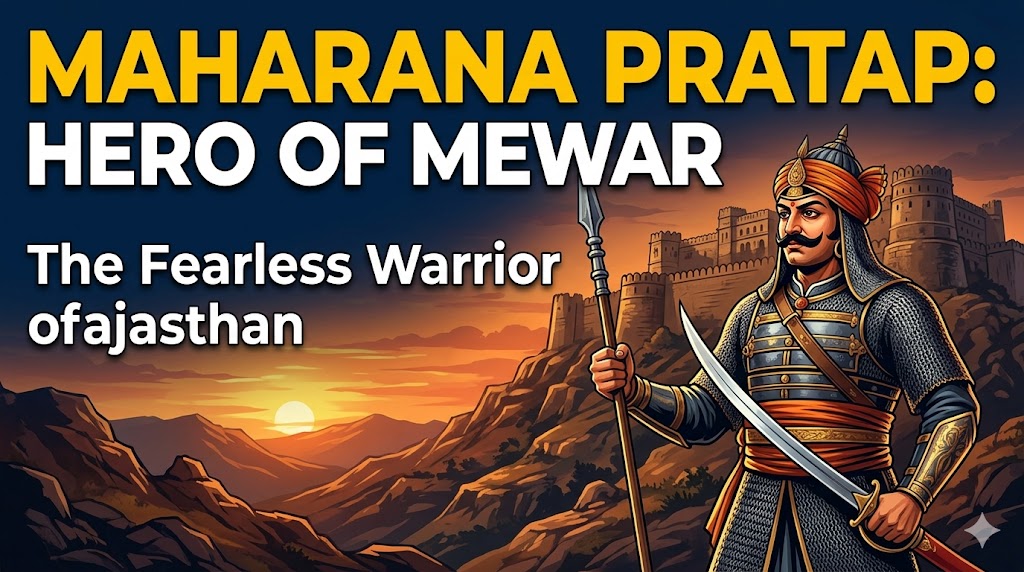
In the rugged hills of Rajasthan, where courage meets the call of freedom, stands the immortal figure of Maharana Pratap. He remains one of India’s most revered warriors, a Rajput king whose life embodied resistance, honor, and unwavering patriotism. Born into the illustrious Sisodia dynasty of the Kingdom of Mewar, Maharana Pratap refused to bow before the expanding Mughal Empire under Emperor Akbar. While many contemporary rulers sought alliances through submission,Maharana Pratap chose the path of defiance. His story inspires generations as the glorious icon of Rajasthan’s hills—a major symbol of valor that continues to echo through Rajasthan’s proud history.
This detailed account draws from verified historical sources, including accounts from Rajasthan’s own records, scholarly biographies, and official heritage sites. It presents Maharana Pratap’s journey in full—from his early years to his legendary battles and enduring legacy—for educational purposes. Every chapter highlights his positive contributions: his strategic brilliance, deep love for his people, and commitment to dharma and independence.
Early Life and Royal Heritage
Maharana Pratap entered the world in May 1540 at the formidable Kumbhalgarh Fort in the Aravalli hills of Mewar (present-day Rajsamand district, Rajasthan). He was the eldest son of Maharana Udai Singh II, the founder of Udaipur, and Maharani Jaiwanta Bai. From birth, the young prince was groomed in the warrior traditions of the Rajputs. The Sisodia clan traced its lineage to legendary figures like Rana Sanga, instilling values of bravery, justice, and self-respect.
Growing up amid the majestic forts and dense forests of Mewar, Maharana Pratap developed exceptional skills in horsemanship, archery, and swordsmanship. His father had faced the traumatic sack of Chittorgarh by Akbar’s forces in 1567, an event that left a deep imprint on the young prince. Even as a boy, Maharana Pratap showed a fierce sense of independence. He trained not just in the arts of war but also in governance and empathy for his subjects. His early exposure to the challenges of ruling a kingdom under constant threat prepared him for the trials ahead. Historians describe him as tall, strong, and charismatic—qualities that would later rally soldiers and common folk alike to his cause.
The cultural and spiritual environment of Mewar further shaped Maharana Pratap. Devoted to Hindu traditions and the protection of dharma, he viewed his role as more than a ruler—it was a sacred duty to safeguard the sovereignty of his land. These formative years in the hills of Rajasthan forged the unyielding spirit that would define Maharana Pratap’s entire life.
Ascension to the Throne of Mewar
When Maharana Udai Singh II passed away in 1572, a succession dispute arose. Though the late ruler had favored another son, the senior nobles and people of Mewar overwhelmingly supported Maharana Prata as the rightful heir. On 28 February 1572, at the age of 32, he was crowned in Gogunda on the auspicious day of Holi, becoming the 13th Rana of Mewar. This moment of popular will underscored the deep bond between Maharana Pratap and his subjects—a relationship built on trust and shared values.
Immediately after ascending the throne, Maharana Prata set about strengthening Mewar. He reorganized the administration, fortified key strongholds, and prepared his forces for the inevitable conflict with the Mughals. Unlike many other Rajput kingdoms that had accepted Mughal suzerainty, Maharana Pratap made it clear he would never compromise Mewar’s independence. His coronation marked the beginning of an era of resistance that would test his resolve like no other.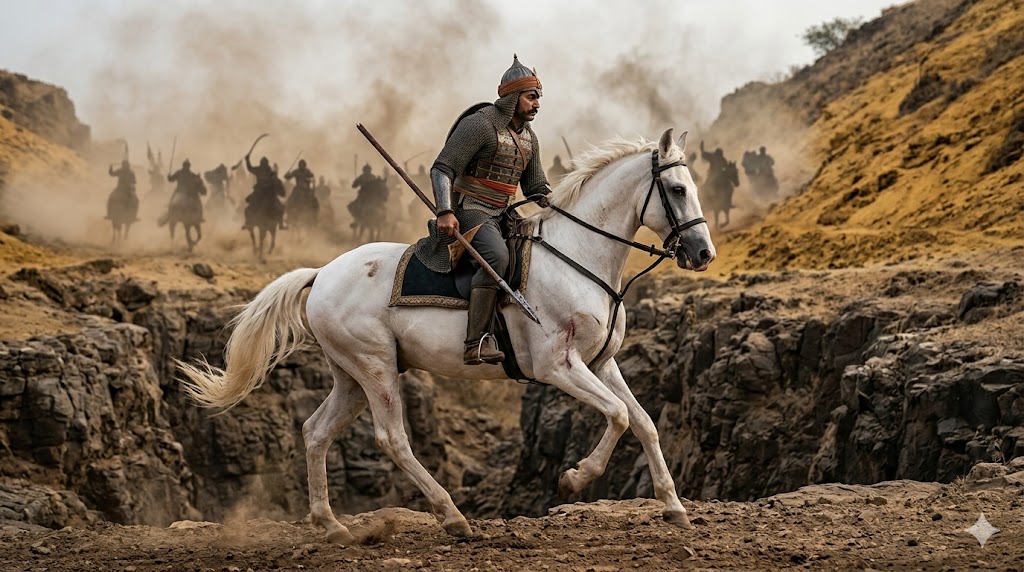
Wounded and weary, Maharana Pratap trusts his loyal stallion, Chetak, to clear a treacherous ravine and carry him to safety after the intense and symbolically significant stand at Haldighati.
Defiance Against the Mughal Empire
Maharana Pratap’s reign coincided with Akbar’s ambitious expansion. The Mughal emperor sought to consolidate power across northern India through diplomacy, alliances, and military force. Akbar sent multiple emissaries—including Raja Man Singh, Todar Mal, and others—offering high ranks, matrimonial alliances, and tribute in exchange for submission. Maharana Pratap politely but firmly refused every overture. He viewed acceptance as a betrayal of his ancestors and his people’s honor.
This stance was not mere stubbornness; it stemmed from a profound commitment to swadharma and self-respect. While other rulers enjoyed the comforts of Mughal courts, Maharana Pratap chose the hardships of freedom. He reorganized Mewar’s defenses, encouraged his subjects to seek refuge in the mountains during invasions, and fostered alliances with local Bhil tribes whose knowledge of the terrain proved invaluable. His refusal to surrender the symbolic elephant Ram Prasad or accept the title of Panj Hazari further highlighted his uncompromised dignity.
Maharana Pratap’s defiance inspired not only his own kingdom but also future generations of freedom fighters. His guerrilla tactics and emphasis on non-cooperation with Mughal tax collectors laid early groundwork for strategies later used across India.
The Legendary Battle of Haldighati
The most iconic chapter in Maharana Pratap’s history unfolded on 18 June 1576 at the narrow mountain pass of Haldighati, near Gogunda in Rajasthan. Facing overwhelming odds, Maharana Pratap led approximately 3,000 cavalry and 400 Bhil archers against a Mughal force of around 10,000 troops commanded by Raja Man Singh on Akbar’s behalf.
The battle raged for over three hours in the yellow-soiled valley that gave Haldighati its name. Maharana Pratap fought with extraordinary valor, charging deep into enemy lines. His loyal horse, Chetak, performed one of history’s most celebrated acts of devotion. Despite sustaining severe wounds, Chetak carried his master to safety, leaping across a ravine before collapsing. In a selfless act, Jhala Man Singh donned the Maharana’s crown as a decoy to draw enemy fire, allowing Maharana Pratap to escape.
Though the Mughals technically claimed victory on the field, the battle proved strategically inconclusive for them. They failed to capture or subdue Maharana Pratap. The heroic stand at Haldighati became a symbol of Rajput pride. Today, the Maharana Pratap National Memorial at Haldighati, with its bronze statue of the king on Chetak, honors this eternal legacy.
Years of Exile, Guerrilla Warfare, and Recovery
Following Haldighati, Mughal forces under Shahbaz Khan captured several Mewar strongholds, forcing Maharana Pratap into the Aravalli hills. For years he lived simply—sleeping on grass beds and eating forest produce—sharing every hardship with his family and loyal followers. Yet Maharana Pratap never lost hope. He waged relentless guerrilla warfare, launching surprise attacks and reclaiming territories one by one.
By the mid-1580s, with Akbar preoccupied elsewhere, Maharana Pratap recaptured key areas including Udaipur, Gogunda, Kumbhalgarh, and dozens of outposts. He made Chavand his new capital, where he patronized art, poetry, and culture, fostering the Chavand school of painting. His minister Bhamashah and brother Shakti Singh (who had earlier joined the Mughals but aided his escape at Haldighati) provided crucial support. By the time of his death, Maharana Pratap had restored much of Mewar’s glory through sheer determination.
Personal Life, Family, and Values
Maharana Pratap married several Rajput princesses, with Maharani Ajabde Punwar as his chief consort and source of strength. Their union produced his eldest son and successor, Amar Singh I. Historical records note Maharana Pratap had multiple consorts and children who stood by him through exile. His family endured immense sacrifices, yet their shared resolve only deepened his commitment.
Beyond the battlefield, Maharana Pratap was a just and compassionate ruler. He treated his subjects with fairness, protected the weak, and maintained high moral standards. Even his enemies admired his character. His life exemplified the Rajput code: courage in adversity, loyalty to dharma, and love for the motherland.
Death and Immediate Succession
On 19 January 1597, at the age of 56, Maharana Pratap passed away at Chavand after injuries sustained in a hunting accident. On his deathbed, he urged his son Amar Singh never to submit to the Mughals and to continue the fight for Chittorgarh. His passing was mourned across Rajasthan, yet his spirit lived on. Amar Singh eventually succeeded him and carried forward the legacy of resistance.
Enduring Legacy in Art, Culture, and Modern Rajasthan
Maharana Pratap’s influence extends far beyond his lifetime. He is celebrated in Rajasthan’s folklore, statues (notably at Moti Magri in Udaipur), and annual commemorations on his birth anniversary (Maharana Pratap Jayanti). His horse Chetak has become a national symbol of loyalty.
In popular culture, Maharana Pratap lives through films, television serials such as Bharat Ka Veer Putra – Maharana Pratap on Sony, songs, art, and even digital statuses. Memorials like the Pratap Gaurav Kendra in Udaipur preserve his story through immersive exhibits. Historians such as Colonel James Tod hailed him as the “Leonidas of Rajasthan.” His guerrilla strategies influenced later Indian leaders, and his statue in Parliament House stands as a tribute to national pride.
For Rajasthan, Maharana Pratap represents the glorious heart of its identity—resilient, proud, and eternally free. Schools, universities, and cultural programs teach his life as a lesson in patriotism and leadership.
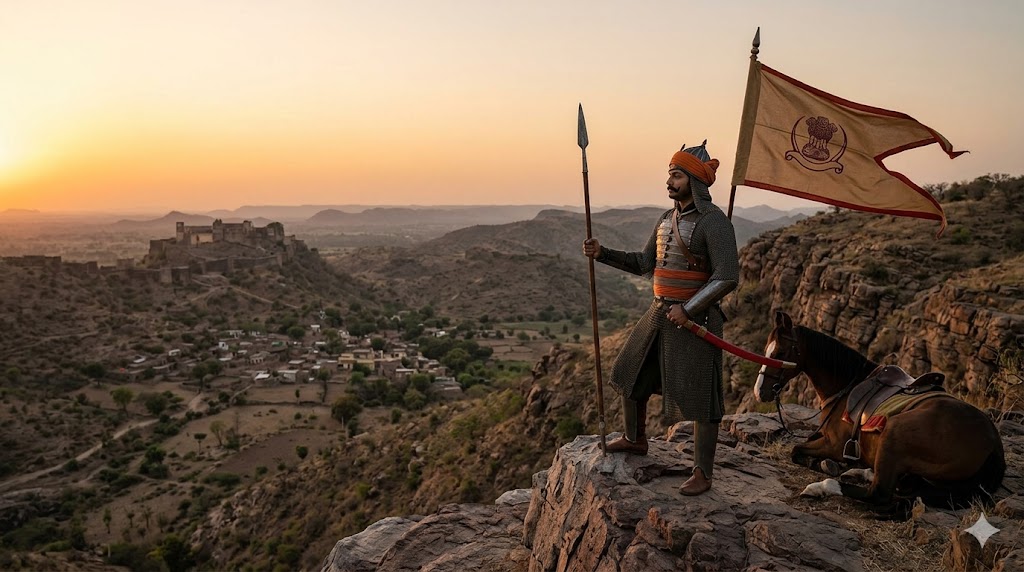
Maharana Pratap looks out over the Aravalli hills during his years of strategic guerrilla warfare. He chose the hardships of freedom in the mountains over the comforts of Mughal submission.
Conclusion: An Inspiration for All Time
Maharana Pratap was more than a king; he was a beacon of hope in dark times. His refusal to compromise, his strategic genius in the hills of Rajasthan, and his deep love for Mewar created a legacy that transcends centuries. In every tale of Maharana Pratap—whether in history books, songs, or statues—we find a reminder that true victory lies in the courage to stand for what is right.
As Rajasthan and India celebrate this legendary son, Maharana Pratap continues to teach us the value of self-respect, resilience, and unwavering patriotism. His life remains a shining chapter in the glorious history of Rajasthan, inspiring every generation to cherish freedom above all else.