"Swami Dayanand Saraswati: Life, Reforms & Legacy"
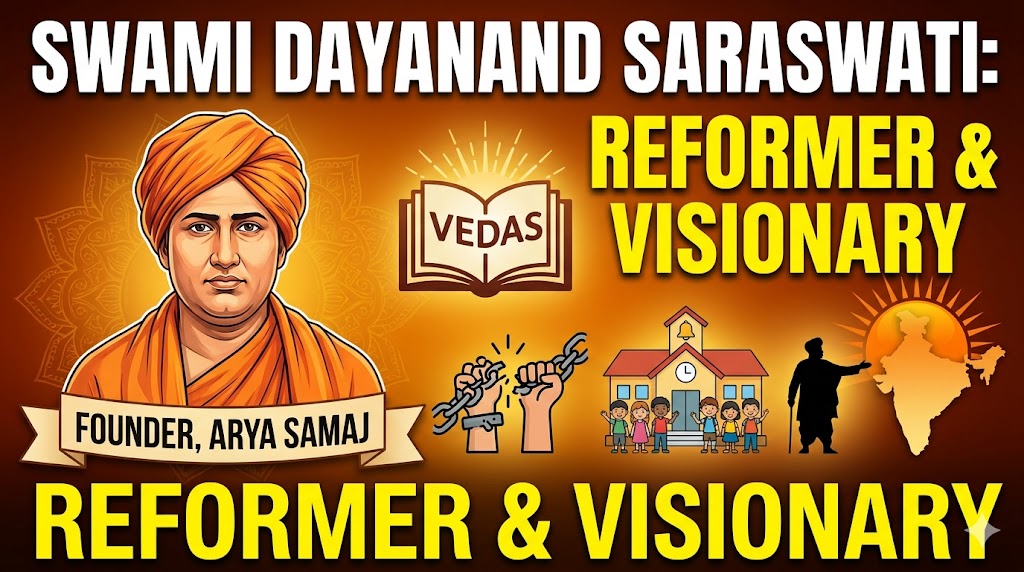
Swami Dayanand Saraswati stands as one of the most transformative figures in modern Indian history. Born in 1824 and passing in 1883, this visionary philosopher, ascetic, and reformer ignited a powerful movement that challenged entrenched social evils and rekindled India’s spiritual and national pride. As the founder of Arya Samaj, Swami Dayanand Saraswati championed a return to the pure teachings of the Vedas while fiercely rejecting idolatry, caste discrimination, child marriage, and other practices that had weakened Hindu society. His call for “Back to the Vedas” was not mere nostalgia—it was a radical blueprint for rational inquiry, social equality, and self-reliance that directly fueled India’s awakening during colonial rule.
Through tireless travels, public debates, and seminal writings like Satyarth Prakash, Swami Dayanand Saraswati preached the importance of Vedic research and critical thinking. He gave India a new framework for education, governance, and personal conduct that empowered ordinary citizens to question orthodoxy and aspire to Swaraj. Today, as India grapples with social divisions and the need for ethical renewal, the teachings of Swami Dayanand Saraswati offer timeless guidance. This article explores his remarkable journey, profound contributions to social reform, pivotal role in the freedom struggle, and enduring relevance in contemporary times.
Early Life and the Spark of Awakening
Swami Dayanand Saraswati was born Mool Shankar Tiwari on 12 February 1824 in Tankara, a small town in Gujarat’s Morbi district, into an orthodox Brahmin family. His father, Karshanji Lalji Tiwari, was a devout Shiva worshipper who instilled traditional rituals in the young boy. At age eight, Swami Dayanand Saraswati underwent the sacred thread ceremony and began formal Vedic studies.
A pivotal incident at age 14 shattered his unquestioning faith. While keeping an all-night vigil at a Shiva temple with his father, he witnessed mice climbing over and defiling the idol while the priests slept. This simple event exposed the futility of idol worship to the young mind: if the deity could not protect its own image, how could it safeguard devotees? The deaths of his sister and a beloved uncle from cholera further deepened his existential quest. By his late teens, Swami Dayanand Saraswati had rejected an arranged marriage and, in 1846, left home to pursue truth as a wandering ascetic.
These early experiences shaped the reformer’s lifelong commitment to reason over ritual. Swami Dayanand Saraswati’s rejection of blind tradition began here, laying the foundation for his later crusade against social evils that plagued Indian society.
For nearly 25 years (roughly 1845–1869), Swami Dayanand Saraswati roamed India as a sannyasi, practicing rigorous yoga, visiting pilgrimage sites, and studying under various gurus. He lived in forests and Himalayan caves, mastering Sanskrit, the six Darshanas, and the Vedas while observing the decay of Hindu practices firsthand.
The turning point came when he met Swami Virajanand Dandeesha in Mathura. This blind but erudite scholar impressed upon Swami Dayanand Saraswati that Hinduism had strayed far from its Vedic roots. In exchange for free tuition, the guru extracted a solemn vow: restore the Vedas as the supreme authority and purge society of superstition and priestly exploitation. Swami Dayanand Saraswati embraced this mission with unwavering zeal. He emerged from this period not only as a scholar but as a fiery orator ready to debate orthodox pandits across the country.
His public debut in Varanasi in 1869 drew over 50,000 people. Swami Dayanand Saraswati systematically dismantled arguments for idol worship, winning widespread acclaim and notoriety. These years of disciplined wandering equipped him with the intellectual arsenal and moral authority to launch a nationwide reform movement.
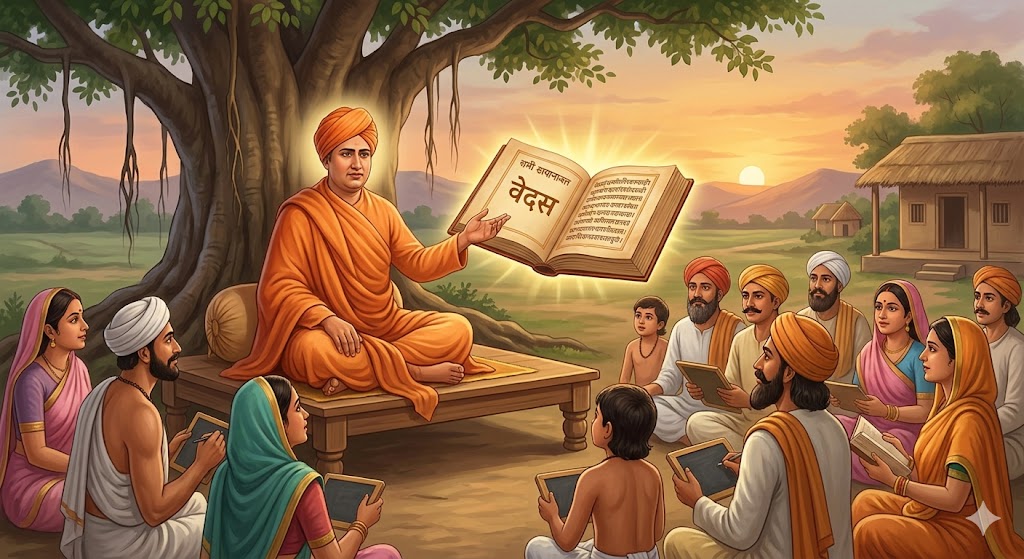
Swami Dayanand Saraswati teaching and pointing toward the radiant Vedas, symbolizing his call to rational inquiry and the rejection of dogma through ancient knowledge.
Founding Arya Samaj: A Revolutionary Platform for Change
On 10 April 1875 in Bombay (now Mumbai), Swami Dayanand Saraswati formally established the Arya Samaj—“Society of Nobles.” Its motto, *Krinvanto Vishwam Aryam* (“Make this world noble”), encapsulated his global vision of righteousness. The organization was deliberately simple: no temples, no hereditary priesthood, and open membership regardless of caste or gender.
Swami Dayanand Saraswati drafted the Ten Universal Principles that remain the bedrock of Arya Samaj philosophy. These principles emphasize truth, justice, the infallibility of the Vedas, and the duty to promote universal welfare. By creating local branches, Vedic schools, and public platforms for debate, Swami Dayanand Saraswati transformed Arya Samaj into a dynamic force for both spiritual revival and social engineering. Within years, the movement spread across northern India, challenging missionary conversions and orthodox resistance alike.
Core Teachings: Preaching Vedic Research and Rational Dharma
At the heart of Swami Dayanand Saraswati’s message was the imperative to return to the Vedas—the eternal, revealed knowledge given by the Supreme Lord. He insisted that the four Vedas (Rig, Yajur, Sama, and Atharva) contain all truth, including scientific principles, and must be studied critically rather than blindly chanted. Swami Dayanand Saraswati encouraged Vedic research through translation, commentary, and open discussion, rejecting later Puranic texts that he viewed as corrupted by idolatry and superstition.
His magnum opus, Satyarth Prakash (Light of Truth), published in 1875 and revised in 1884, remains a comprehensive manual of Vedic living. In it, Swami Dayanand Saraswati outlines duties across life stages (brahmacharya, grihastha, vanaprastha, sannyasa), critiques other religions with scholarly rigor, and promotes monotheism centered on the formless, omnipresent God (Om). He taught that true Dharma rests on impartial justice, truthfulness, and actions benefiting humanity.
Swami Dayanand Saraswati’s teachings stressed rational inquiry and scientific temper long before these became modern buzzwords. He viewed ignorance as the root of misery and knowledge as the path to emancipation. By opening Vedic study to all—women, Shudras, and even non-Hindus through the Shuddhi (purification) movement—Swami Dayanand Saraswati democratized spiritual wisdom and struck at the heart of the priestly monopoly.
Rejecting Social Evils: A Relentless Crusade for Equality
Swami Dayanand Saraswati’s greatest legacy lies in his fearless assault on the social evils that had ossified Indian society. He rejected the hereditary caste system, arguing that varna should be determined by individual qualities, education, and occupation—not birth. Untouchability, he declared, had no Vedic sanction and was a later perversion that degraded humanity. Through Arya Samaj, he promoted inter-caste marriages, interdining, and equal rights, effectively reducing these barriers wherever the movement took root.
Women’s upliftment was another cornerstone. Swami Dayanand Saraswati advocated equal education for girls, widow remarriage, and the abolition of child marriage and Sati. He condemned practices that treated women as property or inferior beings, citing Vedic passages that honored them as equals in the household and society. Animal sacrifice, meat-eating in rituals, pilgrimages, and sorcery also faced his scathing critique as anti-Vedic and exploitative.
Swami Dayanand Saraswati implemented these reforms practically. Arya Samaj branches ran schools, orphanages, and widow homes. Public shastras (debates) exposed the hollowness of superstitious customs. His personal courage—surviving multiple poisoning attempts and continuing his work undeterred— inspired thousands to reject social evils. In doing so, Swami Dayanand Saraswati not only reduced these practices in Arya Samaj circles but shifted public discourse across India, making reform a national imperative.
Educational Vision and Promotion of Rational Inquiry
Swami Dayanand Saraswati understood that lasting change required education. He envisioned a Gurukula system revived for modern times—emphasizing Vedic knowledge alongside practical sciences, physical fitness, and moral discipline. Although the famous Dayanand Anglo-Vedic (DAV) schools and colleges emerged after his death, they realized his dream of affordable, value-based education open to all castes and genders.
He promoted Hindi as a national language to foster unity and Sanskrit for deeper scriptural study. Swami Dayanand Saraswati’s emphasis on critical thinking—questioning dogma through logic, perception, and inference—equipped Indians to resist both colonial education and indigenous superstition. His teachings cultivated a generation of rational patriots who valued self-reliance over blind imitation.
Role in India’s Freedom Struggle: The First Call for Swaraj
Though Swami Dayanand Saraswati passed away in 1883—before the formal launch of the Indian National Congress—he is rightly regarded as a major precursor to the freedom movement. In 1876, he became the first prominent voice to demand Swaraj with the stirring slogan “India for the Indians.” This clarion call resonated deeply and was later popularized by leaders like Bal Gangadhar Tilak.
The Arya Samaj became a cradle of nationalism. Swami Dayanand Saraswati’s disciples and followers included Lala Lajpat Rai, Swami Shraddhanand, Bhagat Singh’s family members, Shyamji Krishna Varma, Vinayak Damodar Savarkar, and many revolutionaries. The organization’s emphasis on self-respect, cultural pride, and resistance to foreign domination (whether British, Christian missionary, or Islamic conversion) fostered the psychological groundwork for political independence. Leaders across the spectrum—from moderates to extremists—acknowledged his influence. Sardar Vallabhbhai Patel, Rabindranath Tagore, and others paid glowing tributes to Swami Dayanand Saraswati as a foundational architect of modern India’s awakening.
By rejecting foreign cultural supremacy and reviving indigenous intellectual traditions, Swami Dayanand Saraswati transformed religious reform into a powerful tool of national resistance. His life and teachings made him one of the major freedom fighters in spirit, even if not in the battlefield sense.
Relevance of His Teachings in Today’s India
In the 21st century, Swami Dayanand Saraswati’s message resonates more strongly than ever. Amid persistent caste tensions, gender inequality, religious polarization, and the challenges of misinformation, his insistence on Vedic research, rational inquiry, and universal welfare offers a corrective path.
His rejection of social evils reminds us that true progress demands constant vigilance against discrimination. The Arya Samaj’s emphasis on education for all, cow protection as environmental and ethical stewardship, and one national language for unity address contemporary debates on inclusivity and national integration. Most importantly, Swami Dayanand Saraswati taught that individual character-building—through truth, justice, and selfless service—forms the bedrock of a strong nation. In an era of rapid technological change, his call to balance material progress with spiritual and moral values remains profoundly relevant. Leaders, educators, and citizens who study his works today find practical solutions for ethical governance, social harmony, and personal fulfillment.
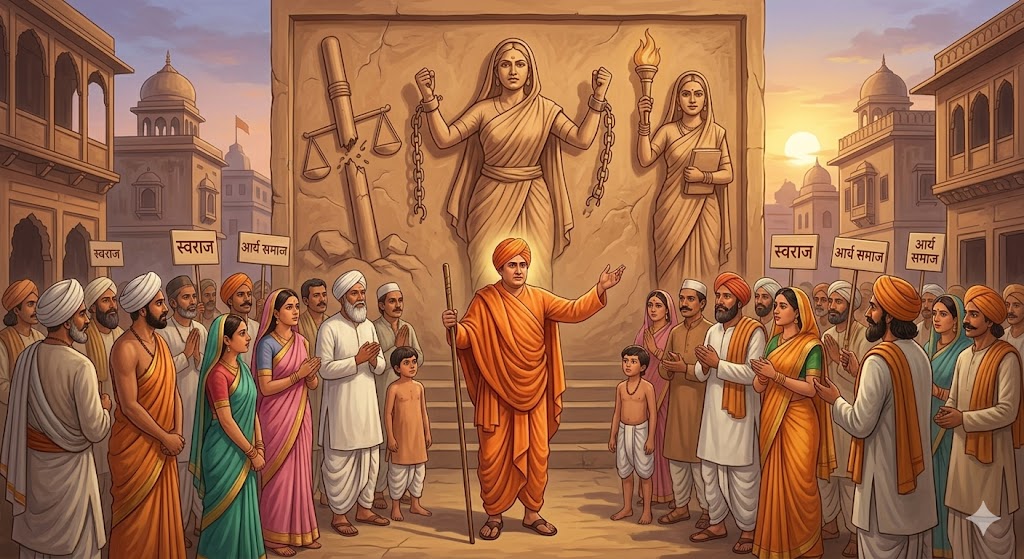
Swami Dayanand Saraswati preaching in a town square, inspiring the first call for Swaraj (Self-Rule). Behind him, a conceptual sculpture shows freedom breaking the chains of social evils.
Conclusion
Swami Dayanand Saraswati was far more than a religious reformer; he was a visionary who reshaped India’s social, educational, and national landscape. From his humble beginnings in Tankara to the founding of Arya Samaj and the authoring of enduring texts, he consistently rejected social evils, preached the transformative power of Vedic research, and gave India teachings that prioritize reason, equality, and self-rule. His contributions to social reform dismantled centuries-old barriers, while his nationalist spirit inspired generations of freedom fighters.
As we navigate the complexities of modern India, the life and legacy of Swami Dayanand Saraswati serve as a guiding light. His teachings urge us to return to first principles—truth, justice, and universal brotherhood—while embracing progress. By studying and applying the principles he championed, we honor not only the reformer but also the enduring spirit of a resurgent India. Swami Dayanand Saraswati’s vision continues to call us toward a nobler, more enlightened future—one where every individual can truly become an “Arya” in thought, word, and deed.