The Story of My Experiments with Truth: A Deep Analysis
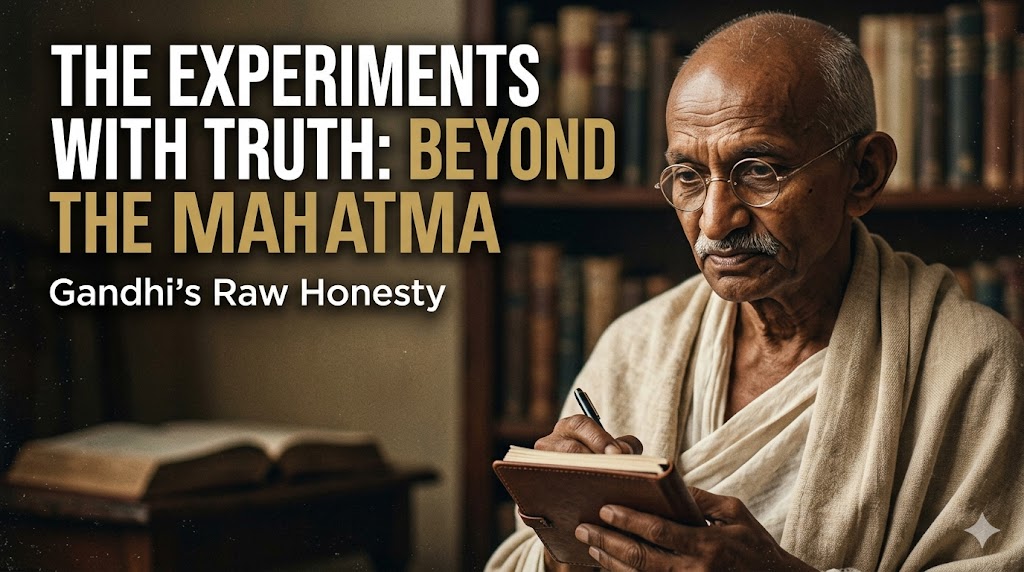
Beyond the Mahatma
When we think of Mohandas Karamchand Gandhi, the image that usually emerges is that of the "Mahatma"—the Great Soul—or the "Father of the Nation." We see a saintly figure in a loincloth who brought an empire to its knees through non-violence. However, the Mahatma Gandhi autobiography, titled The Story of My Experiments with Truth, presents a startlingly different perspective.
In this seminal work, Gandhi does not write as a national hero or a flawless leader. Instead, he writes as a vulnerable, often struggling, common man. This book is not a self-congratulatory memoir but a clinical examination of a soul. It covers his childhood, his education in London, his transformative years in South Africa, and his eventual emergence in Indian politics. Most importantly, it reveals the "hidden" Gandhi—the man who made mistakes, grappled with lust, succumbed to anger, and eventually used "Truth" as a laboratory for self-improvement.
The Genesis of the "Experiments"
Gandhi began writing his autobiography in installments for his journal, Navajivan, between 1925 and 1929. The choice of the word "Experiments" in the title is deliberate. Gandhi viewed his life not as a settled narrative, but as a series of scientific trials where the subject was his own spirit.
Why He Wrote It
Gandhi was initially hesitant to write an autobiography. He feared it might foster a personality cult. He agreed only when convinced that his life could serve as a manual for others seeking Truth. He wanted to demonstrate that if a man as "ordinary" and "weak" as he once was could achieve self-realization, anyone could.
Part 1: The Frailty of Childhood and Youth
The Mahatma Gandhi autobiography begins with an unvarnished look at his upbringing in Porbandar and Rajkot. Unlike many historical figures who sanitize their youth, Gandhi is brutally honest about his moral lapses.
The Stolen Bit of Gold and the Confession
One of the most moving scenes in the book involves a young Gandhi stealing a bit of gold from his brother’s armlet to clear a debt. The guilt was suffocating. Rather than hiding it, he wrote a confession to his dying father. He didn't just ask for punishment; he pledged never to steal again.
"My father read it through, and tears trickled down his cheeks, wetting the paper. For a moment he closed his eyes in thought and then tore up the note. He had sat up to read it. He again lay down. I also wept. I could see my father's agony."
This was Gandhi's first real "experiment" with Ahimsa (non-violence) and Truth. He realized that pure confession is the highest form of repentance.
Struggles with Meat and Lust
Gandhi recounts his brief, secret foray into meat-eating, prompted by a friend’s argument that it would make him strong like the British. The deception involved—lying to his strictly vegetarian parents—caused him such mental anguish that he eventually abandoned the practice.
Furthermore, he discusses his early marriage to Kasturba. He admits to being a "jealous husband" and struggles with his own carnal desires, which he later sought to transcend through the vow of Brahmacharya (celibacy). By sharing these intimate details, the Mahatma Gandhi autobiography humanizes a man who would later be deified.
Part 2: The London Years – A Victorian Indian
In 1888, Gandhi sailed for England to study law. This section of the Mahatma Gandhi autobiography highlights the clash between Eastern values and Western lifestyle.
The "English Gentleman" Phase
For a brief period, Gandhi tried to become the perfect English gentleman. He took dancing lessons, tried to learn the violin, and bought expensive suits and a pocket watch. However, he soon realized the superficiality of these pursuits.
The Vow: Before leaving India, he had promised his mother he would touch neither "wine, woman, nor meat."
The Reality: In London, he nearly starved because he couldn't find vegetarian food, until he stumbled upon a vegetarian restaurant and Henry Salt's A Plea for Vegetarianism. This was a turning point where his vegetarianism shifted from a religious habit to a conscious, ethical choice.
Part 3: South Africa – The Birth of Satyagraha
If India made Gandhi a leader, South Africa made him a Mahatma. The Mahatma Gandhi autobiography spends significant time on the twenty years he spent in South Africa, which he describes as his "laboratory."
The Pietermaritzburg Station Incident
Every student of history knows of Gandhi being thrown off a train at Pietermaritzburg because of his race. In the book, Gandhi describes the internal dialogue that followed. He sat in the cold waiting room, shivering, wondering if he should flee back to India or stay and fight. He chose to stay. This was the birth of Satyagraha—soul force or truth force.
Developing the "Playing 11" of Virtues
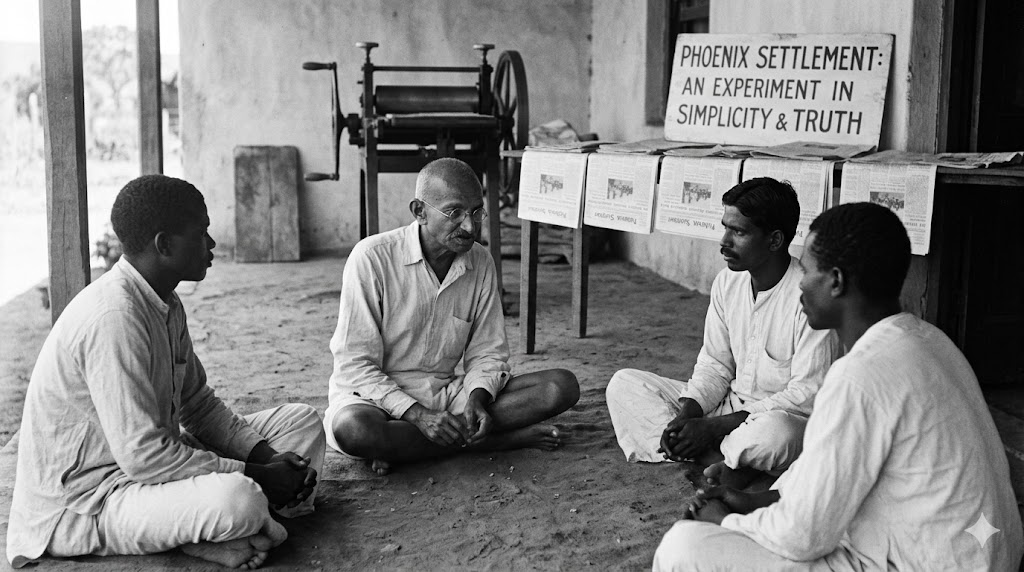
In South Africa, Gandhi didn't just fight for political rights; he restructured his entire life. He established the Phoenix Settlement and Tolstoy Farm, where he practiced:
Manual labor
Communal living
Simplicity
Self-reliance
He even describes how he learned to launder his own collars and cut his own hair to avoid the humiliation of being refused service by white barbers. The Mahatma Gandhi autobiography emphasizes that political freedom is impossible without personal discipline.
Part 4: The Transformation of a Common Man
One of the most striking aspects of the book is Gandhi’s refusal to identify as the "Father of the Nation." To the world, he was a political giant; to himself, he was a seeker.
The "Father" vs. The "Man"
The book ends in 1921, before his most famous campaigns (like the Dandi March). He stopped writing because his life had become so public that there was "nothing lived in secret." He explicitly states that he does not want his words to be treated as "law." He acknowledges his errors in judgment—what he called his "Himalayan Miscalculations"—and discusses how he rectified them.
Facing the Ego
Gandhi believed that the greatest enemy of Truth is the ego. In the Mahatma Gandhi autobiography, he writes:
"The seeker after truth should be humbler than the dust. The world crushes the dust under its feet, but the seeker after truth should so humble himself that even the dust could crush him. Only then, and not till then, will he have a glimpse of truth."
The Philosophy of "Experiments"
To understand the Mahatma Gandhi autobiography, one must understand the three pillars that Gandhi tested throughout his life:
1. Satya (Truth)
For Gandhi, Truth was not just telling the truth; it was God. He believed that Truth is the only thing that is permanent. Every action, whether in the kitchen or the courtroom, had to be aligned with this ultimate reality.
2. Ahimsa (Non-violence)
Non-violence was the means to reach the Truth. Gandhi’s autobiography clarifies that Ahimsa is not the weapon of the weak but the weapon of the strongest. It requires more courage to face a blow without retaliating than to strike back.
3. Aparigraha (Non-possession)
As Gandhi progressed, he shed his worldly possessions. He realized that to serve the poorest of the poor, he had to live like them. This transition from a lawyer in a suit to a "half-naked fakir" is a central theme of his experiments.
Structuring the Truth: A Chapter-by-Chapter Insight
The Mahatma Gandhi autobiography is divided into five parts. Each part represents a distinct evolution in his consciousness.
Part Focus Key Lesson
Part I Childhood & Youth The power of confession and parental respect.
Part II London & Return Intellectualizing his diet and identity.
Part III Early South Africa Encountering systemic racism and the first Satyagraha.
Part IV Spiritual Growth Vows of Brahmacharya and the Zulu Rebellion.
Part V Return to India Champaran, Kheda, and the Rowlatt Act.
Why the "Common Man" Perspective Matters
The user mentions that the book represents Gandhi as a common man who made mistakes. This is the "hidden" brilliance of the Mahatma Gandhi autobiography.
Many people view Gandhi as an unattainable ideal. By admitting to his "lustful" thoughts, his "anger" toward his wife, and his "vanity" as a young man, he bridges the gap between the saint and the sinner. He shows that the path to greatness is paved with the stones of failure. He was a man who had "all kinds of luxuries" and the "love of fame," yet he consciously walked away from them to find something deeper.
Impact on Modern Leadership
The Mahatma Gandhi autobiography remains a bestseller nearly a century later because it offers a blueprint for "Authentic Leadership." In an era of curated social media personas, Gandhi’s radical transparency is refreshing.
Vulnerability as Strength: Gandhi showed that admitting mistakes builds more trust than pretending to be perfect.
Consistency: He didn't have one set of rules for his private life and another for his public life.
The Scientific Temper: He encouraged people to test his ideas for themselves rather than following them blindly.
Critical Analysis: What the Book Omits
While the Mahatma Gandhi autobiography is incredibly honest, it is also selective. It concludes in the early 1920s. It does not cover the Partition of India, his complex relationship with his children (particularly Harilal), or the final years leading to his assassination.
However, as a guide to the internal world of Gandhi, it is unsurpassed. It reveals the "scenes which were not known by the common people"—the nights of prayer, the agony over small moral failures, and the constant striving for self-control.
How to Read the Autobiography Today
When approaching the Mahatma Gandhi autobiography, one should not read it as a historical record, but as a spiritual diary.
Look for the "Why": Don't just focus on what he did, but why he did it.
Identify with the Struggles: Notice how often he failed. It makes his eventual successes more meaningful.
Question Everything: Gandhi wanted his readers to be "experimenters" like him.
Conclusion: The Legacy of the Mahatma Gandhi Autobiography
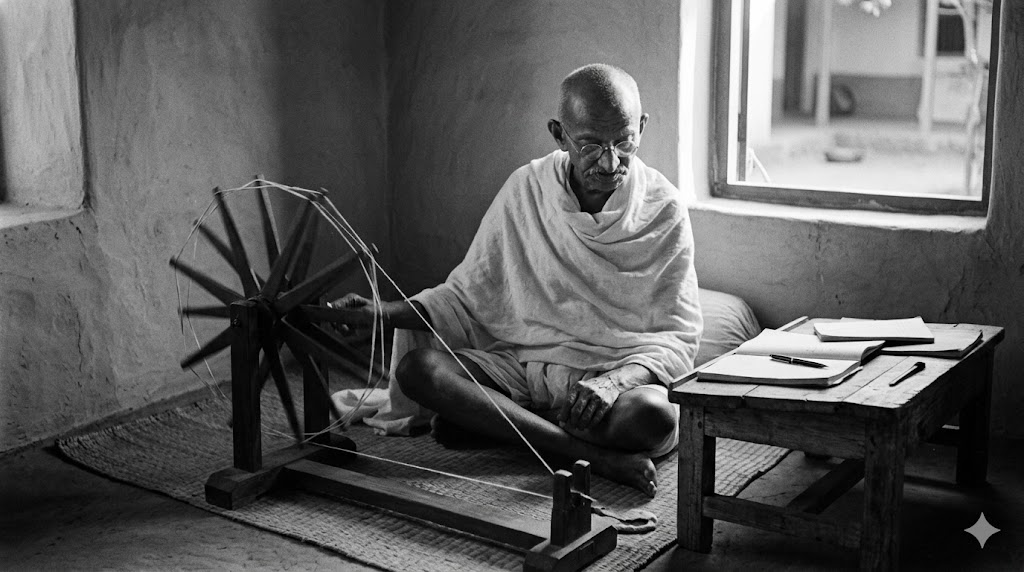
The Mahatma Gandhi autobiography is more than just a book; it is a testament to the power of the human will. It proves that truth is not a destination but a journey. Whether you are interested in history, politics, or personal growth, The Story of My Experiments with Truth offers timeless wisdom.
By portraying himself as a common man who stumbled, fell, and rose again, Gandhi became the ultimate inspiration for generations to come. He didn't just write about the truth; he lived it, one experiment at a time.
Key Takeaways
The Mahatma Gandhi autobiography is a masterclass in radical honesty.
It highlights the importance of aligning personal life with public values.
Gandhi’s experiments with food, health, and celibacy were central to his political power.
The book focuses on the "ordinary" man to inspire others to seek the "extraordinary" truth.