Natyashastra: Oldest Treatise on Drama, Dance & Music
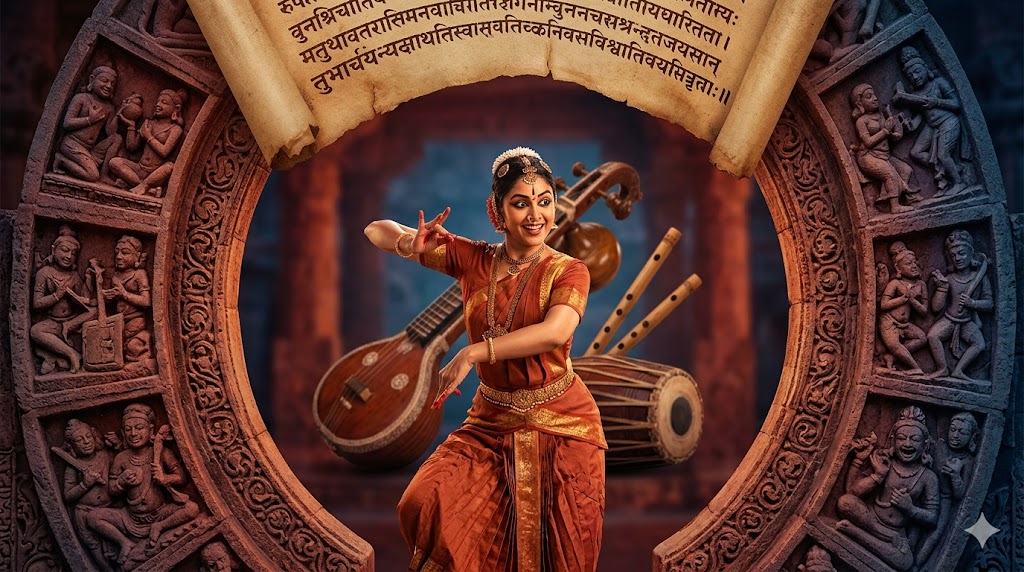
The Natyashastra stands as one of the most profound and enduring contributions to human creativity. Attributed to the sage Bharata Muni, this ancient Sanskrit text is widely regarded as the oldest comprehensive treatise on the performing arts in the world. Composed between approximately 200 BCE and 200 CE—with scholarly estimates placing its roots even earlier in the 1st millennium BCE—it offers a complete framework for drama, dance, music, stagecraft, and aesthetics.
Far more than a technical manual, the Natyashastra by Bharata Muni integrates philosophy, mythology, and practical guidance. It presents performing arts as a sacred fifth Veda, designed to educate, entertain, and elevate audiences toward dharma, emotional balance, and spiritual insight. Its influence extends across Indian classical traditions and resonates globally, shaping how artists today approach storytelling, expression, and audience engagement.
This article explores the Natyashastra in depth: its origins, structure, core theories like Rasa and Navarasa, significance in Hindu dharma, historical importance, UNESCO recognition, and its practical applications in creative fields. Whether you are a student of performing arts, a practitioner, or simply curious about ancient wisdom, the Natyashastra remains a living guide for anyone passionate about drama, dance, and music.
According to tradition, the Natyashastra originated from divine inspiration. Lord Brahma, the creator, crafted the Natya Veda—the fifth Veda—as a means to impart knowledge accessible to all people, regardless of caste or education. He drew elements from the four existing Vedas: recitation (pathya) from the Rigveda, melody (gana) from the Samaveda, gesture and movement (abhinaya) from the Yajurveda, and emotional essence (rasa) from the Atharvaveda. Brahma then taught this sacred knowledge to Bharata Muni, who compiled it into the treatise we know today.
Bharata Muni, often called the father of Indian drama and the performing arts, is a legendary sage whose life details remain shrouded in mythology. Hindu tradition portrays him as a rishi who received this wisdom during a time when society grappled with moral decline—lust, greed, anger, and jealousy. The arts, as envisioned in the Natyashastra, served as a remedy: a vehicle for moral instruction wrapped in entertainment.
Scholars debate the exact authorship and dating. While some view the text as a compilation refined over centuries, the core is consistently attributed to Bharata Muni. Its language, references to earlier Vedic and theatrical traditions, and mentions in later works like those of Kalidasa support a composition window of 200 BCE to 200 CE. This makes the Natyashastra Bharata Muni one of the earliest systematic treatises on any artistic discipline, predating many Western counterparts by centuries.
The text itself opens with sages questioning Bharata about the purpose and origins of natya (drama and performance). His responses form the foundation, blending myth with practical instruction. This narrative style humanizes the work, making it feel like a living dialogue rather than a dry rulebook.
Structure and Content: A Comprehensive Guide to Performing Arts
The Natyashastra comprises 36 chapters (some manuscripts note 37 or 38) and approximately 6,000 poetic verses, primarily in Anustubh meter. It systematically covers every aspect of theatrical production, from conceptual foundations to technical execution.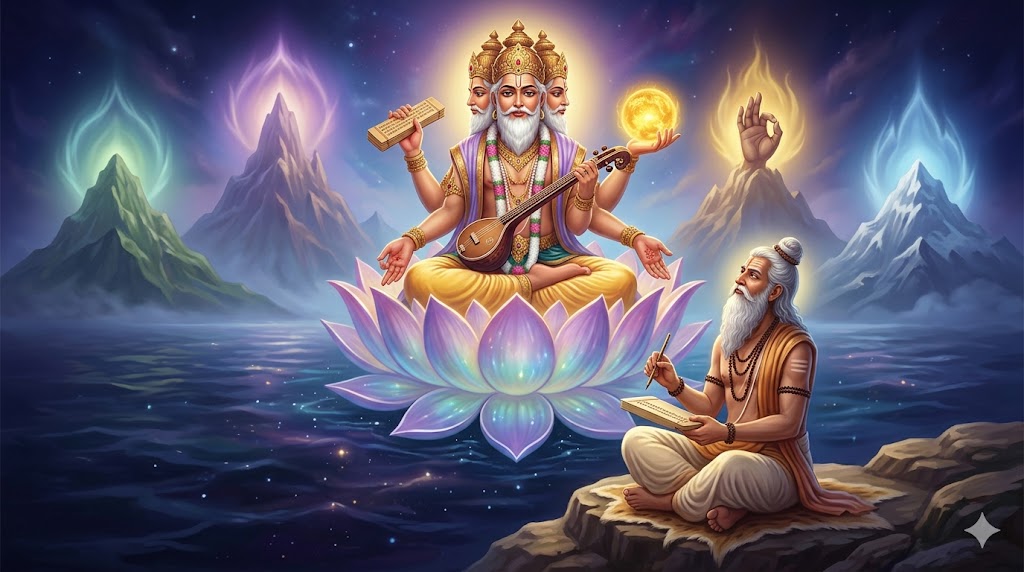
The Divine and Mythological Origin of the Natyashastra
Key sections include:
Chapters 1–5: Mythical origins of drama, construction of the theatre (natya mandapa), consecration rituals, and the theory of Tandava dance associated with Lord Shiva. These lay the groundwork for sacred performance spaces and ritualistic beginnings.
Chapters 6–7: The famous Rasa theory and emotional states (bhavas), which we explore in detail below.
Chapters 8–13: Abhinaya—the art of expression through body (angika), voice (vachika), costumes and makeup (aharya), and inner temperament (sattvika). It details gestures, postures, facial expressions, and stage movements.
Chapters 14–20: Dramaturgy, including plot construction, types of plays, poetry, figures of speech, and speech delivery. Bharata outlines how to structure narratives for maximum emotional impact.
Chapters 21–27: Ten varieties of dramatic forms (rupaka), costumes, character types, and actor training. It emphasizes ensemble work and the director’s role.
Chapters 28–34: Music theory, including vocal and instrumental techniques, scales (shruti, grama, murcchana), ragas, talas, and instruments classified into four categories: stringed (tata), percussion (avanaddha), wind (sushira), and solid (ghana).
Chapters 35–36: Ideal qualities of performers, dramatic characters, and the broader cultural and spiritual benefits of the arts.
This encyclopedic approach ensures that no element of a performance stands alone. Drama, dance, and music interweave seamlessly, creating a holistic experience. Natyashastra’s attention to stage design, lighting, audience seating, and even director-audience dynamics demonstrates remarkable foresight.
The Rasa Theory and Navarasa: The Heart of Emotional Expression
At the core of the Natyashastra lies the Rasa theory, detailed in chapters 6 and 7. Rasa, meaning “essence,” “juice,” or “taste,” refers to the aesthetic emotion evoked in a sensitive spectator (sahrdaya). It transcends ordinary feelings, transforming them into a blissful, transcendent experience that mirrors spiritual realization.
Bharata Muni originally described eight rasas, later expanded to nine (Navarasa) by commentators like Abhinavagupta. Each rasa arises from a stable emotion (sthayi bhava), supported by determinants (vibhava), consequence (anubhava), and transitory states (vyabhichari bhava). The performer does not merely imitate life but crafts these elements to “taste” rasa in the audience.
The Navarasa are:
Śṛṅgāra (Love/Romance): Evokes beauty and attraction; associated with rati (love), Vishnu, and dark colors.
Hāsya (Laughter/Comedy): Sparks joy and mirth; linked to hasa, Shiva, and white.
Karuṇā (Compassion/Sorrow): Stirrs pathos and empathy; tied to shoka, Yama, and grey.
Raudra (Fury/Anger): Conveys destructive rage; connected to krodha, Rudra, and red.
Vīra (Heroism/Courage): Inspires valor and energy; from utsaha, Indra, and bright white.
Bhayānaka (Terror/Fear): Induces dread; based on bhaya, Kala, and black.
Bībhatsa (Disgust/Aversion): Elicits revulsion; from jugupsa, Mahakala, and blue.
Adbhuta (Wonder/Amazement): Arouses awe; from vismaya, Brahma, and yellow.
Śānta (Peace/Tranquility): The ninth, later addition, represents serene detachment; linked to Vishnu and perpetual white. It underpins all others, offering ultimate aesthetic bliss.
Through precise abhinaya, performers evoke these rasas, allowing audiences to experience purified emotions free from personal ego. This theory remains the bedrock of Indian classical dance, theater, and even contemporary storytelling.
Significance in Hindu Dharma and as a Sacred Text
Within Hindu dharma, the Natyashastra holds a revered place as the Natya Veda. It democratizes Vedic wisdom, making profound teachings accessible through visual and auditory means. Performances become a form of yajna (sacrifice), promoting dharma (righteousness), artha (prosperity), kama (pleasure), and ultimately moksha (liberation).
Bharata Muni emphasizes that arts should reflect life’s complexities while guiding toward virtue. Plays draw from epics like the Ramayana and Mahabharata, using conflict and resolution to illustrate moral lessons. The text’s rituals—such as stage consecration and deity worship—infuse performances with sanctity.
Yet its reach is universal. While rooted in Hindu cosmology, the principles of emotional catharsis, ethical storytelling, and aesthetic harmony transcend religious boundaries. The Natyashastra teaches that true art fosters empathy, self-reflection, and unity.
Historical Context and Global Recognition
As the oldest surviving treatise dedicated to performing arts, the Natyashastra influenced centuries of Indian culture. It shaped temple dances, court dramas, classical music systems, and literary poetics. Commentaries by scholars like Abhinavagupta (10th century) further refined its ideas, ensuring its vitality.
Its global fame stems from its timeless insights. Western theater scholars study its dramaturgy alongside Aristotle’s Poetics. In the 20th and 21st centuries, it has inspired international artists exploring cross-cultural expression, actor training, and audience psychology. The text’s emphasis on holistic performance—body, voice, mind, and spirit—resonates in modern acting methods and mindfulness practices.
UNESCO Recognition and Enduring Legacy
In a landmark acknowledgment of its cultural value, manuscripts of the Natyashastra were inscribed in UNESCO’s Memory of the World Register in April 2025, alongside the Bhagavad Gita. This recognition underscores its status as irreplaceable documentary heritage, preserving ancient knowledge for future generations.
The UNESCO listing highlights how the Natyashastra preserves not just techniques but a philosophy of art as a bridge between the material and the divine.
Applications in Drama, Dance, Music, and Creative Fields Today
The Natyashastra’s practical wisdom extends far beyond ancient stages. In drama, it details ten types of plays (nataka, prakarana, and others) and plot construction through five junctions (sandhis: mukha, pratimukha, garbha, vimarsha, nirvahana) and five stages of action (avasthas). Directors use these to build tension, climax, and resolution, ensuring emotional depth in every scene.
For dance, the 108 karanas (basic movement units) and detailed abhinaya form the foundation of Bharatanatyam, Odissi, Kathak, and more. Choreographers worldwide adapt its gestures and expressions to convey narrative without words.
In music, the treatise’s classification of instruments, scales, and dhruva songs informs raga-based compositions and orchestral arrangements. Modern composers blend these with contemporary sounds for film scores and fusion genres.
Creative professionals in theater, cinema, digital media, and even corporate storytelling draw from its principles. The Rasa theory guides scriptwriters in crafting characters that resonate universally. Acting schools incorporate its training methods for emotional authenticity. Even in visual arts and literature, the Navarasa inspire thematic exploration.
In an era of digital entertainment, the Natyashastra reminds us that technology serves best when it amplifies human emotion and ethical storytelling. Its framework supports inclusive, audience-centered creativity that educates while entertaining.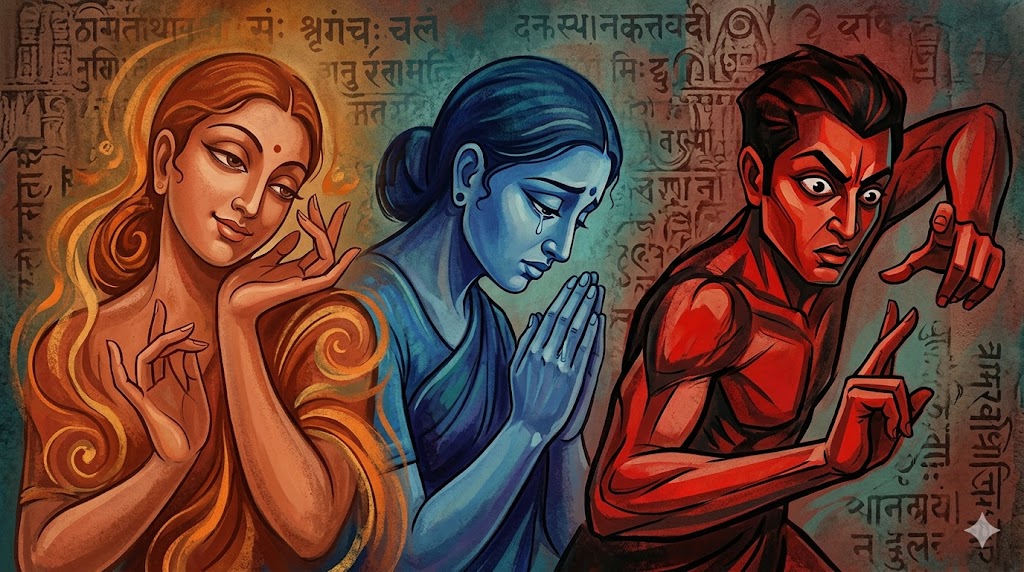
The Practical Application of Rasa Theory
Conclusion
The Natyashastra by Bharata Muni is far more than an ancient book—it is a blueprint for artistic excellence and human understanding. From its mythical origins as the fifth Veda to its detailed guidance on every facet of performance, it continues to illuminate the path for creators across the globe.
As the oldest treatise on performing arts, it bridges Hindu dharma with universal values, proving that great art knows no boundaries of time, culture, or faith. With UNESCO’s recognition, its legacy is secured for generations to come.
Whether on a classical stage or in a modern studio, the principles of Natyashastra—rooted in Rasa, Navarasa, and harmonious expression—invite us to create with purpose, depth, and joy. In embracing this timeless wisdom, we honor not only Bharata Muni but the enduring power of the arts to uplift humanity.