Rani Padmavati: Legend of Chittorgarh Jauhar and Valor
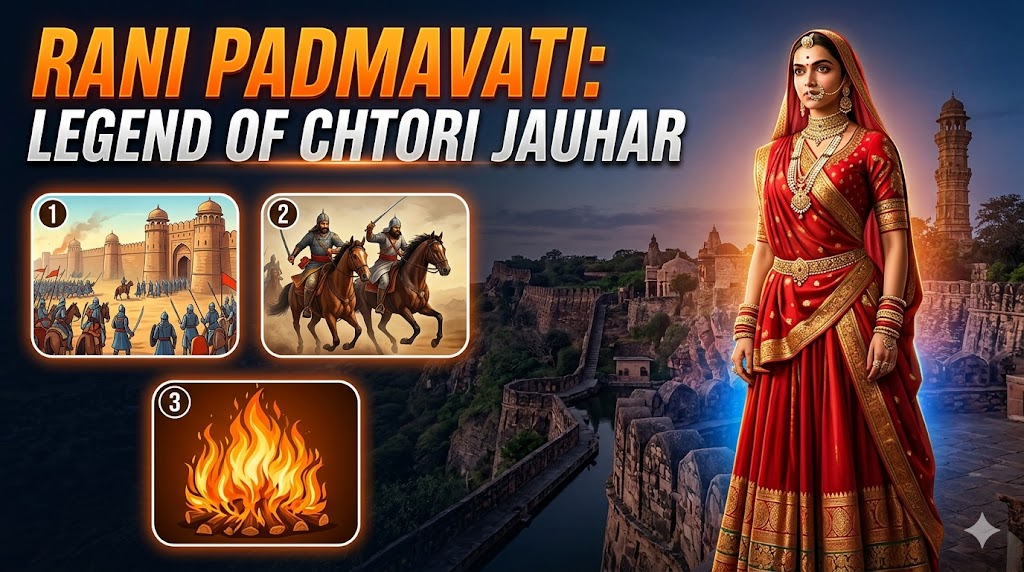
In the annals of Rajasthan’s rich and resilient history, few tales resonate with the same power as that of Rani Padmavati. Often called Rani Padmini in older texts, she stands as a symbol of courage, honor, and sacrifice in the face of overwhelming adversity. This article explores the story of Rani Padmavati strictly through educational lenses drawn from verified historical and literary sources — not cinematic interpretations or modern folklore embellishments. We rely on medieval texts like Malik Muhammad Jayasi’s 1540 Awadhi epic Padmavat, contemporary chronicles by Amir Khusrau, later Rajput bardic accounts such as Hemratan’s Gora Badal Padmini Chaupai, and scholarly analyses from historians who separate documented events from legendary elements.
The narrative of Rani Padmavati unfolds against the backdrop of the Delhi Sultanate’s expansion under Alauddin Khilji in the early 14th century. While the romantic details of her extraordinary beauty inspiring a sultan’s invasion belong to poetic tradition rather than ironclad contemporary records, the core historical reality of the 1303 siege of Chittorgarh Fort remains undisputed. This article examines how Rani Padmavati’s legendary Jauhar became emblematic of Rajput resistance, why Chittorgarh’s stand earned its place as a defining moment in Rajasthan’s history of Agni Jauhar (fire sacrifice), the documented atrocities associated with Khilji’s campaigns, the role of Rawal Ratan Singh, the selfless sacrifices of warriors Gora and Badal, and the enduring controversy this legend stirs within Rajput society even today.
By grounding the discussion in primary sources and cross-referenced scholarship, we aim to provide a balanced, respectful educational resource suitable for students, historians, and cultural enthusiasts alike. The story of Rani Padmavati is not merely one of tragedy; it is a testament to the unyielding spirit of a people who chose dignity over subjugation.
Chittorgarh Fort, perched on a steep hill in present-day Rajasthan, served as the formidable capital of the Guhila (or Sisodia) dynasty of Mewar for centuries. By the late 13th century, Mewar had emerged as a proud Rajput stronghold, fiercely independent and strategically vital due to its location along key trade and military routes between Delhi and the western regions. Rawal Ratan Singh (historically Ratnasimha), who ascended the throne around 1301, belonged to this lineage of warrior-kings known for their code of honor, martial prowess, and devotion to dharma.
The broader political landscape was shaped by the rise of the Delhi Sultanate. Alauddin Khilji, who seized power in 1296 after assassinating his uncle and predecessor Jalaluddin Khilji, pursued aggressive territorial expansion. His reign featured military campaigns against Mongol invaders, southern kingdoms, and Rajput states like Ranthambore (conquered in 1301). Historians such as those referencing Amir Khusrau’s Khaza’in ul-Futuh note that Khilji’s motives were primarily strategic — to consolidate control over rebellious frontier regions and secure tribute or submission from defiant rulers. Mewar’s refusal to fully align with Delhi made it a target.
Rajput society in this era prized values like veerta (bravery), satya (truth), and protection of izzat (honor), particularly for women and family. Jauhar — the ritual of mass self-immolation by women to avoid capture, enslavement, or dishonor — and saka (the men’s final charge to death in saffron robes) were extreme but culturally sanctioned responses when defeat seemed inevitable. Chittorgarh would witness three such Jauhars across centuries (1303, 1535, and 1568), cementing its reputation as a bastion of resistance. The 1303 event, linked to Rani Padmavati in legend, is widely regarded by scholars as the first major Jauhar at the fort and a foundational example of Agni Jauhar in Rajasthan’s collective memory. It was not the “second” in Rajasthan overall, as some oral traditions may suggest earlier isolated instances elsewhere, but it became the archetype that inspired later generations.
The Legend of Rani Padmavati: Origins in Literary Sources
The most detailed and earliest literary account of Rani Padmavati appears in Malik Muhammad Jayasi’s Sufi epic Padmavat (1540 CE), composed nearly 240 years after the siege. Jayasi, writing in Awadhi with Persian influences, framed the tale as an allegorical exploration of spiritual themes: Chittor symbolizes the human body, Ratan Sen the mind, Padmavati wisdom or the ideal soul, and Alauddin Khilji unchecked desire or illusion. This Sufi lens adds layers of poetry and moral instruction, explaining why the narrative diverges from strict history.
In Padmavat, Padmavati is portrayed as the princess of Singhal (identified with Sri Lanka in legend), daughter of King Gandharva sen. A talking parrot named Hiraman escapes her father’s wrath and reaches Chittor, regaling Rawal Ratan Singh with tales of her unparalleled beauty. Smitten, Ratan Singh undertakes a perilous journey across seven seas, performs austerities, and wins her hand in marriage after proving his worth through trials blessed by Shiva and Parvati. He returns to Chittor with Padmavati and a retinue of companions, each paired with equally virtuous women.
A banished Brahmin courtier, Raghav Chetan, seeks revenge by traveling to Delhi and describing Padmavati’s beauty to Sultan Alauddin Khilji, showing him her bangle as proof. Enamored, Khilji marches on Chittor. The poem details Ratan Singh’s initial resistance, a deceptive invitation into the fort, Khilji’s treacherous capture of the king, and the subsequent rescue. Later Rajput adaptations, such as Hemratan’s Gora Badal Padmini Chaupai (1589 CE), refine these elements to emphasize Rajput valor over romance, aligning more closely with local bardic traditions preserved in Rajasthan.
Modern historians, including those citing Amir Khusrau’s contemporary accounts, stress that no 14th-century record mentions Padmavati by name. The legend likely crystallized in the 16th century as a vehicle for cultural memory, blending possible kernels of truth — a brave queen’s leadership in crisis — with poetic invention. Yet its educational value lies in how it preserves Rajput ideals of sacrifice and resistance.
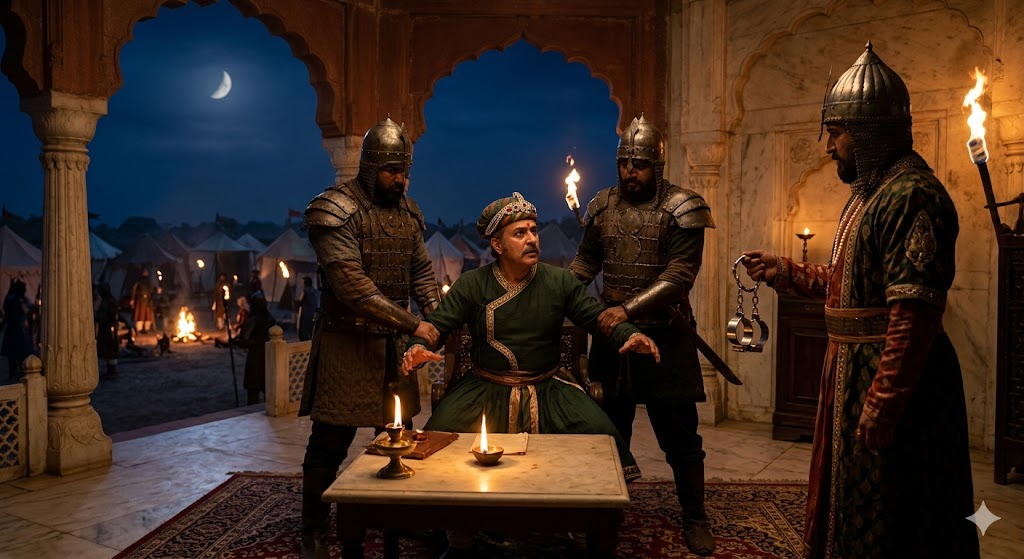
A tense, close-up historical photograph of the moment Rawal Ratan Singh of Chittorgarh is deceptively arrested by Sultanate guards in 1303 inside a marble pavilion, as oil lamps and torches flicker under a crescent moon, emphasizing the atmosphere of betrayal.
Alauddin Khilji’s Atrocities and the Siege of Chittorgarh
Alauddin Khilji’s historical record paints him as a capable but ruthless administrator and conqueror. Contemporary Persian chroniclers like Amir Khusrau and Ziauddin Barani describe his campaigns as marked by swift brutality to deter rebellion. After conquering Gujarat in 1299, he oversaw massacres and temple desecrations. Similar patterns emerged in Ranthambore and during the Chittor campaign.
The siege began in January 1303 when Khilji’s large army encamped around Chittorgarh, cutting off supplies and bombarding the fort with siege engines. The eight-month ordeal tested the defenders amid famine and disease. Khusrau’s Khaza’in ul-Futuh records two failed frontal assaults and the sultan’s strategic positioning. On 26 August 1303, the fort fell. Khilji ordered a general massacre; Khusrau reports thousands slain, though figures may be exaggerated for dramatic effect. Temples were desecrated, and the city was renamed Khizrabad after the sultan’s son.
In the legend, Khilji’s motive intertwined political ambition with lust for Padmavati, but scholarly consensus holds expansionism as primary. His atrocities extended beyond the battlefield: demands for tribute, hostage-taking, and post-victory plunder aimed to break Rajput autonomy. Ratan Singh’s fate varies across sources — pardoned and relocated in some Muslim chronicles, slain in battle in Rajput accounts. The siege exemplified Khilji’s policy of subduing powerful Hindu kingdoms through overwhelming force and psychological terror.
The Role of Rawal Ratan Singh: A King of Honor
Rawal Ratan Singh (Ratnasimha), ruler of Chittorgarh from approximately 1301, embodied Rajput kingship. Inscriptions from the period, such as the 1301 Dariba temple pillar, confirm his reign. He governed a prosperous yet vulnerable kingdom, navigating tensions with Delhi.
In Padmavat and later versions, Ratan Singh is a just and devoted husband who refuses to surrender his queen. He offers tribute but rejects personal humiliation. His capture through deceit — invited as a guest, then seized — highlights Khilji’s treachery. Ratan Singh’s release, facilitated by loyal generals, allowed him to return and fight. He ultimately perished in combat against a rival or in the final defense, depending on the telling.
Historically, the Kumbhalgarh prashasti (1460 CE) and Nainsi’s Khyat suggest he died defending his realm. Ratan Singh’s legacy, whether legendary or factual, underscores leadership rooted in dharma rather than survival at any cost. His refusal to compromise honor inspired his people, setting the stage for the ultimate sacrifice.
The Heroic Sacrifices of Gora and Badal
Among the most inspiring episodes in the Padmavati legend are the exploits of Gora and Badal, two Rajput generals whose loyalty and bravery elevated them to folk-hero status. In Jayasi’s Padmavat and especially Hemratan’s Gora Badal Padmini Chaupai, Gora (a seasoned commander) and his nephew Badal orchestrate a daring rescue of Ratan Singh from Khilji’s camp in Delhi.
Disguised as Padmavati and her female attendants in palanquins, armed warriors infiltrated the sultan’s enclosure. A fierce skirmish ensued; Gora fought valiantly, reportedly continuing to battle even after being beheaded in some dramatic retellings, before falling. Badal ensured the king’s safe return to Chittor. Gora’s wife later committed sati, adding another layer of sacrifice.
These acts transformed the narrative from one of victimhood to active defiance. Gora and Badal did not merely protect their queen — they led by example, becoming symbols for warriors across Rajput kingdoms. Their story spread through oral ballads, reinforcing the idea that true leadership meant placing the ruler’s and queen’s honor above personal survival. In Rajput society, Gora and Badal inspired countless wives and mothers to view such valor as the highest duty. Their sacrifice cemented Rani Padmavati’s role as a unifying figure of dignity.
How Rani Padmavati Led the Jauhar: The First Agni Jauhar of Chittorgarh
As Khilji’s forces breached the defenses on 26 August 1303, Rani Padmavati, according to legend, assumed leadership inside the fort. With defeat certain and the prospect of capture, rape, or conversion looming, she chose Jauhar — the fiery self-immolation that would preserve honor.
Accounts describe Padmavati and Nagmati (Ratan Singh’s other wife) leading thousands of women and children to a prepared pyre or kund within the fort. Padmavati is said to have jumped first, her resolve steeling the others. The flames consumed an entire generation of Rajput women, denying the invaders any trophy. Simultaneously, the surviving men performed saka, charging out in saffron to meet death in battle.
Though the romantic framing is legendary, the Jauhar itself aligns with patterns documented in medieval resistance. Scholars note it as the first Jauhar of Chittorgarh — not the second in Rajasthan, though later events in 1535 (under Rani Karnavati against Bahadur Shah) and 1568 (against Akbar) repeated the ritual on an even larger scale. The 1303 event earned its designation as Rajasthan’s archetypal “Agni Jauhar” because it set the precedent for collective self-sacrifice by fire as an assertion of autonomy. The site, traditionally associated with the Jauhar Kund near the palaces, remains a place of reverence today.
This act was not despair but defiance: a final assertion that Rajput women controlled their destiny. Rani Padmavati’s leadership transformed personal tragedy into collective immortality, inspiring women across kingdoms to prioritize honor over life.
The Aftermath and Cultural Legacy of Chittorgarh’s Sacrifice
Khilji entered a hollow victory — ashes, silence, and no queen to claim. He left a garrison but the fort’s spirit endured. Hammir Singh later reclaimed Mewar’s independence. The legend of Rani Padmavati spread through Sufi poetry, Rajput ballads, and colonial-era chronicles like James Tod’s Annals and Antiquities of Rajast’han (1829–32), which romanticized it for British audiences while preserving Rajput pride.
Educationally, the story teaches resilience amid medieval power struggles. It highlights how oral and literary traditions preserve cultural memory when official records omit inconvenient details. Chittorgarh’s Jauhars symbolize Rajasthan’s ethos: better death with honor than life in chains.
The Padmavati Controversy in Rajput Society
The legend has never been without debate. In the 20th and 21st centuries, particularly during the 2018 controversy surrounding the film Padmaavat, Rajput organizations like Karni Sena protested perceived distortions. They argued that any sympathetic portrayal of Khilji or romantic entanglement insulted ancestral honor and reduced a symbol of resistance to fiction.
The controversy revealed deeper fault lines: Rajput communities view Rani Padmavati as living heritage, not mere myth. Protests highlighted sensitivities around historical memory, identity politics, and the fear that artistic license could erode collective pride. Yet scholars remind us that the core message — sacrifice for dignity — transcends any single version. The debate itself underscores how deeply the story of Rani Padmavati remains woven into Rajput identity, fostering discussions on history versus legend in modern India.
Educational Lessons and Enduring Relevance
Studying Rani Padmavati through reliable sources offers timeless lessons. It illustrates the interplay of power, gender, and resistance in medieval India. It cautions against conflating legend with verifiable fact while appreciating how legends sustain cultural values. For Rajasthan and India, her story reinforces themes of unity in diversity, the cost of empire-building, and the strength found in collective memory.
Rani Padmavati did not seek fame; she sought to protect her people’s honor. Gora and Badal showed that loyalty demands everything. Chittorgarh’s Agni Jauhar became a beacon. In classrooms and cultural forums, this narrative encourages critical thinking: What is history? How do we honor the past without romanticizing violence?
Today, as Rajasthan preserves its forts and festivals, the spirit of Rani Padmavati lives on — not in controversy, but in the quiet resolve of a people who remember their ancestors’ sacrifices.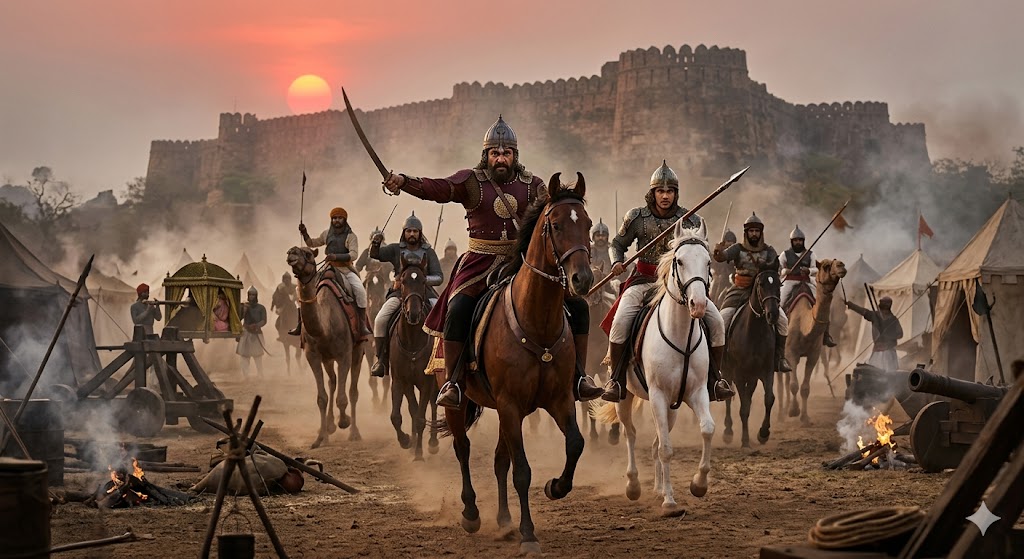
A heroic, ground-level cinematic photograph of Rajput generals Gora and Badal leading a valiant cavalry charge through the 1303 siege encampment at the base of Chittorgarh Fort at dawn, as hazy sunlight crests the fortress ramparts, emphasizing movement and valor.
Conclusion: A Story for All Generations
The complete story of Rani Padmavati, drawn from Padmavat, bardic traditions, and historical cross-verification, reveals a multifaceted legacy. From Khilji’s documented siege and atrocities to the legendary heroism of Ratan Singh, Gora, Badal, and the queen’s Jauhar, it encapsulates Rajasthan’s enduring narrative of valor. Chittorgarh did not merely fall; it rose as a symbol of the first great Agni Jauhar, inspiring subsequent generations.
As we reflect on these events with educational objectivity, we honor the past without endorsing conflict. Rani Padmavati’s tale reminds us that true strength lies in moral courage. May future generations draw inspiration from her dignity, ensuring such stories continue to educate and unite rather than divide.