Every year on April 21, the world pauses to honor something profoundly human yet endlessly powerful: the spark of original thought. World Creativity and Innovation Day stands as a global reminder that creativity and innovation are not mere luxuries for artists or inventors but essential forces shaping human progress. Designated by the United Nations, this observance highlights how fresh ideas solve complex problems, fuel economies, and advance the Sustainable Development Goals. In a rapidly changing world facing climate challenges, inequality, and technological disruption, the day encourages individuals, organizations, and nations to step beyond conventional boundaries and build a better future.
This comprehensive guide delves into the rich history of World Creativity and Innovation Day, its core aims, annual themes, practical celebration ideas, and – perhaps most inspiringly – some of the world’s most impactful creations that continue to define our lives. Whether you are preparing an essay, designing a poster, or simply seeking inspiration, this article offers structured insights grounded in the day’s official purpose and real-world examples. By understanding this observance, we gain clarity on why creativity remains the true wealth of nations in the twenty-first century.
The History of World Creativity and Innovation Day
The roots of World Creativity and Innovation Day trace back to a grassroots initiative in 2001. Canadian creativity expert Marci Segal launched the observance in Toronto with a clear vision: to remind people everywhere to harness their natural creative abilities for positive change. What began as a single day quickly expanded into World Creativity and Innovation Week, deliberately timed to begin on April 15 – the birthday of Leonardo da Vinci, the ultimate symbol of blending arts and sciences.
The first informal celebrations occurred in 2002. Over the following years, the movement gained international traction as advocates emphasized creativity’s role in problem-solving across social, economic, and environmental spheres. A pivotal milestone arrived on April 27, 2017, when the United Nations General Assembly unanimously adopted Resolution 71/284. With support from more than 80 countries, the resolution officially designated April 21 as World Creativity and Innovation Day. The first formal UN observance took place on April 21, 2018, marking the day’s elevation to an international observance.
This UN recognition was no accident. It aligned with growing global awareness that human ingenuity drives sustainable development. Reports from UNESCO, UNDP, and UNOSSC had already described creativity and innovation as “the true wealth of nations in the twenty-first century.” The resolution explicitly connected the day to the 2030 Agenda for Sustainable Development, urging nations to use creative thinking to tackle poverty, hunger, gender equality, and climate action. Since then, World Creativity and Innovation Day has evolved from a niche awareness event into a worldwide platform for dialogue, workshops, and collaborative projects. Governments, educational institutions, businesses, and NGOs now participate actively, reinforcing the day’s message that innovation is accessible to everyone, not just elites in Silicon Valley or research labs.
history also reflects broader shifts in global priorities. In 2021, the United Nations declared the International Year of Creative Economy for Sustainable Development, further amplifying the day’s relevance. Subsequent years have seen increasing integration with digital transformation and green technologies, proving the observance’s adaptability to emerging challenges.
Aims and Significance of World Creativity and Innovation Day
At its core, World Creativity and Innovation Day seeks to raise awareness of creativity’s transformative power in every aspect of human development. The United Nations defines creativity broadly – from artistic expression to practical problem-solving in economic, social, and sustainable contexts. The day’s primary aims include:
Encouraging multidisciplinary thinking at individual and group levels.
Promoting innovation as a driver of economic growth, job creation, and inclusive opportunities, especially for women and youth.
Highlighting creative industries as vital sectors that generate income, exports, and cultural dialogue.
Supporting the achievement of the 17 Sustainable Development Goals through fresh ideas and collaborative action.
Fostering a culture where innovation addresses pressing issues such as poverty eradication, hunger elimination, and environmental sustainability.
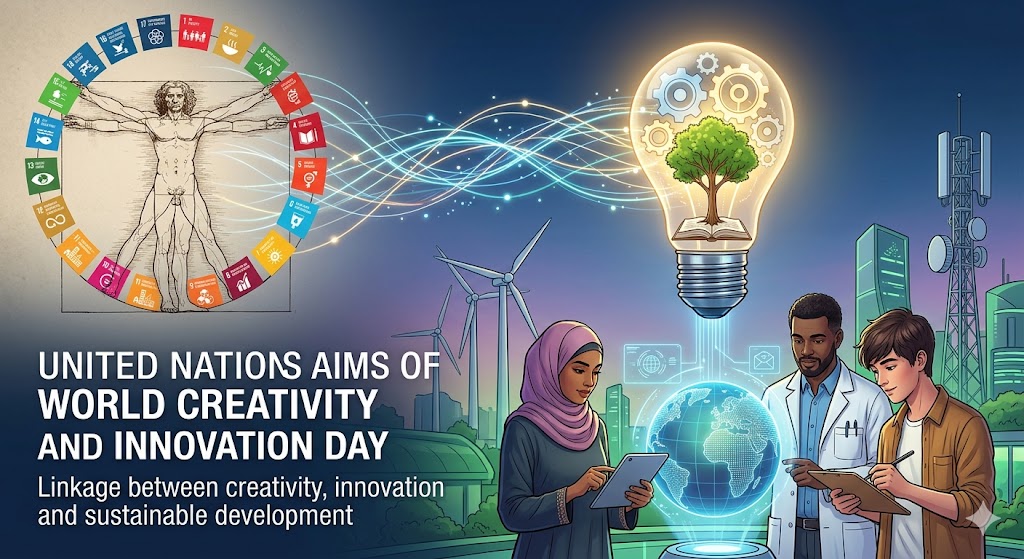
A conceptual visual representing the UN's aims for World Creativity and Innovation Day on April 21
The significance extends far beyond symbolism. In today’s knowledge-based economy, nations that invest in creativity thrive. Creative industries contribute trillions to global GDP and employ millions, particularly in developing countries where they enable leapfrogging traditional development paths. Moreover, the day underscores that innovation is not only about technology but also about social systems, cultural preservation, and ethical governance – especially in the age of artificial intelligence.
World Creativity and Innovation Day also serves an educational purpose. It reminds us that creativity is a skill anyone can cultivate through curiosity, experimentation, and openness to new perspectives. In professional settings, it inspires organizations to rethink processes and embrace risk-taking. For policymakers, it provides a framework for integrating culture and innovation into national strategies. Ultimately, the day reinforces a hopeful message: human ingenuity has always overcome seemingly insurmountable obstacles, and it will continue to do so when channeled responsibly.
Themes of World Creativity and Innovation Day Over the Years
While the United Nations does not mandate a single global theme each year, participating countries and organizations adopt focused messages that align with current challenges. These themes evolve to reflect contemporary priorities while staying true to the day’s foundational goals.
In 2021, observances centered on the International Year of the Creative Economy for Sustainable Development. Events emphasized how creative sectors could accelerate progress toward the SDGs. By 2022, the spotlight shifted to collaboration, encouraging cross-border and cross-sector partnerships to solve complex problems. The 2023 theme, “Step Out and Innovate,” urged participants to break free from conventional thinking and embrace bold experimentation.
The 2024 observances built on this momentum with messages like “INSPIRE: Step Out and Innovate” and “Transforming World, Promoting Sustainable Development.” These highlighted the need for inspirational leadership and practical innovation in urban planning, green technologies, and inclusive growth. In 2025, many nations continued with “Step Out and Innovate,” reinforcing the call for transformative action. For 2026, emerging themes include “Harnessing Creativity for Global Progress,” which ties directly into ongoing efforts to integrate culture into post-2030 development frameworks, such as the Braga Manifesto adopted by UNESCO Creative Cities in 2024.
These themes demonstrate the observance’s flexibility. They consistently link creativity to real-world outcomes – whether through green innovation, digital inclusion, or community-driven solutions. Local adaptations often incorporate cultural elements, making World Creativity and Innovation Day relevant across diverse contexts, from rural villages to global tech hubs.
Practical Ideas for Celebrating World Creativity and Innovation Day
Celebrating World Creativity and Innovation Day need not require large budgets or elaborate events. Simple, meaningful activities can spark lasting change. Schools and workplaces often organize brainstorming sessions where “no idea is too wild.” These foster psychological safety and generate unexpected solutions.
For individuals, the day offers an opportunity to try something new – learning a skill, prototyping a product idea, or journaling creative challenges. Families might host “invention nights” using household items to build prototypes. Educational institutions frequently run essay competitions or art exhibitions centered on innovation for sustainability.
Poster and Visual Ideas: Eye-catching posters feature light bulbs, interlocking gears, diverse human figures, and SDG icons. Use bold colors like electric blue and vibrant yellow to symbolize energy and ideas. Free online templates allow customization with slogans such as “Create Today, Innovate Tomorrow” or “Step Out and Innovate.”
Essay Writing Tips: A strong World Creativity and Innovation Day essay begins with a personal anecdote, links to UN history, analyzes a specific innovation’s impact, and concludes with a forward-looking call to action. Focus on structure: introduction with hook, body paragraphs on history and examples, and a reflective close.
Businesses and communities can host webinars, innovation challenges, or partnerships with local artists. Social media campaigns using hashtags like #WCID or #WorldCreativityDay amplify reach. The key is action: turn awareness into tangible steps, however small.
The World’s Greatest Creations: Iconic Innovations That Shaped Humanity
No discussion of World Creativity and Innovation Day would be complete without examining humanity’s most remarkable creations. These innovations – born from curiosity, necessity, and perseverance – illustrate how creativity translates into lasting progress. Here are some of the most transformative examples, selected for their profound global impact.
The wheel, invented around 3500 BCE in Mesopotamia, revolutionized transportation, trade, and machinery. Initially used for pottery, it soon powered chariots and laid the foundation for modern engineering. Without it, civilization as we know it would have stalled.
The printing press, developed by Johannes Gutenberg in the 1440s, democratized knowledge. By making books affordable and widely available, it fueled the Renaissance, Reformation, and Scientific Revolution. Literacy rates soared, and ideas spread faster than ever before.
Electricity, harnessed effectively in the late 19th century through the work of Thomas Edison and Nikola Tesla, powered the modern world. It illuminated homes, enabled communication, and drove industrial growth. Today, it remains the backbone of digital life.
Penicillin, discovered by Alexander Fleming in 1928, marked the dawn of the antibiotic era. It has saved hundreds of millions of lives by turning once-deadly infections into treatable conditions and dramatically increasing average life expectancy.
The internet and personal computers, evolving from mid-20th-century innovations like the transistor and ARPANET, connected humanity in unprecedented ways. They transformed education, commerce, healthcare, and social interaction, creating a global village while raising new questions about privacy and equity.
Vaccines, pioneered by Edward Jenner in the 18th century and advanced through figures like Louis Pasteur and Jonas Salk, have eradicated or controlled diseases such as smallpox and polio. Their role in the COVID-19 response demonstrated innovation’s power in real time.
The steam engine, refined during the Industrial Revolution, mechanized production and transportation. It paved the way for railroads, factories, and mass manufacturing, fundamentally reshaping economies and societies.
Renewable energy technologies, including solar panels and wind turbines, represent contemporary creativity addressing climate change. Innovations in battery storage and smart grids now make clean energy viable at scale, offering hope for a sustainable planet.
Artificial intelligence and machine learning, building on decades of computer science, are accelerating discoveries in medicine, climate modeling, and personalized education. While ethical challenges remain, their potential to solve intractable problems is immense.
Smartphones, combining computing, communication, and sensors into pocket-sized devices, have placed the world’s knowledge in billions of hands. They enable entrepreneurship in remote areas and support real-time disaster response.
Other notable creations include the airplane, refrigeration, and the plow – each solving fundamental human needs for mobility, preservation, and food security. These innovations share common traits: they emerged from creative problem-solving, often built upon prior discoveries, and delivered benefits that rippled across generations. They remind us that World Creativity and Innovation Day celebrates not just ideas but their real-world application.
Relevance in Education, Current Affairs, and UPSC Preparation
In academic and competitive contexts, World Creativity and Innovation Day holds particular importance. For UPSC aspirants in India, the topic frequently appears in current affairs, essay papers, and interviews. Questions often probe the linkage between creativity, innovation, and sustainable development or require analysis of government initiatives like Startup India and Atal Innovation Mission. Understanding the day’s UN resolution, creative economy reports, and global case studies strengthens answers on topics such as economic growth, technology policy, and cultural diplomacy.
News coverage around April 21 typically highlights national events, corporate innovation drives, and youth-led projects. Media outlets showcase success stories – from grassroots inventors to large-scale sustainable initiatives – reinforcing the day’s message in public discourse.
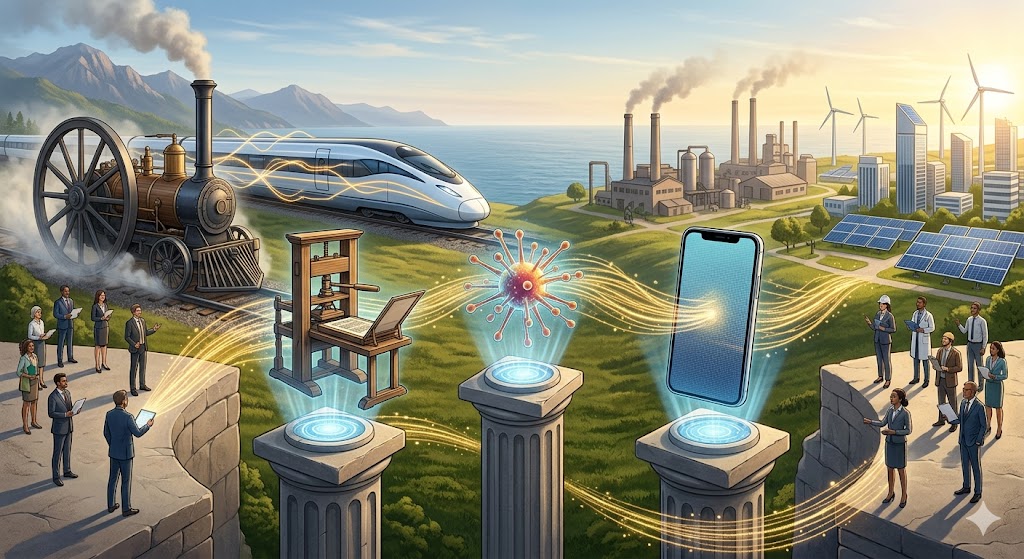
A visual panorama of the ripple effects from humanity's greatest creations discussed in the article. Iconic transformations—from the Gutenberg printing press to modern digital and renewable technologies—radiate forward from stylized pillars, showing how creativity fundamentally reshapes society and the environment.
Conclusion: Embracing Creativity for a Better Tomorrow
World Creativity and Innovation Day on April 21 is more than an annual date on the calendar. It is a call to action – an invitation to every person to contribute original ideas that improve lives and protect our planet. From its humble beginnings in 2001 to its status as a UN observance, the day has consistently championed the belief that creativity and innovation are indispensable for human advancement.
As we reflect on the world’s greatest creations – from the wheel to artificial intelligence – we see a clear pattern: progress stems from daring to imagine differently. The themes of recent years, such as “Step Out and Innovate” and “Harnessing Creativity for Global Progress,” urge us to move beyond comfort zones and collaborate for sustainable outcomes.
Whether through a simple brainstorming session, a thoughtfully designed poster, or a well-crafted essay, each of us can participate. The future belongs to those who create it. On World Creativity and Innovation Day and every day thereafter, let us commit to using our ingenuity responsibly, inclusively, and boldly. In doing so, we honor not only the observance but the very essence of what makes humanity remarkable.
Frequently Asked Questions
What is the primary significance of World Creativity & Innovation Day: History & Impact?
World Creativity and Innovation Day: History, Themes, Significance, and the World’s Greatest CreationsEvery year on April 21, the world pauses to honor something profoundly human yet endlessly powerful: the spark of original thought. World Creativity and Innovation Day stands as a global reminder that creativity and innovation are not mere luxuries for artists or inventors but essential forces shaping human progress.
How does this development impact Current Affairs?
Designated by the United Nations, this observance highlights how fresh ideas solve complex problems, fuel economies, and advance the Sustainable Development Goals. In a rapidly changing world facing climate challenges, inequality, and technological disruption, the day encourages individuals, organizations, and nations to step beyond conventional boundaries and build a better future.This comprehensive guide delves into the rich history of World Creativity and Innovation Day, its core aims, annual themes, practical celebration ideas, and – perhaps most inspiringly – some of the world’s most impactful creations that continue to define our lives.
What are the key future projections to monitor?
Whether you are preparing an essay, designing a poster, or simply seeking inspiration, this article offers structured insights grounded in the day’s official purpose and real-world examples.