OPEC Countries: Members, Production & Global Influence
Current Affairs• April 21, 2026• Global Edition
The Organization of the Petroleum Exporting Countries, better known as OPEC, stands as one of the most influential forces in the global energy landscape. For over six decades, OPEC countries have coordinated petroleum policies to stabilize oil markets, secure fair prices for producers, and ensure reliable supply for consumers worldwide. In an era marked by geopolitical tensions, energy transitions, and economic volatility, understanding OPEC countries remains essential for anyone tracking oil markets, international relations, or energy security.
This comprehensive guide explores the full list of OPEC member countries, the expanded OPEC+ alliance, detailed oil production data from 2021 through recent years, the organization's rich history, and its pivotal role amid the Russia-Ukraine war and other conflicts in the last three years. Whether you're researching opec countries oil production, seeking the latest opec member countries updates, or analyzing global impacts, this article provides clear, structured insights drawn from official sources and market realities.
OPEC is a permanent intergovernmental organization founded to unify petroleum policies among its member nations. Its core goals include coordinating production to stabilize markets, protecting the interests of oil-exporting developing countries, and promoting efficient, economic, and regular supply to consumers. Today, the 12 OPEC countries collectively hold the vast majority of the world's proven crude oil reserves and account for roughly 30-40% of global oil production, depending on market conditions and voluntary adjustments.
OPEC countries exert significant influence because their decisions ripple through global economies. When OPEC countries adjust output, it directly affects crude oil prices, inflation rates, transportation costs, and even government budgets in both producing and consuming nations. In recent years, the alliance has evolved into the broader OPEC+ framework, incorporating key non-OPEC producers like Russia to enhance market management. This cooperation has become especially critical amid supply disruptions, sanctions, and shifting demand patterns.
The impact of OPEC countries extends beyond economics. Many OPEC member countries rely heavily on oil revenues for national development, infrastructure, and social programs. Fluctuations in opec countries oil production can therefore shape domestic stability and international diplomacy.
The History of OPEC: From Founding to a Global Powerhouse
The story of OPEC countries begins in the turbulent post-World War II era. In September 1960, five founding nations—Iran, Iraq, Kuwait, Saudi Arabia, and Venezuela—gathered in Baghdad to form the organization. They sought to counter the dominance of major Western oil companies, often called the "Seven Sisters," which had unilaterally reduced posted prices for crude oil.
Headquartered first in Geneva and then moved to Vienna in 1965, OPEC quickly expanded. Libya joined in 1962, followed by the United Arab Emirates in 1967, Algeria in 1969, Nigeria in 1971, and others over the decades. By the 1970s, OPEC countries had asserted greater sovereignty over their natural resources through nationalizations and production controls.
Key milestones define OPEC's evolution. The 1973 oil embargo during the Arab-Israeli war dramatically raised prices and highlighted the group's leverage. The 1980s brought challenges like the oil glut and price crash, prompting OPEC to introduce a reference pricing basket and engage more with non-member producers. The 1990s and 2000s saw continued volatility, with OPEC countries navigating financial crises, rising Asian demand, and environmental concerns.
A transformative moment came in 2016 with the Declaration of Cooperation, birthing OPEC+. This alliance united OPEC countries with 10 non-OPEC producers to address oversupply from U.S. shale oil. The Charter of Cooperation in 2019 further solidified long-term collaboration. Through economic booms, recessions, and pandemics, OPEC has adapted via regular ministerial conferences, technical committees, and strategic visions emphasizing sustainability and market stability.
These developments underscore how OPEC countries have grown from a small group of founders into a sophisticated organization influencing global energy policy for over 65 years.
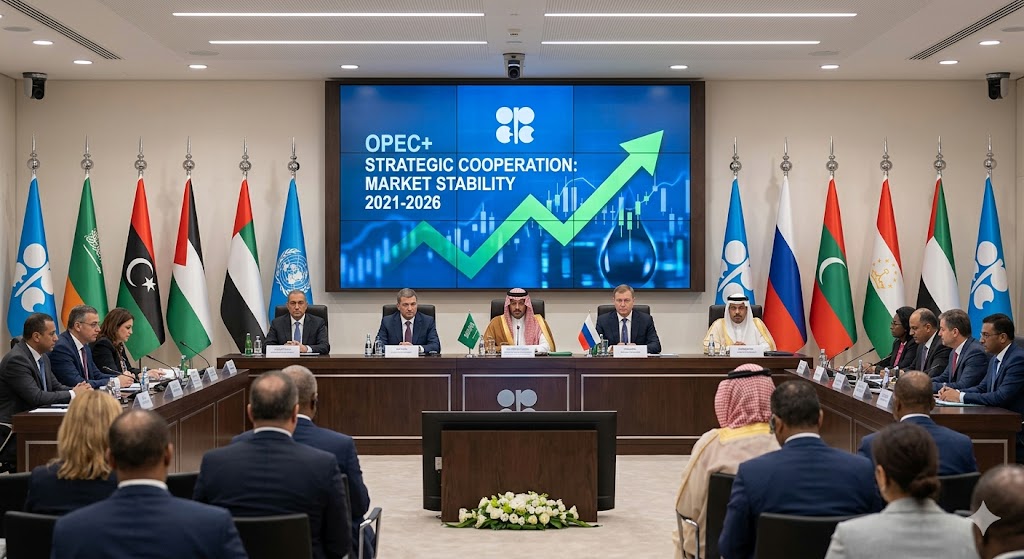
A strategic OPEC+ ministerial meeting, symbolizing the cooperation between OPEC countries (represented by the 12 flags) and key partners like Russia (represented by the seated official) to manage global oil production and maintain market stability from 2021 through 2026.
Current List of OPEC Member Countries
As of 2026, OPEC comprises exactly 12 full member countries. These opec member countries are:
Algeria
Congo (Republic of the Congo)
Equatorial Guinea
Gabon
Iran
Iraq
Kuwait
Libya
Nigeria
Saudi Arabia
United Arab Emirates
Venezuela
The five founder members—Iran, Iraq, Kuwait, Saudi Arabia, and Venezuela—hold special status under the OPEC Statute. Membership requires substantial net exports of crude petroleum and alignment with the organization's objectives, approved by a three-fourths majority including all founders.
Notable changes in recent years include Angola's withdrawal effective January 1, 2024, Ecuador's exit in 2020, Qatar's termination in 2019, and earlier suspensions or reactivations by countries like Gabon and Indonesia. These shifts reflect the dynamic nature of opec countries oil output commitments and national priorities.
Each OPEC member country brings unique strengths. Saudi Arabia remains the largest producer with spare capacity, while nations like Iran and Venezuela operate outside full quota systems due to external factors such as sanctions. African members like Nigeria and Algeria contribute significantly to regional supply diversity.
Understanding OPEC+: The Expanded Alliance
OPEC+ extends the influence of OPEC countries by including major non-OPEC oil producers. Core OPEC+ participants beyond the 12 OPEC members typically include Russia, Azerbaijan, Kazakhstan, Bahrain, Brunei, Malaysia, Mexico, Oman, South Sudan, and Sudan. This broader group controls around 40-45% of global crude oil supply at times.
Formed in late 2016, OPEC+ has proven instrumental in rebalancing markets. Joint ministerial meetings and monitoring committees allow coordinated decisions on production levels. Russia, as the largest non-OPEC partner, plays a particularly prominent role alongside Saudi Arabia in guiding strategy.
The OPEC+ framework has enabled more effective responses to global events, from the COVID-19 demand collapse to recent supply shocks. By pooling resources and sharing data, OPEC countries and their partners achieve greater market stability than OPEC alone could provide.
OPEC Oil Production: Trends and Data from 2021 to 2026
OPEC countries oil production has fluctuated notably in recent years due to voluntary cuts, geopolitical events, and demand recovery. Official data from OPEC's Annual Statistical Bulletin and Monthly Oil Market Reports provide clear insights.
In 2021, as the world emerged from pandemic lows, OPEC crude oil production averaged around 26.3-27 million barrels per day (mb/d). This reflected gradual unwinding of earlier cuts amid recovering demand.
By 2022, production remained in a similar range before late-year adjustments. The Russia-Ukraine conflict introduced new pressures, leading to the first major coordinated cut in October 2022.
Production in 2023 and 2024 saw further voluntary reductions. OPEC Member Countries' output declined by about 0.57 mb/d year-on-year in 2024, part of broader OPEC+ efforts totaling over 2 mb/d in cuts initially, plus additional voluntary measures by key producers like Saudi Arabia and Russia (extended through 2025 and into 2026). World crude oil production overall averaged 72.58 mb/d in 2024, with OPEC+ countries contributing to stability despite lower output.
Recent figures through late 2025 show OPEC crude hovering between 29-31 mb/d monthly, with adjustments continuing. Iran, not fully bound by quotas due to sanctions, has increased output significantly in recent years.
OPEC Oil Production by Country (Approximate Recent Averages, 2025 Data)
Saudi Arabia: ~9.5 mb/d (largest producer with substantial spare capacity)
Iraq: ~4.4 mb/d
Iran: ~4.2 mb/d (strong growth outside quotas)
United Arab Emirates: ~3.8 mb/d
Kuwait: ~2.6 mb/d
Nigeria, Algeria, Libya, and others: 1-2.5 mb/d each, varying with security and investment
Smaller producers like Congo, Equatorial Guinea, Gabon, and Venezuela contribute hundreds of thousands of barrels daily. These opec countries oil production by country figures highlight Saudi Arabia's pivotal role while showing diversification across the Middle East, Africa, and South America.
Overall, OPEC countries crude oil production in 2021-2022 supported post-pandemic recovery, while later cuts aimed to counter oversupply risks and price volatility.
The Impact of the Russia-Ukraine War on OPEC and OPEC Countries
The Russia-Ukraine war, which began in February 2022, has profoundly influenced OPEC countries and the wider OPEC+ alliance. As a key OPEC+ partner, Russia faced Western sanctions that disrupted its exports and logistics. Rather than isolating Russia, OPEC+ chose coordinated production management to stabilize prices and support the broader group.
In October 2022, OPEC+ announced a surprise cut of up to 2 million barrels per day—the largest since the pandemic—to prevent prices from falling amid recession fears. This decision, widely viewed as helping Russia maintain revenues despite sanctions, drew criticism from Western nations but underscored the alliance's independence.
Over the following three years, OPEC countries extended and deepened cuts. Additional voluntary reductions by eight core OPEC+ producers (including Saudi Arabia, Russia, Iraq, UAE, Kuwait, Kazakhstan, Algeria, and Oman) totaled around 2.2 mb/d in early 2024, with phased extensions through 2025 and 2026. These moves helped keep Brent crude in a $70-90 range for much of the period, benefiting OPEC member countries' export revenues even as global demand faced headwinds.
For OPEC countries themselves, the war brought mixed effects. Higher initial prices boosted revenues—OPEC crude export earnings reached hundreds of billions annually—but volatility strained budgets in less diversified economies. Members like Saudi Arabia and the UAE used revenues for Vision 2030-style diversification, while sanctioned nations such as Iran and Venezuela gained from elevated prices despite production constraints.
The conflict also tested OPEC+ unity. Compliance with quotas varied, and compensation mechanisms for overproduction became routine. Yet the alliance held firm, demonstrating how OPEC countries prioritize long-term market balance over short-term politics.
Recent Geopolitical Tensions and Their Effects on OPEC Countries in the Last 2-3 Years
Beyond the Russia-Ukraine war, the past three years have seen additional strains in OPEC countries. Ongoing Middle East tensions, including disruptions in key shipping routes, have occasionally spiked prices and complicated exports. In early 2026, conflicts involving Iran further affected the Strait of Hormuz—the world's critical oil chokepoint—temporarily reducing flows from Gulf OPEC producers and prompting quota adjustments by OPEC+.
These events reinforced OPEC countries' resilience. Production pauses in some cases were offset by increased output elsewhere, such as in Iran. OPEC+ responded with modest quota increases in May 2026 (around 206,000 b/d for key members), though actual hikes remained limited by physical constraints.
For opec member countries, such wars highlight vulnerabilities in export infrastructure but also opportunities. Revenues from elevated prices have funded infrastructure and diversification programs across the group. Nigeria and Algeria, for instance, have invested in gas and renewables alongside oil. Saudi Arabia and the UAE have accelerated non-oil economic reforms.
Overall, these conflicts have accelerated OPEC+ cooperation, with regular virtual meetings ensuring data-driven decisions. OPEC countries have maintained focus on stability rather than escalation, preserving their collective influence.
Key Conventions, Meetings, and Developments in OPEC
OPEC countries advance their agenda through structured gatherings. Ministerial Conferences, held twice yearly (or extraordinarily as needed), set production policies. The Joint Ministerial Monitoring Committee and Joint Technical Committee review compliance and market data monthly or bimonthly.
Major developments include the 2020 historic production adjustments during COVID-19—the largest ever recorded—and the ongoing Declaration of Cooperation framework. International seminars in Vienna have fostered dialogue with consumers and other stakeholders. The OPEC Fund for International Development continues supporting global south projects, extending the organization's humanitarian reach.
Recent years have emphasized sustainability, with OPEC countries participating in climate talks while advocating for realistic energy transitions that include oil's role in development.
Global Impact of OPEC Countries and Future Outlook
The decisions of OPEC countries shape everything from gasoline prices at the pump to inflation in importing nations. By managing roughly one-third of world supply, they help prevent extreme volatility that could harm both producers and consumers.
Looking ahead, OPEC countries face the energy transition, rising non-OPEC supply (especially U.S. shale), and climate policies. Yet their vast reserves—over 1,240 billion barrels collectively—ensure relevance for decades. OPEC+ is likely to continue playing a central role in balancing markets amid uncertainties.
Investments in technology, diversification, and dialogue position OPEC countries for a more sustainable future while maintaining their economic backbone.
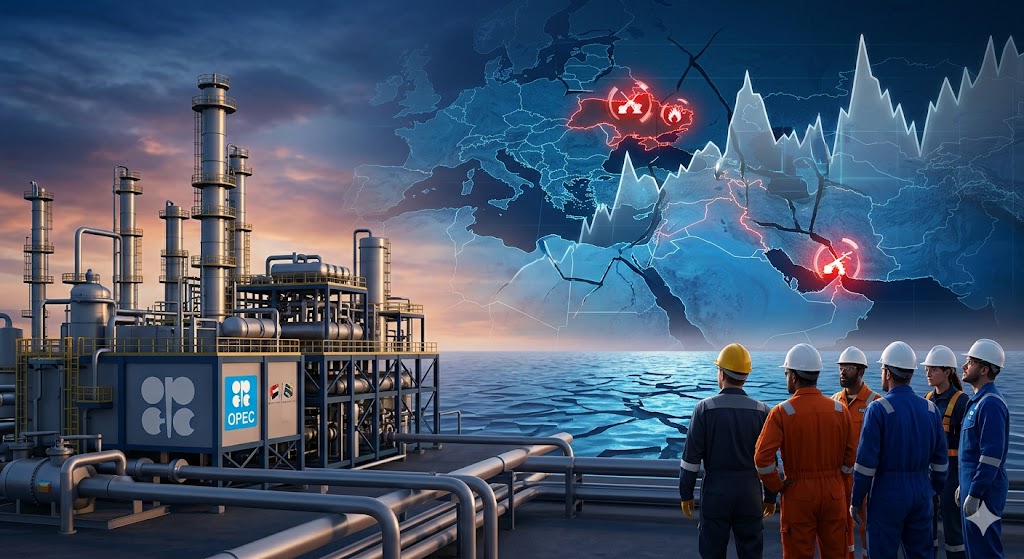
A conceptual visualization showing resilient OPEC energy infrastructure (foreground) maintaining production while navigating the market volatility and geopolitical fractures caused by conflicts in Eastern Europe and key shipping routes (background graphics) during the last three years.
Conclusion
OPEC countries represent far more than a cartel of oil producers—they form a strategic alliance that has navigated six decades of global change with remarkable adaptability. From the 12 current OPEC member countries and the broader OPEC+ partnership to detailed opec oil production trends since 2021, the Russia-Ukraine war's lasting effects, and ongoing geopolitical pressures, the organization continues to prioritize stability.
As energy markets evolve, the history, conventions, and developments of OPEC underscore its enduring importance. For policymakers, investors, and citizens alike, staying informed about OPEC countries oil production and strategies remains key to understanding the future of global energy.
This coordinated approach by OPEC countries not only safeguards their economies but contributes to a more predictable world oil market for everyone.
Frequently Asked Questions
What is the primary significance of OPEC Countries: Members, Production & Global Influence?
The Organization of the Petroleum Exporting Countries, better known as OPEC, stands as one of the most influential forces in the global energy landscape. For over six decades, OPEC countries have coordinated petroleum policies to stabilize oil markets, secure fair prices for producers, and ensure reliable supply for consumers worldwide.
How does this development impact Current Affairs?
In an era marked by geopolitical tensions, energy transitions, and economic volatility, understanding OPEC countries remains essential for anyone tracking oil markets, international relations, or energy security.This comprehensive guide explores the full list of OPEC member countries, the expanded OPEC+ alliance, detailed oil production data from 2021 through recent years, the organization's rich history, and its pivotal role amid the Russia-Ukraine war and other conflicts in the last three years. Whether you're researching opec countries oil production, seeking the latest opec member countries updates, or analyzing global impacts, this article provides clear, structured insights drawn from official sources and market realities.What Is OPEC and Why Do OPEC Countries Matter?OPEC is a permanent intergovernmental organization founded to unify petroleum policies among its member nations.
What are the key future projections to monitor?
Its core goals include coordinating production to stabilize markets, protecting the interests of oil-exporting developing countries, and promoting efficient, economic, and regular supply to consumers.