Sabarimala Case: Women Entry Ruling and 2026 Review
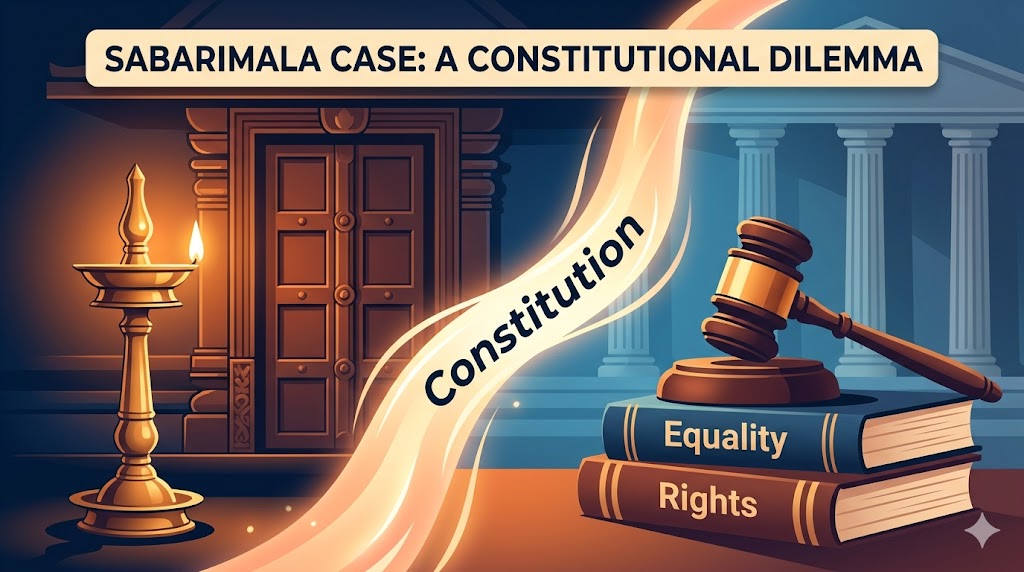
The Sabarimala case stands as one of the most significant and emotionally charged legal battles in modern Indian constitutional history. At its core, it pits the fundamental rights of women to equality and religious freedom against deeply held religious customs at one of India’s most revered pilgrimage sites. The Sabarimala case revolves around the centuries-old tradition at the Sabarimala Ayyappa Temple in Kerala, where women between the ages of 10 and 50 were historically barred from entry. Devotees believe this restriction honors Lord Ayyappa’s vow as a naisthika brahmachari—a perpetual celibate deity.
In 2018, a five-judge bench of the Supreme Court delivered a landmark 4:1 verdict in the Sabarimala case, striking down the ban as unconstitutional. The ruling affirmed that women possess the same right to worship as men under Articles 14, 15, and 25 of the Constitution. Yet the decision ignited widespread protests, political turmoil, and a national debate on the limits of judicial intervention in religious matters. Supporters of women’s entry hailed it as a victory for gender justice, while traditionalists viewed it as an assault on faith.
Nearly eight years later, the Sabarimala case remains unresolved. A nine-judge Constitution Bench began hearing a comprehensive review in April 2026, examining broader questions about essential religious practices, judicial review of faith, and the balance between constitutional morality and religious autonomy. This article delves into the Sabarimala case in detail: its historical roots, the 2018 ruling, the public discourse and protests by women supporters against entrenched state-backed customs, the Centre’s evolving arguments, and the current status as hearings continue.
Understanding the Sabarimala case requires appreciating not just legal technicalities but the profound societal tensions it exposes—between tradition and modernity, faith and equality, and individual rights versus collective religious identity. As the Supreme Court re-examines the Sabarimala case in 2026, its outcome could reshape how India navigates similar disputes across religions.
The Sabarimala Temple, nestled in the Western Ghats of Pathanamthitta district, Kerala, attracts millions of devotees annually. Dedicated to Lord Ayyappa—believed to be the divine offspring of Shiva and Mohini (Vishnu’s female avatar)—the deity is worshipped in his naisthika brahmachari form, embodying eternal celibacy, discipline, and spiritual austerity.
According to tradition, this celibate vow demands strict separation from women of menstruating age to preserve the deity’s sanctity. Male pilgrims undertake a rigorous 41-day vratham (austerity), observing celibacy, vegetarianism, and other disciplines before the arduous trek to the shrine. The custom of excluding women aged 10-50 was not merely a social norm but was codified in 1965 under Rule 3(b) of the Kerala Hindu Places of Public Worship (Authorisation of Entry) Rules. This rule permitted exclusion “at such time during which they are not by custom and usage allowed to enter a place of public worship.”
The Travancore Devaswom Board, which manages the temple, defended the practice as an essential religious practice integral to the unique character of Ayyappa worship. Proponents argued that allowing women in this age group would undermine the temple’s spiritual essence, likening it to disturbing a yogi’s meditation. This view drew from ancient texts and agamas governing temple rituals for celibate deities.
Critics, however, contended that the ban reflected patriarchal notions of impurity tied to menstruation rather than genuine theology. They pointed out that women visit other Ayyappa temples without restriction and that the Sabarimala prohibition gained legal force only in the 20th century. The Kerala High Court upheld the ban in 1991, reinforcing it as a long-standing custom. This set the stage for the constitutional challenge that would define the Sabarimala case.
The Legal Journey Leading to the Supreme Court
The Sabarimala case formally began in 2006 when the Indian Young Lawyers Association filed a public interest litigation under Article 32 of the Constitution. Petitioners argued that the exclusion violated women’s fundamental rights to equality (Article 14), non-discrimination (Article 15), and freedom to practice religion (Article 25). They described the ban as discriminatory, reducing women to their biological functions and denying them the right to express devotion to Lord Ayyappa.
The State of Kerala and the Devaswom Board initially resisted, citing religious custom and Article 26, which protects the rights of religious denominations to manage their own affairs. Over the years, the case saw multiple hearings, with intervenors including women’s rights groups, devotee organizations, and political parties joining the fray.
By 2018, the matter reached a five-judge Constitution Bench. The core issues framed by the court included whether the exclusion constituted discrimination, whether it qualified as an essential religious practice, and whether Ayyappa devotees formed a distinct religious denomination entitled to protection under Article 26.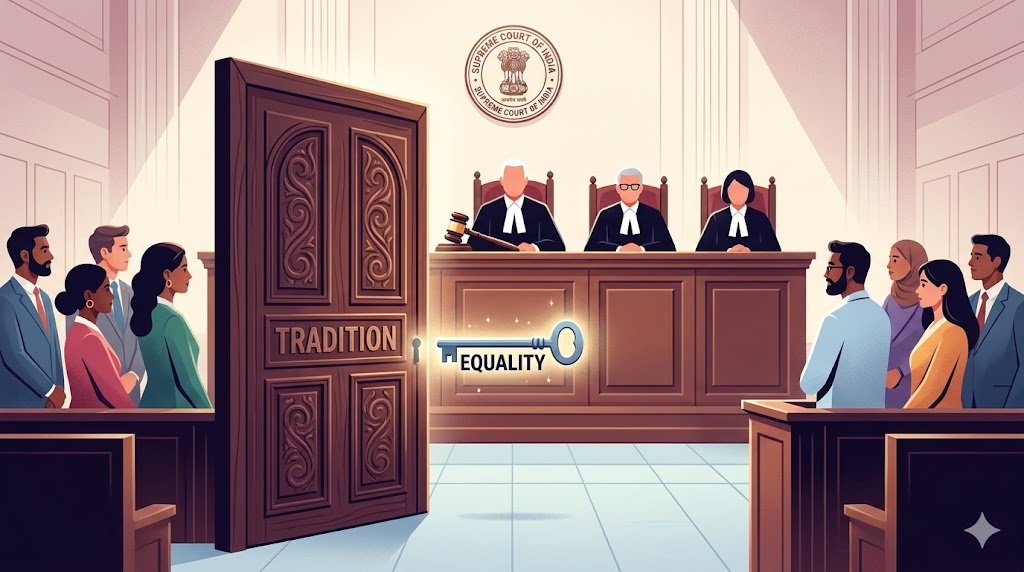
"The 2018 Supreme Court Judgment: A Landmark 4:1 Verdict."
The 2018 Supreme Court Judgment: A Landmark 4:1 Verdict
On September 28, 2018, the Supreme Court delivered its much-anticipated judgment in the Sabarimala case. In a 4:1 majority, the bench—comprising Chief Justice Dipak Misra, Justices A.M. Khanwilkar, R.F. Nariman, and D.Y. Chandrachud—ruled that the ban on women aged 10-50 was unconstitutional. The court struck down Rule 3(b) as ultra vires the Kerala Hindu Places of Public Worship Act and violative of fundamental rights.
The majority held that the practice did not qualify as an essential religious practice under Article 25. They reasoned that exclusion based on biological differences like menstruation amounted to gender discrimination, incompatible with constitutional values of equality and dignity. Justice Chandrachud notably described the ban as a form of “untouchability” rooted in notions of purity and pollution, drawing parallels to Article 17. The judges emphasized that religious practices cannot override women’s right to worship freely. Once a temple is open to the public as a Hindu place of worship, it cannot impose arbitrary exclusions that denude women of their Article 25(1) rights.
Crucially, the majority determined that Ayyappa devotees do not constitute a separate religious denomination under Article 26. They are part of the broader Hindu fold, and thus the temple’s customs must align with constitutional morality. The bench rejected the argument that the deity’s celibacy required the ban, asserting that faith cannot justify discrimination. In essence, the 2018 ruling in the Sabarimala case affirmed that women’s constitutional rights to equality and religious practice take precedence over contested customs.
The Dissenting Opinion: Justice Indu Malhotra’s Stand
Justice Indu Malhotra, the lone woman judge on the bench, dissented powerfully. She argued that courts should exercise restraint in matters of deep religious sentiment. According to her, the essential character of a religious practice must be judged by the faith and beliefs of its followers, not by external notions of rationality or logic. Justice Malhotra viewed Ayyappans as a distinct denomination entitled to Article 26 protections and held that the exclusion formed an integral part of their worship. She warned that judicial overreach could set dangerous precedents, eroding the pluralism that defines India’s secular fabric. Her dissent in the Sabarimala case underscored the need to harmonize rights rather than subordinate religious freedom to equality claims.
Public Discourse, Protests, and Women Supporters vs. Tradition
The 2018 verdict in the Sabarimala case triggered unprecedented public backlash. Protests erupted across Kerala and beyond, with devotees blocking roads, organizing human chains, and clashing with police. Many viewed the ruling as an attack on their faith, leading to emotional scenes of women devotees themselves opposing entry.
Women supporters of the judgment, including activists from the Indian Young Lawyers Association and feminist groups, attempted to trek the hill to assert their rights. Several faced hostility, verbal abuse, and physical obstruction from crowds. These efforts highlighted the divide: on one side, women protesting for constitutional equality against state-enforced customs and traditional gatekeepers; on the other, millions of devotees, including women outside the 10-50 age group, defending the temple’s sanctity.
Political lines blurred. The ruling Left Democratic Front (LDF) government in Kerala initially committed to implementing the verdict but faced fierce criticism. The opposition BJP and traditionalist organizations amplified the narrative of cultural erosion. Media coverage amplified the Sabarimala case into a national flashpoint, sparking debates on social media, television, and public forums about whether courts should “reform” religion or respect lived faith.
The Centre’s Arguments: From 2018 to the Present
In the original Sabarimala case hearings, the Centre’s position was nuanced, but review petitions saw shifting stances. By 2026, during the nine-judge bench proceedings, the Centre has strongly argued that the 2018 judgment was wrongly decided. Solicitor General Tushar Mehta contended that concepts like patriarchy and gender stereotypes are Western imports alien to India’s civilizational ethos, where women are often placed on a pedestal through goddess worship. The government emphasized public morality rooted in faith over imposed constitutional morality and questioned whether non-devotees or outsiders could challenge core religious practices.
The Centre also cited examples of temples barring men to underscore that gender-specific restrictions exist symmetrically in certain traditions. These arguments reflect a broader push to limit judicial interference in religious affairs, directly challenging the 2018 Sabarimala precedent.
Current Status: The 2026 Nine-Judge Bench Review
As of April 2026, the Sabarimala case has returned to the Supreme Court in a vastly expanded form. A nine-judge Constitution Bench, led by Chief Justice Surya Kant, commenced final hearings on April 7, 2026. The bench is addressing seven key constitutional questions referred from the review petitions, including the scope of judicial review over essential religious practices, the interplay between Articles 25 and 26, and whether courts can test religious beliefs against rationality.
Hearings have featured intense arguments from the Travancore Devaswom Board, the Centre, women’s rights advocates, and devotee groups. The 2018 verdict remains in force pending the larger bench’s decision, but the outcome could have far-reaching implications for similar cases involving women’s entry into places of worship across faiths. With arguments expected to conclude soon, the nation awaits clarity on whether the Sabarimala case will reaffirm gender justice or recalibrate the boundaries of religious autonomy.
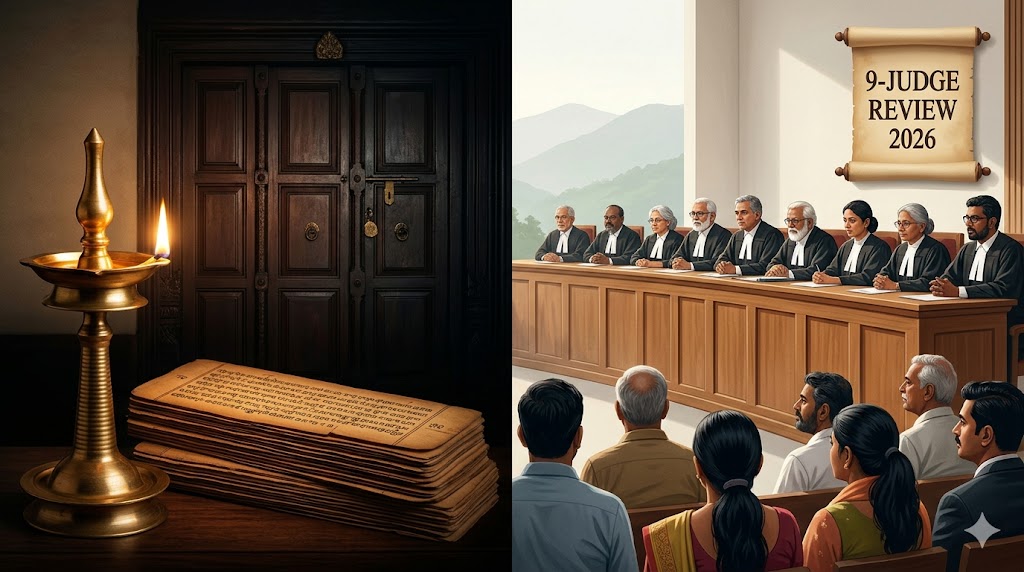
"Current Status: The 2026 Nine-Judge Bench Review."
Broader Implications and the Road Ahead
The Sabarimala case transcends a single temple. It raises timeless questions: Can constitutional rights override religious customs? Who defines “essential practices”? And how does a secular democracy reconcile diversity of faith with equality? The 2018 ruling advanced women’s rights but at the cost of alienating large sections of believers. The ongoing review offers an opportunity for nuanced jurisprudence that respects both.
For women supporters who protested against restrictive state rules and customs, the Sabarimala case symbolizes empowerment. For traditionalists, it represents the need to safeguard sacred spaces. Whatever the 2026 verdict, it will influence public discourse on religion and rights for generations.
In conclusion, the Sabarimala case exemplifies the dynamic tension at the heart of Indian democracy. By prioritizing constitutional values in 2018 while inviting deeper reflection now, the Supreme Court continues to navigate one of society’s most complex fault lines. As the nine-judge bench deliberates, the Sabarimala case reminds us that true justice lies not in erasure of tradition or rights, but in their thoughtful reconciliation.