Nelson Mandela: Life, Apartheid, struggles & Legacy
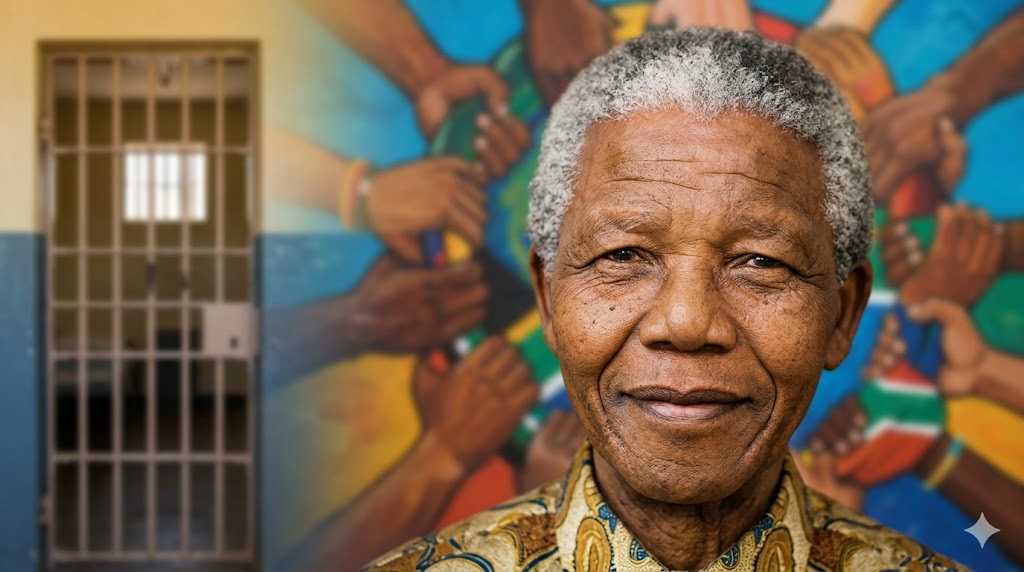
Nelson Mandela stands as one of the most revered figures in modern history—a man whose life embodied the relentless pursuit of justice, equality, and human dignity. Born into a world sharply divided by race, he rose from rural roots in South Africa to become the country’s first Black president. His story is not just a biography of personal triumph; it is a powerful testament to the fight against systemic discrimination. In an era when apartheid enforced brutal separation between white and Black South Africans, Nelson Mandela dedicated his life to dismantling those barriers. Even today, in 2026, his legacy resonates as societies worldwide continue to grapple with similar forms of exclusion, including persistent caste discrimination that affects millions across the globe.
This article explores Nelson Mandela’s remarkable journey—his early influences, the cultural and racial struggles that forged his resolve, his leadership in ending apartheid, and the establishment of the Truth and Reconciliation Commission. It also examines how the lessons from his era apply to ongoing global challenges, including caste-based oppression and the psychological toll of discrimination that can push marginalized communities toward cycles of disadvantage and crime. Written from an educational perspective, this piece highlights how education, reconciliation, and collective action remain essential tools for building equitable societies.
Nelson Rolihlahla Mandela was born on July 18, 1918, in the village of Mvezo in South Africa’s Eastern Cape. His birth name, Rolihlahla, literally means “troublemaker”—a prophetic label for the man who would later challenge an entire regime. Raised in the Thembu royal family after his father’s early death, young Nelson absorbed the rich Xhosa cultural traditions while witnessing the daily humiliations of colonial rule and racial inequality.
The cultural and racial struggles of his youth profoundly shaped him. South Africa in the early 20th century was already a land of stark contrasts: white minority rule enforced through laws that stripped Black people of land, voting rights, and basic freedoms. Mandela later recalled how these early experiences ignited his awareness of injustice. As a student at the University of Fort Hare and later at the University of the Witwatersrand, where he studied law, he encountered the intellectual foundations of resistance. He joined the African National Congress (ANC) in 1944, co-founding its Youth League to inject new energy into the organization.
These formative years reveal a key truth about Nelson Mandela’s life: personal hardship and collective oppression fueled his commitment. The discrimination he observed—not just in laws but in everyday interactions between white and Black South Africans—planted the seeds of defiance. By the 1950s, he had become a practicing lawyer in Johannesburg, using his profession to defend victims of apartheid legislation. His first marriage to Evelyn Ntoko Mase and later union with Winnie Madikizela-Mandela reflected both personal stability and shared activism, as both women supported his growing public role.
The Defiance Campaign and Turn to Armed Resistance
By the 1950s, apartheid had become an official policy under the National Party government. Pass laws restricted Black movement, separate amenities divided public spaces, and the Group Areas Act forcibly relocated communities. Nelson Mandela emerged as a central figure in the 1952 Defiance Campaign, a mass non-violent protest against unjust laws. He traveled the country, mobilizing support and facing repeated arrests—the beginning of what would become a lifetime of legal persecution.
The 1955 Congress of the People produced the Freedom Charter, a visionary document calling for a non-racial democracy. Mandela helped draft it, but the government responded with the 1956 Treason Trial, charging him and others with conspiracy. Though acquitted, the trial underscored the regime’s determination to silence dissent.
The Sharpeville Massacre of 1960, where police killed 69 peaceful protesters, marked a turning point. The ANC was banned, and Nelson Mandela shifted from strict non-violence to selective sabotage. He co-founded Umkhonto we Sizwe (“Spear of the Nation”), the ANC’s armed wing, arguing that peaceful methods had failed against a violent state. Arrested in 1962 and sentenced to life imprisonment in the 1964 Rivonia Trial, Mandela delivered his famous “I Am Prepared to Die” speech from the dock. In it, he articulated the moral imperative of the struggle: “I have fought against white dominance, and I have fought against Black domination. I have cherished the ideal of a democratic and free society in which all persons live together in harmony and with equal opportunities.”
His 27 years in prison—much of it on Robben Island—became a global symbol. The “Free Nelson Mandela” campaign united activists worldwide, turning his name into a rallying cry for human rights.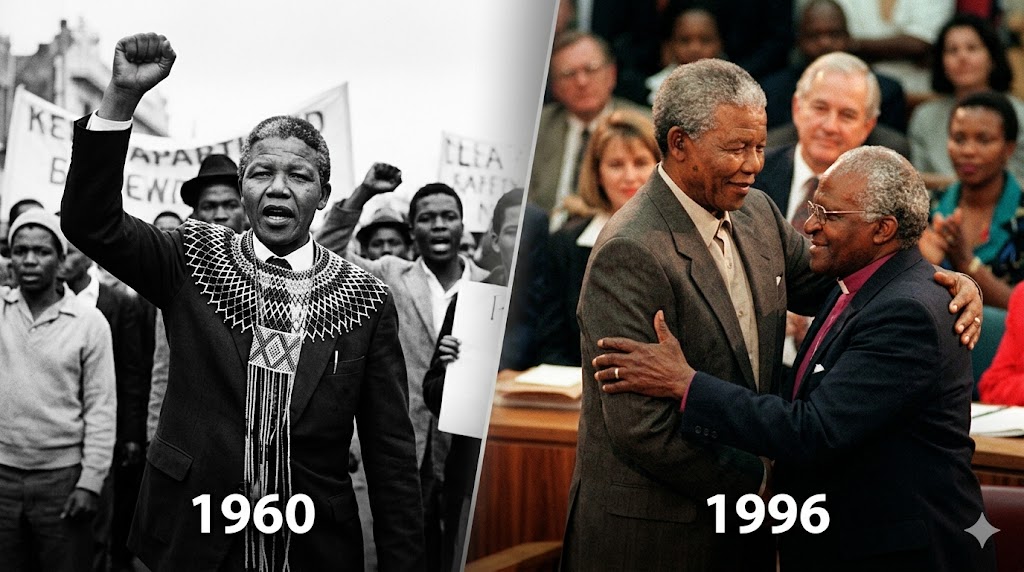
The Truth and Reconciliation Commission: Healing a Nation
Imprisonment, Release, and the Path to the Presidency
Prison did not break Nelson Mandela; it refined his leadership. He studied Afrikaans to understand his oppressors, organized fellow inmates, and maintained correspondence that sustained the movement. Released on February 11, 1990, by President F.W. de Klerk amid mounting international pressure and domestic unrest, Mandela walked out a free man at age 71. He immediately resumed negotiations to dismantle apartheid.
The early 1990s were turbulent. Political violence threatened to derail talks, yet Mandela’s insistence on reconciliation prevailed. In 1993, he and de Klerk shared the Nobel Peace Prize. The 1994 multiracial elections brought the ANC to power, and on May 10, 1994, Nelson Mandela was inaugurated as South Africa’s first Black president. His administration focused on nation-building: a new constitution, land reform, healthcare expansion, and poverty reduction. He retained elements of the previous economic framework while prioritizing inclusion.
Nelson Mandela’s success lay in balancing justice with pragmatism. He understood that true freedom required addressing the deep wounds of white-Black divisions without descending into revenge. His presidency (1994–1999) demonstrated that one man’s vision could transform a divided society.
The Truth and Reconciliation Commission: Healing a Nation
One of Mandela’s most visionary acts was establishing the Truth and Reconciliation Commission (TRC) in 1995. Chaired by Archbishop Desmond Tutu, the TRC embodied restorative justice rather than retribution. It invited victims of gross human rights violations to share their stories in public hearings and allowed perpetrators— from both the apartheid regime and liberation movements—to apply for amnesty in exchange for full disclosure of their crimes.
The commission documented atrocities committed under apartheid, including torture, assassinations, and forced removals. By exposing the truth, it aimed to foster national healing. Mandela authorized the process knowing it would be painful, yet he believed forgiveness was essential for unity. The TRC’s final report, released in 1998, recommended reparations and institutional reforms. While implementation faced challenges, the commission set a global precedent for transitional justice.
Nelson Mandela’s support for the TRC illustrated his philosophy: confronting the past honestly prevents it from poisoning the future. It addressed the societal differences between white and Black South Africans head-on, promoting empathy over enmity.
Mandela’s Enduring Legacy and Global Inspiration
Nelson Mandela died on December 5, 2013, at age 95, but his influence endures. International Nelson Mandela Day, observed every July 18, encourages acts of service in his honor. Films like *Invictus* and documentaries capture his story for new generations. Quotes such as “No one is born hating another person because of the color of his skin” continue to inspire educators and activists.
His life offers mini-bios for children: a boy who loved learning, became a lawyer, stood up for fairness, and forgave his jailers. For adults, it provides profound lessons on leadership, resilience, and the power of education to combat prejudice.
Caste Discrimination in 2026: An Unfinished Global Struggle
As we reflect on Nelson Mandela’s achievements in 2026, it is sobering to recognize that discrimination has not vanished—it has evolved. Caste-based systems, particularly in South Asia but with global echoes, mirror the hierarchical control once enforced by apartheid. Over 260 million people worldwide still face caste discrimination, a form of structural exclusion rooted in descent, occupation, and social stigma.
In 2026, urban India exemplifies how caste persists amid development. Reports document ongoing atrocities, residential segregation, and discrimination in education and employment. The University Grants Commission’s 2026 regulations aim to promote equity in higher education by addressing caste bias, yet challenges remain. Globally, the 2025 Toronto Global Conference for a Caste-Free World produced the Toronto Declaration, urging the United Nations to treat caste discrimination with the same urgency as racism and apartheid. Activists highlight intersections with gender, labor exploitation, and migration, showing how caste reproduces in new contexts—from supply chains to conservation efforts.
Nelson Mandela’s fight against racial apartheid provides a blueprint. Just as he challenged white-Black divides, today’s movements demand recognition that caste is not a relic but a living barrier to equality. People worldwide are not yet rid of these systems; they arise even in developed economies through subtle networks of exclusion. Education remains key—curricula that teach anti-caste and anti-racist histories can break cycles of ignorance.
The Human Cost: Discrimination, Mental Health, and Social Outcomes
Discrimination—whether racial or caste-based—inflicts deep psychological wounds. Systemic bias creates chronic stress, leading to higher rates of anxiety, depression, PTSD, and suicidality among marginalized groups. Black communities in South Africa and elsewhere, like Dalit and lower-caste populations globally, often face barriers to mental health care due to stigma, underdiagnosis, and unequal access.
This toll extends to societal outcomes. Limited opportunities, poverty, and repeated trauma can contribute to cycles where some individuals in oppressed communities encounter the criminal justice system. Studies show that racial and caste discrimination correlate with the “school-to-prison pipeline,” harsher policing, and disproportionate arrests rather than treatment for mental illness. Black and lower-caste youth experience higher rates of school discipline and criminalization, perpetuating disadvantage.
Yet Mandela’s story rejects fatalism. He transformed personal and collective suffering into constructive action. Criticism of Black or lower-caste communities often ignores root causes—structural inequality—not inherent traits. Education empowers resilience: programs teaching Mandela’s principles of reconciliation and self-worth help individuals reclaim agency and reduce vulnerability to negative paths.
In 2026, as caste conferences and equity regulations highlight persistent issues, Mandela’s emphasis on truth-telling offers hope. Societies must address how discrimination warps mental health and opportunity, investing in inclusive education, mental health support, and policy reforms.
Lessons for Education and a More Equitable Future
Nelson Mandela believed education was the most powerful weapon against discrimination. He once said, “Education is the most powerful weapon which you can use to change the world.” Today, schools and universities worldwide can draw from his life to teach empathy, critical thinking, and activism.
For children, simplified stories of his prison years and peaceful release illustrate forgiveness. For adults, case studies of the TRC and ongoing caste struggles encourage dialogue. Global education initiatives—incorporating anti-bias training and diverse histories—can prevent the mental health crises and social fractures discrimination breeds.
Mandela’s success proves that one leader, supported by a movement, can shift history. In 2026, as people continue facing caste and racial barriers, his legacy calls us to action: educate, reconcile, and build societies where no one is defined by birth or skin color.

"Caste Discrimination in 2026: An Unfinished Global Struggle" or "Lessons for Education.
Conclusion: A Call to Carry the Torch
Nelson Mandela’s life—from rural boy to global statesman—demonstrates the transformative power of courage against oppression. He confronted apartheid’s atrocities, bridged white-Black divides, and created the Truth and Reconciliation Commission to heal a fractured nation. His journey shaped South Africa and inspired the world.
Yet the work continues. In 2026, caste discrimination remains a major global challenge, intertwined with racial inequities that affect mental well-being and life chances. By studying Mandela’s biography, quotes, speeches, and history, we gain tools to combat these forces. Education is our greatest ally. Let us honor his memory not only by celebrating Nelson Mandela Day but by actively dismantling discrimination in all its forms—racial, caste, or otherwise—for a truly free and equal world.