In the shadow of fading unipolarity, the world finds itself grappling with a familiar yet transformed rivalry. The new cold war—marked by intensifying competition between the United States and a deepening Russia-China axis—reveals a striking truth: the Cold War never truly ended. Its alliances, proxy strategies, and ideological lenses endure, refracted through today’s regional conflicts. What began as postwar realignments after World War II and hardened into bipolar blocs during the original Cold War now quietly orchestrates the new cold war’s contours.
This article examines how Cold War alliances remain the invisible scaffolding of modern geopolitics. It traces the persistence of friends and foes across decades, the enduring appeal of proxy strategies, and the way old frameworks continue to shape regional flashpoints. Far from obsolete relics, these elements actively define the new cold war, even as economic interdependence and technological disruption introduce new variables. Understanding this continuity is essential for grasping why global stability feels perpetually just out of reach.
The Illusion of the Cold War’s End
When the Berlin Wall fell in 1989 and the Soviet Union dissolved in 1991, many declared the Cold War over. Triumphalism in the West suggested history itself had reached a liberal democratic endpoint. Yet three decades later, the new cold war demonstrates that structural realities proved far more resilient than optimistic narratives.
The original Cold War was never merely about ideology. It was about spheres of influence, military containment, and the strategic use of proxies to avoid direct superpower confrontation. Those same imperatives survived the Soviet collapse. NATO did not disband; instead, it expanded eastward, incorporating former Warsaw Pact states and even Baltic republics once under Moscow’s orbit. Russia, stripped of its superpower status in the 1990s, watched this expansion with growing resentment—a sentiment that would later fuel its revanchist policies.
Meanwhile, China’s economic rise, initially welcomed as a market opportunity, gradually revealed itself as a systemic challenge. By the mid-2010s, Washington had begun framing Beijing as a peer competitor. The new cold war crystallized not in a single declaration but through cumulative actions: trade wars, technology restrictions, military buildups in the Indo-Pacific, and the formalization of the Russia-China “no-limits partnership.”
Critics sometimes argue that today’s rivalry differs fundamentally because of globalization. Economic ties between the West and China remain deep, and nuclear deterrence still constrains direct conflict. Yet these differences mask deeper continuities. Proxy strategies—once used in Korea, Vietnam, and Afghanistan—reappear in Ukraine, the Middle East, and potential flashpoints around Taiwan. Old alliances, though rebranded, still determine who supplies weapons, intelligence, and diplomatic cover in these conflicts. The new cold war is not a reboot; it is an evolution of the same geopolitical DNA.
Enduring Alliances: Friends and Foes Across Eras
History shows that nations have no permanent friends or enemies—only permanent interests. Yet in practice, certain alignments have displayed remarkable durability from World War II through the Cold War and into the new cold war.
Consider the transatlantic bond. The United States and Western Europe forged their partnership against Nazi Germany during World War II. That alliance seamlessly transitioned into the anti-Soviet NATO framework in 1949. Today, NATO remains the cornerstone of Western security architecture in the new cold war. Its expansion after 1991, once justified as stabilizing Eastern Europe, is now viewed by Moscow as encirclement. The same capitals that stood together against the Warsaw Pact now coordinate sanctions and military aid against Russia in Ukraine.
On the other side, the Russia-China relationship offers a mirror image of continuity with adaptation. During the late Cold War, Beijing and Moscow were bitter rivals, even clashing along their border in 1969. Yet strategic necessity eventually brought them closer. In the new cold war, their partnership has deepened dramatically. Joint military exercises, energy deals, and diplomatic coordination against what both call “Western hegemony” echo the old Soviet bloc’s logic, albeit without formal treaty obligations like the Warsaw Pact. Recent developments, including the consolidation of ties amid Middle East tensions, illustrate how this axis counters U.S.-led initiatives.
Japan and South Korea provide further evidence of lasting alignments. Both nations transitioned from World War II adversaries or occupied territories to key U.S. allies during the Cold War. In the new cold war, they remain central to Washington’s Indo-Pacific strategy through frameworks like the Quad and trilateral security pacts. Their threat perceptions—focused on China and North Korea—mirror Cold War-era concerns about communist expansion.
Not every alignment has remained static, of course. India, once leaning toward the Soviet Union during the Cold War, now balances relations with Russia while deepening defense ties with the United States. Global South nations frequently resist being drawn into the new cold war’s binary, preferring strategic autonomy. Yet even here, patterns persist: many former non-aligned states still navigate the same great-power gravitational pulls that defined the original Cold War.
These continuities are not accidental. Alliances form around shared threats and complementary capabilities. As long as the core rivalry between Washington and the Moscow-Beijing axis endures, the old map of friends and foes provides a reliable guide.
The New Geopolitical DNA: A stylized visualization showing the 21st-century Russia-China energy and industrial axis countering Western-led economic interdependencies, with the underlying shadows of Cold War infrastructure still visible.
Proxy Strategies: Timeless Tools of Great-Power Competition
Proxy strategies defined Cold War statecraft because they allowed superpowers to contest influence without risking nuclear escalation. The same logic operates in the new cold war, albeit with updated players and technologies.
During the original Cold War, the United States and Soviet Union armed opposing sides in Korea, Vietnam, Angola, and Nicaragua. Each conflict served as a laboratory for testing doctrines, weapons, and resolve. Today, Ukraine functions as the clearest proxy theater. Western weapons, intelligence, and training flow to Kyiv while Russia receives critical support—drones, artillery shells, and diplomatic cover—from Iran, North Korea, and, crucially, China. The battlefield has become a proving ground for 21st-century warfare, much as Korea tested early Cold War strategies.
The Middle East offers another case study. Iran’s network of proxy militias, long viewed through a Cold War-era lens of revolutionary export, now intersects with the new cold war. Recent escalations involving Iran have reportedly accelerated Russia-China alignment, unraveling aspects of U.S. regional strategy. Saudi Arabia and Israel, traditional U.S. partners, navigate these dynamics while pursuing their own security interests—echoing how regional powers once leveraged superpower rivalries for local advantage.
Proxy strategies have evolved in sophistication. Cyber operations, disinformation campaigns, and economic coercion supplement traditional arms transfers. Yet the underlying principle remains unchanged: great powers compete indirectly through third parties to avoid direct confrontation. In the new cold war, this approach preserves strategic ambiguity while imposing costs on adversaries.
Critics note that globalization complicates pure proxy dynamics. Supply chains entangle sponsors and proxies alike. Nevertheless, the preference for indirect engagement persists because the risks of escalation—particularly nuclear—have only grown. Proxy strategies thus remain the safest battlefield for the new cold war’s contests.
Regional Conflicts Through Old Lenses
The new cold war manifests most visibly in regional conflicts viewed through outdated but still potent frameworks. Analysts often apply Cold War-era containment logic to today’s flashpoints, sometimes with distorting effects.
In Europe, Russia’s actions in Ukraine are frequently interpreted as a direct challenge to the post-Cold War order. NATO’s eastward expansion, once seen as consolidating democracy, is now framed by Moscow as existential encroachment. The resulting conflict has galvanized the alliance, reinforcing the very structures it sought to undermine. Old lenses—East versus West, democracy versus autocracy—shape both Western resolve and Russian narratives.
The Indo-Pacific presents a parallel dynamic centered on Taiwan and the South China Sea. Beijing’s assertiveness is read through the prism of Cold War containment: a rising power challenging U.S. primacy much as the Soviet Union once did. Washington’s response—strengthening alliances with Japan, Australia, the Philippines, and India—mirrors earlier efforts to build anti-communist coalitions. Military exercises, freedom-of-navigation operations, and technology export controls all echo Cold War containment tactics.
The Middle East, long a theater of superpower proxy competition, shows how old alliances adapt to new realities. Iran’s alignment with Russia and China fits neatly into the emerging axis. Meanwhile, U.S. support for Israel and Gulf partners continues patterns established during the original Cold War, when the region served as a battleground against Soviet influence. Recent escalations have only intensified these alignments, demonstrating how regional rivalries become subsumed into the broader new cold war framework.
These conflicts are not isolated. They interconnect through arms flows, diplomatic signaling, and resource competition. Old lenses—bloc thinking, zero-sum calculations—persist because they simplify complex realities for policymakers and publics alike. Yet they also risk escalation by reducing nuanced regional grievances to great-power chess moves.
The Evolution of Politics: Continuity Amid Change
Politics in the new cold war exhibits a paradoxical quality: it transforms while remaining fundamentally the same. Interests evolve; structural incentives endure.
Economic globalization, absent during much of the original Cold War, creates interdependencies that complicate outright decoupling. Supply chains for semiconductors, rare earth minerals, and energy link adversaries even as strategic competition intensifies. Climate change and pandemics demand cooperation that cuts across traditional alliances. These factors introduce fluidity absent in the more rigid bipolar era.
Nevertheless, core drivers of state behavior—security dilemmas, power transitions, and status competition—remain constant. The new cold war features the same emphasis on military modernization, alliance management, and narrative control that characterized its predecessor. Technological competition over artificial intelligence, quantum computing, and space represents the updated arena for what was once an arms race focused on nuclear delivery systems.
Domestic politics also plays a recurring role. Nationalist narratives in Russia, China, and even segments of the United States echo Cold War-era mobilization tactics. Public opinion is shaped through information operations, much as propaganda defined earlier eras.
The key difference lies in multipolarity’s complexity. Middle powers and Global South nations possess greater agency than during the original Cold War. Yet even here, patterns reassert themselves: many states hedge between blocs, pursuing interests without fully committing—precisely the non-aligned strategy of the mid-20th century.
Thus, while conditions change across ages, the fundamental grammar of international politics—alliances forged in rivalry, strategies of indirect confrontation—persists. The new cold war is not a repetition but a variation on a well-worn theme.
The New Cold War Dynamics: Setting the Stage for an Uncertain Future
As the new cold war matures, its architects draw consciously from historical precedents. Washington’s Indo-Pacific strategy explicitly invokes containment analogies. Beijing and Moscow frame their partnership as resistance to outdated hegemony, invoking anti-colonial rhetoric familiar from earlier eras.
Regional conflicts serve as pressure valves and testing grounds. Each flare-up—whether in Eastern Europe, the Taiwan Strait, or the Persian Gulf—tests the resilience of alliances and the effectiveness of proxy approaches. The cumulative effect is a fragmented global order where cooperation on transnational issues coexists uneasily with competitive zero-sum maneuvering.
The stakes are high. Miscalculation in any theater could cascade across regions, given the interconnected nature of modern supply chains and security commitments. Yet history also offers hope: the original Cold War ended not through military victory but through internal transformation and diplomatic realism. Similar pathways may exist today if leaders recognize the limits of old lenses.
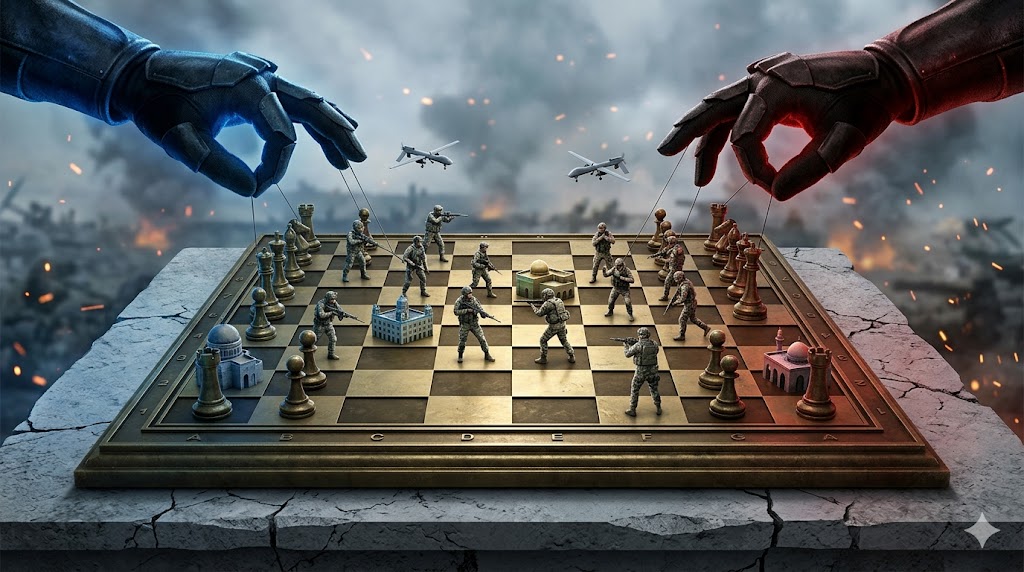
The Logic of Indirect Engagement: Great powers compete and test advanced technologies, such as drones and cyber capabilities, by manipulating conflicts and third-party actors on a global chessboard, avoiding direct confrontation while maximizing strategic leverage.
Conclusion: Learning from Enduring Patterns
The new cold war is not an aberration but the logical extension of Cold War alliances and proxy strategies adapted to contemporary realities. From World War II’s realignments through decades of bipolar confrontation, the same nations largely occupy familiar roles. Regional conflicts become the arenas where these enduring patterns play out, often exacerbating local grievances in service of great-power objectives.
Understanding this continuity does not imply fatalism. It equips policymakers and citizens to navigate the new cold war with clearer eyes—recognizing when old frameworks illuminate threats and when they distort opportunities for de-escalation. In an era of rapid technological and climatic change, breaking free from outdated lenses may prove the ultimate strategic imperative.
The unending war is not inevitable. But ignoring its historical roots ensures we remain prisoners of the past while shaping an increasingly fragile future.
Frequently Asked Questions
What is the primary significance of "Why Cold War Alliances Shape the New Cold War"?
Why Cold War Alliances Shape the New Cold War In the shadow of fading unipolarity, the world finds itself grappling with a familiar yet transformed rivalry. The new cold war—marked by intensifying competition between the United States and a deepening Russia-China axis—reveals a striking truth: the Cold War never truly ended.
How does this development impact International Affairs?
Its alliances, proxy strategies, and ideological lenses endure, refracted through today’s regional conflicts. What began as postwar realignments after World War II and hardened into bipolar blocs during the original Cold War now quietly orchestrates the new cold war’s contours. This article examines how Cold War alliances remain the invisible scaffolding of modern geopolitics.
What are the key future projections to monitor?
It traces the persistence of friends and foes across decades, the enduring appeal of proxy strategies, and the way old frameworks continue to shape regional flashpoints.