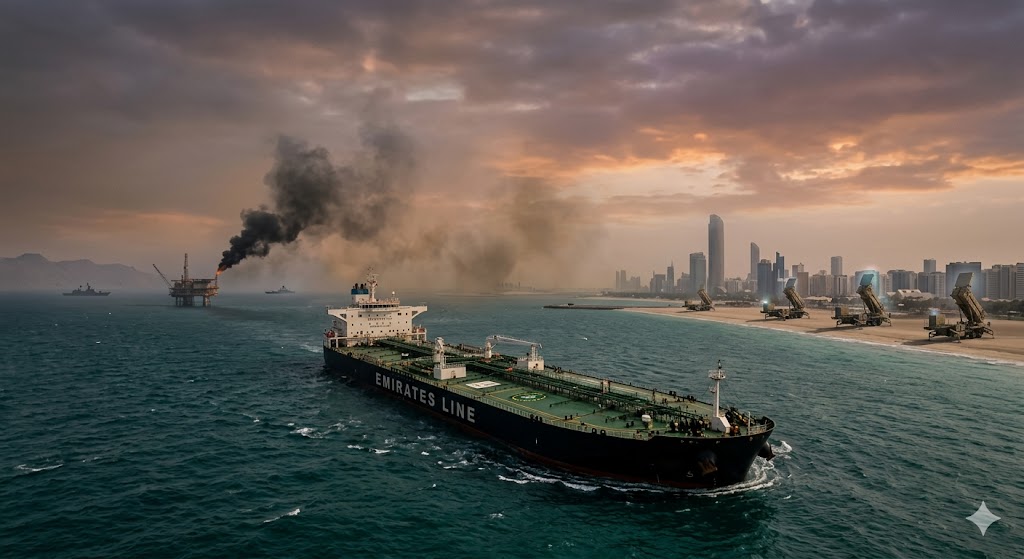
UAE Seeks US Financial Lifeline Amid Iran War Crisis
International Affairs• April 20, 2026• Global Edition
The 2026 US-Israel-Iran war, which erupted on February 28 with coordinated airstrikes, has reshaped not only the geopolitical landscape of the Middle East but also its economic foundations. What began as targeted operations against Iranian nuclear and missile capabilities has escalated into a broader conflict involving retaliatory strikes, disruptions to critical oil shipping routes, and significant financial pressures on all parties involved.
In this volatile environment, the United Arab Emirates (UAE) has emerged as a key player navigating a delicate balance. While absorbing direct impacts from Iranian missile and drone attacks, the UAE is actively seeking precautionary financial support from the United States through potential currency swap arrangements. At the same time, it continues substantial expenditures and investments directed toward the US, reinforcing long-standing strategic and economic ties. This article examines the recent financial strains triggered by the conflict—often referred to in economic analyses as a war-induced crisis—focusing on expenditure challenges affecting financial, economic, and defense security. It explores how Iran, the US, and Israel are contending with mounting costs, the UAE’s pivot toward US backing, and emerging trends in bilateral financial flows.
The war’s ripple effects have tested regional resilience, with global oil prices surging, supply chains fracturing, and recession risks looming for Gulf economies. Yet amid these pressures, the UAE’s proactive engagement with Washington underscores a commitment to stability and diversification. By delving into these dynamics, we gain insight into how expenditures on defense and economic safeguards are reshaping security paradigms in the region.
The conflict ignited when US and Israeli forces launched nearly 900 strikes in a single day on February 28, 2026, targeting Iranian military sites, leadership, and strategic infrastructure. Iran responded with hundreds of missiles and thousands of drones aimed at US bases, Israel, and Gulf allies, including the UAE. The fragile ceasefires attempted in subsequent weeks have done little to halt the underlying tensions, particularly around the Strait of Hormuz, a vital chokepoint for 20% of global oil and LNG supplies.
Economically, the war triggered the largest supply disruption in modern oil market history. Brent crude prices jumped over 50% in the initial weeks, climbing past $120 per barrel at peaks, while LNG and related commodities costs doubled in Asia. The Strait’s partial closure and Iranian threats led shipping lines to reroute, inflating global freight expenses and contributing to stagflation fears worldwide. For the Gulf Cooperation Council (GCC) states, including the UAE, this translated into stranded exports, force majeure declarations on energy shipments, and production drops exceeding 6 million barrels per day collectively.
These disruptions have compounded pre-existing vulnerabilities. Global growth forecasts for 2026 have been revised downward, with the IMF warning of potential recession if the conflict prolongs. Arab nations could see GDP losses between $120 billion and $194 billion, according to UNDP estimates. The crisis has intertwined financial security with defense and economic stability, as governments divert resources to repair infrastructure, bolster defenses, and cushion citizens from inflation spikes.
Iran’s Deepening Financial and Economic Crisis
Iran has borne the brunt of the war’s direct costs, with its already sanctioned economy contracting sharply. Analysts project a 10% GDP shrinkage in 2026, driven by widespread infrastructure damage from US-Israeli strikes. Over 4,000 civilian buildings were hit, alongside critical facilities like steel plants, shipyards, and enrichment sites. Naval capabilities were decimated, with 92% of large vessels sunk or damaged.
Inflation has surged dramatically, reaching levels not seen in recent decades. Food prices alone climbed over 105% year-on-year in some categories, with bread and cereals up 140%, meats 135%, and transportation costs 67%. The central bank issued its largest-ever banknote—a 10 million rial note—to cope with the currency’s free fall. Grain imports, reliant on Persian Gulf ports, were severely disrupted, exacerbating food shortages and humanitarian concerns.
Iran’s retaliatory strategy, while inflicting regional pain, has backfired economically. By targeting Gulf infrastructure, Tehran hoped to pressure adversaries but instead accelerated its own isolation. Revenue from oil sales, already limited by sanctions, plummeted further amid the Hormuz blockade. These expenditures on missile barrages and proxy support have strained state finances, undermining long-term economic security and forcing reliance on dwindling reserves. The war has not only eroded Iran’s defense capabilities but also its financial sovereignty, highlighting how military outlays can precipitate broader instability.
The geopolitical crisis centered on the Strait of Hormuz (illustrated by the distressed map) has disrupted energy flows, escalating defense costs across the region while simultaneously driving the UAE to reinforce its economic security through a strategic financial partnership with the United States.
US and Israel: War Expenditures Straining Budgets and Security Priorities
The United States, as a primary actor, has incurred substantial direct costs exceeding $200 billion in the conflict’s early phases alone. This includes advanced munitions, aircraft operations, naval deployments, and rescue missions, such as the recovery of a F-15E crew shot down over Iran. Gasoline prices in the US rose 30% nationally, contributing to broader inflationary pressures that delayed interest rate cuts and heightened recession risks to around 30%, per some forecasts.
Defense spending has quadrupled production of interceptors and related systems, diverting resources from domestic priorities. While US energy independence has buffered some oil shocks, uncertainty has dampened investment and hiring. Bond yields climbed, and stock markets experienced sharp sell-offs in early March. These expenditures underscore a tension between military objectives and economic stability, with analysts questioning the sustainability of prolonged engagement.
Israel, too, faces significant financial burdens. Iranian strikes on population centers and infrastructure, combined with its own offensive operations, have required massive outlays for air defenses and ground responses. The conflict’s spillover into Lebanon added further costs. Like the US, Israel must balance defense security with economic resilience, as global market volatility affects its tech-driven economy. Both nations’ involvement illustrates how war expenditures can challenge financial security, even for advanced economies with diversified revenue streams.
UAE’s Economic Challenges: Balancing Defense Costs and War Impacts
The UAE, despite its diversification efforts, has not been immune. Iranian forces launched over 1,700 missiles and drones toward the country—more than any other target outside direct US or Israeli sites—with several impacting populated areas, including Dubai International Airport grounds, Jebel Ali port, and residential zones. Four civilians were killed, and infrastructure sustained damage, prompting temporary stock market halts and aviation disruptions.
Dubai responded swiftly with over $270 million in economic support for businesses and families affected by the fallout. Energy infrastructure and aluminum production faced hits, contributing to global commodity price spikes. Food and water security concerns arose from Strait disruptions, as the UAE imports much of its caloric intake. Tourism, a cornerstone of the economy, suffered from airspace closures and event cancellations, while expatriate confidence wavered amid the psychological toll of strikes.
Defense expenditures have risen sharply. The UAE has invested tens of billions in US-made fighter jets, helicopters, and air defense systems, which intercepted over 90% of incoming threats. These systems, part of the country’s designation as a major US defense partner, proved critical but underscore the high costs of security in a volatile region. The war has tested the UAE’s economic model, built on stability and openness, yet its robust sovereign wealth reserves and non-oil sectors—projected to drive 5.6% GDP growth in 2026 per the Central Bank—provide a buffer.
Financial security remains a priority, with the 2026 federal budget balanced at AED 92.4 billion, up 29% from the prior year, emphasizing social development, infrastructure, and investments. However, the conflict has exposed vulnerabilities in relying on traditional energy routes and alliances.
UAE Turning to the US for Wartime Financial Support and Compensation Mechanisms
In a notable development, the UAE has opened preliminary discussions with the US about a financial backstop to mitigate deeper crisis risks. Central Bank Governor Khaled Mohamed Balama raised the prospect of a currency-swap line in Washington meetings last week with Treasury Secretary Scott Bessent and Federal Reserve officials. This would provide low-cost access to dollars to support the dirham or bolster reserves amid liquidity strains from oil revenue losses and capital flow risks.
UAE officials emphasized the request as precautionary, noting the country has so far avoided the worst effects but remains vigilant. The war’s damage to energy infrastructure and Hormuz blockades has cut dollar inflows, prompting this engagement. While no formal request has been filed, the talks signal a strategic reliance on US partnership for economic security. This aligns with broader expenditures on US defense assets, positioning the UAE as a key ally seeking reciprocal support.
Iran has separately demanded compensation from the UAE via a UN letter, accusing it of enabling strikes, but the UAE’s outreach to Washington focuses on forward-looking safeguards rather than reparations. This move enhances financial resilience while reinforcing defense ties.
Recent Trends in UAE Expenditures and Investments to the US
Amid the crisis, the UAE has reaffirmed its landmark $1.4 trillion investment commitment to the US over the next decade. Announced in 2025 and accelerated during high-level visits, the framework targets AI infrastructure, semiconductors, clean energy, advanced manufacturing, and critical infrastructure. Ambassador Yousef Al Otaiba’s March 2026 letter to the US-UAE Business Council stressed that deployment and funding would proceed without interruption, even as Gulf tensions escalate.
This represents a significant expenditure trend: outward foreign direct investment from the UAE reached AED 1.1 trillion recently, with the US as a prime destination. The 2026 federal budget allocates AED 15.4 billion to financial investments, a 431% increase, supporting these ambitions. Deals in AI and technology have already materialized, including data center commitments and national security alignments.
These outflows demonstrate confidence in US markets despite regional turmoil. They also yield strategic returns, enhancing technology transfers and economic diversification away from oil. Recent trends show acceleration in non-oil bilateral trade, surpassing $38 billion pre-war, with growth in aviation, energy, and tech sectors. The UAE’s expenditures to the US thus serve dual purposes: bolstering American industries while securing long-term UAE prosperity.
Intersecting Financial, Economic, and Defense Security Challenges
The war has blurred lines between financial, economic, and defense security. For all parties, expenditures on military hardware and operations have diverted funds from growth initiatives. Iran’s crisis threatens regime stability, while US and Israeli costs risk domestic fiscal strain. The UAE’s approach—seeking US liquidity support while investing heavily there—exemplifies pragmatic hedging.
Broader implications include heightened recession risks for Gulf economies, with Goldman Sachs warning of 2-5% contractions in some states. Global stagflation threats persist, as oil volatility feeds inflation and slows trade. Defense security now demands integrated economic strategies, as seen in the UAE’s US partnerships.
The UAE's dual-track approach: While investing tens of billions in advanced US defense systems to intercept intense missile and drone attacks (left), the nation accelerates massive, long-term capital outflows to the US in AI, technology, and clean energy (right), demonstrating confidence in American markets despite the surrounding wartime economic shockwaves.
Outlook: Resilience Through Strategic Partnerships
Looking ahead, the UAE’s financial engagement with the US positions it for recovery. Its diversified economy, strong reserves, and proactive budgeting suggest quicker rebound than peers if hostilities ease. Continued expenditures to the US will likely deepen ties, fostering innovation and security.
For Iran, reconstruction will be arduous without sanctions relief. The US and Israel must weigh war costs against strategic gains. Ultimately, the conflict underscores that true security encompasses financial stability alongside military strength.
In conclusion, the 2026 Iran war has imposed a multifaceted expenditure crisis, compelling nations to reassess priorities. The UAE’s turn to the US for support, paired with sustained investments, highlights a forward-thinking model amid uncertainty. As trends evolve, these dynamics will shape regional prosperity and global economic security for years to come.
Frequently Asked Questions
What is the primary significance of UAE Seeks US Financial Lifeline Amid Iran War Crisis?
The 2026 US-Israel-Iran war, which erupted on February 28 with coordinated airstrikes, has reshaped not only the geopolitical landscape of the Middle East but also its economic foundations. What began as targeted operations against Iranian nuclear and missile capabilities has escalated into a broader conflict involving retaliatory strikes, disruptions to critical oil shipping routes, and significant financial pressures on all parties involved. In this volatile environment, the United Arab Emirates (UAE) has emerged as a key player navigating a delicate balance.
How does this development impact International Affairs?
While absorbing direct impacts from Iranian missile and drone attacks, the UAE is actively seeking precautionary financial support from the United States through potential currency swap arrangements. At the same time, it continues substantial expenditures and investments directed toward the US, reinforcing long-standing strategic and economic ties.
What are the key future projections to monitor?
This article examines the recent financial strains triggered by the conflict—often referred to in economic analyses as a war-induced crisis—focusing on expenditure challenges affecting financial, economic, and defense security.