Delimitation Bill 2026: Explained, Vote & Latest Update
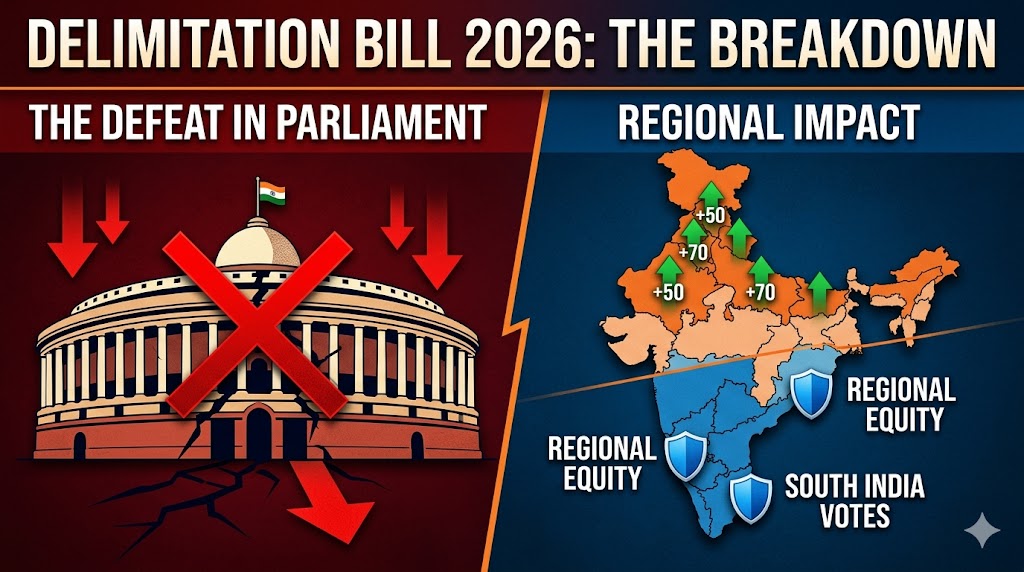
In a dramatic turn of events during the special Parliament session in April 2026, the delimitation bill became the focal point of intense political debate across India. Introduced on April 16 alongside two companion bills, the delimitation bill sought to reshape the electoral map of the world’s largest democracy. Yet, just 24 hours later, the core constitutional amendment it supported was defeated in the Lok Sabha, leading the government to withdraw the delimitation bill itself.
For anyone searching “what is delimitation bill” or “delimitation bill 2026 latest news,” this article provides a complete, professional breakdown. We explore the historical context, exact provisions of the delimitation bill, the parliamentary vote, statements from Union Home Minister Amit Shah, and strong reactions from Tamil Nadu Chief Minister MK Stalin (also referred to as CM Stalin). By the end, you will understand not only the delimitation bill’s intent but also why its defeat marks a significant moment in Indian federalism.
The delimitation bill was never just about redrawing boundaries. It was tied to implementing the long-awaited 33% women’s reservation in legislatures. Supporters viewed it as essential for “one person, one vote, one value.” Critics, particularly from southern states, saw it as a threat to regional equity. This balanced analysis draws from official records, parliamentary proceedings, and expert commentary to deliver clarity without bias.
What Is Delimitation? A Simple Yet Crucial Concept
Before diving into the delimitation bill 2026, it is important to grasp the fundamentals. Delimitation is the constitutional process of redrawing the boundaries of parliamentary and state assembly constituencies based on the latest population census. The goal is simple: ensure every Member of Parliament or MLA represents roughly the same number of people, upholding the democratic principle of equal representation.
Under Articles 81, 82, and 170 of the Indian Constitution, seats in the Lok Sabha and state assemblies must be allocated to states and union territories in proportion to their population. Within each state, constituencies are drawn to be geographically compact while factoring in administrative boundaries, physical features, and public convenience. Reserved seats for Scheduled Castes and Scheduled Tribes are also readjusted during this exercise.
India has conducted delimitation four times since independence—in 1952, 1963, 1973, and 2002-08—each following a census. However, the 42nd Constitutional Amendment (1976) and the 84th Amendment (2001) froze the number of seats based on the 1971 census until the first census after 2026. This freeze was a deliberate policy to reward states that successfully controlled population growth. The current delimitation bill sought to break that freeze using 2011 census data instead of waiting for the upcoming 2026-27 census.
In essence, the delimitation bill aimed to update an outdated electoral framework while simultaneously enabling women’s reservation. Without understanding this linkage, the intense controversy surrounding the delimitation bill india remains incomplete.
History of Delimitation in India: From Freeze to Fresh Debate
To appreciate the delimitation bill 2026, one must look back. After the 1971 census, Parliament decided against immediate readjustment to incentivise family planning. Southern states like Tamil Nadu, Kerala, Karnataka, and Andhra Pradesh excelled in population control and economic development, while northern states experienced higher growth rates.
By the 2001 census, the freeze was extended until after 2026. The last delimitation exercise (2002-08) used 2001 data but kept total seats unchanged. This created imbalances: some Lok Sabha constituencies now have nearly 40 lakh voters, while others have far fewer, violating the “one person, one vote” ideal that Amit Shah repeatedly emphasised during the 2026 debate.
The 106th Constitutional Amendment (2023), popularly known as the Nari Shakti Vandan Adhiniyam, reserved one-third of seats for women in the Lok Sabha and state assemblies. However, its implementation was linked to the first post-2023 census and subsequent delimitation—originally expected after 2027. The delimitation bill 2026 proposed to accelerate this by using 2011 data and increasing total seats, allowing women’s reservation to kick in potentially by the 2029 elections.
This historical context explains why the delimitation bill suddenly dominated searches for “delimitation bill parliament” and “delimitation bill latest news” in mid-April 2026.
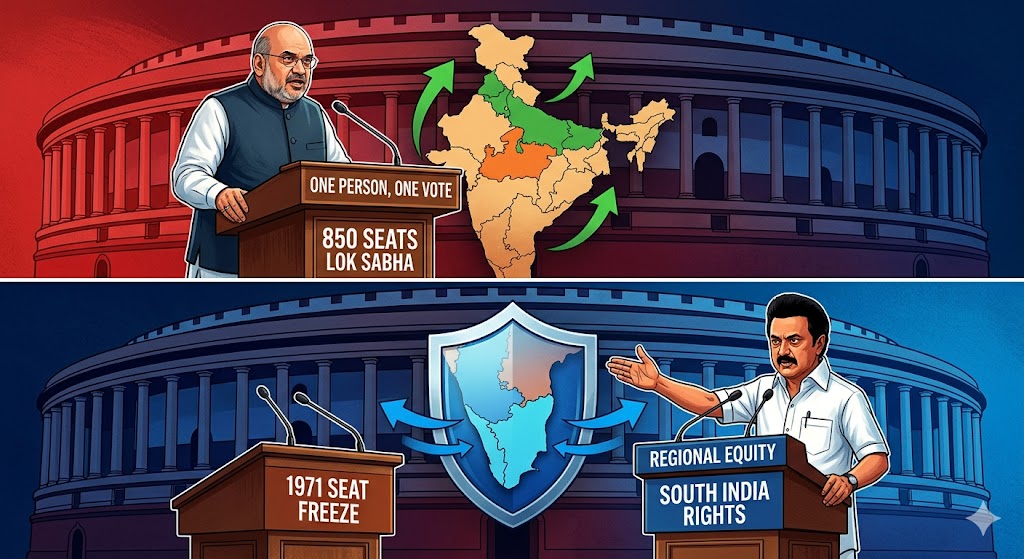
The political conflict over the Delimitation Bill 2026: The image illustrates the debate’s peak, juxtaposing the Union Government's push for demographic justice and an expanded 850-seat Lok Sabha (top panel, evoking Amit Shah's defense) against Southern India’s fierce resistance (bottom panel, evoking MK Stalin's opposition), which prioritized regional equity and population control successes.
The Delimitation Bill 2026: Key Provisions and Breakdown
The delimitation bill, formally titled “The Delimitation Bill, 2026,” was introduced in the Lok Sabha on April 16, 2026, by the Ministry of Law and Justice. It worked in tandem with the Constitution (131st Amendment) Bill, 2026, and the Union Territories Laws (Amendment) Bill, 2026. Here is a clear, clause-by-clause breakdown of what the delimitation bill proposed:
1. Constitution of Delimitation Commission: The central government could constitute a commission headed by a sitting or former Supreme Court judge, including the Chief Election Commissioner (or nominee) and the concerned State Election Commissioner. Associate members from Lok Sabha and assembly MPs/MLAs would assist but hold no voting rights.
2. Population Basis and Census Usage: Delimitation would use “the latest published census figures” available when the commission is formed. For this exercise, that meant the 2011 census, bypassing the pending 2026-27 census.
3. Expansion of Lok Sabha and Assemblies: The bill raised the ceiling on Lok Sabha seats from 550 (530 states + 20 UTs) to 850 (815 states + 35 UTs)—a roughly 50% increase. Similar proportional increases applied to state assemblies.
4. Readjustment of Seats: Seats would be reallocated among states and UTs strictly proportional to population. Constituencies would be redrawn for geographic compactness and administrative convenience. SC/ST reservations would be readjusted, with women’s quota applied across all categories post-delimitation.
5. Link to Women’s Reservation: The bill amended the 2023 women’s reservation law by removing the mandatory post-2027 census requirement, allowing implementation based on the new 2011-based delimitation.
6. Repeal of Delimitation Act, 2002: The existing law would be repealed to make way for the fresh commission.
7. Process and Finality: Proposals would be published in the Gazette, objections heard, and final orders issued with the force of law, immune from judicial review.
Government projections indicated that even with a uniform 50% seat increase, northern states like Uttar Pradesh, Bihar, and Rajasthan would see larger absolute gains, while southern states would gain seats but lose relative share. For instance, without expansion, Tamil Nadu’s Lok Sabha seats could drop from 39 to 32; with 50% growth, it would rise to around 48 but represent a smaller percentage of the larger House.
This detailed framework formed the heart of the delimitation bill explained in parliamentary debates.
Government’s Rationale: Amit Shah on Delimitation Bill
Union Home Minister Amit Shah delivered a robust defence during the Lok Sabha debate. He argued that the delimitation bill was essential to restore “one person, one vote, one value.” With some constituencies ballooning to 40 lakh voters, fair representation had become impossible. Shah rejected north-south divide narratives, stating the country should not be fragmented along regional lines. He emphasised that no state would lose seats under the government’s formula and even offered an immediate amendment guaranteeing a uniform 50% increase across all states if the opposition supported the bill.
Shah also linked the delimitation bill directly to women’s empowerment. Delaying implementation until after the 2027 census would push women’s reservation beyond 2029. He accused opponents of blocking increased SC/ST seats and genuine democratic reform. His speech, widely covered as “Amit Shah on delimitation bill,” stressed national unity over regional politics.
Opposition’s Stand: MK Stalin and CM Stalin on Delimitation Bill
Southern leaders, led by Tamil Nadu Chief Minister MK Stalin (often called CM Stalin in headlines), mounted fierce resistance. Stalin described the delimitation bill as a “carefully crafted trap” that would penalise states for successful population control and economic progress. He publicly burned a copy of the bill in protest and called the fight “not just a protest, but a war” to protect Tamil Nadu’s rights.
In video statements and emergency meetings with DMK MPs, Stalin warned that the delimitation bill would erode southern influence in Parliament and tax devolution. He hailed the bill’s defeat as a “victory for Tamil Nadu” and a “trailer” for bigger electoral battles ahead, framing it as “Tamil Nadu vs Delhi.” Other southern parties, Congress, TMC, and sections of the opposition echoed these fears, arguing the delimitation bill disguised a political realignment favouring the Hindi belt.
Rahul Gandhi and Shashi Tharoor also criticised the move, with Tharoor terming it “political demonetization” for the south.
The Parliamentary Vote and Dramatic Defeat
On April 17, 2026, after two days of heated debate, the Constitution (131st Amendment) Bill—the backbone of the delimitation package—went to vote in the Lok Sabha. With 528 members present and voting, it required a two-thirds majority (at least 352 votes). The final tally: approximately 298 in favour and 230 against. The bill fell short by over 50 votes and was defeated.
The government immediately withdrew the delimitation bill and the Union Territories Laws (Amendment) Bill, declaring them infructuous. This marked the first constitutional amendment defeat for the Modi government in 12 years and a rare parliamentary setback.
Latest News and Immediate Aftermath (April 2026 Update)
As of April 20, 2026, the delimitation bill stands withdrawn. The women’s reservation law remains on the statute books but cannot be implemented until the next census and fresh delimitation exercise, expected post-2027. Prime Minister Modi addressed the nation, urging unity, while opposition leaders celebrated the outcome as a defence of federalism.
Analysts predict the issue will resurface after the 2026-27 census. Southern states have demanded statutory guarantees to protect their relative share, while the government maintains commitment to population-based equity.
Implications for Indian Democracy and Federalism
The delimitation bill episode highlights deep tensions in India’s federal structure. Proportional representation based on population is constitutionally sound, yet critics argue it ignores decades of differential development and population policies. A larger Lok Sabha could enhance representation but risks diluting southern voices unless compensatory mechanisms (such as uniform percentage increases or revised fiscal formulas) are introduced.
For women’s reservation, the delay is unfortunate but perhaps necessary for broader consensus. The defeat also underscores the importance of bipartisan support for constitutional changes in a diverse nation.
Economically prosperous southern states contribute disproportionately to national GDP yet fear reduced political clout. Northern states, with larger populations, seek fairer share. Bridging this gap will define future reforms.
What Happens Next? Future of Delimitation in India
With the delimitation bill 2026 defeated, the freeze on seat allocation continues until after the first census post-2026. The next delimitation commission will likely use fresh census data, and Parliament may revisit women’s reservation implementation through a more consultative process.
Political observers expect renewed debate during state elections and the 2029 general polls. Parties will need to balance demographic justice with regional equity. The government has signalled openness to amendments, while opposition unity on this issue appears strengthened.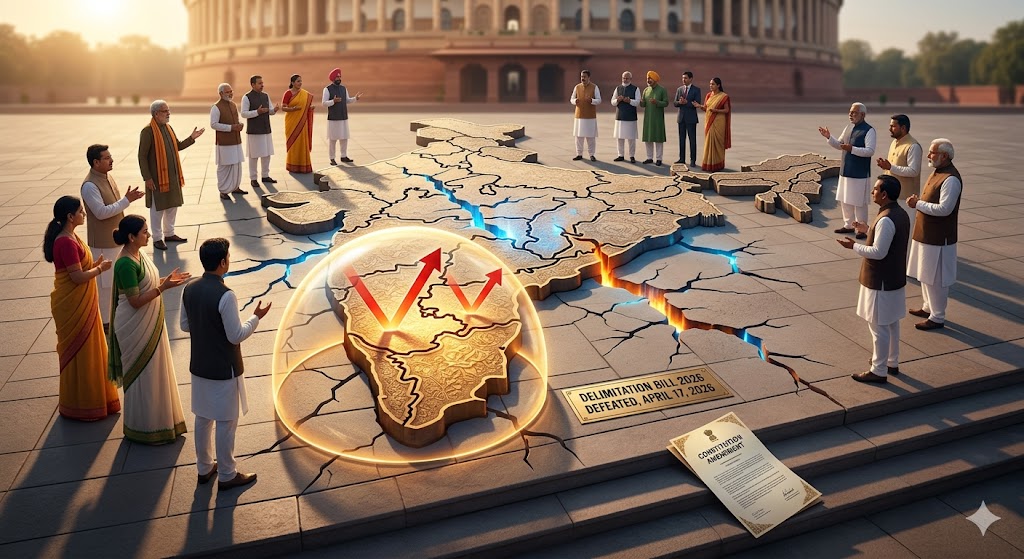
The aftermath of the bill's dynamic defeat: A metaphorical view of India’s federal map (partially fractured stone, with blue and orange light), illustrating the post-April 17, 2026, status quo. Southern states remain protected by the 1971 seat freeze (the energy shield), with the withdrawal of the crucial ‘Constitution Amendment’ document (lying face down on the plaza), signifying that any future redraw must now wait until after the next census
Conclusion: Lessons from the Delimitation Bill Debate
The delimitation bill 2026, though short-lived, exposed fault lines in India’s electoral democracy. It was a bold attempt to modernise representation and empower women, yet it stumbled on concerns of fairness and federal balance. Amit Shah’s passionate advocacy for equal vote value clashed with MK Stalin’s resolute defence of southern interests—both reflecting legitimate constitutional visions.
As India prepares for its next census, the lessons are clear: any future delimitation exercise must incorporate safeguards for all regions. True democratic strength lies not in division but in inclusive dialogue that strengthens the Union while respecting its diversity.
This comprehensive guide to the delimitation bill—covering its explanation, breakdown, parliamentary fate, and latest updates—equips readers with factual clarity. Whether you searched for “delimitation bill defeat” or “delimitation bill india 2026,” the outcome underscores that Indian democracy remains vibrant and responsive to diverse voices.