*Understanding the AI Ethics and Accountability"
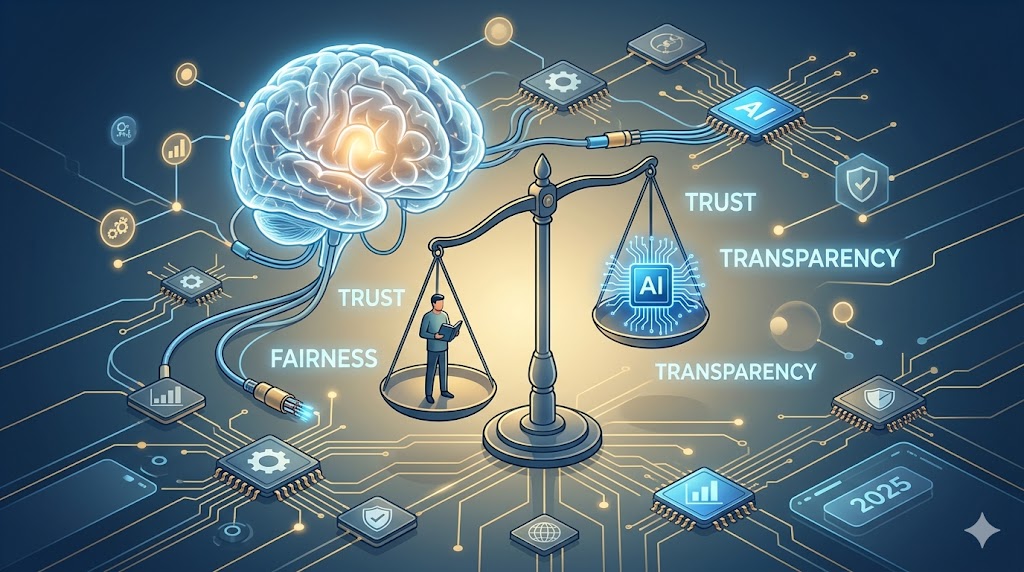
In an era where artificial intelligence shapes decisions from medical diagnoses to financial approvals, the conversation around AI ethics and accountability has never been more urgent. Organizations, governments, and individuals alike grapple with ensuring that powerful technologies align with human values rather than undermine them. This article examines the foundations of AI ethics and accountability, their practical implementation, and the pathways forward in 2025 and beyond. Whether you are exploring ai ethics 101 concepts or seeking deeper insights into ethics of ai frameworks, this guide provides a structured overview grounded in current developments.
AI ethics and accountability represent more than abstract ideals. They form the bedrock for building systems that are fair, transparent, and trustworthy. As AI integrates deeper into society, the stakes involve not only innovation but also the prevention of harm. From bias in algorithms to questions of who bears responsibility when things go wrong, these issues touch every sector. By the end of this discussion, readers will gain clarity on what is ethical AI, the challenges involved, and actionable strategies for responsible deployment.
At its core, AI ethics and accountability involves designing, developing, and deploying artificial intelligence in ways that respect human rights, promote fairness, and ensure clear lines of responsibility. Ethics of ai focuses on moral principles—such as avoiding harm, ensuring equity, and protecting privacy—while accountability ensures that developers, organizations, and users can trace decisions back to responsible parties.
Ethical AI explained simply means technology that operates within agreed-upon boundaries of human values. It goes beyond technical performance to consider societal impact. For instance, an AI system recommending loan approvals must not perpetuate discrimination based on race or gender. AI ethics and accountability demands mechanisms like audit trails and human oversight to address errors or unintended consequences.
In practice, this field draws from philosophy, law, and computer science. Early discussions in ai ethics lectures and ai ethics ted talks highlighted risks such as opaque “black box” models. Today, the emphasis has shifted toward operationalizing these ideas. AI ethics challenges arise because AI learns from vast datasets that may embed historical biases. Accountability addresses this by requiring organizations to document design choices and maintain oversight throughout the AI lifecycle.
Core Principles of Ethical AI
Several foundational principles guide AI ethics and accountability. These consistently appear across major frameworks and provide a practical blueprint for organizations.
Fairness and non-discrimination stand at the forefront. AI systems must avoid amplifying societal biases. Transparency and explainability ensure users understand how decisions are reached. Accountability requires clear assignment of responsibility for outcomes. Privacy and data protection safeguard personal information. Safety and reliability demand that systems perform consistently under real-world conditions. Human oversight prevents full automation of critical decisions.
These principles are not optional add-ons. They must be embedded from the initial design phase. In ai ethics and society, experts stress that ignoring them erodes public trust. For example, the OECD AI Principles, endorsed by many nations, emphasize inclusive growth, human rights, transparency, and accountability. Similarly, UNESCO’s Recommendation on the Ethics of Artificial Intelligence highlights proportionality, safety, privacy, and multi-stakeholder governance.
AI ethics and accountability benefits when organizations adopt these principles holistically. Internal policies might include regular bias audits, impact assessments, and ethics review boards. In 2025, many enterprises have moved beyond voluntary guidelines to enforceable internal standards that align with global expectations.
The Role of Accountability in AI Systems
Accountability distinguishes ethical AI from mere technical capability. It answers the question: who is responsible when an AI system causes harm? Unlike traditional software, AI’s adaptive nature makes tracing errors complex. AI ethics and accountability therefore requires robust mechanisms such as logging decision processes, conducting regular audits, and establishing clear governance structures.
In high-stakes environments, accountability prevents diffusion of responsibility. Developers, deployers, and end-users each play distinct roles. Frameworks in 2025 increasingly mandate “responsibility by design,” where accountability is built into the system architecture. This includes designating AI ethics officers within companies and creating escalation paths for ethical concerns.
Real-world implications are significant. If an autonomous vehicle causes an accident or a hiring algorithm discriminates, accountability frameworks determine legal and moral repercussions. Progressive organizations treat AI ethics and accountability as a competitive advantage, fostering trust among customers and regulators alike
AI-assisted diagnosis illustration focusing on human-in-the-loop validation, data privacy, and equitable access in clinical settings.
Global Frameworks and Regulations Shaping AI Ethics
By 2025, AI ethics and accountability has evolved from aspirational principles to enforceable standards. The European Union’s AI Act represents a landmark, categorizing systems by risk level and imposing strict obligations on high-risk applications. In the United States, sectoral approaches and executive guidance complement state-level initiatives. The United Kingdom promotes a pro-innovation framework centered on fairness, transparency, and accountability.
Internationally, the OECD AI Principles and NIST AI Risk Management Framework offer flexible yet comprehensive guidance. A particularly notable contribution comes from the Vatican’s Rome Call for AI Ethics, launched in 2020 and expanded through interfaith collaboration. This initiative promotes “algorethics”—an ethical approach to AI that prioritizes human dignity. Its six principles—transparency, inclusion, accountability, impartiality, reliability, security, and privacy—have been endorsed by tech giants, governments, and religious leaders. The Rome Call underscores shared responsibility across sectors, making it a powerful example of ai ethics and society collaboration.
These frameworks reflect a broader shift. In 2025, enforcement has become the norm. Litigation, board-level oversight, and regulatory fines underscore that AI ethics and accountability is now a business imperative rather than an optional consideration.
AI Ethics Challenges and How to Overcome Them
Despite progress, ai ethics challenges remain substantial. Algorithmic bias persists when training data reflects historical inequalities. Lack of transparency in complex models fuels distrust. Privacy concerns arise from massive data requirements. Scalability issues complicate oversight in rapidly evolving systems.
Additional hurdles include the “black box” problem, where even creators struggle to explain outcomes. Resource constraints affect smaller organizations attempting to implement robust AI ethics and accountability measures. Global regulatory fragmentation creates compliance headaches for multinational companies.
Solutions exist through proactive strategies. Regular bias testing, diverse development teams, and explainable AI techniques help mitigate risks. Continuous education—drawing from ai ethics lecture series and ai ethics tutorial resources—builds organizational capacity. Collaboration between technologists, ethicists, and policymakers fosters balanced approaches. In ai ethical concerns discussions, experts emphasize iterative testing and stakeholder engagement as keys to progress.
AI Ethics and Accountability in Healthcare
The healthcare sector illustrates both the promise and perils of AI ethics and accountability. AI tools now assist in diagnostics, treatment planning, and administrative efficiency. Yet ai ethics in healthcare demands heightened scrutiny due to life-altering consequences.
Key concerns include data privacy, informed consent, and algorithmic bias. Models trained on non-diverse populations may produce inaccurate recommendations for underrepresented groups. Transparency becomes critical when AI influences clinical decisions—physicians and patients need to understand the basis of suggestions.
Accountability in healthcare AI requires clear protocols. Who is liable if an AI-assisted diagnosis leads to harm? Frameworks in 2025 stress human oversight, rigorous validation, and equitable access. Regulatory bodies like the FDA and EU authorities classify many medical AI applications as high-risk, mandating stringent transparency and accountability measures.
Successful implementation involves multidisciplinary teams that integrate clinical expertise with ethical review. Case studies show that organizations prioritizing AI ethics and accountability achieve better patient outcomes and higher trust levels. As AI expands in personalized medicine and predictive analytics, maintaining ethical guardrails will determine whether technology truly serves humanity.
Real-World Examples and Case Studies
Examining concrete examples illuminates AI ethics and accountability in action. Several high-profile deployments reveal both successes and lessons learned. In hiring, companies have refined algorithms to reduce gender bias through careful auditing—demonstrating how targeted interventions advance fairness. Financial institutions use explainable models for credit scoring, allowing applicants to understand and contest decisions.
In healthcare, AI systems for skin cancer detection initially showed disparities across skin tones. Developers responded by diversifying datasets and incorporating fairness metrics, improving equity. These cases highlight that ethical AI requires ongoing vigilance rather than one-time fixes.
Public sector examples further underscore the point. Governments deploying AI for resource allocation have established independent oversight boards to ensure accountability. Such measures prevent unintended discrimination while preserving efficiency gains. AI ethics debates often reference these instances to illustrate that responsible innovation is achievable when principles guide practice.
Insights from AI Ethics Lectures and TED Talks
Public discourse benefits immensely from accessible ai ethics lecture formats and ai ethics ted talk presentations. Thought leaders have explored questions ranging from bias mitigation to the societal implications of autonomous systems. These discussions demystify complex topics and inspire broader engagement with ai ethics and accountability.
Presentations frequently address practical dilemmas: How do we balance innovation speed with ethical caution? What role should human judgment play alongside AI? Viewers gain perspectives on emerging challenges and evidence-based solutions. For students in ai ethics class 8 through advanced levels, or even ai ethics for kids adapted materials, these resources provide valuable entry points.
The educational value extends to professionals considering ai ethics career transition. Exposure to expert viewpoints clarifies pathways into governance, policy, and responsible development roles.
Career Opportunities in AI Ethics and Responsibilities
Demand for expertise in AI ethics and accountability has surged. Roles such as AI ethicist, responsible AI specialist, and governance analyst have become prominent in 2025. These positions blend technical knowledge with ethical reasoning and regulatory awareness.
Professionals transitioning into the field often come from diverse backgrounds—philosophy, law, computer science, or public policy. Key skills include bias detection, stakeholder facilitation, and framework implementation. Organizations across sectors seek individuals who can translate principles into operational reality.
AI ethics career transition paths frequently involve certifications, specialized training, or participation in ethics review boards. The field offers intellectual challenge and societal impact. As regulations tighten, companies invest in internal teams dedicated to ai ethics and responsibilities, creating stable career opportunities.
Best Practices for Organizations in 2025
Implementing AI ethics and accountability effectively requires structured approaches. Organizations should begin with a clear policy statement endorsed at the executive level. Cross-functional ethics committees provide ongoing guidance. Regular training ensures all employees understand their roles.
Technical best practices include embedding fairness checks in development pipelines and maintaining comprehensive documentation. Third-party audits enhance credibility. Engagement with external stakeholders—users, regulators, and communities—builds broader legitimacy.
In 2025, successful companies treat AI ethics and accountability as integral to strategy rather than a compliance checkbox. Metrics track not only performance but also ethical outcomes. This holistic mindset positions organizations for sustainable success amid evolving expectations.
The Future of Ethical AI and Society
Looking ahead, AI ethics and accountability will shape how technology integrates into daily life. Advances in generative AI and autonomous systems will intensify the need for robust frameworks. Global cooperation, as exemplified by initiatives like the Rome Call, offers hope for harmonized standards.
Challenges will persist, but so will innovation in solutions. Explainable AI, federated learning for privacy, and automated governance tools promise progress. Ai ethics and society discussions will increasingly focus on equity—ensuring benefits reach all populations.
Ultimately, the future depends on collective commitment. Policymakers, technologists, and citizens must collaborate to steer AI toward positive outcomes. Ethical AI 2025 and beyond hinges on proactive stewardship today.
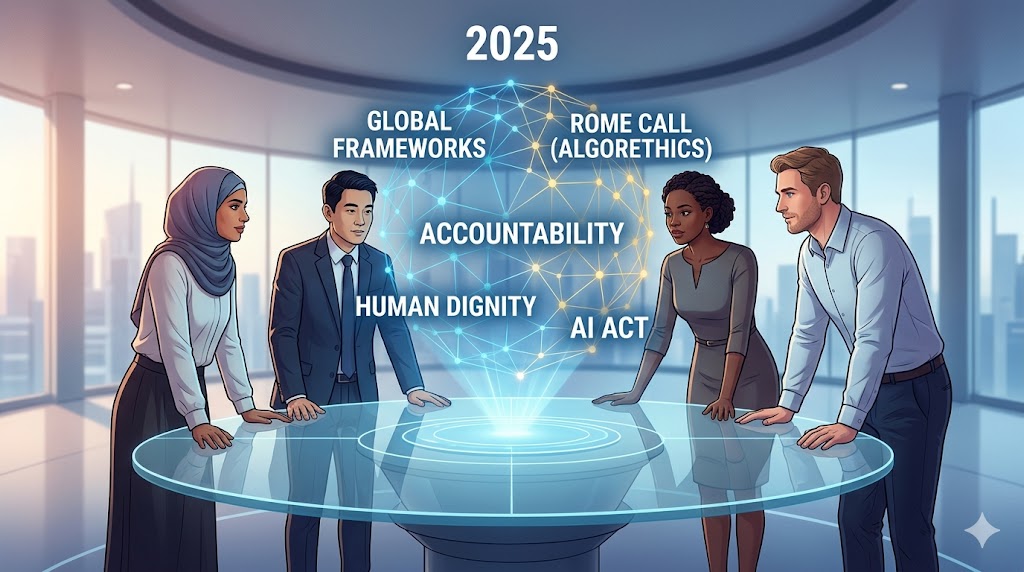
Conceptual depiction of global cooperation in 2025, where diverse representatives establish ethical "algorethics" standards based on dignity and accountability.
Conclusion
AI ethics and accountability stands as a defining issue of our technological age. By embracing core principles, learning from global frameworks, addressing challenges head-on, and investing in responsible practices, we can harness AI’s potential while safeguarding human values. From healthcare applications to societal impacts, the choices made now will determine whether artificial intelligence serves as a force for good.
Organizations and individuals alike benefit from deeper engagement with ai ethics. Whether through formal study, professional development, or informed public dialogue, every contribution matters. As we navigate this evolving landscape, a commitment to ethics and accountability ensures that technological progress aligns with our highest aspirations for a just and inclusive future.