Space Colonization: Future Prospects and Challenges
Space Colonization: Future Prospects and Challenges
Humanity stands at a pivotal moment in its cosmic journey. The dream of space colonization—once confined to science fiction—has evolved into a tangible scientific and engineering pursuit. Driven by the need for long-term survival, scientific discovery, and economic expansion, space colonization represents more than exploration; it is a strategic imperative for becoming a multi-planetary species. From the Apollo era’s lunar triumphs to today’s ambitious Mars plans, the path forward demands careful navigation of formidable technical, physiological, and ethical hurdles.
This article examines the historical foundations, motivations, key destinations, and profound challenges of space colonization. Drawing from verified sources including NASA reports, SpaceX updates, and expert analyses, it outlines a realistic roadmap while highlighting insights from visionaries like Elon Musk and physicist Brian Cox. Whether considering Mars colonization, Titan’s unique potential, or distant interstellar ambitions, the future of space colonization hinges on innovation, international cooperation, and sustainable practices.
The Historical Roots of Space Colonization
The concept of space colonization traces its modern roots to the mid-20th century, but its inspirational foundation lies in the Apollo space missions of the 1960s and 1970s. NASA’s Apollo program achieved the first human Moon landings between 1969 and 1972, with six missions successfully placing 12 astronauts on the lunar surface. These feats demonstrated humanity’s capacity to venture beyond Earth orbit, proving that complex spacecraft, life-support systems, and precise navigation could sustain crews in the harsh vacuum of space.
Post-Apollo, NASA’s 1975 Space Settlements Design Study formally assessed colonization feasibility, acknowledging science fiction’s influence while grounding proposals in engineering realities. Early visions emphasized self-sustaining habitats using in-situ resource utilization (ISRU)—extracting oxygen, water, and building materials from extraterrestrial soils. The International Space Station (ISS), continuously inhabited since 2000, has provided critical data on long-duration human presence, informing everything from radiation shielding to psychological resilience.
Today, space colonization builds on these legacies. NASA’s Artemis program uses the Moon as a proving ground for Mars colonization, targeting sustained lunar presence by the early 2030s before venturing farther. Private enterprise, led by SpaceX, accelerates timelines with reusable Starship technology. This historical progression underscores a key truth: space colonization is not a sudden leap but an incremental evolution rooted in decades of verified progress.
Why Colonize Space? Motivations and Benefits
The drive for space colonization stems from existential, scientific, and economic imperatives. Foremost is survival. As Earth faces climate change, resource depletion, and potential catastrophes, establishing off-world settlements creates a backup for humanity. Elon Musk has long argued that space colonization, particularly Mars colonization, ensures species longevity against planetary risks.
Scientifically, space colonization unlocks unparalleled discovery. Mars once harbored conditions suitable for life; studying its geology and climate reveals Earth’s past and future. Titan, Saturn’s largest moon, offers hydrocarbon lakes and a thick atmosphere—laboratories for understanding prebiotic chemistry. Interstellar colonization, though distant, could answer whether life exists elsewhere.
Economically, the space economy fuels growth. Valued at roughly $546 billion in 2023, it is projected to exceed $1 trillion by 2040 through satellite services, tourism, resource extraction, and manufacturing in microgravity. A thriving space economy could generate trillions in new industries, from lunar mining to asteroid prospecting, while spurring terrestrial innovation in robotics, energy, and medicine.
Brian Cox emphasizes practicality: Mars is the only planet beyond Earth we could realistically colonize, with abundant subsurface water and minerals already accessible with current technology. No revolutionary breakthroughs are required—just scaled engineering and determination.
Space colonization also promises societal benefits: international collaboration, equitable resource sharing, and inspiration for future generations. Yet these gains require addressing profound challenges.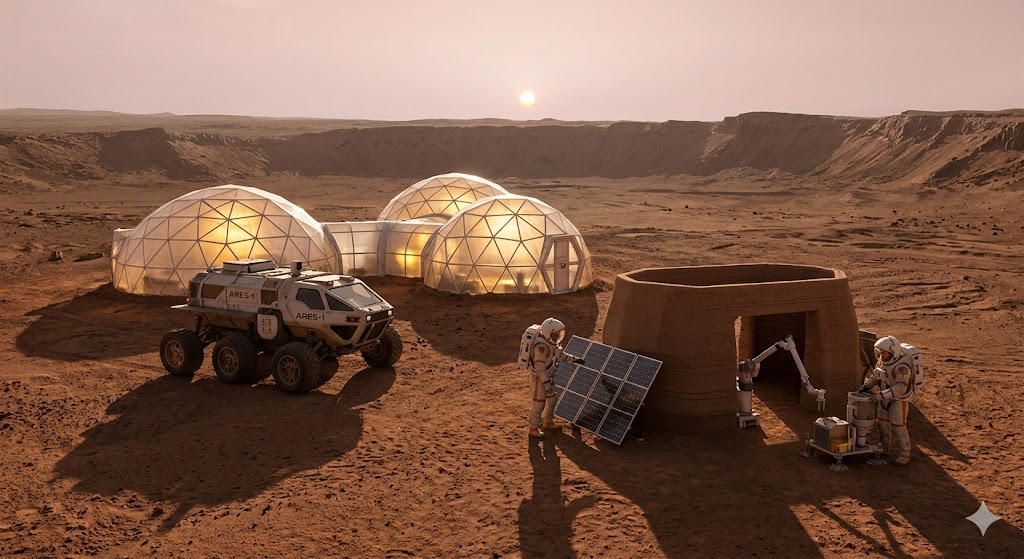
A long-term outpost on Titan, Saturn’s largest moon. The image illustrates the unique challenges and opportunities described in the article, including the thick, hazy nitrogen atmosphere that offers radiation shielding and the complex infrastructure needed to operate near hydrocarbon lakes in extreme cold.
Promising Destinations for Space Colonization
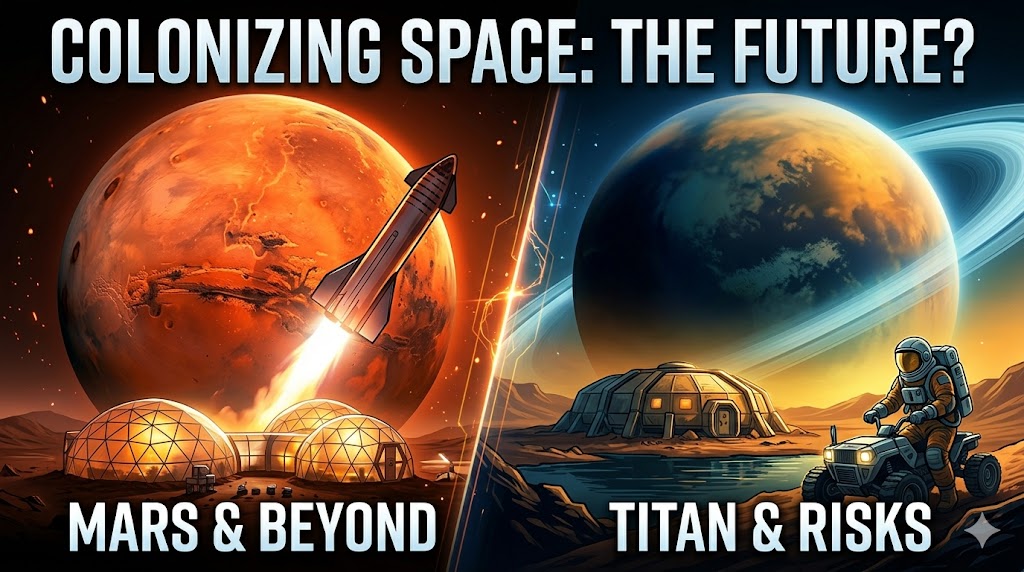
Not all celestial bodies suit space colonization equally. Mars leads current efforts due to proximity (six to nine months travel time) and resources. NASA’s robotic scouts have confirmed water ice beneath the surface, essential for life support and fuel production. SpaceX envisions uncrewed Starship landings as early as 2026, followed by crewed missions in the late 2020s, scaling to a self-sustaining city. Musk’s updated plans prioritize lunar infrastructure first but maintain Mars as the ultimate goal within five to seven years.
Titan offers a compelling alternative. Its dense nitrogen atmosphere—thicker than Earth’s—provides natural radiation shielding and pressure, reducing habitat structural demands. Methane and ethane lakes supply hydrocarbons for fuel and plastics, while low gravity eases construction. Surface temperatures hover near -290°F, but the environment avoids the vacuum and extreme radiation plaguing Mars or the Moon. Scientists note Titan’s Earth-like liquid bodies make it uniquely habitable for long-term space colonization.
The Moon serves as the essential stepping stone. Artemis missions will establish a lunar base by 2032, testing ISRU, habitats, and operations critical for Mars colonization. Farther out, interstellar colonization targets exoplanets, but vast distances demand generation ships or advanced propulsion—realities still decades or centuries away.
Each destination balances opportunity with unique constraints, shaping the multi-decade roadmap for space colonization.
Major Challenges of Space Colonization
Space colonization faces multifaceted obstacles that demand rigorous solutions.
Radiation and Health Risks: Beyond Earth’s magnetic field, cosmic rays and solar particles threaten crews. Mars lacks a global magnetic shield, exposing colonists to levels that could increase cancer risk and damage DNA. Low gravity (38% of Earth’s on Mars, 14% on Titan) causes bone loss, muscle atrophy, and cardiovascular issues. NASA studies from the ISS highlight these concerns, alongside psychological strain from isolation and confinement.
Life Support and Self-Sufficiency:. Closed-loop systems must recycle air, water, and waste while producing food. Martian soil (regolith) contains toxic perchlorates; Titan’s atmosphere requires processing for breathable oxygen. ISRU—extracting resources on-site—is critical but technically demanding. Energy sources like solar power face dust storms on Mars or dim sunlight on Titan.
Distance and Logistics: Mars launch windows occur every 26 months. A one-way trip demands reliable propulsion, life support for months, and massive cargo capacity. SpaceX’s Starship aims to carry 100+ tons per flight, but scaling to thousands of missions for a million-person city remains daunting.
Economic and Technical Barriers: Launch costs have plummeted thanks to reusability, yet sustaining colonies requires trillions in investment. Terraforming Mars—warming the planet and thickening its atmosphere—is currently infeasible with present technology.
Legal and Ethical Issues: The 1967 Outer Space Treaty prohibits national appropriation of celestial bodies and mandates peaceful use for all humankind. It offers no clear framework for private property rights, resource claims, or governance of colonies. Questions of sovereignty, environmental protection, and equitable benefit-sharing loom large as commercial players enter the arena.
Psychological and social dynamics add complexity. Long-term isolation can lead to stress, conflict, or mental health crises. Diverse, inclusive crews and robust support systems will be essential.
Technological Innovations and Key Players
Progress in space colonization relies on collaboration between governments and private industry. NASA’s Artemis program and SLS rocket provide the backbone for lunar operations, while SpaceX’s Starship revolutionizes access with full reusability and orbital refueling. Elon Musk’s vision integrates robotics—such as Tesla Optimus units—for initial site preparation ahead of human arrival.
Brian Cox stresses that existing technology suffices for initial Mars colonization steps. Robots can establish bases, followed by human crews leveraging local resources. Advances in 3D printing, nuclear propulsion, and AI autonomy will accelerate self-sufficiency.
International partners, including ESA and emerging space nations, contribute expertise in habitats and life sciences. The space economy incentivizes innovation: commercial lunar landers and satellite constellations fund deeper exploration.
The Space Economy: Driving Sustainable Growth
A vibrant space economy underpins viable space colonization. Beyond exploration, it creates markets in orbital manufacturing, space tourism, and resource utilization. Lunar ice could supply propellant; Martian regolith, construction materials. By 2040, lunar economic activity alone may reach $170 billion annually.
This growth mitigates costs through public-private partnerships. Reusable rockets have reduced launch expenses dramatically, enabling exponential mission cadence. Sustainable practices—minimizing debris and preserving celestial environments—ensure long-term viability.
Speculative Futures: Rogue, Exiled, and Interstellar Colonies
While current focus remains solar-system bound, space colonization inspires speculation about rogue or exiled colonies. In distant scenarios, self-governing settlements might operate independently, governed by direct democracy or new legal frameworks. Interstellar colonization—reaching nearby stars—requires breakthroughs in propulsion and closed ecosystems, potentially spanning generations. Challenges include genetic diversity, energy demands, and ethical questions of separation from Earth.
These ideas, though futuristic, highlight governance needs for any space colonization effort.
How to Colonize Space: A Practical Roadmap
Successful space colonization follows phased steps:
1. Robotic Precursors: Deploy landers and rovers for resource mapping and infrastructure (e.g., SpaceX’s 2026 Mars uncrewed flights).
2. Lunar Proving Ground: Establish Artemis bases for ISRU testing and long-duration operations.
3. Crewed Missions: Send small teams to build initial habitats using 3D-printed structures and local materials.
4. Self-Sufficiency: Scale life support, agriculture, and manufacturing until colonies sustain themselves.
5. Expansion: Grow populations through regular resupply and eventual reproduction off-world.
6. Governance: Develop international agreements expanding the Outer Space Treaty.
International cooperation, ethical frameworks, and iterative testing will determine success.
Conclusion: A Shared Cosmic Future
Space colonization is no longer a distant dream but an achievable horizon. From Apollo’s legacy to Starship’s promise, humanity possesses the tools to overcome challenges of radiation, distance, and self-sufficiency. Mars colonization leads the charge, with Titan offering intriguing alternatives and interstellar goals inspiring the long view.
Experts like Elon Musk and Brian Cox remind us that the technology exists; what remains is commitment, collaboration, and courage. As the space economy expands and legal frameworks evolve, space colonization could secure humanity’s future while enriching life on Earth.
The journey demands humility and unity. By addressing challenges head-on and drawing on verified science, we can transform space colonization from aspiration into enduring reality—one habitat, one mission, one step at a time.