In an era of shifting global alliances, the defence partnership between India and Russia continues to stand as one of the most enduring and strategically significant relationships in the world. On April 19, 2026, fresh details of a landmark intergovernmental agreement surfaced publicly, capturing international attention. This pact, formally known as the Reciprocal Exchange of Logistics Support (RELOS) agreement, formalises procedures for mutual deployment of military personnel, ships and aircraft. It explicitly permits up to 3,000 troops from one nation to be stationed in the other’s territory at any given time, alongside limited naval and air assets. Far from a sudden development, this represents the operationalisation of a framework signed in February 2025 and effective since January 2026. The public disclosure around mid-April 2026 has only underscored the depth of ongoing collaboration.
This article examines the current state of India-Russia defence facts, unpacks the defence strategies of both nations, and provides a clear, detailed explanation of the RELOS pact—including how it was negotiated, ratified and made public. Readers will gain insight into its practical implications without hype or speculation.
The defence relationship between India and Russia traces back to the Cold War era, when the Soviet Union emerged as India’s primary arms supplier. After India’s independence, New Delhi sought reliable partners to build a modern military capable of safeguarding its sovereignty. Moscow stepped in with technology transfers, licensed production and favourable credit terms that no Western supplier matched at the time.
By the 1970s, Soviet-origin equipment formed the backbone of the Indian Armed Forces. Key acquisitions included MiG fighters, T-55 and later T-72 tanks, and naval platforms like the Kilo-class submarines. The 1971 Indo-Soviet Treaty of Peace, Friendship and Cooperation provided a strategic umbrella during the Bangladesh Liberation War. Even after the Soviet Union’s dissolution in 1991, the partnership endured. In 2000, both countries elevated ties to a “Special and Privileged Strategic Partnership.”
Joint ventures became the norm. The BrahMos cruise missile programme, a 50-50 joint venture between India’s DRDO and Russia’s NPO Mashinostroyeniya, stands as a flagship success. India has licensed production of T-90 tanks and Su-30MKI aircraft, creating thousands of jobs and building indigenous capability. These projects reflect a relationship built on mutual trust rather than transactional deals.
Current Facts on India-Russia Defence Cooperation
As of 2026, Russia remains a cornerstone of India’s defence inventory, though India has diversified suppliers to reduce dependency. According to the Stockholm International Peace Research Institute (SIPRI), Russia accounted for 36% of India’s arms imports between 2020 and 2024, making it the single largest supplier despite a decline from previous decades. Major ongoing programmes include:
S-400 Triumf air defence systems: Deliveries continue under a 2018 contract valued at over $5 billion, enhancing India’s layered air defence against regional threats.
BrahMos supersonic cruise missiles: Extended-range variants and ship-launched versions are in service, with exports to friendly nations also under discussion.
Joint exercises: The tri-service INDRA exercises remain regular, covering land, sea and air domains. Humanitarian assistance and disaster relief (HADR) drills have also increased.
Trade in defence equipment exceeds billions annually. Beyond hardware, cooperation extends to maintenance, upgrades and technology transfer. India’s push for “Atmanirbhar Bharat” (self-reliant India) has led to co-development rather than outright purchases, ensuring long-term sustainability.
Geopolitically, the partnership has weathered external pressures. Despite Western sanctions on Russia following the Ukraine conflict, India has continued selective procurement while maintaining strategic autonomy. Russia has reciprocated by offering discounted energy supplies, indirectly supporting India’s defence budget stability.
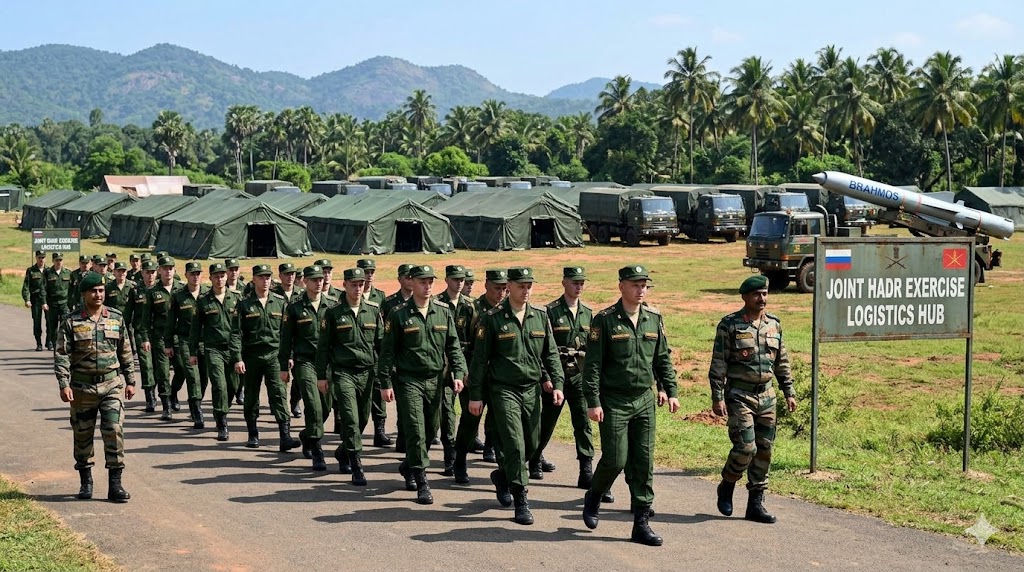
A conceptual visualization of a temporary logistics deployment under the RELOS pact. A Russian ground forces contingent arrives at a joint logistics hub in India (set in a tropical environment), illustrative of the purposes covered by the 3,000-troop mutual limit.
Defence Strategies: India’s Perspective
India’s defence strategy rests on three pillars: strategic autonomy, multi-alignment and capability enhancement. New Delhi refuses to join formal military alliances, preferring flexible partnerships that serve national interests. The India-Russia relationship fits perfectly here. It provides access to high-end systems without the political strings often attached by Western suppliers.
Against the backdrop of a rising China along the Line of Actual Control, India values Russia’s neutral stance and its willingness to supply critical platforms. At the same time, India engages the United States through frameworks like the Quad and has signed logistics agreements such as LEMOA. The RELOS pact complements rather than contradicts these ties, demonstrating pragmatic diplomacy.
India’s long-term strategy also emphasises indigenisation. By partnering with Russia on joint production, New Delhi acquires not just weapons but know-how. This approach reduces vulnerability to supply-chain disruptions and builds a domestic defence industrial base. The 3,000-troop limit in the RELOS agreement aligns with this strategy: it enables practical logistics support for joint exercises and HADR missions without compromising sovereignty or creating permanent foreign bases.
Defence Strategies: Russia’s Perspective
For Russia, the partnership with India serves as a vital anchor in Asia amid strained relations with the West. Moscow’s “Pivot to the East” policy prioritises deepening ties with major powers like India to offset isolation and tap into growing markets. Defence cooperation remains the most tangible pillar.
Russia benefits from India’s large, steady demand for advanced weaponry. Exports to India help sustain Russian defence industries facing sanctions-related challenges. The RELOS agreement further enhances operational flexibility. Russian naval vessels can access Indian ports in the Indian Ocean for refuelling and repairs—critical for long-range deployments. In return, Indian forces gain access to Russian Arctic infrastructure, supporting New Delhi’s growing interest in polar regions.
Russia also views the pact through a broader geopolitical lens. By strengthening military-to-military links with India, Moscow counters narratives of encirclement and maintains influence in the Indo-Pacific. Joint training and logistics sharing build interoperability, making future cooperation more seamless. The five-year duration with automatic extension signals long-term commitment, giving both sides predictability.
The RELOS Agreement: Origins, Negotiation and Key Provisions
The Reciprocal Exchange of Logistics Support (RELOS) agreement was signed in Moscow on February 18, 2025. Negotiations had been underway for several years, building on earlier defence cooperation frameworks. Both sides recognised the need for a formal mechanism to streamline temporary deployments during exercises, training and humanitarian missions.
The document defines clear procedures for the movement of military formations, warships and aircraft. It covers logistical support including accommodation, medical care, transportation, fuel, water, electricity and spare parts. Payments can be settled through barter or mutually agreed mechanisms, reducing bureaucratic hurdles.
A central feature is the cap on deployments to maintain balance and prevent misuse:
Maximum of 5 military ships of the sending state in the receiving state’s ports or waters.
Maximum of 10 military aircraft in the receiving state’s territory and airspace.
Maximum of 3,000 military personnel of the sending state present simultaneously.
These limits apply “unless the parties agree otherwise,” allowing flexibility for larger joint activities if mutually decided. The agreement explicitly applies to joint exercises, training operations, humanitarian assistance, disaster relief and any other cases agreed upon by both governments. It entered into force on January 12, 2026, after Russia completed its ratification process in December 2025. India’s internal approvals were handled concurrently.
Importantly, RELOS does not create permanent bases. It facilitates temporary, purpose-driven access—similar to India’s LEMOA with the United States but tailored to the unique contours of the Indo-Russian partnership.
How the April 19 Pact Was Decided and Publicised
The query often references “the Indian Russia pact of April 19.” In reality, the agreement itself became operational in January 2026. What occurred around April 18-19, 2026, was the publication of the full text on Russia’s official legal information portal. This step made the document publicly accessible, triggering widespread media coverage and analysis.
The decision to publish at this time appears procedural rather than reactive. Russia routinely posts ratified agreements on the portal once all internal processes conclude. The timing coincided with ongoing bilateral defence discussions and heightened global interest in Indo-Russian ties. Indian officials have maintained a low-profile approach, consistent with their preference for quiet diplomacy on sensitive military matters.
The pact was “decided” through years of quiet negotiations, formal signing in February 2025 and ratification in late 2025. Its public emergence on April 19 simply confirmed what had already been in force for three months. The 3,000-troop provision was not a last-minute addition but a carefully negotiated safeguard ensuring reciprocity and control.
Strategic Implications of the Pact
The RELOS agreement carries several practical and symbolic benefits. For India, it opens reliable logistics access in Russian Arctic ports, supporting future naval operations in a strategically vital region. For Russia, it secures supply lines in the warm waters of the Indian Ocean. Both nations gain cost and time savings during joint activities—critical in an era of extended supply chains and contested sea lanes.
Symbolically, the pact reaffirms the resilience of the relationship despite external pressures. It signals to the world that India and Russia prioritise strategic autonomy over bloc politics. In a multipolar order, such arrangements strengthen deterrence without provoking unnecessary confrontation.
Potential challenges exist. Critics may question whether the pact complicates India’s relations with Western partners. However, the limited scale (3,000 troops maximum) and clear focus on logistics rather than combat deployments mitigate such concerns. India’s simultaneous engagement with multiple powers demonstrates sophisticated balancing rather than contradiction.
Geopolitical Context and Regional Dynamics
The agreement arrives at a time of flux. Russia’s focus on Ukraine has not diminished its commitment to Asian partnerships. India, facing border tensions with China, values a reliable supplier that does not lecture on foreign policy. The pact also indirectly addresses concerns over Chinese influence in the Indian Ocean by enhancing mutual naval access.
Within the broader Quad framework, the RELOS deal highlights India’s unique position: it maintains deep historical ties with Russia while forging new partnerships with the United States, Japan and Australia. This multi-alignment approach enhances India’s leverage and security options.
Future Prospects for India-Russia Defence Cooperation
Looking ahead, the RELOS agreement lays groundwork for deeper integration. Possible next steps include expanded joint production, co-development of next-generation systems and increased officer exchanges. The five-year renewable term provides stability for long-term planning.
Both nations aim to elevate trade beyond defence into energy, technology and connectivity. The Chennai-Vladivostok maritime corridor and Arctic cooperation initiatives complement the military pact, creating a multi-dimensional partnership.
Challenges remain—currency fluctuations, technology sanctions and competing global priorities. Yet the track record suggests both sides possess the pragmatism and mutual respect necessary to navigate them.
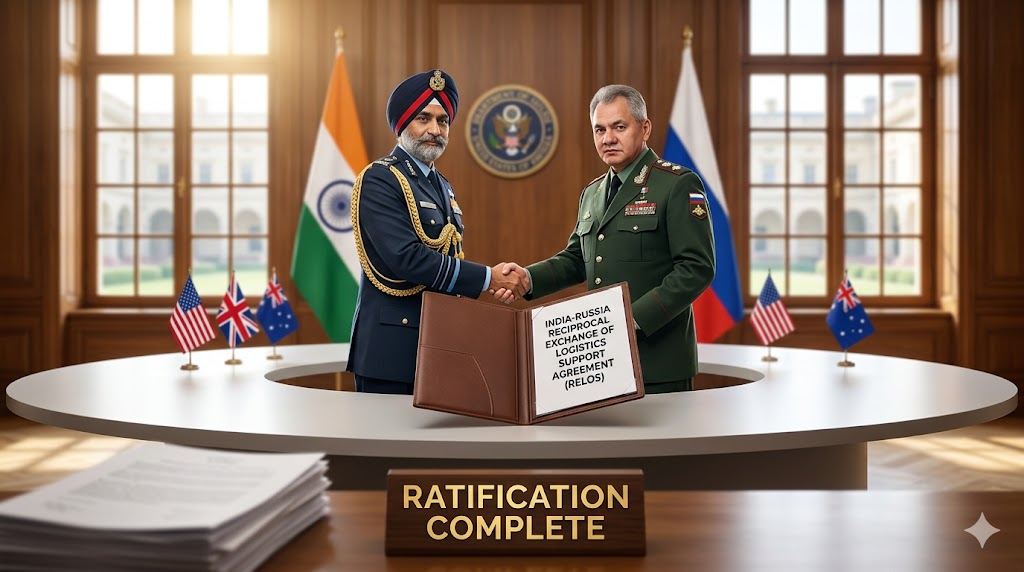
Operationalizing the logistics pact. A conceptual photograph visualizes senior Indian and Russian military officers formalizing the ratification of the Reciprocal Exchange of Logistics Support (RELOS) agreement, emphasizing bureaucratic process over combat operations.
Conclusion
The India-Russia defence pact that entered public discourse around April 19, 2026, represents continuity rather than rupture. By enabling up to 3,000 troops, five warships and ten aircraft under strict limits, the RELOS agreement strengthens operational efficiency while preserving sovereignty. It builds upon decades of trust, aligns with the defence strategies of both nations and reflects a mature, interest-driven partnership.
As global security dynamics evolve, this framework offers a model of pragmatic cooperation. India gains logistical reach and technological depth; Russia secures a steadfast partner in Asia. Together, they demonstrate that enduring alliances can thrive amid complexity. The coming years will test and likely reinforce this vital relationship, benefiting both countries and contributing to regional stability.
Frequently Asked Questions
What is the primary significance of India-Russia Defence Pact 2026: 3,000 Troops Allowed?
In an era of shifting global alliances, the defence partnership between India and Russia continues to stand as one of the most enduring and strategically significant relationships in the world. On April 19, 2026, fresh details of a landmark intergovernmental agreement surfaced publicly, capturing international attention.
How does this development impact Defence?
This pact, formally known as the Reciprocal Exchange of Logistics Support (RELOS) agreement, formalises procedures for mutual deployment of military personnel, ships and aircraft. It explicitly permits up to 3,000 troops from one nation to be stationed in the other’s territory at any given time, alongside limited naval and air assets.
What are the key future projections to monitor?
Far from a sudden development, this represents the operationalisation of a framework signed in February 2025 and effective since January 2026.