The Mahabharata stands as one of humanity's greatest literary treasures, a vast Sanskrit epic attributed to the sage Vyasa. Spanning 18 parvas or books, it weaves together history, philosophy, ethics, and profound lessons on life, war, and righteousness. At its core lies the Kurukshetra war—a cataclysmic 18-day conflict between the Pandava brothers and their cousins, the Kauravas, fought on the sacred plains of Kurukshetra.
This colossal narrative begins in the Adi Parva with the origins of the Kuru dynasty, royal intrigues, and the childhood rivalries that sowed seeds of enmity. It unfolds through the Sabha Parva, where Yudhishthira's gambling loss leads to the Pandavas' exile; the Vana Parva, filled with forest adventures and divine encounters; and the Virata Parva, marking their year in disguise. The Udyoga Parva sees failed peace negotiations, setting the stage for war.
The war proper ignites in the Bhishma Parva, covering the first ten days under the command of the invincible grandsire Bhishma. As commander-in-chief of the Kaurava forces, Bhishma fought with unparalleled valor, yet his heart lay divided—he loved both sides but remained bound by his oath to the throne of Hastinapura. Major incidents included fierce duels, celestial weapons, and the revelation of the Bhagavad Gita on the first day, where Lord Krishna imparted timeless wisdom on duty (karma yoga) to a despondent Arjuna. Bhishma fell on the tenth day, pierced by Arjuna's arrows while lying on a bed of arrows, choosing the moment of his death. His fall marked a turning point, shifting the war's momentum and plunging both armies into deeper moral complexities.
As the dust settled on Bhishma's heroic end, the Kauravas faced a leadership void. The stage was now set for Drona Parva, the seventh parva, which narrates the next five days of battle under the stewardship of a revered yet controversial figure: Dronacharya.
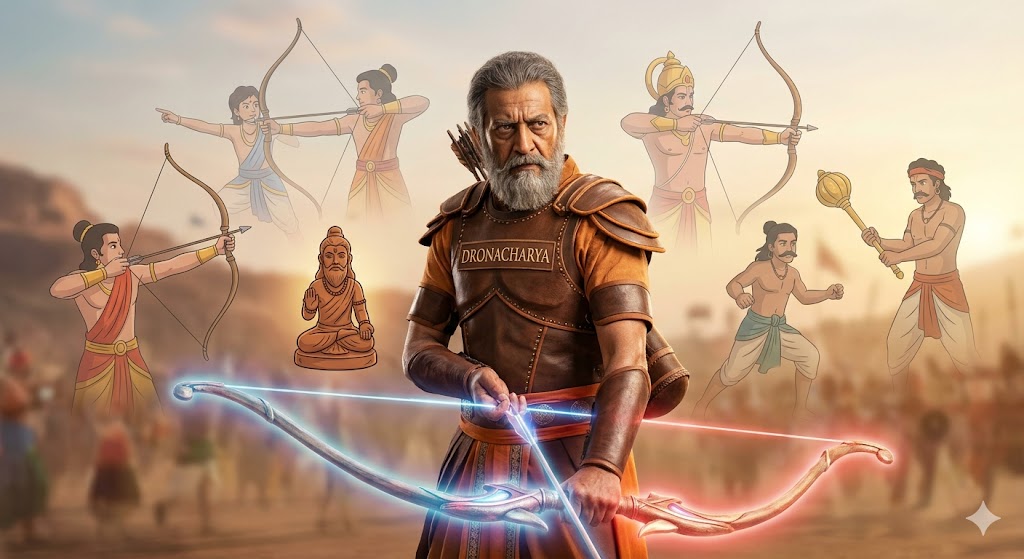
Dronacharya, born as Bharadwaja's son and a Brahmin by birth, emerged as one of the Mahabharata's most skilled warriors and teachers. Trained in the arts of warfare by the legendary Parashurama, he mastered celestial weapons and archery like few others. Poverty-stricken in his youth, Drona sought friendship and aid from his childhood companion, King Drupada of Panchala. Drupada's humiliating rejection fueled Drona's resolve; he later captured Drupada in battle and extracted half his kingdom as revenge, establishing his own realm.
Appointed royal preceptor by Bhishma, Dronacharya trained both the Pandava and Kaurava princes in Hastinapura. Under his guidance, Arjuna blossomed into the world's greatest archer, while others like Bhima, Duryodhana, and Ashwatthama honed their prowess. Drona instilled discipline, strategy, and the ethics of Kshatriya dharma. Yet, his legacy carries shadows of bias rooted in the era's caste system.
A poignant example is the tale of Eklavya, a gifted Nishada (tribal) youth of low birth who idolized Drona. Eklavya self-taught archery by creating a clay idol of his guru and surpassed even Arjuna in skill. When Eklavya sought formal training, Dronacharya refused—not merely due to his non-Kshatriya status, but amid fears that a low-born prodigy might challenge the social order and Arjuna's supremacy. As gurudakshina (teacher's fee), Drona demanded Eklavya's right thumb, crippling his archery forever. This episode highlights the caste-based prejudices of the time: merit yielded to the varna hierarchy. Critics view it as exploitation, while traditional interpretations frame it as Drona's duty to protect his royal pupils' futures.
Drona was no villain, however. He was a professional and exemplary guru whose contributions shaped the epic's warriors. He emphasized rules of engagement—fair combat, protection of non-combatants, and honor in battle—yet the war tested these ideals. Bound by obligation to the Kauravas (who had granted him wealth and status), Drona fought for them despite his affection for the Pandavas. He warned Duryodhana of inevitable defeat and his own fated end at Dhrishtadyumna's hands, yet duty prevailed. His story reminds us: even great teachers are human, navigating bias, loyalty, and dharma amid impossible choices.
Dronacharya: A complex Brahmin warrior and guru whose legacy shaped a generation of warriors in Hastinapura, yet carried the burden of institutional bias, obligation, and the ultimate moral compromise of the Kurukshetra war.
The Dawn of Drona Parva: Transition from Bhishma's Fall
Drona Parva (also called Dronaparva) comprises eight upaparvas across roughly 204 chapters. It opens with shockwaves from Bhishma's defeat rippling through the Kaurava camp. Dhritarashtra grieves deeply as Sanjaya narrates events. Karna, previously sidelined by Bhishma's disdain, seeks the grandsire's blessings and joins the fray, boosting morale.
Duryodhana, desperate for victory, crowns Drona as commander-in-chief on the 11th day. Drona accepts with a heavy heart, vowing to capture Yudhishthira alive (per Duryodhana's wish) but privately acknowledging his limitations against destiny. He forms the Kaurava army in a "sakata" (cart) formation, while the Pandavas adopt a "krauncha" (heron) array. The war intensifies, rules fraying as personal losses mount.
Day 11: Drona's Installation and the First Clashes
Under Dronacharya's leadership, the Kauravas press aggressively. Drona deploys celestial weapons, decimating Panchala forces. He slays warriors like Satyajit and creates rivers of blood. Arjuna duels his guru respectfully, avoiding a fatal strike out of reverence. Bhima routs Salya in a mace duel, while Abhimanyu shines, felling multiple foes. Ghatotkacha clashes with Alamvusha in a demonic battle.
Duryodhana's strategy targets Yudhishthira, but Arjuna's interventions save the day. Sunset brings withdrawal, with both sides bloodied yet unbroken. Drona's prowess proves formidable, yet the Pandavas hold firm.
Day 12: Samsaptakas Vanquished and Bhagadatta's Fall
The Samsaptakabadha Parva unfolds as Duryodhana deploys the Narayani Sena—elite warriors sworn to slay Arjuna. Krishna diverts Arjuna to handle them, where he unleashes illusions and wind weapons, annihilating thousands. Meanwhile, Drona advances on Yudhishthira but faces fierce resistance.
Arjuna confronts Bhagadatta, the mighty king of Pragjyotisha atop his invincible elephant Supratika. After a grueling duel, Arjuna fells Bhagadatta with a precise arrow, honoring the old king's valor. Other duels rage: Bhima slays the ruler of Anga, while Abhimanyu and others display brilliance. Losses mount, but Drona's command keeps the Kauravas cohesive.
Day 13: The Chakravyuha and Abhimanyu's Heart-Wrenching Sacrifice
The Abhimanyu-vadha Parva marks Drona Parva's emotional peak. Drona forms the impenetrable Chakravyuha (discus formation) to trap the Pandavas. Only Arjuna knows its full secret; with him diverted fighting Samsaptakas, young Abhimanyu—Arjuna's son, trained in the womb by Krishna—volunteers to breach it.
Abhimanyu enters gloriously, slaughtering thousands and felling princes like Lakshmana (Duryodhana's son) and others. Trapped without an exit strategy, he fights alone as Jayadratha blocks reinforcements. Karna cuts his bow from behind; others destroy his chariot and weapons. In a final mace duel, Duhshasana's son delivers the fatal blow. Abhimanyu's death sends grief rippling across the Pandava camp, exposing war's brutality and the erosion of fair combat. Yudhishthira despairs; Arjuna vows revenge.
Day 14: Arjuna's Vow and Jayadratha's Demise
Grief fuels the Pratijna and Jayadratha-vadha Parvas. Arjuna swears to kill Jayadratha by sunset or self-immolate. Krishna aids with strategy. The day explodes in carnage: Arjuna carves through Kaurava ranks, slaying elephants, warriors, and kings. Drona and others defend Jayadratha fiercely.
As sunset nears, Krishna creates an illusion of darkness. Jayadratha emerges; Arjuna beheads him with a divine arrow. Jayadratha's head flies to his father's lap in the heavens, fulfilling a boon. Night falls, but fighting continues. Ghatotkacha, Bhima's demon son, wreaks havoc until Karna deploys his divine Shakti weapon, killing him at great personal cost.
Day 15: Dronacharya's Final Stand and Tragic End
The Drona-vadha Parva brings the parva's climax. Drona fights like a lion in his youth, slaying Panchala warriors and nearly capturing Yudhishthira. Desperate, the Pandavas resort to stratagem. Bhima kills an elephant named Ashwatthama and announces, "Ashwatthama is dead!" Yudhishthira, ever truthful, confirms it softly: "Ashwatthama the elephant."
Heartbroken, believing his son slain, Drona lays down arms, enters meditation, and attains yoga—his soul ascending. Dhrishtadyumna, Drupada's son (born to kill Drona), beheads the defenseless guru, violating war's sacred rules. The Kauravas reel in panic; Ashwatthama later unleashes the Narayana astra in rage, neutralized only when Pandavas drop their weapons.
Drona's death underscores deceit’s cost and the guru's complex humanity. A professional teacher who shaped legends, he fell not solely by Pandava might but by their moral compromise—yet his contributions to archery and dharma endure.
Legacy of Drona Parva: Timeless Lessons from Kurukshetra
Drona Parva transforms the Mahabharata from heroic saga to profound meditation on war's horrors. Battles grow merciless; night fighting emerges; rules shatter. Deaths of Abhimanyu, Jayadratha, Ghatotkacha, and Drona highlight youth's waste, vengeance's cycle, and leadership's burdens.
Dronacharya embodies the guru's ideal—flawed by caste biases yet devoted to excellence. His story invites reflection: How do systems of birth limit talent? When does duty clash with conscience?
As the war hurtles toward Karna Parva and beyond, Drona Parva reminds us that victory demands sacrifice, truth bends under pressure, and even gods' protégés face mortality. Vyasa's verses teach that dharma triumphs not through might alone, but wisdom forged in fire.
In studying Drona Parva, we honor the epic's educational purpose: to illuminate humanity's eternal struggle between light and shadow. May its lessons guide us toward righteousness in our own battles.
Frequently Asked Questions
What is the primary significance of Drona parva: An Epic of Dharma, Duty, and Destiny?
The Mahabharata stands as one of humanity's greatest literary treasures, a vast Sanskrit epic attributed to the sage Vyasa. Spanning 18 parvas or books, it weaves together history, philosophy, ethics, and profound lessons on life, war, and righteousness.
How does this development impact Dharma?
At its core lies the Kurukshetra war—a cataclysmic 18-day conflict between the Pandava brothers and their cousins, the Kauravas, fought on the sacred plains of Kurukshetra.This colossal narrative begins in the Adi Parva with the origins of the Kuru dynasty, royal intrigues, and the childhood rivalries that sowed seeds of enmity. It unfolds through the Sabha Parva, where Yudhishthira's gambling loss leads to the Pandavas' exile; the Vana Parva, filled with forest adventures and divine encounters; and the Virata Parva, marking their year in disguise.
What are the key future projections to monitor?
The Udyoga Parva sees failed peace negotiations, setting the stage for war.The war proper ignites in the Bhishma Parva, covering the first ten days under the command of the invincible grandsire Bhishma.