Jainism stands as one of the world's oldest living religions, rooted deeply in the spiritual soil of ancient India. Often described as a path of extreme non-violence and self-discipline, Jainism offers a unique perspective on existence, karma, and liberation that continues to inspire millions. Though small in numbers compared to other faiths, its influence on Indian culture, ethics, and even global ideas of peace is profound and far-reaching.
At its heart, Jainism is not the creation of a single founder in the conventional sense. Instead, it traces its eternal dharma through a lineage of enlightened teachers known as Tirthankaras, or "ford-makers," who guide souls across the turbulent river of rebirth toward moksha, or ultimate liberation. The most recent of these, Mahavira, lived in the 6th century BCE and is frequently (though inaccurately) called the founder by outsiders. In truth, Jainism predates him, emerging from the broader Śramaṇa movement alongside Buddhism as a response to the ritual-heavy Vedic traditions of the time.
Today, with approximately 4.5 million adherents in India (0.4% of the population per the 2011 census) and a global diaspora pushing the total toward 6 million, Jainism thrives quietly through its emphasis on ahimsa (non-violence), aparigraha (non-possession), and anekantavada (the multiplicity of truth). This article explores the origin of Jainism, its Tirthankaras, the role of Prakrit language in its scriptures, core teachings, relationship with Hinduism and Buddhism, the Digambar and Shwetambar sects, its spread across India and the globe, famous festivals, and how its preachings shape living Jainism. Written for educational purposes, it draws on historical and philosophical sources to provide a clear, structured overview suitable for students, researchers, or anyone seeking to understand this remarkable religion.
The history of Jainism stretches back into the mists of antiquity, far beyond verifiable historical records. Jains believe their dharma is eternal, revealed periodically by Tirthankaras in each cosmic cycle. Scholarly consensus places its verifiable roots in the 9th–8th century BCE within the Śramaṇa tradition of eastern India, a counter-movement to Brahmanical rituals that emphasized asceticism, renunciation, and personal effort toward spiritual freedom.
The first Tirthankara of the current descending cycle (Avasarpini) is Rishabhanatha, also known as Adinatha. Tradition holds he lived millions of years ago and organized human society, teaching agriculture, crafts, and the basics of ethical living. Historical evidence strengthens around the 23rd Tirthankara, Parshvanatha (circa 8th–9th century BCE), who preached the "fourfold restraint" — non-violence, truth, non-stealing, and non-possession. His followers formed organized communities, and many scholars accept him as a real historical figure.
The 24th and final Tirthankara, Vardhamana Mahavira (599–527 BCE), codified and popularized the teachings. Born a prince in Kundagrama (near modern Vaishali, Bihar), he renounced worldly life at 30, practiced intense austerity for 12 years, attained kevala jnana (omniscience), and spent the next 30 years preaching across northern India. His nirvana on the day now celebrated as Diwali marked the end of an era. Jainism spread rapidly in the centuries following, patronized by kings like those of the Maurya and later Chalukya dynasties, flourishing in mathas (monasteries) and among merchant communities.
Unlike many religions, Jainism never sought political dominance. It survived invasions and shifts in power through its resilient lay-follower base of traders and artisans, who embodied ethical business practices. By the medieval period, it had established strongholds in western and southern India, leaving behind magnificent temples and rock-cut sculptures that testify to its artistic and philosophical legacy.
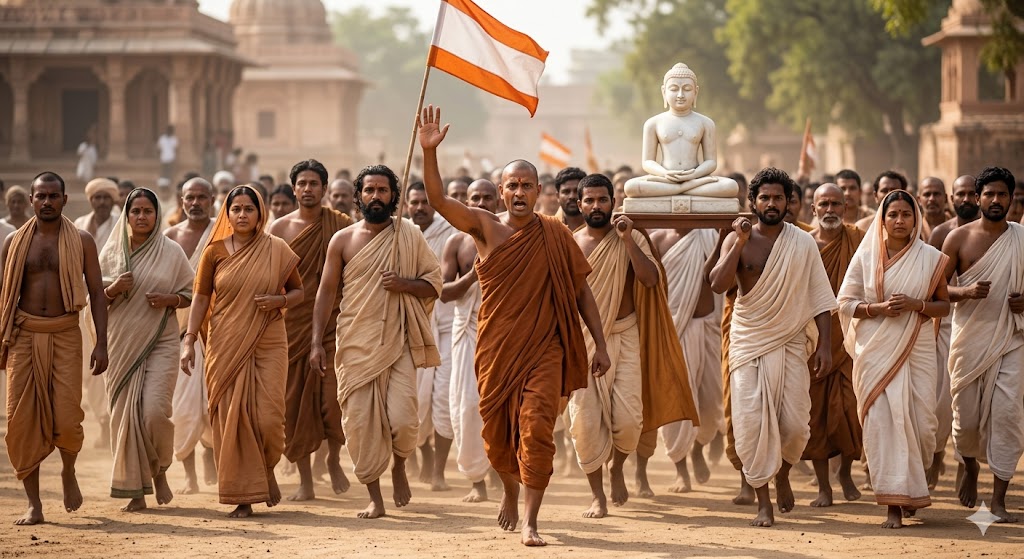
The original path of Śramaṇa: This dynamic photograph, generically representing a 6th century BCE procession in ancient India, visualizes the shared historical context of Jainism and Buddhism as Śramaṇa traditions that prioritized asceticism, non-violence, and personal effort over Vedic rituals.
The 24 Tirthankaras: Spiritual Guides Across Ages
Central to Jainism is the concept of Tirthankaras — omniscient beings who conquer samsara (the cycle of birth and death) and create a ford, or tirtha, for others to cross. There are 24 in the present time-cycle, each born as humans but achieving perfection through rigorous tapas (austerity). They are not gods to be worshipped for favors but exemplars whose lives and teachings illuminate the path.
Rishabhanatha, the first, is credited with founding organized society and the first 18 of the 24. Subsequent Tirthankaras include Ajitanatha, Sambhavanatha, and others, each associated with a unique emblem (lanchanas) like the bull for Rishabhanatha or the lion for Mahavira. The 23rd, Parshvanatha, is historically significant for his four vows, which Mahavira expanded to five by adding brahmacharya (celibacy).
Mahavira remains the most celebrated. His life story — renunciation, meditation under a sal tree, and tireless preaching — embodies Jain ideals. Each Tirthankara's biography follows a pattern: divine descent into the womb, auspicious birth, renunciation, omniscience, and final liberation. These narratives, preserved in texts like the Kalpasutra, serve as moral guides, emphasizing detachment from material bonds.
Jains revere all Tirthankaras equally through idols in temples, where daily rituals honor their victory over inner passions rather than seeking boons. This focus on human potential underscores Jainism's optimistic view: anyone, through right effort, can attain the same state.
The Language of Jain Scriptures: Prakrit and Its Significance
Jain canonical literature, known as the Agamas, was composed in Prakrit — specifically Ardhamagadhi Prakrit for Śvetāmbara texts and Sauraseni Prakrit for Digambara ones. This choice was deliberate: Prakrit was the everyday language of the people in Magadha, where Mahavira preached, making the dharma accessible beyond Sanskrit-speaking elites.
Ardhamagadhi ("half-Magadhi") captures the oral tradition of Mahavira's discourses, compiled by his disciples (ganadharas) and later formalized in councils. The Agamas cover cosmology, ethics, karma theory, and monastic rules across 45–84 texts depending on the sect. Digambaras, believing the original canon largely lost, rely on later works like the Shatkhandagama in Prakrit as well.
Prakrit's use highlights Jainism's democratic ethos — dharma for the masses, not just priests. Over centuries, commentaries shifted to Sanskrit, but the original Prakrit texts remain the foundation, studied today in pathshalas and universities. This linguistic heritage connects Jainism to ancient India's vernacular traditions, preserving a living link to its origins.
Core Teachings and Philosophy of Jainism
Jainism's philosophy revolves around the soul's journey from bondage to freedom. Reality comprises jiva (living souls) and ajiva (non-living matter, space, time, etc.). Karma — subtle particles attracted by actions and intentions — binds the soul, causing rebirth. Liberation requires stopping karmic influx and shedding accumulated karma.
The path is the Three Jewels (Ratnatraya):
Samyak Darshana (right faith): Belief in the Tirthankaras' teachings.
Samyak Jnana (right knowledge): Understanding the seven tattvas (truths) like jiva, ajiva, and karma.
Samyak Charitra (right conduct): Ethical living through vows.
The Five Great Vows (Mahavratas for ascetics; Anuvratas for laity) form the ethical core:
1. Ahimsa— Non-violence in thought, word, and deed, extending to all life forms (even microscopic).
2. Satya — Truthfulness.
3. Asteya — Non-stealing.
4. Brahmacharya — Celibacy or chastity.
5. Aparigraha— Non-possession and non-attachment.
Unique to Jainism is Anekantavada — the doctrine that reality is multifaceted; no single viewpoint captures absolute truth. This fosters tolerance and humility, expressed through Syadvada (relativity of statements, prefixed by "syat" or "in a certain sense"). These principles explain why Jainism has influenced thinkers like Mahatma Gandhi, who drew ahimsa into India's independence movement.
Monks and nuns (sadhus and sadhvis) preach through example, wandering barefoot, owning nothing, and delivering discourses on Agamas. Lay Jains practice moderated vows, supporting the ascetic order while pursuing righteous livelihoods.
Jainism's Relationship with Hinduism and Buddhism
Jainism shares India's cultural matrix with Hinduism (often called Sanatan Dharma) and Buddhism but remains distinct. All three emerged from ancient Indian thought, rejecting or reforming Vedic animal sacrifices and emphasizing dharma, karma, and moksha. Yet Jainism critiques Brahmanical rituals as insufficient for liberation, prioritizing personal austerity over priestly mediation.
With Buddhism, parallels abound: both Śramaṇa traditions arose in the Gangetic plain around the 6th–5th centuries BCE, stressing ahimsa and monasticism. Mahavira and Buddha were contemporaries; their paths diverged on nuances like soul (Jainism affirms eternal jivas; Buddhism denies a permanent self). Jain texts note interactions, but the faiths developed separately.
Hinduism absorbed Jain concepts like non-violence into Vaishnavism and Shaivism, while Jains revere some Hindu deities in folk practice. Scholars view them as parallel streams within Sanatan Dharma broadly, yet Jainism maintains independence — no Vedas, no creator God, strict vegetarianism. This interplay enriched Indian civilization without erasing Jainism's unique identity.
Major Sects: Digambara and Shwetambara
After Mahavira's nirvana, a gradual split occurred, solidifying into Digambara ("sky-clad") and Śvetāmbara ("white-clad") by the 3rd–1st centuries BCE, partly due to a famine in Magadha. Under Acharya Bhadrabahu, some migrated south, preserving stricter practices; those remaining under Sthulabhadra adapted.
Digambara monks renounce all clothing, symbolizing complete detachment (women wear white as nuns, called aryikas). They believe women cannot attain moksha in the current body and view the original Agamas as lost. Idols are unadorned; emphasis is on internal purity
Śvetāmbara monks and nuns wear simple white garments. They accept women can achieve liberation (recognizing Mallinatha as female) and preserve 45+ Agamas. Temple worship is more elaborate, with adorned idols.
Doctrinal differences are minor; both uphold the same core philosophy. Sub-sects exist within each (e.g., Sthanakvasi among Śvetāmbara reject idols). The divide reflects practical adaptations to environment and interpretation, yet unity prevails in reverence for Tirthankaras.
Spread of Jainism Across India and the Globe
In India, Jainism concentrated in the west and south after early northern origins. States like Maharashtra, Rajasthan, Gujarat, Karnataka, and Madhya Pradesh host the majority, with vibrant communities in Mumbai (4% Jain) and pilgrimage sites like Palitana (Shatrunjaya) and Shravanabelagola (Gomateshwara statue). Merchant Jains drove economic growth, paying a disproportionate share of taxes while upholding ethical trade.
Globally, diaspora communities emerged in the 19th–20th centuries through Gujarati and Rajasthani traders. Kenya and East Africa have significant populations; the US, UK, Canada, and Europe host temples and centers. Total worldwide followers hover around 6 million, with North America alone at 100,000+. Jain temples abroad blend tradition with modern outreach, promoting vegetarianism and non-violence education.
Famous landmarks include Dilwara Temples (Rajasthan) and Ellora caves, showcasing architectural brilliance. Jainism's global fame stems from its pacifist ethos, influencing environmental ethics and animal rights movements.
Famous Festivals and Celebrations in Jainism
Jain festivals revolve around the five kalyanakas (auspicious events) in Tirthankaras' lives. Key ones include:
Paryushana Parva(August–September): The most important, lasting 8 days (Śvetāmbara) or 10 (Digambara). It involves fasting, scripture recitation, and Samvatsari — a day of universal forgiveness where Jains seek and grant pardon, cleansing karma.
Mahavir Jayanti (April): Processions and discourses mark the 24th Tirthankara's birth.
Diwali: Commemorates Mahavira's nirvana and moksha; lamps symbolize inner light.
Others: Akshaya Tritiya (varshi tapa fasting), Gyana Panchami (knowledge worship).
These occasions blend austerity with community joy, reinforcing teachings through practice.
Living Jainism: Teachings, Preachings, and Modern Practices
Living Jainism means integrating vows into daily life. Lay followers adopt vegetarianism (many avoid root vegetables to minimize harm), practice aparigraha through simple living, and support monks who preach via viharas (wanderings) and upadeshas (discourses). Priests — though Jainism has no formal clergy — are ascetics who exemplify detachment.
Modern Jains excel in business, education, and philanthropy while navigating challenges like youth secularization. Case studies from UPSC curricula highlight Jainism's role in ancient Indian history and ethical governance. Globally, it promotes interfaith dialogue on peace and ecology.
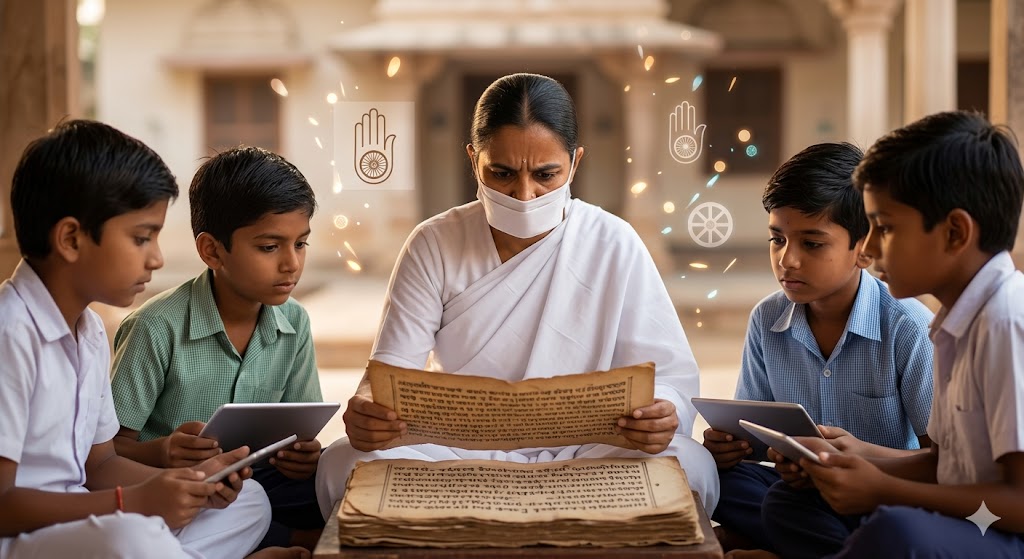
Living Prakrit philosophy: A generic Śvetāmbara Jain nun facilitates a study session with young students in an ancient Indian pathshala, conceptualizing how Jainism's core teachings on non-violence (ahimsa) and relativity (anekantavada) remain relevant in the modern world through education and adaptive practice.
Conclusion
Jainism endures as a beacon of compassion and intellectual humility. From its origins through Tirthankaras and Prakrit scriptures to its sects, festivals, and worldwide presence, it teaches that true strength lies in conquering the self. In an age of conflict and materialism, its message — live and let live — remains timelessly relevant. Whether studying for exams or personal growth, exploring Jainism reveals a religion not just of the past but of profound, living wisdom.
Frequently Asked Questions
What is the primary significance of Jainism: Origin, Tirthankaras, Teachings, Sects & Legacy?
Jainism stands as one of the world's oldest living religions, rooted deeply in the spiritual soil of ancient India. Often described as a path of extreme non-violence and self-discipline, Jainism offers a unique perspective on existence, karma, and liberation that continues to inspire millions.
How does this development impact Dharma?
Though small in numbers compared to other faiths, its influence on Indian culture, ethics, and even global ideas of peace is profound and far-reaching.At its heart, Jainism is not the creation of a single founder in the conventional sense. Instead, it traces its eternal dharma through a lineage of enlightened teachers known as Tirthankaras, or "ford-makers," who guide souls across the turbulent river of rebirth toward moksha, or ultimate liberation.
What are the key future projections to monitor?
The most recent of these, Mahavira, lived in the 6th century BCE and is frequently (though inaccurately) called the founder by outsiders.