In an era where classical computing approaches its physical limits, quantum technology emerges as a transformative force poised to redefine industries, solve previously intractable problems, and reshape our understanding of computation itself. From the enigmatic principles of quantum mechanics to practical applications in quantum computers and quantum internet systems, this field promises breakthroughs that could accelerate drug discovery, optimize global supply chains, enhance cybersecurity, and drive sustainable green technology solutions.
As we stand on the cusp of 2026, quantum technology is no longer confined to theoretical physics labs. Major players like IBM Quantum are pushing hardware boundaries, while innovative companies such as Quix Quantum advance photonic approaches that bring scalable systems closer to real-world deployment. This article delves deep into what quantum technology truly is, its foundational mechanics, current advancements, challenges, and the profound impact it will have on our future. Whether you are a technology enthusiast, industry professional, or policymaker, understanding quantum technology is essential for navigating the next decade of innovation.
Quantum technology leverages the counterintuitive behaviors of particles at the subatomic scale—behaviors that defy everyday logic yet power everything from semiconductors in your smartphone to next-generation quantum AI systems. By the end of this comprehensive guide, you will grasp not only the science but also the strategic implications for businesses and society at large.
What Is Quantum Technology?
At its core, quantum technology refers to a suite of tools and systems that harness the principles of quantum mechanics—the branch of physics describing the behavior of matter and energy at the smallest scales. Unlike classical technology, which relies on predictable binary states, quantum technology exploits phenomena such as superposition, entanglement, and interference to perform operations impossible for traditional computers.
Quantum mechanics, first formalized in the early 20th century by pioneers like Niels Bohr, Werner Heisenberg, and Erwin Schrödinger, revealed that particles like electrons and photons do not follow the rigid rules of Newtonian physics. Instead, they exist in probabilistic states until observed or measured. This foundational shift has already revolutionized fields like electronics and nuclear power, but the second quantum revolution—now underway—applies these principles deliberately to create entirely new capabilities.
Today, quantum technology encompasses several interconnected domains: quantum computing, quantum communication (including the quantum internet), quantum sensing, and quantum simulation. Each builds upon the same quantum building blocks but targets different challenges. For instance, quantum computing aims to solve complex optimization problems exponentially faster, while quantum communication promises unhackable data transmission.
The appeal of quantum technology lies in its potential scale. A quantum computer with just a few hundred high-quality qubits could outperform the world's most powerful supercomputers for specific tasks. As investments pour in from governments and corporations, quantum technology is transitioning from experimental curiosity to strategic infrastructure, much like the internet did in the 1990s.
Core Principles of Quantum Mechanics in Technology
To appreciate quantum technology, one must first understand its three pillars: superposition, entanglement, and quantum interference.
Superposition allows a quantum system, such as a qubit, to exist in multiple states simultaneously. In classical computing, a bit is either 0 or 1. A qubit, however, can represent 0, 1, or any linear combination of both until measured. This property enables quantum computers to process vast numbers of possibilities in parallel, offering massive computational speedups for problems involving combinatorics or simulations.
Entanglement, often described as "spooky action at a distance," links particles so that the state of one instantly influences another, regardless of distance. This correlation forms the backbone of quantum internet protocols and enables secure key distribution that classical encryption cannot match.
Quantum interference, meanwhile, allows engineers to amplify correct solutions while canceling out incorrect ones through carefully orchestrated wave-like behaviors. Together, these principles underpin quantum tunneling—a phenomenon where particles pass through energy barriers they classically could not surmount. Quantum tunneling already powers tunnel diodes and scanning tunneling microscopes; in advanced quantum technology, it contributes to more efficient sensors and potential breakthroughs in materials science.
These mechanics are not abstract theory. They translate directly into technology. Quantum mechanics in tech has already improved GPS accuracy via atomic clocks and enhanced medical imaging through quantum sensors. The next frontier integrates them into scalable systems for everyday impact.
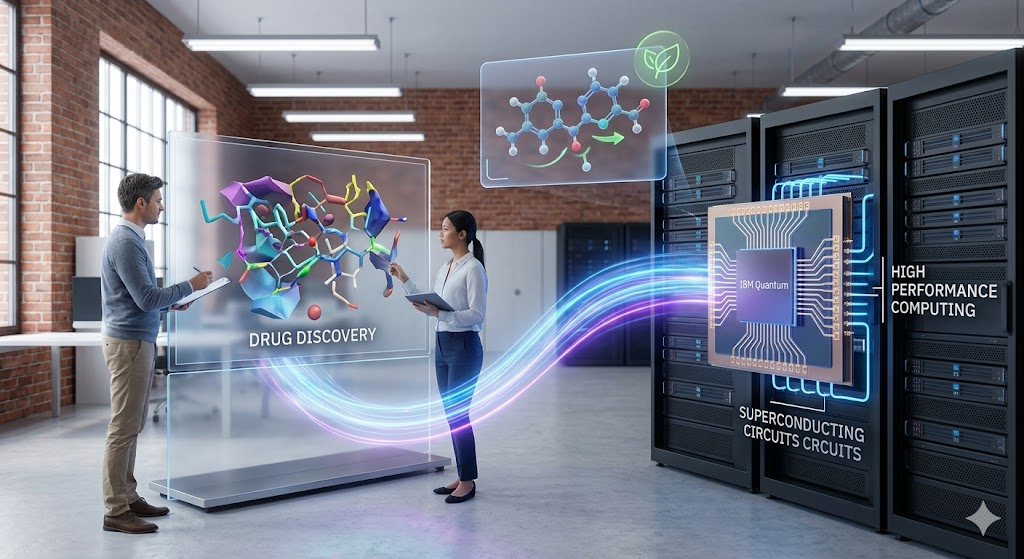
Quantum technology in practice: This image conceptualizes the integration of quantum processors within classical high-performance computing clusters, enabling advanced quantum simulations for drug discovery and molecular design.
Quantum Bits: The Building Blocks of Quantum Technology
The qubit stands as the fundamental unit of quantum technology, analogous to the classical bit but infinitely more versatile. Qubits can be realized through various physical systems: superconducting circuits (as in IBM Quantum processors), trapped ions, photons (central to Quix Quantum's photonic approach), or even topological structures for greater stability.
A single qubit in superposition holds far more information than a classical bit. Scale this to dozens or hundreds of entangled qubits, and the information capacity grows exponentially—2^n possible states for n qubits. However, qubits are fragile. Environmental noise causes decoherence, collapsing superpositions prematurely. Error correction techniques, such as surface codes or quantum low-density parity-check codes, are critical to maintaining fidelity.
IBM Quantum has pioneered accessible qubit systems through its cloud platform, allowing researchers worldwide to experiment with real hardware. Recent advancements include processors with improved connectivity and coherence times, paving the way for practical quantum advantage by late 2026.
Quix Quantum, Europe's leader in photonic quantum computing, takes a different route. By using light particles (photons) as qubits, their systems operate at room temperature, integrate seamlessly with existing fiber-optic infrastructure, and scale more readily for data-center deployment. In 2025, Quix Quantum secured funding to deliver the world's first single-photon-based universal quantum computer in 2026, highlighting how diverse hardware platforms enrich the quantum technology ecosystem.
Quantum computers represent the most publicized face of quantum technology. Unlike classical supercomputers that brute-force calculations sequentially, quantum computers leverage parallelism to tackle problems in chemistry, finance, logistics, and machine learning.
For example, simulating molecular interactions for drug discovery—a task requiring immense classical resources—becomes feasible on quantum hardware. Pharmaceutical companies could screen billions of compounds in days rather than years, accelerating the development of new therapies.
IBM Quantum leads this charge with its roadmap targeting quantum advantage (where quantum systems outperform classical methods for useful problems) by the end of 2026 and fault-tolerant systems by 2029. Their hybrid quantum-classical architectures integrate quantum processors with high-performance computing clusters, delivering immediate value through tools like Qiskit.
Other platforms, including photonic ones from Quix Quantum, excel in specific algorithms such as Gaussian boson sampling or certain optimization tasks. By 2026, experts predict hybrid workflows where quantum processors handle intractable subproblems while classical systems manage the rest—a pragmatic step toward widespread adoption.
Quantum computing also threatens current cryptography. Shor's algorithm could factor large numbers efficiently, rendering RSA encryption obsolete. This drives the urgent development of post-quantum cryptography standards.
Quantum Internet: The Secure Network of Tomorrow
Beyond computing, quantum technology enables the quantum internet—a global network for transmitting quantum states rather than classical bits. Using entanglement and quantum key distribution (QKD), it offers theoretically unbreakable encryption. Any eavesdropping attempt disturbs the quantum states, alerting users instantly.
The quantum internet will not replace the classical web but complement it. It will connect distant quantum computers into distributed supercomputers, enable ultra-precise quantum sensors for climate monitoring, and support secure government communications.
Early prototypes already link laboratories across cities. As fiber-optic and satellite integration advances, a functional quantum internet could emerge within the decade, bolstering cybersecurity in an age of rising digital threats.
Quantum AI: Synergies Between Quantum Technology and Artificial Intelligence
Quantum AI merges quantum technology with machine learning, promising faster training of models and superior handling of high-dimensional data. Quantum algorithms like the quantum approximate optimization algorithm (QAOA) excel at combinatorial problems that plague classical AI, such as portfolio optimization or supply-chain routing.
In manufacturing and logistics, quantum AI could optimize routes in real time, reducing fuel consumption and emissions—a direct contribution to green technology. Hybrid quantum-classical neural networks are already showing promise in drug-response prediction and patient data analysis.
Google Quantum AI and others explore quantum machine learning for materials discovery, potentially unlocking superconductors or efficient batteries for renewable energy. While full quantum AI supremacy remains years away, near-term hybrid systems deliver tangible gains today.
Applications in Green Technology and Sustainability
Quantum technology holds immense potential for environmental challenges. Accurate quantum simulations of chemical reactions could design catalysts for carbon capture or hydrogen production, making green energy more viable.
Climate modeling benefits enormously. Quantum computers can process complex atmospheric data with unprecedented precision, improving forecasts and policy decisions. Optimization algorithms powered by quantum technology enhance energy grid efficiency, minimizing waste in smart cities.
In agriculture, quantum sensors enable precise soil and crop monitoring, reducing water and fertilizer use. Materials science applications may yield lighter, stronger composites for electric vehicles or more efficient solar panels.
As governments prioritize sustainability, quantum technology aligns perfectly with net-zero goals, offering tools that classical systems simply cannot match at scale.
Challenges and Limitations of Quantum Technology
Despite its promise, quantum technology faces significant hurdles. Qubit stability remains paramount; maintaining coherence long enough for useful computation demands extreme conditions like near-absolute-zero temperatures for many platforms.
Scalability is another bottleneck. Building systems with thousands of logical qubits requires breakthroughs in error correction and manufacturing. Cost, talent shortages, and the need for specialized infrastructure slow commercialization.
Ethical and societal questions loom large: Who controls quantum advantage? How do we prepare workforces for a quantum-driven economy? Geopolitical competition adds urgency, with nations racing to secure technological sovereignty.
Regulatory frameworks for quantum encryption and data privacy must evolve rapidly. Nevertheless, steady progress—evident in 2026 roadmaps from IBM Quantum and Quix Quantum—suggests these challenges are surmountable.
The Future of Quantum Technology in 2026 and Beyond
By 2026, quantum technology enters a pivotal phase. Hybrid infrastructures become standard, with quantum processors embedded in classical data centers. Practical quantum advantage emerges in niche areas like optimization and simulation, while photonic systems from Quix Quantum enable plug-and-play deployment.
Government investments surge, educational programs expand, and businesses across finance, healthcare, and energy begin quantum-readiness assessments. Fault-tolerant systems appear on the horizon by 2029, unlocking broader commercial impact in the 2030s.
Longer-term, quantum technology could enable room-temperature superconductors, personalized medicine at the molecular level, and even quantum-enhanced AI surpassing human cognition in specific domains. The fusion of quantum technology with classical systems will define advanced computing technology for generations.
The photonic path: This image conceptualizes the research and scaling of universal quantum computing using photonic integrated circuits, aiming for deployment in classical data centers by late 2026
Impact of Quantum Tech on Industries and Society
The ripple effects of quantum technology will touch every sector. Finance gains superior risk modeling and fraud detection. Logistics achieves unprecedented efficiency. Healthcare accelerates from diagnostics to treatment design.
Green technology benefits through sustainable materials and energy optimization, helping combat climate change. National security strengthens via quantum-secure communications, though it also demands vigilance against new threats.
Society-wide, quantum technology raises prosperity potential while demanding equitable access. Workforce reskilling becomes critical. Public understanding—supported by accessible explanations and animations—will foster informed policy.
Visualizing these concepts helps: Numerous online animations illustrate qubits in superposition or entanglement in action, making abstract ideas tangible for students and executives alike.
Quantum technology stands as one of the most profound technological shifts of our time. Rooted in quantum mechanics yet reaching toward practical quantum computers, quantum internet, and quantum AI, it offers solutions to humanity's greatest challenges—from sustainable green technology to unbreakable security.
As IBM Quantum, Quix Quantum, and global innovators advance the field, the future appears brighter and more interconnected than ever. Organizations that invest early in quantum readiness will lead the next industrial revolution. For individuals, staying informed about quantum technology ensures participation in a world transformed by qubits, entanglement, and quantum tunneling.
The journey has begun. Quantum technology is not merely the future—it is the present unfolding before us. Embrace it, understand it, and prepare for an era where the impossible becomes routine.
Frequently Asked Questions
What is the primary significance of "Quantum Technology Explained: Future Ahead 2026"?
Quantum Technology Explained: Future AheadIn an era where classical computing approaches its physical limits, quantum technology emerges as a transformative force poised to redefine industries, solve previously intractable problems, and reshape our understanding of computation itself. From the enigmatic principles of quantum mechanics to practical applications in quantum computers and quantum internet systems, this field promises breakthroughs that could accelerate drug discovery, optimize global supply chains, enhance cybersecurity, and drive sustainable green technology solutions.As we stand on the cusp of 2026, quantum technology is no longer confined to theoretical physics labs.
How does this development impact Technology?
Major players like IBM Quantum are pushing hardware boundaries, while innovative companies such as Quix Quantum advance photonic approaches that bring scalable systems closer to real-world deployment. This article delves deep into what quantum technology truly is, its foundational mechanics, current advancements, challenges, and the profound impact it will have on our future.
What are the key future projections to monitor?
Whether you are a technology enthusiast, industry professional, or policymaker, understanding quantum technology is essential for navigating the next decade of innovation.Quantum technology leverages the counterintuitive behaviors of particles at the subatomic scale—behaviors that defy everyday logic yet power everything from semiconductors in your smartphone to next-generation quantum AI systems.