"AI in Education: Transforming Learning Worldwide"
Technology• April 19, 2026• Global Edition
The intersection of artificial intelligence and education marks one of the most profound shifts in human learning history. From adaptive tutoring systems that personalize lessons to AI-powered tools that free teachers from administrative burdens, AI in education is no longer a futuristic concept—it is reshaping classrooms, curricula, and careers across the globe. As we stand in 2026, the global AI education market has surged to approximately $7.05–7.57 billion, with projections soaring toward $112–136 billion by 2035 at a compound annual growth rate exceeding 34%. Student adoption tells an even more compelling story: usage jumped from 66% in 2024 to 92% in 2025, making AI a primary research and brainstorming partner for the vast majority of higher-education learners.
This detailed exploration examines the deep connection between AI technology and education. It highlights how AI elevates learning to advanced levels, captivates the world with its potential, and seamlessly bridges physical and digital classrooms. Whether for students, teachers, professionals, or coaching programs, the impact is undeniable. Yet, as with any transformation, it comes with challenges—concerns that AI might undermine critical thinking or exacerbate inequalities. By addressing both the promise and the pitfalls, this article provides a balanced, forward-looking view of education technology in the AI era.
The Evolution of Tech in Education: From Traditional Roots to the AI Revolution
Education has always evolved alongside technology, but the pace accelerated dramatically during the global quarantine triggered by the COVID-19 pandemic. In early 2020, over 1.6 billion students worldwide faced school closures, forcing an overnight pivot to online classes. What began as emergency remote learning became a catalyst for the technical era we inhabit today. Countries rapidly adopted digital platforms, learning management systems, and video tools, laying the groundwork for AI integration.
This quarantine-driven shift delivered a major impact on the globe, normalizing visual representation in online classes through interactive simulations, virtual reality, and real-time analytics. Pre-pandemic, digital education served as a supplement; post-quarantine, it became essential. China, for instance, embraced AI education early, with pilot schools using facial recognition to monitor engagement and AI systems grading artwork or assessing psychological well-being. By 2030, China aims to embed AI across all primary and secondary curricula, from foundational cognitive skills in early grades to systems thinking in high school.
In Africa, similar momentum builds through international partnerships. Chinese collaborations focus on AI for agriculture, language translation, and inclusive tools in local dialects, while U.S. and European initiatives emphasize ethical AI and digital infrastructure. These examples illustrate how the technical era born from necessity now drives equitable access and innovation worldwide.
How AI Connects Technology to Education: Core Mechanisms and Tools
At its heart, AI in education leverages machine learning, natural language processing, and data analytics to make learning more intuitive and effective. Intelligent tutoring systems analyze student performance in real time, adjusting difficulty levels and providing targeted feedback—much like a personal coach available 24/7.
Free AI tools for education have democratized access. Platforms like Google Gemini, ChatGPT (free tier), Khanmigo by Khan Academy, MagicSchool.ai, and Canva’s AI feature empower users without high costs. Teachers generate lesson plans, quizzes, and differentiated materials in minutes. Students receive instant explanations or practice speaking foreign languages with interactive bots. Professionals in coaching programs use AI for scenario simulations and skill assessments.
Generative AI further enhances this connection. It creates immersive 3D virtual classrooms, adaptive learning paths, and even virtual campus activities. Tools like Duolingo’s AI chatbot or Carnegie Learning’s STEM platforms demonstrate practical application, turning abstract concepts into engaging experiences.
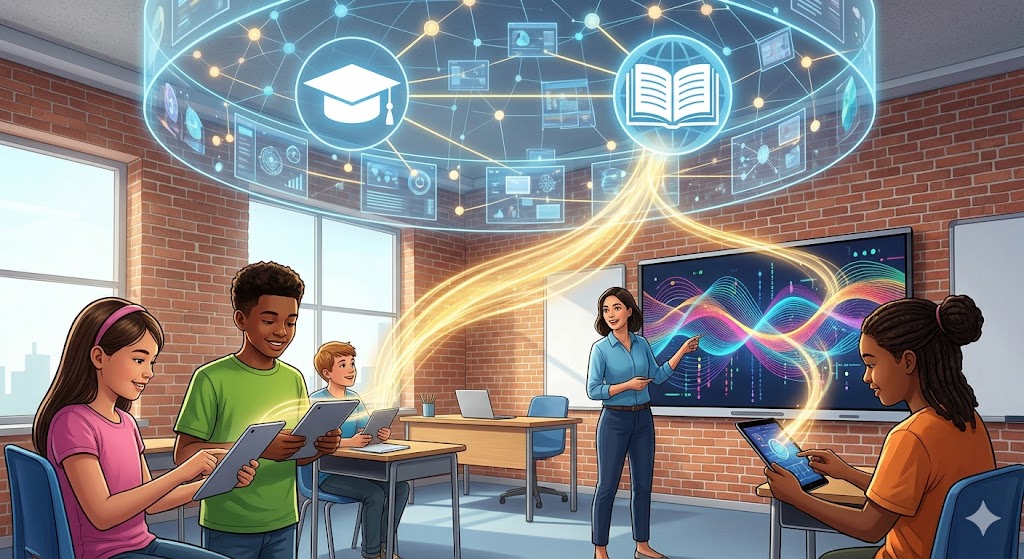
The future of education is hybrid: this image conceptualizes the seamless integration of physical classrooms with adaptive digital learning environments, where AI tools harmonize instruction for students and teachers across the globe.
AI’s Role for Students: Personalized, Engaging, and Future-Ready Learning
Students stand at the forefront of AI in education’s benefits. Adaptive platforms tailor content to individual paces, learning styles, and strengths, closing achievement gaps that traditional one-size-fits-all methods often widen. Exam scores in universities using AI chatbots and guided support have risen by up to 10%, while K-12 students report higher engagement through game-based simulations.
In physical classrooms, AI appears via smart boards and real-time analytics dashboards that help instructors identify struggling learners instantly. In digital classrooms, virtual reality labs let students explore ancient civilizations or molecular structures hands-on from anywhere. For coaching and professional development, AI simulates job interviews or technical certifications, building confidence before real-world application.
Yet fascination extends beyond convenience. Learners worldwide are captivated because AI makes education feel personal and empowering. A student in rural Africa using multilingual AI tutors or one in urban China collaborating in virtual metaverse spaces experiences learning as dynamic rather than passive.
Empowering Teachers and Professionals: Efficiency Meets Human Connection
Teachers often describe AI as a time-saving ally rather than a replacement. AI grading tools, lesson generators, and administrative assistants reduce paperwork, allowing more focus on mentorship and relationship-building—the irreplaceable human element of teaching. Over 60% of educators now adopt AI weekly, though many note a training gap; 87% report receiving no formal AI professional development.
For professionals and coaching institutions, AI streamlines corporate training with personalized modules and performance analytics. In higher education and executive programs, AI writing detection tools ensure integrity while fostering original thought. The result? Educators and trainers spend less time on routine tasks and more on inspiring creativity and critical thinking.
In both physical and digital settings, AI augments rather than supplants. A teacher in a brick-and-mortar classroom might use AI to generate bilingual exit tickets, while an online coach employs virtual assistants for round-the-clock support. This hybrid approach defines modern education technology.
Physical Classrooms Meet Digital Realms: Seamless AI Integration
One of the most fascinating aspects of AI in education is its ability to bridge physical and digital environments. In traditional classrooms, interactive panels, IoT sensors, and AI-powered cameras create smart spaces that adapt lighting, temperature, or content based on engagement data. Augmented reality overlays digital information onto real objects, making abstract lessons tangible.
Digital classrooms extend this further. Virtual 3D spaces hosted in the metaverse allow global collaboration, while AI chatbots provide instant help outside school hours. Hybrid models—blending in-person instruction with online reinforcement—have become standard since the quarantine era. Students might attend a live lecture, then receive AI-generated practice problems customized to their weaknesses.
This convergence reimagines education. No longer confined by geography or time zones, learning becomes continuous, inclusive, and visually rich. Visual representation through AI-driven videos, simulations, and interactive dashboards has proven especially powerful in online classes born from the pandemic response.
Global Perspectives: AI in Education Across Continents
The world’s fascination with AI and education stems from its
universal potential. In China, national policies integrate AI from age six, with schools piloting facial-expression analysis and intelligent tutoring. Africa sees AI addressing unique challenges: tools translate English to local sign languages in Kenya or produce children’s books in Bambara in Mali, preserving culture while expanding access.
Europe and North America focus on ethical frameworks, teacher training, and AI literacy curricula. Developing regions leverage low-cost mobile AI to overcome infrastructure barriers. Everywhere, the story is the same: AI in education levels playing fields while preparing learners for an AI-driven workforce.
Addressing Concerns: Is AI Ruining Education—or Exposing Its Flaws?
No discussion of AI in education is complete without balance. Critics rightly ask why AI is bad for education or how it might be ruining it. Over-reliance can erode critical thinking; studies show students using AI for skill-building sometimes score higher initially but retain less on closed-book assessments. Cheating remains a worry, though AI writing detection tools help mitigate it. Privacy risks, algorithmic bias, and reduced human interaction also loom large.
Parents express concerns: 80% worry about harmful effects, while teachers note weakened peer connections. Yet evidence suggests thoughtful implementation counters these risks. AI does not replace teachers—it amplifies their impact when paired with strong pedagogy and clear guidelines. The real danger lies not in the technology but in hasty adoption without equity or oversight.
The Future of Education: Reimagining Learning in the AI Era
Looking ahead, the edtech revolution promises even greater personalization, accessibility, and efficiency. By 2030, AI could help close global learning gaps, support lifelong upskilling, and foster creativity through collaborative human-AI partnerships. Initiatives like OECD’s Digital Education Outlook emphasize generative AI’s responsible use.
The technical era, sparked by quarantine-driven online classes, continues evolving. Visual, immersive, and adaptive tools will define classrooms—physical, digital, or hybrid. Students, teachers, professionals, and coaches alike will thrive in this environment, equipped not just with knowledge but with the skills to harness AI ethically.
An educator leverages an interactive smart panel powered by AI analytics to provide real-time, data-driven feedback and personalized instruction, showcasing the time-saving efficiency and enhanced human connection defined in modern teaching.
Conclusion: Embracing AI as Education’s Greatest Ally
AI in education represents far more than tools and algorithms—it embodies humanity’s drive to learn better, teach smarter, and connect deeper. From the quarantine-fueled birth of widespread online classes to today’s sophisticated global applications, the journey has been remarkable. As adoption surges and innovations multiply, the world remains fascinated because AI promises an advanced, inclusive, and inspiring educational future.
The key lies in thoughtful integration: celebrating human connection while leveraging technology’s strengths. Educators, policymakers, and learners who embrace this balance will shape not only the next generation but the very future of education itself. The revolution is here—and it is profoundly human at its core.
Frequently Asked Questions
What is the primary significance of "AI in Education: Transforming Learning Worldwide"?
The intersection of artificial intelligence and education marks one of the most profound shifts in human learning history. From adaptive tutoring systems that personalize lessons to AI-powered tools that free teachers from administrative burdens, AI in education is no longer a futuristic concept—it is reshaping classrooms, curricula, and careers across the globe.
How does this development impact Technology?
As we stand in 2026, the global AI education market has surged to approximately $7.05–7.57 billion, with projections soaring toward $112–136 billion by 2035 at a compound annual growth rate exceeding 34%. Student adoption tells an even more compelling story: usage jumped from 66% in 2024 to 92% in 2025, making AI a primary research and brainstorming partner for the vast majority of higher-education learners.This detailed exploration examines the deep connection between AI technology and education.
What are the key future projections to monitor?
It highlights how AI elevates learning to advanced levels, captivates the world with its potential, and seamlessly bridges physical and digital classrooms.