US Russia Oil U-Turn in Iran War: Blockade & Ship Attacks
International Affairs• April 18, 2026• Global Edition
The 2026 Iran-Israel war has reshaped global geopolitics in ways few anticipated when hostilities erupted on February 28. What began as targeted US-Israeli strikes against Iranian nuclear and military infrastructure has spiraled into a broader confrontation involving shipping lanes, energy markets, and third-party nations. At the heart of today’s developments lies a complex interplay: the United States’ pragmatic but controversial U-turn on Russian oil sanctions, Iran’s recent firing on two Indian-linked ships in the Strait of Hormuz, and Washington’s ongoing naval blockade of Iranian ports.
These three elements are not isolated incidents. They reflect the economic and military pressures shaping the Iran-Israel war as it enters its eighth week. Oil prices have surged past $110 per barrel at times, global supply chains are strained, and diplomatic efforts remain fragile. This article examines the current situation with clarity and context, drawing on verified developments as of April 18, 2026.
The conflict traces its immediate roots to long-standing tensions over Iran’s nuclear program and regional proxy activities. On February 28, joint US-Israeli Operation Epic Fury delivered precision strikes that eliminated key Iranian leadership figures, including Supreme Leader Ali Khamenei, and crippled missile production sites. Iran responded with waves of ballistic missiles and drones targeting Israeli cities and US assets across the region.
By mid-March, the fighting had expanded to the maritime domain. Iran declared control over portions of the Strait of Hormuz, threatening to close the critical chokepoint through which 20 percent of global oil passes. The United States, determined to keep energy flowing while isolating Tehran, responded with escalating naval measures. Meanwhile, Russia—already under Western sanctions for its actions in Ukraine—found itself indirectly benefiting from the chaos as energy markets tightened.
This backdrop set the stage for the three pivotal developments now dominating headlines in the Iran-Israel war.
The US U-Turn on Russia Oil: Pragmatism Over Principle?
In early March 2026, as Iranian attacks disrupted shipping and oil prices spiked, the Trump administration issued a 30-day general license allowing countries to purchase Russian oil already loaded onto vessels at sea. What began as a narrow waiver for India quickly expanded to all buyers worldwide. Treasury Secretary Scott Bessent described the move as “a temporary step to stabilize global energy markets roiled by the Iran war.”
Critics labeled it a U-turn on Russia oil policy. After years of tightening sanctions post-2022, Washington appeared to ease pressure on Moscow precisely when the Kremlin could use the revenue most. Yet US officials insist the core policy remains unchanged: Russian oil stays sanctioned once current stocks clear. Energy Secretary Chris Wright emphasized on March 8 that “Russia’s oil remains sanctioned. There’s no change in policy towards Russia.”
The decision was driven by hard economics. With Iranian crude offline and Hormuz traffic reduced by more than 40 percent in some weeks, global supply fears pushed prices higher. European allies, already wary of a full energy crisis, quietly supported the measure even as they publicly criticized it. By April, the waiver had helped ease prices back toward $100 per barrel, though volatility persists.
For the broader Iran-Israel war, this US U-turn on Russia oil carries strategic weight. It signals Washington’s willingness to prioritize energy security over ideological consistency when allied interests are at stake. Moscow, for its part, has used the breathing room to maintain exports and indirectly support its partnership with Tehran. Analysts note that every barrel of Russian oil reaching market reduces the incentive for Iran to reopen its own export terminals—further complicating US blockade efforts.
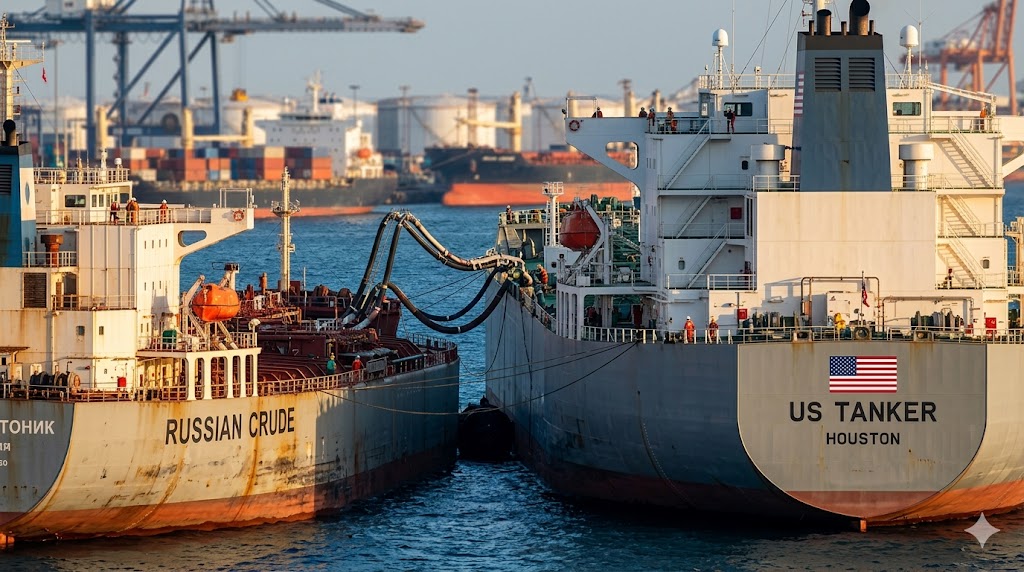
A visual representation of the US U-turn on Russian energy sanctions. During the 2026 conflict, a Russian-marked oil tanker (foreground, labeled 'RUSSIAN CRUDE') is shown transferring oil to a US-flagged supertanker, symbolizing the temporary easing of restrictions to stabilize global markets.
Iran Firing on Indian Ships: A Direct Challenge to Neutral Shipping
On March 10–12, 2026, the Islamic Revolutionary Guard Corps Navy (IRGCN) fired on multiple commercial vessels transiting the Strait of Hormuz after they allegedly ignored repeated warnings. Among those hit were two vessels with direct Indian connections: the Thai-flagged, India-bound bulk carrier Mayuree Naree heading to Kandla port in Gujarat, and the US-owned tanker Safesea Vishnu route to India.
Iranian state media reported that the IRGCN used projectiles and unmanned explosive boats after the ships failed to heed radio hails. One Indian national was killed in the Safesea Vishnu attack, with additional crew members missing from the Mayuree Naree. India’s Ministry of External Affairs issued a strong condemnation, describing the incidents as “unacceptable” and calling for the immediate protection of civilian shipping.
New Delhi’s response has been measured but firm. While maintaining diplomatic channels with Tehran—rooted in long-standing energy and Chabahar port ties—India has summoned Iran’s ambassador and increased naval escorts for its merchant fleet. The attacks occurred amid Iran’s broader campaign to disrupt traffic it views as supporting the US-Israel coalition.
For the Iran-Israel war, these strikes on Indian ships serve multiple purposes. They demonstrate Iran’s ability to project power beyond its immediate borders, deter neutral nations from aligning too closely with Washington, and raise insurance premiums for all vessels in the Gulf. Shipping data shows a 35 percent drop in India-bound traffic through Hormuz in the two weeks following the incidents, forcing some operators to reroute via the longer Cape of Good Hope path.
India now finds itself caught between its strategic partnership with the United States and its energy dependence on the region. The episodes have fueled domestic calls for greater naval presence in the Indian Ocean and accelerated diversification of oil import sources.
The US Blockade: Enforcing Isolation in Real Time
On April 13, 2026, US Central Command activated a formal blockade of all maritime traffic entering or exiting Iranian ports and coastal waters. President Trump described the operation as “a necessary response after peace talks in Islamabad collapsed.” More than 15 US Navy warships, including an aircraft carrier and multiple destroyers, now patrol the approaches to the Strait of Hormuz and Iranian territorial seas.
The blockade is deliberately narrow: it targets Iranian ports specifically rather than closing the entire strait to third-party shipping. Nevertheless, the practical effect has been significant. Six merchant vessels were turned back in the first 48 hours, and Iranian oil exports have plummeted. CENTCOM reports that no vessels have successfully breached the line as of April 18.
Iran has responded with threats of retaliation against Gulf neighbors’ ports and sporadic attempts by sanctioned supertankers to run the gauntlet. On April 17, Tehran claimed the strait was “completely open,” a statement the US dismissed as propaganda while maintaining the blockade in place.
The military logic is straightforward. By choking Iran’s sea trade, Washington aims to starve the regime of revenue and limit its ability to resupply proxy forces. Economically, the blockade has already forced Iran to ration fuel domestically and accelerated damage to its already sanctions-battered economy.
Yet the operation carries risks. Any miscalculation could draw in China or Russia more directly, both of whom have voiced opposition to what they call “unilateral maritime coercion.” Insurance markets have reacted sharply, with war-risk premiums for Gulf voyages doubling in some cases.
Interconnections: One Conflict, Three Pressure Points
These developments are tightly linked within the Iran-Israel war framework. The US U-turn on Russia oil was explicitly framed as a response to supply shocks caused by Iranian disruption of Hormuz shipping. Those same disruptions prompted Iran’s decision to fire on vessels—including the Indian ships—as a deterrent. The resulting chaos justified, in Washington’s eyes, the imposition of the full naval blockade.
Together, the three elements create a feedback loop. Higher global oil prices from the blockade and ship attacks make the Russian oil waiver politically palatable. Iranian attacks on neutral shipping, including Indian vessels, harden international opinion against Tehran and bolster support for the US-led blockade. And the blockade itself keeps pressure on Iran even as limited ceasefires take hold in related theaters such as Lebanon.
Economically, the combined impact is staggering. Global GDP growth forecasts for 2026 have been revised downward by 0.8 percentage points according to preliminary IMF assessments. Asian economies, particularly India and China, face the steepest short-term challenges due to higher energy costs and rerouted shipping.
Militarily, the situation underscores the shift from kinetic strikes on land to economic warfare at sea—a domain where the US Navy retains unmatched dominance but where asymmetric responses from Iran remain possible.
International Reactions and India’s Delicate Balancing Act
Reactions have varied sharply. European NATO allies have expressed unease over the Russian oil waiver but have not blocked it. Gulf states, while publicly neutral, quietly welcome any measure that weakens Iran’s regional influence. China has criticized the blockade as a threat to freedom of navigation and has increased its own naval patrols in the Indian Ocean.
India’s position is particularly nuanced. As a major buyer of both Russian and Iranian oil in the past, New Delhi has benefited from discounted Russian crude while condemning Iranian attacks on its shipping. Prime Minister Modi’s government has called for de-escalation and offered to host future talks—an offer welcomed by both Washington and Tehran.
The incidents involving Indian ships have, however, prompted concrete steps: enhanced coordination with the US Navy for convoy protection and accelerated development of strategic petroleum reserves. India’s stance reflects a broader truth about the Iran-Israel war: even non-belligerent powers are being forced to choose sides or pay the price of neutrality.
Future Outlook: Ceasefire Hopes Versus Prolonged Stalemate
As of April 18, 2026, diplomatic activity remains intense. A 10-day ceasefire between Israel and Lebanon took effect on April 16, offering a potential model for broader de-escalation. US officials have signaled openness to talks if Iran agrees to verifiable limits on uranium enrichment and ceases attacks on commercial shipping.
Yet significant hurdles remain. Iran insists the US blockade must end before any substantive negotiations. The Trump administration has countered that sanctions relief—including any reversal of the Russia oil measures—will only follow concrete Iranian concessions.
Energy markets will likely remain volatile through the summer. Shipping companies are already negotiating long-term contracts that bypass the Gulf entirely. For India, the twin shocks of Iranian ship attacks and higher oil prices may accelerate its push toward renewable energy and diversified suppliers.
The Iran-Israel war has already redrawn maps of influence in the Middle East. Whether the current combination of US Russia oil policy adjustments, maritime confrontations, and blockade enforcement leads to a negotiated settlement or a protracted war of attrition will depend on decisions made in the coming weeks.
A visual representation of the tense maritime situation. Dawn in the Strait of Hormuz shows a US Navy destroyer (center) enforcing the blockade, alongside the 'India-Bound' commercial ship MV Mayuree Naree, listing with smoke visible following an Iranian attack in March 2026.
Conclusion
The current situation in the 2026 Iran-Israel war is defined by three interlocking crises: America’s calculated U-turn on Russian oil sanctions, Iran’s aggressive firing on Indian ships in the Strait of Hormuz, and the United States’ determined naval blockade of Iranian ports. Each development carries immediate humanitarian, economic, and strategic costs.
Collectively, they illustrate how modern great-power conflict extends far beyond the battlefield into the global economy and neutral nations’ waterways. As stakeholders from Washington to New Delhi monitor every tanker movement and oil futures contract, the world watches to see whether these pressure points will force a breakthrough—or deepen the conflict further.
For now, the blockade holds, Russian oil flows under temporary license, and Indian sailors remember the cost of sailing through contested waters. The Iran-Israel war continues, with its next chapter written not only in missile trajectories but in the quiet calculus of energy security and maritime freedom.
Frequently Asked Questions
What is the primary significance of US Russia Oil U-Turn in Iran War: Blockade & Ship Attacks?
The 2026 Iran-Israel war has reshaped global geopolitics in ways few anticipated when hostilities erupted on February 28. What began as targeted US-Israeli strikes against Iranian nuclear and military infrastructure has spiraled into a broader confrontation involving shipping lanes, energy markets, and third-party nations.
How does this development impact International Affairs?
At the heart of today’s developments lies a complex interplay: the United States’ pragmatic but controversial U-turn on Russian oil sanctions, Iran’s recent firing on two Indian-linked ships in the Strait of Hormuz, and Washington’s ongoing naval blockade of Iranian ports. These three elements are not isolated incidents. They reflect the economic and military pressures shaping the Iran-Israel war as it enters its eighth week.
What are the key future projections to monitor?
Oil prices have surged past $110 per barrel at times, global supply chains are strained, and diplomatic efforts remain fragile.

.jpeg)