Strait of Hormuz 2026: Iran Reimposes Restrictions
International Affairs• April 18, 2026• Global Edition
In the volatile waters of the Persian Gulf, few choke point carry as much global significance as the strait of hormuz. On April 18, 2026, Iranian authorities announced they had reimposed strict controls over the strait of hormuz, reversing a brief reopening announced just a day earlier. Citing repeated US violations of a fragile ceasefire — including what Iranian officials describe as "piracy" through a naval blockade of Iranian ports — Tehran has once again placed the strait of hormuz under the "strict management and control of the armed forces."
This latest twist in the strait of hormuz crisis comes amid an already tense iran us standoff strait of hormuz that has disrupted one of the world’s most critical energy arteries for weeks. With roughly one-fifth of global seaborne oil passing through its narrow waters, any sustained restrictions in the strait of hormuz carry profound implications for energy markets, international trade, and regional stability. As Iranian military commanders warn that passage will remain tightly regulated until the US fully lifts its blockade, the world watches nervously to see whether the strait of hormuz blockade 2026 will escalate into a broader oil crisis strait of hormuz impact.
This article examines the background, recent developments, stated positions of both sides, and the far-reaching dangers that renewed restrictions on the strait of hormuz pose for the Middle East and global oil supplies.
The strait of hormuz is a narrow waterway connecting the Persian Gulf to the Gulf of Oman and, ultimately, the Arabian Sea. At its narrowest point, the strait of hormuz measures just 21 miles wide, with shipping lanes tightly constrained by international maritime boundaries and the proximity of Iranian and Omani territorial waters.
For decades, the strait of hormuz has served as the primary export route for oil and liquefied natural gas produced by Saudi Arabia, the United Arab Emirates, Iraq, Kuwait, and Qatar. Analysts estimate that approximately 20-21 million barrels of oil pass through the strait of hormuz each day — accounting for about 20 percent of global seaborne petroleum trade and a significant share of the world’s LNG supply. Much of this cargo is destined for energy-hungry markets in Asia, particularly China, which receives roughly one-third of its imported oil via the strait of hormuz.
Beyond hydrocarbons, the strait of hormuz is vital for fertilizer exports, with the region supplying 30-35 percent of global urea and 20-30 percent of ammonia. Disruptions here ripple far beyond energy prices, affecting global food production and industrial supply chains. The strait of hormuz’s geography — flanked by Iran to the north and Oman to the south — has long made it a focal point of geopolitical tension. Iran’s Islamic Revolutionary Guard Corps (IRGC) maintains a strong naval presence in the area, while the United States and its allies regularly conduct freedom-of-navigation operations to underscore the waterway’s international status.
In the context of the ongoing strait of hormuz crisis, these geographic and economic realities take on heightened urgency. Any Iranian move to restrict traffic in the strait of hormuz immediately threatens global energy security, a fact that has shaped diplomatic and military calculations for years.
Historical Context of Tensions in the Strait of Hormuz
The strait of hormuz has witnessed repeated crises over the past four decades. During the 1980s Iran-Iraq War, the so-called “Tanker War” saw both sides attack commercial shipping, prompting international intervention. In 2011-2012, Iran threatened to close the strait of hormuz in response to Western sanctions over its nuclear program. Similar warnings resurfaced in 2019 amid tanker attacks attributed to Iranian forces, and again during periods of heightened US-Iran friction.
These incidents underscore a consistent pattern: Iran views control over the strait of hormuz as a legitimate deterrent and bargaining chip against perceived external threats. The IRGC has repeatedly asserted its ability to disrupt traffic in the strait of hormuz through mines, fast-attack boats, and anti-ship missiles. Conversely, Western powers have always maintained that the strait of hormuz constitutes an international strait under the United Nations Convention on the Law of the Sea (UNCLOS), guaranteeing freedom of transit passage.
The current strait of the hormuz crisis did not emerge in isolation. It forms part of a broader escalation that began with US and Israeli strikes on Iran in late February 2026. Shipping traffic through the strait of hormuz plummeted almost immediately as the IRGC issued warnings and conducted attacks on merchant vessels. By early March 2026, the strait of hormuz was effectively closed to most commercial traffic, with only carefully vetted ships — primarily from non-aligned nations — permitted passage under Iranian oversight.
Insurance premiums for vessels transiting the strait of hormuz soared, major shipping lines suspended operations, and oil prices spiked dramatically. The strait of hormuz iran dynamic once again demonstrated how a single waterway could destabilize global markets.
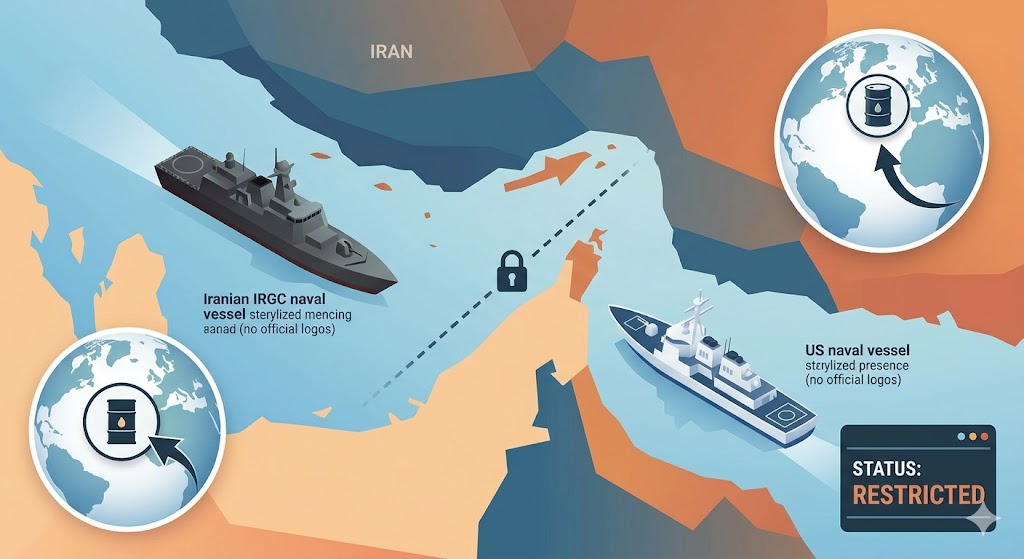
: A stylized illustration depicting the high-stakes standoff between generic Iranian and US naval vessels, with a diagonal padlock icon symbolizing the restricted passage in the Strait of Hormuz.
Timeline of the 2026 Strait of Hormuz Crisis
The strait of hormuz blockade 2026 unfolded in stages. Following initial strikes in late February, the IRGC began enforcing restrictions almost immediately. By March 2, Iranian forces had declared the strait of hormuz closed to vessels linked to the United States, Israel, or their allies. Multiple merchant ships came under attack, with confirmed incidents involving gunfire, mines, and boarding attempts. Traffic through the strait of hormuz dropped to near zero for weeks.
A fragile ceasefire brokered in Pakistan offered a momentary reprieve. On April 17, Iran’s foreign minister declared the strait of hormuz “completely open” to commercial vessels for the remainder of the Lebanon truce period. President Trump publicly welcomed the move, stating the strait of hormuz was “fully open and ready for business.” However, he simultaneously reaffirmed that the US naval blockade of Iranian ports would remain in force until a comprehensive deal — what he termed the “transaction with Iran” — reached 100 percent completion.
Within hours, Iranian officials reversed the course. The country’s joint military command announced on April 18 that control of the strait of hormuz had “reverted to its previous state” under armed forces oversight. The explicit reason: the continued US blockade, which Tehran labeled an act of “piracy” and a violation of ceasefire terms.
This rapid about-face — from brief reopening to renewed restrictions in the strait of hormuz— has left shipping companies scrambling. Vessels have been observed turning away from the entrance to the strait of hormuz, while reports emerged of IRGC gunboats firing on a tanker attempting passage.
Iran’s Position: Reimposing Controls in Response to US Actions
Iranian officials have been unequivocal. The military’s operational command, Khatam Al-Anbiya, stated that the strait of hormuzwould remain under “strict management and control of the armed forces” until the United States restores “complete freedom of navigation for vessels from an Iranian origin to a destination, and from a destination back to Iran.”
Senior IRGC figures have framed the US blockade as repeated provocation. They argue that maintaining restrictions on Iranian ports while demanding unrestricted access through the strait of hormuz constitutes an unacceptable double standard. One commander warned that any continued “insecurity” created by the US presence would prompt Iran to halt all exports and imports across the Persian Gulf, Gulf of Oman, and even the Red Sea.
Iranian leaders emphasize that the strait of hormuz iran relationship grants Tehran legitimate security interests in the waterway. They point to the blockade’s economic impact on Iran — which relies heavily on sea-borne trade — as justification for symmetric pressure through the strait of hormuz. As one statement put it, security in the region must be “for all or for none.”
This stance aligns with long-standing Iranian doctrine: the strait of hormuz is not merely a commercial route but a strategic asset that can be leveraged in times of confrontation.
The US Perspective and Trump’s Blockade Strategy
From the American viewpoint, the blockade targets only vessels entering or leaving Iranian ports and does not impede third-party traffic through the strait of hormuz. US Central Command has repeatedly clarified this distinction, stressing that freedom of navigation for non-Iranian shipping remains intact. President Trump has described the measure as necessary leverage to secure a lasting agreement on Iran’s nuclear program and regional behavior.
In public statements, Trump has linked the lifting of the blockade directly to progress in negotiations, insisting it will remain until the “transaction with Iran is 100% complete.” This language underscores a transactional approach: pressure through the strait of hormuz and port restrictions is intended to accelerate diplomatic outcomes rather than provoke indefinite closure.
The US has also conducted mine-clearing operations and deployed additional naval assets to support safe passage. Washington argues that Iran’s selective restrictions and reported attacks on tankers violate international norms and threaten global commerce, justifying the current trump strait of hormuz blockade posture.
Impact on Global Oil Supply and the Looming Oil Crisis
The renewed restrictions on the strait of hormuz could not come at a more sensitive moment for energy markets. With traffic already severely curtailed since February, global oil inventories have been drawn down and prices have remained elevated. A full re-closure of the strait of hormuz would remove roughly 20 percent of daily seaborne oil supply from world markets, an event with potentially catastrophic economic consequences.
Even partial restrictions create uncertainty. Shipping firms hesitate to commit vessels without clear guarantees of safe passage, leading to delays, higher insurance costs, and rerouting that strains alternative pipelines and ports. Oil prices, already volatile, risk another sharp spike. Fertilizer and petrochemical supply chains face parallel disruptions, with downstream effects on global agriculture and manufacturing.
The oil crisis strait of hormuz impact extends beyond immediate supply. Long-term, repeated crises in the strait of hormuz accelerate efforts to diversify energy sources and develop bypass infrastructure. Yet such projects require years to materialize, leaving the world economy exposed in the interim.
Why Imposing Restrictions on the Strait of Hormuz Is Dangerous for the Middle East
The decision to reimpose controls over the strait of hormuz carries profound risks for regional stability. First, it heightens the chance of direct naval confrontation. With US warships enforcing a blockade and IRGC gunboats patrolling the strait of hormuz, the margin for miscalculation is razor-thin. A single incident — such as the reported gunfire on a tanker on April 18 — could escalate into open conflict, drawing in additional actors.
Second, the strait of hormuz crisis exacerbates existing fractures across the Middle East. Gulf Arab states, many of which depend on the waterway for their own exports, face economic pressure and security dilemmas. The broader iran us standoff strait of hormuz risks pulling Oman, which shares sovereignty over parts of the strait, into uncomfortable neutrality or active involvement.
Third, prolonged disruption undermines diplomatic efforts. While the strait of hormuz serves as leverage, its weaponization also hardens negotiating positions on all sides. The longer the strait of hormuz blockade 2026 persists, the more difficult it becomes to achieve the comprehensive deal both sides claim to desire.
Finally, human and environmental costs cannot be ignored. Merchant mariners from dozens of nations operate in an increasingly hostile environment, while any major incident risks oil spills that could devastate fragile marine ecosystems in the Gulf.
In short, imposing further restrictions on the strait of hormuz is dangerous because it transforms a vital commercial artery into a potential battlefield, with consequences that extend far beyond the immediate participants.
Outlook: Can the Strait of Hormuz Remain Open?
As of April 18, 2026, the situation in the strait of hormuz remains fluid. Ships continue to turn away, insurance markets are on edge, and diplomats in multiple capitals are scrambling to prevent further escalation. Whether the strait of hormuz returns to full commercial operation depends on rapid progress in US-Iran negotiations and mutual willingness to de-escalate.
Experts caution that history offers mixed lessons. The previous strait of hormuz crises eventually eased through back-channel diplomacy and economic self-interest. Yet the current combination of active military operations, high-stakes nuclear talks, and domestic political pressures on both sides makes this episode uniquely perilous.
For now, the strait of hormuz stands as both a symbol of Iranian resilience and a reminder of global interdependence. Its status — open, restricted, or closed — will continue to shape oil prices, shipping routes, and Middle East security for the foreseeable future.
A conceptual infographic illustration showcasing the global economic ripple effects of the Strait of Hormuz 2026 blockade, with red lines indicating disrupted supply chains to major Asian markets and spiking oil prices.
Conclusion: A Choke point That Could Reshape the Middle East
The reimposition of restrictions on the strait of hormuz by Iran in response to the ongoing US blockade underscores the waterway’s enduring role as the central question of the Middle East crisis. What began as a regional dispute has become a global concern, with the global oil supply strait of hormuz hanging in the balance.
As Iranian officials insist the strait of hormuz will remain under tight control until the US ends what they call piracy, and as Washington maintains its position until a full agreement is reached, the stakes could scarcely be higher. The strait of hormuz crisis serves as a stark warning: in an interconnected world, even a narrow stretch of water can trigger an oil crisis strait of hormuz impact capable of reshaping economies and alliances.
Policymakers, energy executives, and ordinary citizens alike must recognize that stability in the strait of hormuz is not optional — it is essential. The coming days and weeks will determine whether the strait of hormuz once again becomes a conduit for commerce or remains a flashpoint for confrontation. The world cannot afford to look away.
Frequently Asked Questions
What is the primary significance of Strait of Hormuz 2026: Iran Reimposes Restrictions?
In the volatile waters of the Persian Gulf, few choke point carry as much global significance as the strait of hormuz. On April 18, 2026, Iranian authorities announced they had reimposed strict controls over the strait of hormuz, reversing a brief reopening announced just a day earlier.
How does this development impact International Affairs?
Citing repeated US violations of a fragile ceasefire — including what Iranian officials describe as "piracy" through a naval blockade of Iranian ports — Tehran has once again placed the strait of hormuz under the "strict management and control of the armed forces."This latest twist in the strait of hormuz crisis comes amid an already tense iran us standoff strait of hormuz that has disrupted one of the world’s most critical energy arteries for weeks. With roughly one-fifth of global seaborne oil passing through its narrow waters, any sustained restrictions in the strait of hormuz carry profound implications for energy markets, international trade, and regional stability.
What are the key future projections to monitor?
As Iranian military commanders warn that passage will remain tightly regulated until the US fully lifts its blockade, the world watches nervously to see whether the strait of hormuz blockade 2026 will escalate into a broader oil crisis strait of hormuz impact.This article examines the background, recent developments, stated positions of both sides, and the far-reaching dangers that renewed restrictions on the strait of hormuz pose for the Middle East and global oil supplies.The Strategic Importance of the Strait of HormuzThe strait of hormuz is a narrow waterway connecting the Persian Gulf to the Gulf of Oman and, ultimately, the Arabian Sea.

.jpeg)