The United Nations Security Council stands as the cornerstone of international efforts to maintain peace and security. In the ongoing 2026 US-Israel-Iran war, the UN Security Council has assumed a central position, actively engaging in emergency sessions, facilitating negotiations, and pushing for ceasefires. This conflict, which erupted on February 28, 2026, with US and Israeli strikes on Iran followed by Iranian retaliatory actions across the region, has tested the limits of global diplomacy. The UN Security Council recognizes its unique responsibility under the UN Charter to prevent escalation, protect civilians, and broker lasting solutions. As tensions involving the US, Israel, and Iran continue to ripple through the Middle East, affecting the Strait of Hormuz and Gulf states, the UN Security Council’s involvement underscores why multilateral institutions remain indispensable.
This article examines the structure and powers of the UN Security Council, its historical precedents in similar crises, and its specific contributions to de-escalation in the current war. It also explores how the UN Security Council coordinates with specialized agencies and national security mechanisms to support negotiations and ceasefire implementation. Through detailed analysis, we highlight why the UN Security Council’s role is not only symbolic but essential for stopping this war and preventing broader instability.
Understanding the United Nations Security Council: Structure, Powers, and Mandate
The United Nations Security Council, often referred to as the UN Security Council, is one of the six principal organs of the United Nations. Established in 1945 under the UN Charter, the UN Security Council consists of 15 members: five permanent members (China, France, Russia, the United Kingdom, and the United States) with veto power, and ten non-permanent members elected for two-year terms. This composition ensures that major powers have a voice while allowing broader representation.
The primary mandate of the UN Security Council is to maintain international peace and security. Article 24 of the UN Charter grants the UN Security Council this responsibility on behalf of all member states. The UN Security Council can adopt resolutions that are legally binding, authorize peacekeeping operations, impose sanctions, or even approve the use of force under Chapter VII. However, the veto power held by the permanent five (P5) members often leads to deadlock, as seen in many Middle East conflicts.
In the context of the 2026 US-Israel-Iran war, the UN Security Council’s powers have been put to the test. The UN Security Council has convened multiple emergency briefings since late February, demonstrating its agility in responding to rapid escalation. Yet, divisions among members—particularly between the US and its allies on one side and Russia and China on the other—illustrate the challenges the UN Security Council faces in achieving consensus. Despite these hurdles, the UN Security Council continues to apply diplomatic pressure, knowing full well that its credibility and the stability of the international order depend on its ability to act decisively.
The UN Security Council also collaborates with specialized agencies within the UN system. For instance, the International Atomic Energy Agency (IAEA), a specialized agency focused on nuclear non-proliferation, provides critical technical assessments that inform UN Security Council deliberations on Iran’s nuclear program. Similarly, humanitarian agencies like the UN High Commissioner for Refugees (UNHCR) and the World Food Programme (WFP) work alongside the UN Security Council to address the civilian fallout from the war. National security agencies from the US and Israel, while not formally part of the UN framework, indirectly influence proceedings by sharing intelligence that shapes briefings and draft resolutions. This interplay between the UN Security Council and both specialized agencies and member-state security mechanisms enhances its effectiveness in addressing complex threats.
Historical Context: The UN Security Council’s Track Record in Middle East Conflicts
To appreciate the UN Security Council’s current role, it is essential to review its history in the region. The UN Security Council has long been involved in Middle East peace efforts, from the 1948 Arab-Israeli War to the Iran-Iraq conflict in the 1980s and the Gulf War of 1990-1991. Resolutions such as 242 (1967) and 338 (1973) established foundational principles for Israeli-Arab peace, while sanctions regimes against Iraq and Iran demonstrated the UN Security Council’s capacity to enforce compliance through economic and diplomatic tools.
In more recent decades, the UN Security Council addressed the Iranian nuclear issue through resolutions leading to the 2015 Joint Comprehensive Plan of Action (JCPOA). Although the US withdrew from the JCPOA in 2018, the UN Security Council remained a forum for debate on sanctions snapback and verification. These precedents show that the UN Security Council excels at creating frameworks for negotiation even when immediate enforcement is elusive.
The 2026 US-Israel-Iran war builds on this legacy. Unlike previous crises, the conflict rapidly expanded beyond bilateral tensions, drawing in Gulf states through Iranian retaliatory strikes. The UN Security Council’s emergency session on February 28, 2026—just hours after the initial strikes—mirrored past responses to sudden escalations. By March 11, the UN Security Council had adopted Resolution 2817, condemning Iran’s attacks on neighboring Arab states in strong terms. Co-sponsored by over 135 member states, the resolution passed with 13 votes in favor and abstentions from China and Russia. This outcome highlights the UN Security Council’s ability to act when a majority coalesces, even amid P5 divisions.
Such actions reinforce the UN Security Council’s reputation as the body ultimately responsible for halting wars. The UN Security Council knows that inaction could lead to wider regional spillover, including disruptions to global energy supplies via the Strait of Hormuz. History teaches that sustained UN Security Council engagement often paves the way for ceasefires, as evidenced by the 1991 Gulf War ceasefire resolutions.
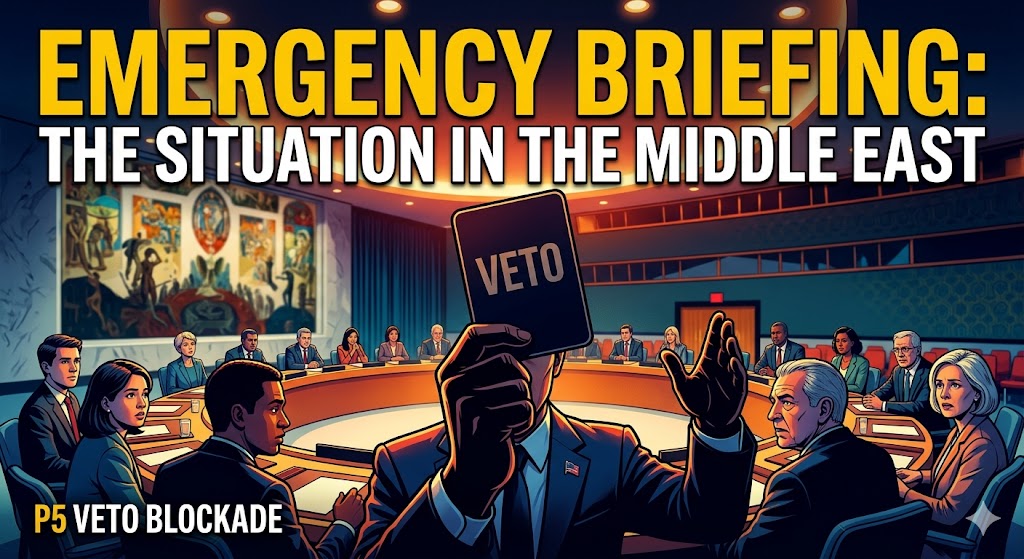
A stylized illustration depicting a generic UNSC delegate raising a 'VETO' card during an emergency briefing on "The Situation in the Middle East," capturing the central diplomatic tension within the chamber.
The Outbreak of the 2026 US-Israel-Iran War and Initial UN Security Council Response
The 2026 US-Israel-Iran war began on February 28 with coordinated US and Israeli airstrikes targeting Iranian military and nuclear facilities. Iran responded with missile and drone barrages against Israel and several Gulf states, including Qatar, Bahrain, Kuwait, the UAE, Jordan, and Saudi Arabia. Civilian infrastructure suffered significant damage, and the conflict threatened international shipping lanes.
The UN Security Council responded swiftly. An emergency meeting under the agenda item “The situation in the Middle East” featured briefings from the Secretary-General and member states. The UN Security Council heard calls for immediate de-escalation, with many ambassadors emphasizing the need for dialogue over military action. Secretary-General António Guterres urged all parties to respect international law and return to negotiations, warning of uncontrollable consequences.
In the weeks that followed, the UN Security Council became the primary venue for diplomatic maneuvering. Draft resolutions circulated, reflecting competing narratives: one side focused on Iran’s retaliatory actions as a threat to international peace, while others highlighted the initial strikes as unprovoked aggression. The adoption of Resolution 2817 marked a significant step. The UN Security Council explicitly condemned Iran’s “egregious attacks” and demanded their cessation, reaffirming rights to self-defense under Article 51 of the Charter. However, the resolution stopped short of addressing the originating strikes symmetrically, underscoring the UN Security Council’s political realities.
Throughout March and early April, the UN Security Council held regular briefings and consultations. These sessions allowed the UN Security Council to monitor developments, including Iranian threats to close the Strait of Hormuz and subsequent naval tensions. The UN Security Council’s persistent engagement kept communication channels open, even as fighting intensified.
The UN Security Council’s Critical Role in Ceasefire Negotiations and De-Escalation
By early April 2026, the UN Security Council shifted focus toward ceasefire negotiations. A fragile two-week ceasefire between the US and Iran was announced on April 8, mediated initially through Pakistani channels but supported by broader international pressure, including from the UN Security Council. The UN Security Council played an indirect but vital facilitative role by providing a neutral platform for statements and informal consultations.
The UN Security Council knows its responsibility extends beyond condemnation to active mediation support. In subsequent briefings, members emphasized extending the ceasefire and addressing root causes, such as nuclear concerns and regional security architecture. The UN Security Council has encouraged third-party involvement, including from the League of Arab States, to bridge gaps between the US, Israel, and Iran.
Specialized agencies complement these efforts. The IAEA continues monitoring nuclear sites, providing the UN Security Council with verified data essential for any long-term agreement. Humanitarian agencies deliver aid to affected populations in Iran, Lebanon, and Gulf states, reducing suffering that could otherwise prolong the conflict. Meanwhile, intelligence from US and Israeli security agencies informs UN Security Council assessments, ensuring resolutions are grounded in facts rather than rhetoric.
Negotiations remain complex. The UN Security Council has witnessed competing draft resolutions—one emphasizing freedom of navigation in the Strait of Hormuz, another calling for comprehensive de-escalation. Although some initiatives have stalled due to veto threats, the UN Security Council’s persistence has prevented total collapse of diplomatic efforts. As of mid-April 2026, the ceasefire holds tenuously, with talks resuming in various formats. The UN Security Council continues to stress that only sustained multilateral dialogue can achieve a durable stoppage of hostilities.
Challenges Facing the UN Security Council: Veto Power and Geopolitical Divisions
Despite its importance, the UN Security Council faces structural challenges. The veto power, designed to protect vital interests of the P5, has limited stronger action against all parties in the US-Israel-Iran war. Russia and China have criticized unilateral strikes and abstained from or opposed certain resolutions, arguing they fail to address underlying causes. Conversely, the US and its allies have defended actions as necessary self-defense.
These divisions mirror past impasses, such as those over Syria or Ukraine. Yet the UN Security Council has adapted by issuing presidential statements, holding arria-formula meetings, and coordinating with the General Assembly when needed. In this war, the UN Security Council’s ability to adopt Resolution 2817 despite abstentions demonstrates flexibility.
Another challenge involves integrating input from specialized agencies and national security bodies. While the UN Security Council relies on IAEA reports for technical credibility, differing intelligence assessments from US and Israeli agencies versus Iranian claims can complicate consensus. The UN Security Council navigates these by prioritizing verifiable information and inclusive dialogue.
Public pressure and media scrutiny also influence the UN Security Council. Global calls for peace amplify the UN Security Council’s sense of responsibility, pushing members to find common ground.
The UN Security Council’s Collaboration with Specialized and Security Agencies
The UN Security Council does not operate in isolation. It coordinates closely with UN specialized agencies to address multifaceted aspects of the war. The IAEA’s role in verifying Iran’s nuclear activities provides the UN Security Council with objective data, informing sanctions or confidence-building measures. Humanitarian agencies manage displacement and aid delivery, mitigating the human cost that could derail negotiations.
On the security front, the UN Security Council benefits from intelligence shared by member states’ agencies. US and Israeli security apparatus have supplied assessments on threats, enabling the UN Security Council to craft targeted responses. While these agencies remain national, their inputs enrich UN Security Council deliberations, ensuring resolutions reflect real-time threats.
This synergy exemplifies the UN Security Council’s broader ecosystem. By leveraging specialized expertise and security insights, the UN Security Council strengthens its capacity to negotiate ceasefires and enforce compliance.
Why the UN Security Council Bears Ultimate Responsibility to Stop the War
The UN Security Council knows it bears the primary responsibility to stop this war. The Charter assigns the UN Security Council exclusive authority over threats to international peace. In the 2026 US-Israel-Iran conflict, failure to act risks not only regional catastrophe but also erosion of the rules-based order.
Through emergency sessions, resolutions, and quiet diplomacy, the UN Security Council has already prevented worse outcomes. Its calls for ceasefire extensions and renewed talks demonstrate commitment. As negotiations progress, the UN Security Council remains the indispensable forum for binding agreements.
Looking Ahead: Prospects for Lasting Peace and the UN Security Council’s Enduring Role
The path forward demands continued UN Security Council leadership. Extending the current ceasefire, addressing nuclear concerns via IAEA-backed mechanisms, and establishing regional security dialogues are priorities. The UN Security Council must balance enforcement with diplomacy, using its full toolkit of resolutions and sanctions relief where appropriate.
Reform discussions—such as expanding permanent membership—may gain momentum post-conflict, but the UN Security Council’s immediate focus remains resolution of the war. With specialized agencies and security partners, the UN Security Council is well-positioned to guide stakeholders toward peace.
Conclusion: The Indispensable Guardian of International Peace
The United Nations Security Council has demonstrated once again why it is the world’s premier body for conflict resolution. In the 2026 US-Israel-Iran war, the UN Security Council has convened emergency debates, passed key resolutions like 2817, and supported ceasefire negotiations amid deep divisions. Its collaboration with specialized agencies and integration of security insights from member states amplify its impact.
As the fragile ceasefire holds and talks continue, the UN Security Council’s responsibility to stop the war remains paramount. Through persistent diplomacy, the UN Security Council not only addresses immediate violence but also lays foundations for enduring stability in the Middle East. In an era of complex threats, the UN Security Council’s role reaffirms the power of multilateralism. The international community must support the UN Security Council fully, ensuring it can fulfill its Charter mandate and prevent future conflicts from spiraling out of control.
Frequently Asked Questions
What is the primary significance of UN Security Council Role in US-Israel-Iran Ceasefire?
The Role of the United Nations Security Council in the 2026 US-Israel-Iran War: Negotiations, Ceasefires, and Global ResponsibilityThe United Nations Security Council stands as the cornerstone of international efforts to maintain peace and security. In the ongoing 2026 US-Israel-Iran war, the UN Security Council has assumed a central position, actively engaging in emergency sessions, facilitating negotiations, and pushing for ceasefires.
How does this development impact International Affairs?
This conflict, which erupted on February 28, 2026, with US and Israeli strikes on Iran followed by Iranian retaliatory actions across the region, has tested the limits of global diplomacy. The UN Security Council recognizes its unique responsibility under the UN Charter to prevent escalation, protect civilians, and broker lasting solutions.
What are the key future projections to monitor?
As tensions involving the US, Israel, and Iran continue to ripple through the Middle East, affecting the Strait of Hormuz and Gulf states, the UN Security Council’s involvement underscores why multilateral institutions remain indispensable.This article examines the structure and powers of the UN Security Council, its historical precedents in similar crises, and its specific contributions to de-escalation in the current war.