Women's Reservation Bill 2026 Rejected in Lok Sabha
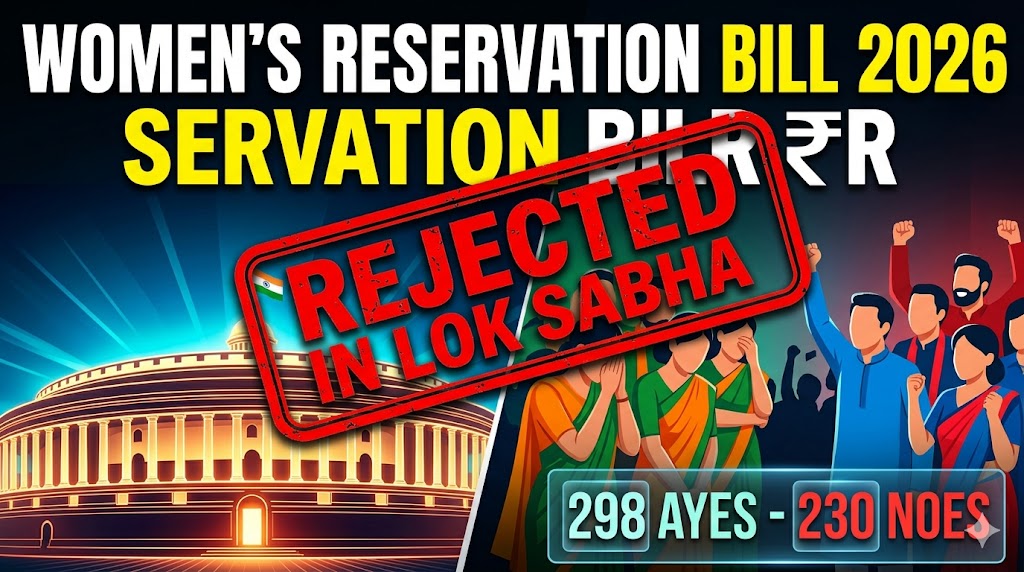
The rejection of the Women's Reservation Bill 2026 in the Lok Sabha on April 17 has sent shockwaves through Indian politics. In a rare parliamentary moment, a constitutional amendment aimed at fast-tracking 33% reservation for women in legislatures fell short of the mandatory two-thirds majority. This development comes nearly three years after the original Nari Shakti Vandan Adhiniyam was passed in 2023, raising fresh questions about the future of gender representation in India's highest decision-making bodies.
What made this vote particularly significant is that it marked one of the first instances in over two decades where a major constitutional amendment bill introduced by the government failed to clear the Lok Sabha due to insufficient support. The bill, formally the Constitution (131st Amendment) Bill, 2026, was part of a broader legislative package that included the Delimitation Bill and amendments to Union Territory laws. Its defeat highlights deep divisions between the ruling NDA and the opposition INDIA bloc on issues that go beyond women's empowerment.
Background: From 2023 Passage to the 2026 Amendment Push
The journey of the women's reservation bill in India has been long and arduous. For nearly three decades, successive governments attempted to secure one-third reservation for women in Parliament and state assemblies. The breakthrough finally came in September 2023 when the Constitution (106th Amendment) Act—popularly known as the Nari Shakti Vandan Adhiniyam—was passed with near-unanimous support in both houses of Parliament.
The 2023 law mandated 33% reservation for women in the Lok Sabha and state legislative assemblies, including sub-quotas for Scheduled Castes and Scheduled Tribes. However, its implementation was explicitly linked to the completion of a fresh census and subsequent delimitation exercise. This meant the quota could not take effect before the next delimitation, originally expected after the 2026 Census, potentially delaying actual reservation until the 2029 or even 2034 elections.
In early April 2026, the government convened a special three-day parliamentary session from April 16 to 18 to operationalize the 2023 Act. The Union Cabinet had cleared the draft of the Constitution (131st Amendment) Bill, 2026, along with supporting legislation. The key objectives were clear: expedite delimitation using the latest available census data, increase the strength of the Lok Sabha from 543 to approximately 850 seats, and ensure that 33% women's reservation could be implemented from the 2029 general elections.
Home Minister Amit Shah and other senior BJP leaders emphasized that the amendment package would translate the promise of women's empowerment into reality without further delay. Prime Minister Narendra Modi personally urged MPs to support the bill, describing it as a historic opportunity to strengthen democracy through greater female participation.
The Dramatic Vote: How the Women's Reservation Bill 2026 Was Defeated
On April 17, 2026, after two days of intense debate, the Lok Sabha proceeded to a division vote on the Constitution (131st Amendment) Bill, 2026. The results were telling: 298 members voted in favor (ayes), while 230 voted against (noes), with zero abstentions. A total of 528 MPs were present and voting.
For a constitutional amendment to pass, it requires not just a simple majority but a two-thirds majority of the members present and voting—approximately 352 votes in this case. The bill fell short by a significant margin of around 54 votes. This outcome effectively defeated the government's attempt to fast-track the women's reservation framework.
Parliamentary records show this was a rare defeat. Constitutional amendment bills introduced by the ruling side have typically sailed through with comfortable margins in recent years. The rejection of the women's reservation bill 2026 amendment thus stands out as a notable parliamentary event, underscoring the strength of the united opposition's strategy.
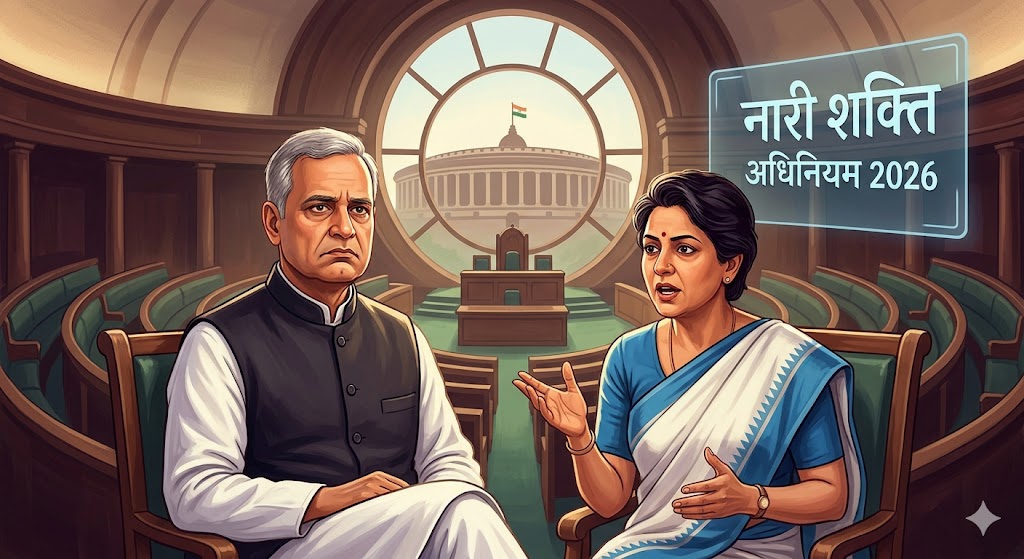
Government leadership (male figure) and Opposition leadership (female figure) engaged in dialogue in the foreground of the Lok Sabha, with Parliament visible in the background, summarizing the intensely debated Nari Shakti Adhiniyam 2026 amendment.
Why the Opposition Rejected the Bill: Vipakshi Dal's Strong Stand
The opposition parties, collectively referred to as the vipakshi dal, mounted a united front against the bill. Their primary objection was not to the principle of women's reservation itself but to the way the government had bundled it with contentious delimitation provisions.
Congress leader Priyanka Gandhi Vadra stated clearly during the debate that the bill was “not about women's reservation but democracy.” She argued that the opposition could never agree to linking the women's quota with delimitation, which many southern and opposition-ruled states fear would disproportionately benefit northern states with higher population growth. Several opposition leaders echoed the view that the bill was not genuinely related to women empowerment but served as a political tool to reshape electoral boundaries ahead of 2029.
The INDIA bloc maintained that they fully support the 2023 Women's Reservation Act. However, they accused the government of using the special session to push a broader agenda that could alter the federal balance of power in Parliament. Critics within the opposition highlighted a “trust deficit” and warned that proceeding without a new census based on current demographics would be unfair to states that have successfully controlled population growth.
This position resonated strongly during the debate, leading to the decisive “no” votes that sealed the bill's fate. The opposition celebrated the outcome as a victory for democratic checks and balances, insisting that women's empowerment should not come at the cost of regional equity.
BJP's Response and Amit Shah's Comments on the Women's Reservation Bill 2026
The BJP and its allies reacted sharply to the defeat. Senior leaders, including women MPs from the party, staged a protest outside Parliament, expressing disappointment over what they termed a “betrayal of 65 crore women of the country.”
Amit Shah, in his interventions during the session, was unequivocal. He asserted that no one had opposed the constitutional amendment for women's reservation in principle, yet the opposition had clearly voted against it by rejecting the enabling framework. Shah argued that the government's intent was solely to ensure the 2029 elections could be held with women's reservation in place. He reminded the House that the original bill had been pending for decades and that the Modi government had finally delivered on it in 2023.
The Home Minister further contended that the opposition's resistance exposed their true priorities. While claiming to champion women empowerment, their actions, according to Shah, demonstrated reluctance when concrete steps were proposed. BJP spokespersons reinforced this narrative, stating that the rejection was not just a parliamentary setback but a missed opportunity for genuine gender justice.
Prime Minister Modi had earlier appealed to all parties to rise above partisan considerations and support the bill, calling it essential for building a Viksit Bharat where women play a central role in nation-building.
Current Issues Surrounding the Women Reservation Bill in Lok Sabha
The defeat has left several pressing issues unresolved. The original 2023 Nari Shakti Vandan Adhiniyam remains on the statute books but continues to be ineffective without the necessary census and delimitation. Experts now predict that implementation may slip further, possibly to the 2034 elections or later, depending on when the next census is completed and delimitation finalized.
Key challenges include:
Timeline Uncertainty: Without the 2026 amendment, the reservation cannot be activated in time for 2029 polls.
Federal Tensions: The delimitation debate has intensified north-south divides, with southern states apprehensive about losing relative representation.
Women's Representation Gap: India currently lags behind many democracies in female parliamentary participation. The rejection delays the structural change needed to bridge this gap.
Political Polarization: The vote has deepened the rift between the NDA and opposition, making future consensus on electoral reforms more difficult.
In the immediate aftermath, both sides are engaged in blame games. The government is exploring alternative routes to honor its commitment, while the opposition is urging the Centre to delink women's reservation from delimitation entirely.
Impact of the Rejection on Women's Empowerment
The rejection of the women's reservation bill 2026 has understandably disappointed advocates of gender equality. Many women leaders and organizations had hoped the amendment would deliver tangible progress by the next general elections. The delay means that the transformative potential of one-third reservation—rotational seats, sub-quotas for SC/ST women, and a 15-year safeguard period—remains on hold.
However, supporters of the opposition's position argue that a rushed or flawed implementation could create more problems than it solves. They emphasize that true women empowerment requires not just numbers in Parliament but also an environment free from regional imbalances that could affect governance quality.
The episode also revives important questions: Can women's reservation be decoupled from delimitation? Should a fresh census be prioritized before any seat readjustment? And how can political parties bridge the trust gap to deliver on a commitment that enjoyed cross-party support in 2023?
Despite the setback, the 2023 Act's existence provides a foundation. Over 1.4 million women have already gained experience as elected representatives in panchayats, proving that reservation works when implemented effectively. The current debate, while contentious, keeps the focus on the larger goal of inclusive democracy.
What Lies Ahead: Possible Steps and Broader Comments
As the dust settles on the April 17 vote, attention turns to the next steps. The government may choose to reintroduce a modified version of the amendment after further consultations or proceed with the original 2023 timeline. Legal experts suggest that the existing law cannot be bypassed without another constitutional route.
Opposition leaders have reiterated their willingness to support a clean women's reservation bill unlinked from delimitation. BJP leaders, meanwhile, have vowed to continue the fight for women's political empowerment, promising that the aspirations of half the population will not be sidelined.
The rejection also serves as a reminder of the complexities of Indian federalism. Any future legislation will likely need to balance the twin imperatives of gender justice and equitable regional representation.
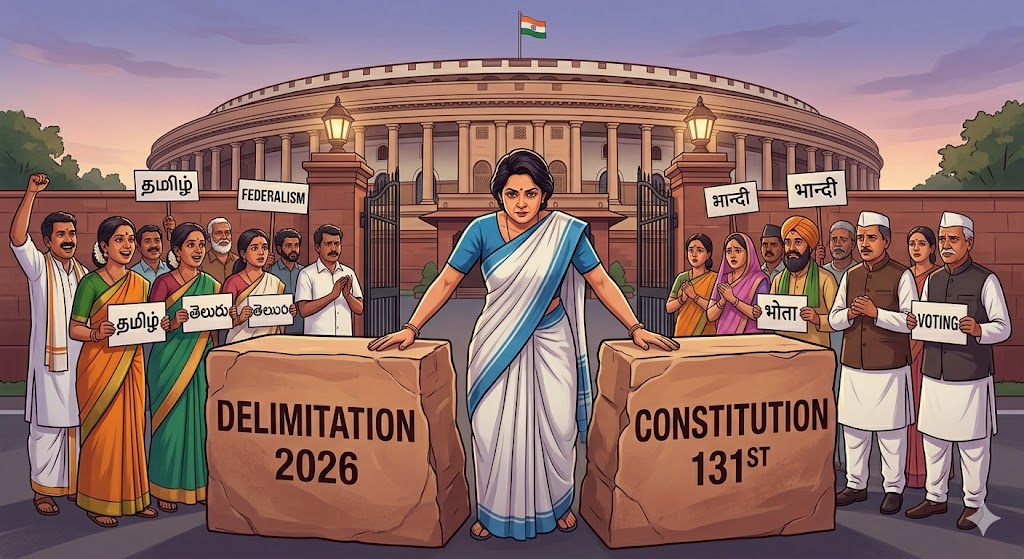
Conceptual figure of 'Nari Shakti' (Woman Power) pushing apart 'DELIMITATION 2026' and 'CONSTITUTION 131ST' blocks, summarizing how federal concerns and regional differences ultimately blocked the 2026 fast-track amendment.
Conclusion: A Defining Moment for Indian Democracy
The defeat of the Women's Reservation Bill 2026 in the Lok Sabha is more than a procedural failure—it reflects the intricate interplay of gender politics, regional aspirations, and parliamentary strategy in contemporary India. While the bill fell short of the two-thirds threshold, the intense debate it generated has placed women's representation firmly back on the national agenda.
As the country prepares for future electoral cycles, the core question remains: How can India translate the near-universal consensus on women's reservation into effective, time-bound action? The answer will require statesmanship from all sides, moving beyond partisan rhetoric to deliver meaningful empowerment for women in Parliament and beyond.
The 2023 law stands as a beacon of intent. Its eventual implementation—whenever it occurs—will mark a historic milestone. Until then, the rejection of the 2026 amendment serves as both a challenge and an opportunity for renewed dialogue on building a more inclusive democracy.