"Black Hole Theory: From Basics to Universe Inside"
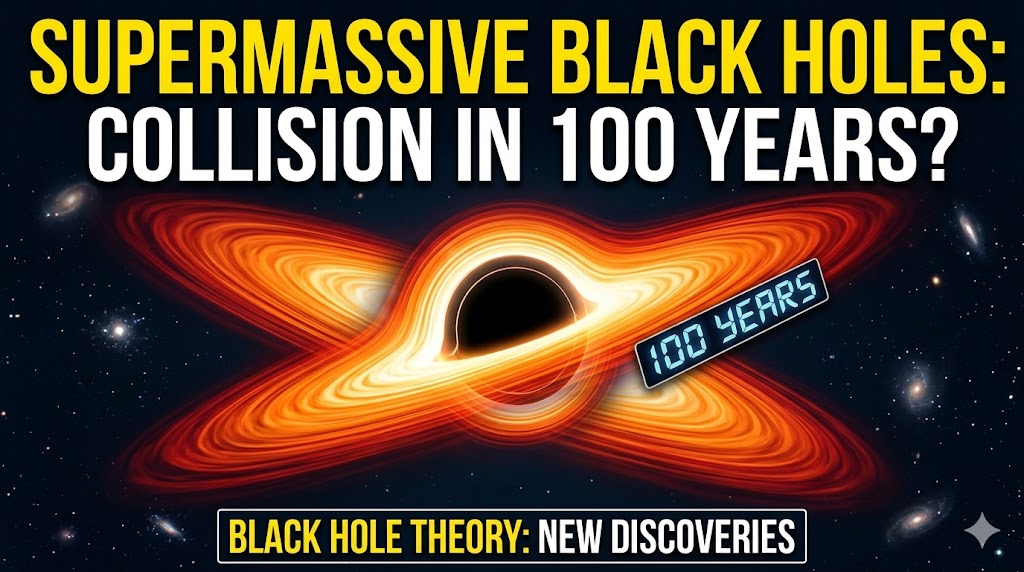
Black hole theory stands as one of the most profound pillars of modern astrophysics, blending Albert Einstein’s general relativity with quantum mechanics to explain some of the universe’s most extreme phenomena. These enigmatic objects, where gravity becomes so intense that not even light can escape, challenge our understanding of space, time, and reality itself. From the basic question—what is a black hole?—to speculative ideas like the universe inside black hole theory, scientists continue to probe these cosmic giants.
Recent advancements, including the iconic black hole photo captured by the Event Horizon Telescope and groundbreaking observations in 2026, have brought black hole theory into sharper focus. Yet the field remains dynamic, with hypotheses linking black holes to the Big Bang, white hole theory, and even the possibility that our entire cosmos resides within one. This article explores black hole theory comprehensively for educational purposes, drawing on verified scientific sources. We will examine formation processes, types, physics, paradoxes, and culminate in a startling 2026 discovery: two supermassive black holes that could collide in as little as 100 years, sending detectable ripples across the universe.
Understanding black hole theory is not merely academic—it reshapes how we view our place in the cosmos. As physicist Brian Cox often emphasizes in his explanations, black holes force us to confront the limits of known physics.
At its core, a black hole is a region of spacetime where gravity is so overwhelming that nothing—not particles, electromagnetic radiation, or even light—can escape once it crosses the event horizon. The term “black hole” was popularized by physicist John Wheeler in 1967, though the concept dates back to 18th-century ideas of “dark stars” whose escape velocity exceeded the speed of light.
Black hole means, in simple terms, a gravitational trap born from extreme density. The Schwarzschild radius defines the event horizon for a non-rotating black hole: for Earth’s mass, it would be about the size of a marble; for the Sun, roughly 3 kilometers. Beyond this boundary lies the singularity, a point of infinite density where current physics breaks down.
Black hole facts highlight their invisibility in visible light, yet they reveal themselves through effects on surrounding matter—accretion disks, relativistic jets, and gravitational lensing. The famous black hole photo of M87 in 2019, followed by Sagittarius A in 2022 and ongoing EHT updates through 2026, provided the first direct visual evidence, showing the glowing ring of hot gas around the shadow of the event horizon.
How Black Holes Form
Black holes form through several pathways, each tied to stellar evolution or cosmic conditions. The most common mechanism involves stellar black holes. When a massive star (typically 8–20 times the Sun’s mass or more) exhausts its nuclear fuel, its core collapses under gravity. If the remnant exceeds the Tolman–Oppenheimer–Volkoff limit (about 2–3 solar masses), it crumples into a black hole rather than forming a neutron star.
This process, known as core-collapse supernova, releases immense energy while the outer layers explode outward. Black hole churns, or the violent dynamics during collapse, involve rapid rotation and magnetic fields that can launch powerful jets observable as gamma-ray bursts.
Supermassive black holes, containing millions to billions of solar masses, likely formed in the early universe through direct collapse of massive gas clouds or rapid mergers of smaller black holes. Primordial black holes represent another theoretical class, possibly forming in the extreme densities of the Big Bang itself, as first proposed by Stephen Hawking.
Massive black hole growth occurs via accretion—devouring gas, dust, and stars—and mergers. Recent simulations and observations confirm that black holes “churn” spacetime, warping it dramatically.
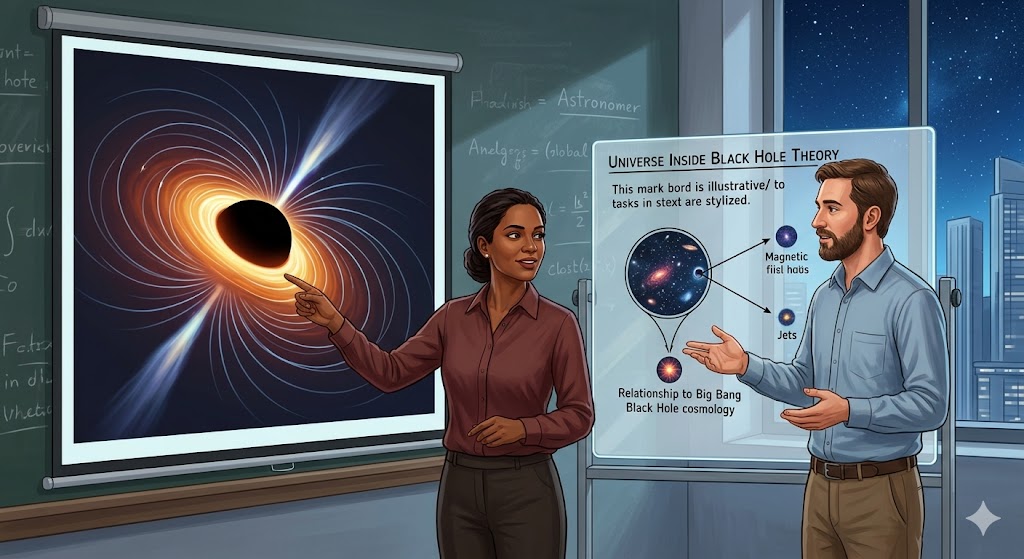
Researchers present advanced black hole physics, comparing direct polarized imaging of magnetic jets with theoretical models of black hole cosmology (the universe inside a black hole).
Types of Black Holes
Black hole classification depends on mass and origin:
Stellar black holes: 3–100 solar masses, formed from individual stars. They are the most common detectable via X-ray binaries.
Supermassive black holes: Millions to billions of solar masses, residing at galactic centers. The Milky Way’s Sagittarius A is one example.
Primordial black holes: Hypothetical, ranging from microscopic to stellar masses, potentially comprising dark matter. James Webb Space Telescope (JWST) data from 2025 has spotlighted candidates in the early universe, including “naked” black holes lacking surrounding galaxies.
Intermediate-mass black holes: A rarer bridge category, now confirmed in some star clusters.
Each type influences black hole physics differently, from quantum effects in tiny ones to galaxy-shaping roles in massive ones.
Black Hole Physics and Gravity
Black hole gravity exemplifies general relativity. Einstein’s equations predict the curvature of spacetime around mass, and Karl Schwarzschild’s 1916 solution described the simplest black hole. Near the event horizon, time dilation becomes extreme: clocks appear to stop for distant observers.
Rotating (Kerr) black holes feature an ergosphere where objects can extract energy via the Penrose process. Charged (Reissner–Nordström) variants add electromagnetic complexity. Hawking radiation, a quantum effect, suggests black holes emit thermal radiation and slowly evaporate, linking gravity to quantum field theory.
Black hole physics also drives phenomena like black hole sun-like metaphors in popular culture, though scientifically it underscores their role in cosmic evolution.
Inside a Black Hole and the Information Paradox
What happens inside a black hole? For an infalling observer, crossing the event horizon feels unremarkable initially, but tidal forces—spaghettification—stretch and shred matter near the singularity. From the outside, nothing ever crosses; time freezes at the horizon.
The black hole paradox, or information paradox, arises here. Hawking radiation appears thermal and random, seemingly destroying information about infallen matter, violating quantum unitarity. Resolutions involve holography (information encoded on the horizon) or firewall proposals. Recent 2025 gravitational-wave detections from black hole collisions have strengthened tests of these ideas, confirming Hawking’s area theorem.
Brian Cox, in various lectures, describes this as a profound clash between relativity and quantum mechanics, often highlighting how black holes may hold keys to a unified theory.
White Hole Theory and Connections to the Big Bang
White hole theory proposes the time-reversed counterpart of black holes: regions from which matter and light emerge but cannot enter. Mathematically allowed in general relativity, white holes feature a past singularity and outward event horizon.
Some models link white holes to the Big Bang, suggesting our universe’s origin resembles a white hole explosion. Recent 2025 research explores black holes transitioning into white holes via quantum gravity, potentially ejecting matter and even “time” derived from dark energy. This big bang black hole connection offers an alternative to singular origins, with our cosmos as the interior of a parent black hole.
Is the Universe a Black Hole? The Universe Inside Black Hole Theory
One of the most intriguing extensions of black hole theory asks: is the universe a black hole? Or more precisely, could our observable universe lie inside one?
Black hole cosmology, or Schwarzschild cosmology, posits that the Big Bang was the interior view of a black hole in a larger “parent” universe. In 2025, JWST data analyzed by Lior Shamir revealed an unexpected asymmetry in galaxy rotations—two-thirds clockwise, one-third counterclockwise—suggesting the universe was born rotating. This aligns with formation inside a rotating black hole, where the parent’s spin imprints on daughter universes.
Theoretical physicist Nikodem Poplawski notes that such a scenario naturally explains the observed asymmetry and positions our universe as potentially one of many within a multiverse of black hole interiors. While not proven, this universe inside black hole theory elegantly ties quantum fluctuations, inflation, and cosmic expansion without invoking singularities as true endpoints.
Recent Discoveries: Black Hole Photos and Beyond
The Event Horizon Telescope’s black hole photo revolutionized the field, imaging M87’s shadow in 2019 and Sagittarius A in 2022. By 2026, EHT releases include polarized light maps of jets and magnetic fields, revealing how black holes launch relativistic outflows spanning thousands of light-years.
These visuals confirm theoretical predictions and fuel public interest through black hole videos and documentaries featuring experts like Brian Cox.
The Looming Supermassive Black Hole Collision: A 100-Year Cosmic Event
Black hole theory reaches a dramatic crescendo with mergers. Stellar-mass collisions have been detected by LIGO/Virgo since 2015, but supermassive ones were elusive—until April 2026.
An international team led by Silke Britzen at the Max Planck Institute for Radio Astronomy announced the first close pair of supermassive black holes in the galaxy Markarian 501, about 500 million light-years away. Using over two decades of radio observations from the Very Long Baseline Array, researchers detected two distinct jets: one known, and a hidden second jet orbiting counterclockwise with a 121-day period.
The black holes, each 100 million to a billion solar masses, are separated by just 250–540 astronomical units and spiraling inward rapidly. Depending on precise masses, they could merge in as little as 100 years. Upon collision, they will emit powerful low-frequency gravitational waves detectable by pulsar timing arrays, offering a rare real-time view of galaxy evolution and black hole growth.
Britzen described the discovery as “awesome,” noting the orbital motion sways the entire jet system. Co-author Héctor Olivares added that rising wave frequencies could allow us to “watch a supermassive black hole merger unfold.” This event underscores black hole theory’s predictive power and connects directly to cosmic structure formation.
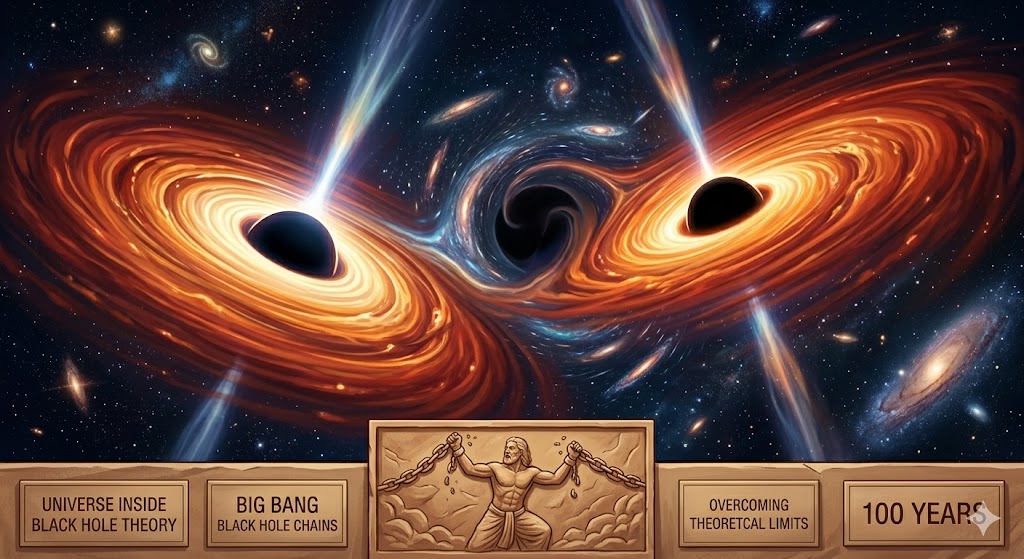
A dramatic panoramic rendering of two supermassive black holes in the Markarian 501 system just before their 100-year collision. The interaction of the massive accretion disks creates extreme gravitational warpedness.
Conclusion
Black hole theory illuminates the universe’s darkest secrets while revealing its interconnected beauty. From primordial seeds and stellar collapses to the possibility that our cosmos is itself a black hole interior, these objects bridge the smallest quantum scales and largest cosmic structures. The white hole theory, information paradox resolutions, and stunning black hole photos continue to inspire.
As we anticipate the Markarian 501 merger within the next century, black hole theory reminds us that the universe is dynamic and full of surprises. Ongoing research, including JWST insights and gravitational-wave astronomy, promises further revelations. For students, educators, and enthusiasts, these concepts foster deeper curiosity about the cosmos we inhabit.