"Samrat Choudhary: Bihar's New Chief Minister 2026"
Politics• April 14, 2026• Global Edition
In a historic shift in Bihar's political landscape, Samrat Choudhary has emerged as the new Chief Minister of Bihar. On April 15, 2026, he took oath as the state's 24th Chief Minister, becoming the first leader from the Bharatiya Janata Party (BJP) to hold the top post. This transition follows the resignation of veteran leader Nitish Kumar, who had dominated Bihar politics for over two decades. The appointment of Samrat Choudhary as Bihar Chief Minister marks not just a change in leadership but a new chapter for the National Democratic Alliance (NDA) government in the state.
As Bihar Chief Minister Samrat Choudhary steps into the role, expectations are high. With his experience as Deputy Chief Minister, extensive administrative background, and deep roots in OBC politics, he brings a blend of continuity and fresh energy. The new government will also feature two Deputy Chief Ministers from the Janata Dal (United) or JD(U), reinforcing the alliance's strength and ensuring balanced representation. This move underscores the collaborative spirit within the NDA even as the BJP assumes the chief ministerial position for the first time in Bihar.
This article delves into the life and career of Samrat Choudhary, the legacy of his predecessor Nitish Kumar, the circumstances of this leadership change, and what the future might hold under the intelligent and pragmatic stewardship of Bihar Chief Minister Samrat Choudhary. From development initiatives to addressing long-standing challenges, his tenure promises focused governance aimed at making Bihar a model state.
Nitish Kumar's resignation on April 14, 2026, after serving as Chief Minister in multiple stints since 2005, brought an end to an era often described as one of "Sushasan" or good governance. Having recently taken oath as a Rajya Sabha member, Kumar chose to step down, paving the way for a smooth transition within the NDA. His decision, though anticipated in political circles, surprised many given his long-standing dominance in Bihar politics.
Under Nitish Kumar, Bihar witnessed significant transformation. Once notorious for lawlessness and underdevelopment in the early 2000s, the state saw improvements in infrastructure, education, and rural livelihoods. Key achievements included the appointment of over 100,000 school teachers, widespread village electrification, and the construction of all-weather roads. Programs like Jeevika empowered rural women through self-help groups, while the bicycle scheme boosted girls' education. The total prohibition on alcohol, though controversial, was hailed by many as a bold social reform.
Yet, Nitish Kumar's tenure was not without challenges. Frequent alliance shifts—earning him the nickname "Paltu Ram" in some quarters—created perceptions of political instability. Protests erupted over issues like the caste-based survey, remarks on population control, and law and order concerns during certain periods. Economic growth, while steady, faced hurdles from debt burdens and unemployment. Critics pointed to occasional lapses in governance, including delays in scheme implementation and debates over corruption allegations.
The leadership change to Samrat Choudhary as Bihar CM reflects the evolving dynamics within the NDA. Kumar himself is believed to have endorsed Choudhary, signaling continuity in governance philosophy while allowing the BJP greater prominence. This transition ensures the "caravan of development" moves forward without disruption, as Choudhary himself noted in his first remarks.
Who is Samrat Choudhary?
Samrat Choudhary, born on November 16, 1968, in Lakhanpur village of Munger district, hails from a politically influential family. Also known by his alias Rakesh Kumar, he belongs to the Koeri (Kushwaha) community, a significant OBC group in Bihar. His father, Shakuni Choudhary, was a veteran politician who served as a multiple-term MLA and MP. His mother, Parvati Devi, was an MLA from Tarapur. This familial legacy provided young Samrat with early exposure to grassroots politics.
Educated up to the doctorate level, Choudhary pursued higher studies at Madurai Kamaraj University. He is married to Mamta Kumari, and the couple has one son and one daughter. Grounded in traditional values yet driven by modern aspirations, Samrat Choudhary represents a new generation of Bihar leaders who combine organizational skills with administrative acumen.
His early life in rural Bihar instilled in him a deep understanding of the challenges faced by farmers, youth, and backward communities. These experiences shaped his commitment to inclusive development, a theme that has defined his political career.
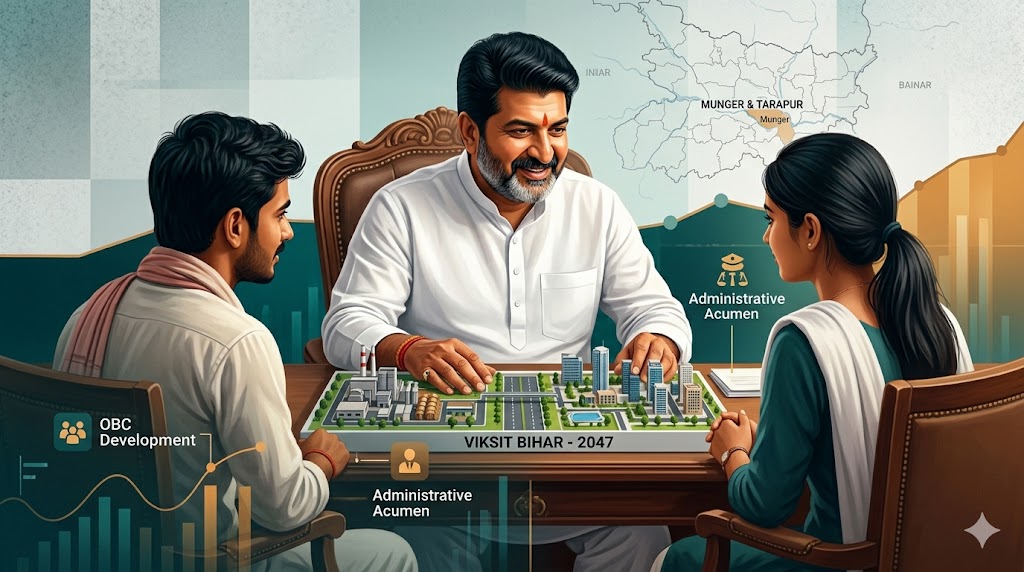
A conceptual mixed-media portrait focusing on Samrat Choudhary's political identity. Seated at an elegant desk, he is shown explaining a 'Viksit Bihar - 2047' industrial model to a young farmer and student. Integrated background collages subtly weave in maps of Munger and Tarapur with stylized data streams for 'OBC Development' and 'Administrative Acumen,' reflecting the key points of his journey.
Samrat Choudhary's Political Journey: From RJD Roots to BJP Leadership
Samrat Choudhary's political odyssey spans over three decades and reflects the fluidity of Bihar politics. He began in the late 1990s with the Rashtriya Janata Dal (RJD), serving as AYgriculture Minister in the Rabri Devi government in 1999. He won Assembly elections from Parbatta in 2000 and 2010, establishing himself as a capable legislator and even serving as Chief Whip of the opposition.
In 2014, he joined JD(U) and held portfolios like Urban Development and Housing under Jitan Ram Manjhi. A strategic shift to the BJP in 2017 accelerated his rise. He served as vice-president of Bihar BJP, became Leader of Opposition in the Legislative Council, and was appointed state president in 2023. As a star campaigner, he played a pivotal role in strengthening the party's base among OBCs.
Choudhary's tenure as BJP state president saw him lead protests on issues like job creation and teacher recruitment. His symbolic "turban vow" to dethrone Nitish Kumar until the alliance realigned highlighted his aggressive yet disciplined style. By January 2024, following Nitish Kumar's return to the NDA, Samrat Choudhary was sworn in as Deputy Chief Minister alongside Vijay Kumar Sinha. He handled critical portfolios including Finance, Home, Urban Development, and more.
Elected as MLA from Tarapur in the 2025 Assembly polls, he continued to deliver on governance. His unanimous election as BJP Legislature Party leader on April 14, 2026, and subsequent selection as Chief Minister underscore the trust reposed in him by the NDA.
Contributions as Deputy Chief Minister: Laying the Groundwork
As Deputy Chief Minister from 2024 to 2026, Samrat Choudhary proved his mettle. Presenting Bihar's largest-ever budget of ₹2.79 lakh crore, he announced a 10.64% growth rate and claimed 2.5 crore people had risen above the poverty line. He created over 30,000 government posts and prioritized projects like the Patna Metro.
In the Home portfolio, he launched aggressive anti-crime measures: bulldozer actions against mafias, fast-track courts, anti-paper leak squads, and the 'Abhay Brigade' for women's safety. Initiatives like junta darbars at police stations and reduced emergency response times demonstrated his focus on citizen-centric governance.
These achievements position Bihar Chief Minister Samrat Choudhary as a leader ready to build on proven successes while introducing innovative reforms.
Nitish Kumar's Legacy: Development Amid Protests and Challenges
Nitish Kumar's two-decade rule transformed Bihar from a "BIMARU" state into one with improved human development indicators. Infrastructure boomed with roads, power, and health centers. Social schemes empowered women and EBCs, and the caste survey aimed at equitable resource distribution.
However, protests highlighted friction points—be it over prohibition enforcement, alliance flips, or statements perceived as divisive. Economic challenges like migration and unemployment persisted despite progress. Kumar's legacy is one of resilience and reform, yet it also left room for a successor like Samrat Choudhary to accelerate momentum toward "Viksit Bihar."
Samrat Choudhary as Bihar Chief Minister: The Current Political Scenario and Two Deputy CMs
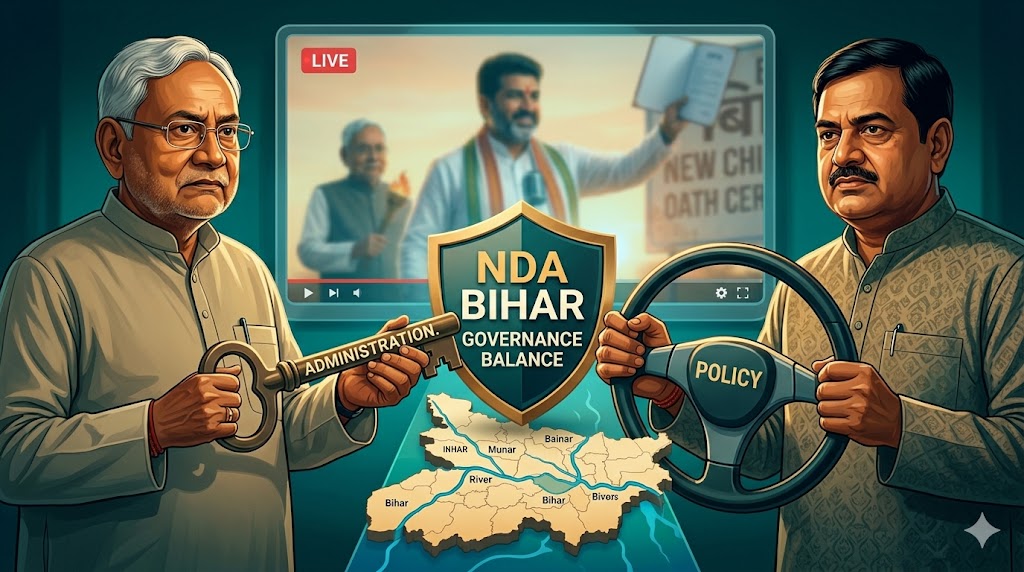
The current politics scenario in Bihar reflects stability under the NDA umbrella. With BJP as the single largest party, Samrat Choudhary's elevation ensures strong central backing under Prime Minister Narendra Modi's vision. The inclusion of two Deputy Chief Ministers from JD(U)—experienced leaders Bijendra Prasad Yadav and Vijay Kumar Choudhary—maintains alliance equilibrium and leverages JD(U)'s organizational strength.
This arrangement addresses caste and regional balances, with Choudhary's Koeri base complementing JD(U)'s wider outreach. As Bihar Chief Minister Samrat Choudhary leads, the focus remains on governance over politics, with early signals emphasizing integrity and people-centric service.
Vision for the Future: How an Intelligent Samrat Choudhary Can Deliver Better for Bihar
Looking ahead, Bihar Chief Minister Samrat Choudhary is poised to build a brighter future. His "intelligent" approach—rooted in data-driven decisions, as seen in budget presentations and crime-tracking systems—could accelerate development. Priorities may include:
Economic Growth and Jobs: Expanding industrial corridors, skill development, and agro-processing to curb migration.
Infrastructure Push: Fast-tracking metro projects, highways, and rural connectivity in line with Viksit Bharat goals.
Law and Order: Strengthening police reforms and anti-mafia drives for investor confidence.
Social Welfare: Enhancing education, health, and women empowerment schemes while addressing OBC aspirations.
Sustainable Development: Focusing on agriculture modernization, renewable energy, and disaster resilience.
With NDA support and his administrative experience, Samrat Choudhary can potentially outperform past benchmarks by reducing bureaucratic hurdles and fostering public-private partnerships. His emphasis on unity and growth, as stated in initial remarks, suggests a pragmatic roadmap that learns from Nitish Kumar's successes while correcting gaps.
Challenges remain—fiscal discipline, opposition criticism, and equitable growth across regions. Yet, under his leadership, Bihar could witness accelerated progress toward becoming a developed state by 2047.
The Two Deputy CMs and Alliance Strength
Conclusion
The appointment of Samrat Choudhary as Bihar Chief Minister heralds a new dawn. From his humble beginnings in Munger to the helm of the state, his journey embodies determination and adaptability. As he assumes office alongside two JD(U) Deputy Chief Ministers, the focus shifts to delivery and development.
Bihar stands at a crossroads. With Samrat Choudhary at the helm, the state has an opportunity to harness its demographic dividend and rich resources more effectively. His vision, backed by experience and alliance unity, promises a future where good governance translates into tangible prosperity for every citizen.
As developments unfold, all eyes remain on Bihar Chief Minister Samrat Choudhary. His success will not only define the NDA's future in the state but also set a benchmark for transformative leadership in eastern India.
Frequently Asked Questions
What is the primary significance of "Samrat Choudhary: Bihar's New Chief Minister 2026"?
In a historic shift in Bihar's political landscape, Samrat Choudhary has emerged as the new Chief Minister of Bihar. On April 15, 2026, he took oath as the state's 24th Chief Minister, becoming the first leader from the Bharatiya Janata Party (BJP) to hold the top post.
How does this development impact Politics?
This transition follows the resignation of veteran leader Nitish Kumar, who had dominated Bihar politics for over two decades. The appointment of Samrat Choudhary as Bihar Chief Minister marks not just a change in leadership but a new chapter for the National Democratic Alliance (NDA) government in the state.As Bihar Chief Minister Samrat Choudhary steps into the role, expectations are high.
What are the key future projections to monitor?
With his experience as Deputy Chief Minister, extensive administrative background, and deep roots in OBC politics, he brings a blend of continuity and fresh energy.