As voters across Assam, Kerala, and Puducherry head to the polling booths today, April 9, 2026, the political landscape of India stands at a critical juncture. These three assembly elections, though geographically and demographically diverse, carry national significance. With results slated for May 4, the outcomes will not only decide the fate of state governments but also signal broader trends for the Bharatiya Janata Party (BJP) and its rivals ahead of future national battles.
The single-phase polling in all three regions marks the end of an intense campaign period that saw high-profile rallies, alliance realignments, and fierce ideological debates. In Assam, the BJP-led NDA seeks a historic third consecutive term. Kerala witnesses a razor-sharp contest between the ruling Left Democratic Front (LDF) and the opposition United Democratic Front (UDF), with the BJP eyeing a long-awaited breakthrough. Puducherry, the smallest of the lot with just 30 seats, has turned into a triangular fight involving the incumbent NDA, the Congress-DMK alliance, and actor Vijay’s debutant Tamilaga Vettri Kazhagam (TVK).
This article offers a comprehensive, data-driven analysis of the possibilities, drawing on recent opinion polls, ground realities, and campaign dynamics as they stand on this pivotal polling day. We examine each state’s political backdrop, key issues, varying campaign styles, and realistic predictions for the winning parties—paying special attention to the BJP’s prospects and the unique possibilities unfolding in Kerala.
Election Schedule at a Glance
The Election Commission of India announced the schedule in mid-March 2026, setting a tight timeline for all three polls:
Polling Date: April 9, 2026 (single phase across 126 seats in Assam, 140 in Kerala, and 30 in Puducherry)
Counting of Votes: May 4, 2026
Voter Base: Over 2.49 crore in Assam, approximately 2.71 crore in Kerala, and 9.44 lakh in Puducherry
Campaigning concluded on April 8 amid a charged atmosphere. Today, as silence prevails and voters exercise their franchise, the focus shifts to turnout, last-minute swings, and the effectiveness of door-to-door outreach that defined the final stretch.
Assam Assembly Elections 2026: BJP Poised for Hat-Trick
Assam’s 126-member Legislative Assembly has been under BJP-led NDA control since 2016, with Chief Minister Himanta Biswa Sarma steering the state through a second term since 2021. The alliance, comprising the BJP, Asom Gana Parishad (AGP), and United People’s Party Liberal (UPPL), enters the fray with a strong governance record centered on peace, infrastructure, and welfare.
Key Issues and Ground Realities
Voters are weighing development initiatives—such as improved road connectivity in the Brahmaputra valley, tea industry reforms, and flood mitigation—against lingering concerns like illegal immigration, ethnic tensions in the Bodoland region, and economic disparities in rural pockets. The NDA has effectively projected stability after decades of Congress-led instability, a narrative reinforced by Prime Minister Narendra Modi and Union Home Minister Amit Shah during their rallies.
Opinion polls released in the final week paint a consistent picture. Surveys by C-Voter, Matrize, and Vote Vibe project the BJP-led NDA securing 87 to 102 seats, with vote shares hovering around 46-48%. The Congress-led opposition, including regional players, is expected to manage 22-35 seats at best. This suggests a comfortable majority for the incumbents, potentially larger than in 2021.
Campaign Variations in Assam
The NDA’s campaign stood out for its disciplined, development-focused messaging. Star campaigners emphasized “double-engine” governance, leveraging central schemes like PM Awas Yojana and Ayushman Bharat. Regional allies handled local ethnic dynamics skillfully, preventing fragmentation.
In contrast, the Congress, under Gaurav Gogoi, attempted to consolidate anti-incumbency but struggled with internal fissures and the entry of smaller outfits like Raijor Dal. Campaigns here varied sharply: urban areas saw heavy digital outreach, while rural and tribal belts witnessed traditional booth-level mobilization. As of today, April 9, heavy Central Armed Police Forces deployment ensures smooth voting, reflecting the high stakes in sensitive constituencies like Dispur, Jalukbari, and Sivasagar.
Winning Possibilities
Most analysts concur that a BJP-led NDA government under Himanta Biswa Sarma is the most probable outcome. The party’s organizational machinery, combined with perceived governance dividends, positions it favorably. However, a surprise swing in minority or tribal pockets could narrow margins. For the BJP specifically, retaining Assam would bolster its Northeast footprint and serve as a morale booster ahead of other polls.
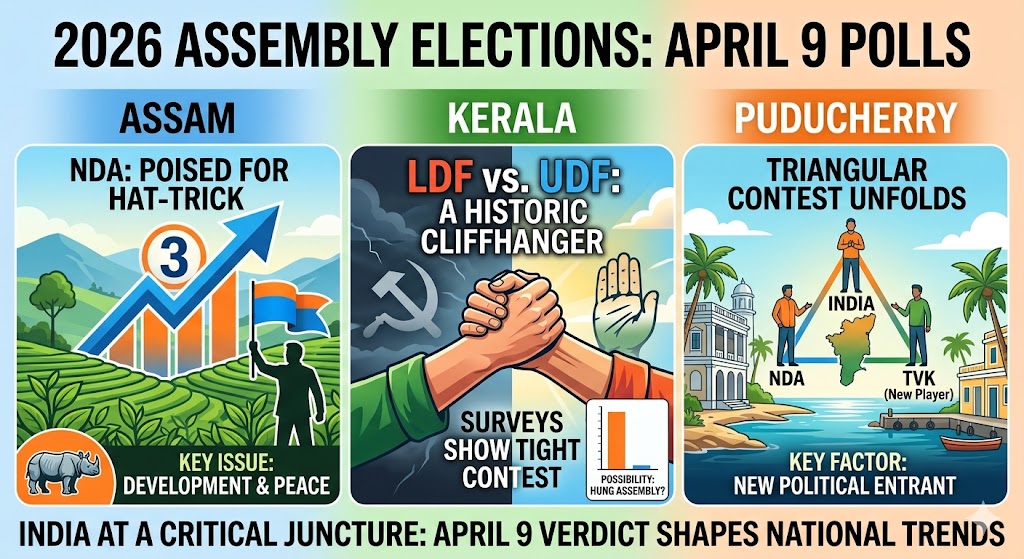
Assam: A deep dive into whether the BJP-led NDA can secure a historic hat-trick on the back of development and peace initiatives.
Kerala: Analyzing the high-stakes "photo-finish" battle between the LDF and UDF, where every vote could lead to a historic third term or a hung assembly.
Puducherry: Exploring the new triangular dynamic as traditional alliances face off against fresh political entrants like the TVK.
Kerala Assembly Elections 2026: A Cliffhanger with Historic Possibilities
Kerala’s 140-seat assembly has long been a bipolar battleground between the LDF (CPI(M)-led) and UDF (Congress-led). Chief Minister Pinarayi Vijayan’s LDF seeks a rare third consecutive term, an achievement no front has managed in the state’s history. Yet, anti-incumbency clouds the horizon.
Core Issues Shaping the Contest
The LDF highlights its welfare delivery—pensions, housing schemes, and health initiatives—claiming 97% of promises fulfilled. Critics point to youth unemployment exceeding 30%, economic slowdowns, and controversies including the 2024 gold smuggling case and Sabarimala-related tensions. The UDF, led by V.D. Satheesan, promises pragmatic change, better governance, and an end to perceived authoritarianism.
The BJP-led NDA, though traditionally a third force, has expanded its footprint through local body gains and targets Hindu-majority segments in Thiruvananthapuram, Thrissur, Palakkad, and Pathanamthitta. Development pitches, downplaying overt polarization, aim to convert incremental vote shares into seats.
Opinion Polls and Predictions
Recent surveys reflect razor-thin margins. Matrize projects LDF at 62-68 seats and UDF at 67-73, with NDA securing 5-8. VoteVibe and others show UDF at 64-74 and LDF at 63-73, vote shares nearly tied at 39-40%. No front appears headed for a clear majority, raising the tantalizing possibility of a hung assembly or post-poll realignments—scenarios rare in Kerala’s history.
Malabar region (48 seats) remains the decisive battleground, where UDF must regain lost ground from 2021. For the BJP, even 5-8 seats would mark a breakthrough after years of patient grassroots work.
How Campaigns Varied in Kerala
Kerala’s campaigns were markedly different from Assam’s top-down approach. Door-to-door canvassing, neighborhood meetings, and cultural events dominated, reflecting the state’s high literacy and politically aware electorate. The LDF leaned on its cadre network and welfare narratives, while UDF focused on anti-incumbency storytelling. BJP’s outreach, including rallies by Defence Minister Rajnath Singh, targeted specific demographics with development and cultural appeals.
On April 9, as polling unfolds, last-mile personal contacts and family discussions will likely sway undecided voters. The three-cornered fight adds unpredictability—BJP gains could indirectly benefit one front by splitting votes.
Special Focus: Kerala’s Possibilities
Kerala offers the most intriguing possibilities among the three states. A UDF victory would signal strong anti-incumbency and restore alternation in power. An LDF hat-trick would be historic, underscoring the resilience of Left politics amid national shifts. For BJP and the NDA, even a modest seat haul could position the party as a future alternative, eroding the bipolarity that has defined Kerala for decades. Whatever the result, today’s verdict will reshape alliances and strategies for years.
Puducherry Assembly Elections 2026: Triangular Contest in a Small but Strategic UT
Puducherry’s 30-seat assembly may be small in size, but its political theater is anything but. The NDA, led by Chief Minister N. Rangasamy’s AINRC in alliance with BJP and others, defends its “double-engine” governance. The opposition Congress-DMK bloc seeks a comeback, while TVK introduces fresh volatility.
Prevailing Issues
Demands for full statehood, administrative autonomy vis-à-vis the Lieutenant Governor, rising costs, unemployment, and privatization concerns dominate discourse. The NDA highlights welfare schemes and central support. The INDIA bloc accuses the ruling dispensation of eroding local powers. TVK, positioning itself as a clean alternative, appeals to younger voters disillusioned with both fronts.
Campaign Dynamics and Predictions
Alliances finalized late, with some reported cracks. NDA’s seat-sharing (AINRC contesting more, BJP around 14) reflects pragmatic adjustments. Congress-DMK coordination faced delays, while TVK’s solo contesting in all seats could split votes significantly.
No comprehensive pre-poll surveys dominate headlines, but ground reports suggest the NDA retains an edge due to incumbency advantages in key pockets. However, anti-incumbency and TVK’s Gen-Z appeal in urban and enclave areas (Karaikal, Mahe, Yanam) introduce uncertainty. A fragmented verdict remains possible, with TVK potentially playing kingmaker in close contests.
Campaigns here blended high-voltage rallies by national leaders (Amit Shah, M.K. Stalin) with hyper-local outreach. BJP’s youth wing focused on mobilization, while TVK leveraged celebrity pull. Today’s polling will test whether organizational strength trumps star power.
Winning Outlook
The NDA appears best placed to retain power, but margins could shrink. A Congress-DMK resurgence or TVK-induced surprises cannot be ruled out. For BJP, consolidating its role in the alliance strengthens its southern presence.
BJP’s Strategic Canvas Across the Three Polls
The BJP’s approach varied strategically, reflecting regional nuances. In Assam, it played the incumbent card aggressively, projecting stability. In Kerala, patient expansion and targeted development pitches aim for incremental gains. In Puducherry, alliance management and central leverage form the core.
As of April 9, the party’s campaign machinery—AI-driven micro-targeting, booth-level accountability, and star campaigners—has been in full swing. Success in Assam would validate its Northeast model; breakthroughs in Kerala or Puducherry would signal deeper southern penetration. Even limited gains would keep the party relevant in multi-cornered fights.
National Implications and Voter Turnout Factors
These elections test narratives of incumbency versus change, development versus welfare, and bipolar versus multi-party contests. High turnout today, especially among women and youth, could tilt balances. Security arrangements in Assam, dry days in Kerala, and special booths in Puducherry underscore the ECI’s focus on free and fair polls.
Broader takeaways include the resilience of regional alliances, the BJP’s adaptive strategies, and the enduring appeal of welfare politics in the south.
Conclusion: A Defining Day for Indian Federalism
As polling booths open across Assam’s valleys, Kerala’s backwaters, and Puducherry’s coastal enclaves on this April 9, 2026, the electorate holds the power to shape the next five years. Predictions favor the NDA in Assam, a photo-finish in Kerala with exciting possibilities, and a competitive edge for the ruling alliance in Puducherry tempered by new players.
Whatever the final tallies on May 4, these results will reverberate nationally. For political observers, strategists, and citizens alike, today marks not just an end to campaigning but the beginning of fresh mandates. The coming weeks promise intense scrutiny as democracy unfolds its verdict—one ballot at a time.
Frequently Asked Questions
What is the primary significance of 2026 Polls: Assam, Kerala & Puducherry Predictions?
2026 Polls: Assam, Kerala & Puducherry PredictionsAs voters across Assam, Kerala, and Puducherry head to the polling booths today, April 9, 2026, the political landscape of India stands at a critical juncture. These three assembly elections, though geographically and demographically diverse, carry national significance.
How does this development impact Politics?
With results slated for May 4, the outcomes will not only decide the fate of state governments but also signal broader trends for the Bharatiya Janata Party (BJP) and its rivals ahead of future national battles.The single-phase polling in all three regions marks the end of an intense campaign period that saw high-profile rallies, alliance realignments, and fierce ideological debates. In Assam, the BJP-led NDA seeks a historic third consecutive term.
What are the key future projections to monitor?
Kerala witnesses a razor-sharp contest between the ruling Left Democratic Front (LDF) and the opposition United Democratic Front (UDF), with the BJP eyeing a long-awaited breakthrough.