Pakistan's Arabian Sea Missile Test: Navy Power Display
International Affairs• April 14, 2026• Global Edition
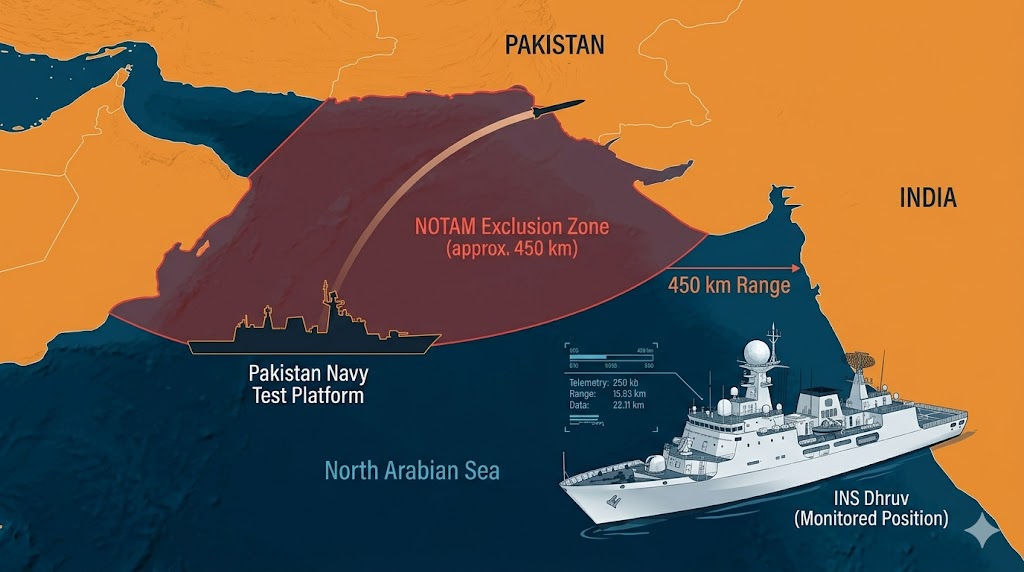
In mid-April 2026, Pakistan issued a revised Notice to Airmen (NOTAM) that temporarily closed a vast exclusion zone in the North Arabian Sea, stretching approximately 450 kilometers from key coastal points near Karachi, Ormara, Gwadar, and Sonmiani. The move, effective for April 14 and 15, immediately sparked intense speculation across defense circles. Many observers interpreted it as preparation for an advanced missile test—like naval in nature—conducted under operational conditions. While official confirmation from Pakistan’s Inter-Services Public Relations (ISPR) on a successful launch remains limited in public reporting, the scale of the restricted area and the timing align with routine but high-profile validation of strategic systems.
This Pakistan missile test arrives at a moment of layered regional complexity. It coincides with Pakistan’s recent diplomatic efforts to mediate the US-Iran conflict in Islamabad and comes against the backdrop of ongoing economic pressures, including sharp fuel price hikes and looming loan repayments. For analysts, the event raises pointed questions: Does it represent a straightforward demonstration of Pakistan Navy prowess, or does it carry subtle signaling amid enduring India-Pakistan strategic competition? This article examines the test’s technical and operational dimensions, its implications for naval deterrence, India’s measured response, echoes of 2025 bilateral frictions, Pakistan’s broader diplomatic posture, and the economic realities shaping its defense priorities. Through a balanced lens, it assesses whether such activity signals preparation for conflict or calibrated power projection in an uncertain security environment.
Background and Technical Details of the Test
Pakistan has long maintained a robust missile development program, blending indigenous designs with incremental upgrades to its surface-to-surface, cruise, and anti-ship inventories. Recent activity includes the January 2026 successful flight test of the Taimoor air-launched cruise missile (600 km range) by the Pakistan Air Force and earlier unveiling of the SMASH hypersonic anti-ship system. The April NOTAM, however, points toward a sea-based or naval-integrated platform—possibly involving submarine-launched or ship-fired systems—given the maritime exclusion zone and references to “weapons test” in official notices.
The revised NOTAM expanded an earlier danger area to roughly 415-450 km, closing airspace from sea level to unlimited altitude. Such measures are standard for ballistic or cruise missile trials to ensure aviation and maritime safety, yet the unusually large footprint drew attention. Defense watchers noted the zone’s overlap with Pakistan Navy operational areas, where systems like the Babur-class cruise missiles or advanced variants could be evaluated for range, accuracy, and evasion capabilities. Though exact specifications of the tested system were not publicly detailed at the time of the NOTAM, speculation centered on enhancements to existing naval strike options, potentially incorporating hypersonic or precision-guided features to counter modern air defenses.
Routine testing serves multiple purposes: validating reliability under real-sea conditions, training crews, and reassuring domestic audiences of credible deterrence. In this case, the Pakistan missile test unfolded without reported incidents, reinforcing the navy’s ability to operate in contested waters. Reports also highlighted associated maritime warnings, underscoring coordinated efforts between naval and air authorities.
At its core, the Arabian Sea activity illustrates Pakistan’s emphasis on sea denial and maritime domain awareness. The navy has invested heavily in modernizing its fleet, integrating advanced sensors, unmanned systems, and long-range strike assets. A test of this magnitude—conducted far from shore—signals operational maturity, showing that Pakistani forces can project power well beyond coastal defenses and maintain readiness in the face of regional volatility.
Such exercises contribute to what strategists term “deterrence by denial.” By demonstrating the capacity to hold at-risk targets at extended ranges, Pakistan aims to complicate any potential adversary’s planning. The choice of the Arabian Sea, a vital artery for energy shipments and trade, further amplifies the message: Pakistan retains the tools to influence maritime security dynamics if required. Analysts point out that these drills also serve internal cohesion, showcasing technological progress to both military personnel and the public at a time when economic headlines often dominate discourse.
Importantly, the test does not appear linked to any immediate crisis trigger. Instead, it fits a pattern of periodic validation seen in prior years. Pakistan routinely issues NOTAMs ahead of launches, and this instance follows established protocols. The focus on naval platforms aligns with broader doctrine prioritizing protection of sea lines of communication and response to evolving threats in the Indian Ocean region.
An infographic illustrating the test parameters, showcasing the 450 km NOTAM exclusion zone and the relative positions of the Pakistan Navy test platform and India's monitoring vessel, INS Dhruv.
India’s Response: Monitoring and Readiness
India responded promptly but professionally. Defense sources confirmed the deployment of INS Dhruv—the Indian Navy’s dedicated missile-tracking and ocean-surveillance vessel—into the Arabian Sea shortly before the NOTAM window. Equipped with advanced radar, telemetry antennas, and data-collection systems, the ship is designed precisely for observing ballistic and cruise missile activity at long range. Its positioning reflected standard intelligence-gathering practice rather than escalation.
New Delhi has consistently monitored Pakistani missile programs through a mix of satellite, aerial, and naval assets. The INS Dhruv deployment underscores India’s commitment to maintaining situational awareness without provocative maneuvers. Official Indian statements remained measured, avoiding direct commentary on the test while emphasizing the robustness of its own deterrent posture. This approach—calibrated observation paired with readiness—mirrors the mature crisis-management mechanisms both sides have developed over decades.
The event thus served as a reminder of the quiet intelligence contest that underpins South Asian strategic stability. Neither side sought confrontation; instead, each demonstrated capability and resolve. India’s actions reinforced its preparedness to counter any shift in the regional balance, while Pakistan proceeded with its scheduled activity.
Echoes of 2025 India-Pakistan Tensions
The April 2026 test inevitably invites comparison to earlier episodes of heightened alert. In March and April 2025, bilateral frictions escalated following the Pahalgam terror incident in Indian-administered Kashmir. Pakistan responded then with its own missile activity, including a training launch of the Abdali surface-to-surface system (450 km range) as part of Exercise INDUS. Those tests occurred amid mutual military posturing, border deployments, and diplomatic exchanges.
While the current Arabian Sea event lacks the same acute trigger, it revives familiar themes: the interplay between conventional modernization and nuclear-shadowed deterrence. Both countries continue to refine delivery systems—Pakistan emphasizing mobility and precision, India focusing on multi-layered defenses and longer-range options. The 2025 episode illustrated how terror-related incidents can rapidly militarize the discourse; the 2026 test, by contrast, appears more routine yet still carries symbolic weight in a neighborhood where capabilities are closely watched.
Importantly, neither side has allowed these demonstrations to derail broader diplomatic channels. Track-II dialogues, confidence-building measures, and backchannel contacts have helped manage risks. The latest Pakistan missile test, occurring in a period of relative calm, may therefore be read as maintenance of the status quo rather than preparation for renewed confrontation.
Pakistan’s Mediation Role in the US-Iran Conflict
Beyond South Asia, Pakistan positioned itself as a diplomatic actor during the brief but intense US-Iran hostilities of early 2026. Islamabad hosted high-level talks aimed at brokering a lasting ceasefire after six weeks of conflict. Pakistani officials facilitated direct engagement between US and Iranian delegations, contributing to a temporary pause in fighting. Though the April 11-12 meetings in Islamabad yielded no comprehensive agreement—Washington cited unmet demands and Tehran pointed to inflexible positions—the effort highlighted Pakistan’s willingness to engage constructively on global flashpoints.
Critics sometimes question the feasibility of such mediation given Pakistan’s own security challenges. Supporters counter that geographic proximity, historical ties with both sides, and a track record of shuttle diplomacy lend credibility. The US-Iran episode occurred against rising oil prices that directly affected Pakistan’s economy, adding urgency to stabilization efforts. By hosting the talks, Pakistan not only burnished its international image but also signaled that it prioritizes de-escalation in distant theaters even while tending to its neighborhood defenses.
The timing overlap—mediation efforts concluding just before the Arabian Sea NOTAM—illustrates the dual track of Pakistani policy: diplomatic outreach alongside prudent military readiness.
Economic Context: Defense Amid Fiscal Pressures
Pakistan’s defense activities unfold against a challenging economic backdrop. In early April 2026, the government announced steep fuel price increases: petrol rose to approximately Rs 458 per litre and diesel to Rs 520 per litre, driven by global oil volatility linked to the Middle East conflict. These hikes, the second in a month, added inflationary pressure on households and industry.
Compounding the strain, Pakistan prepared to repay a $3.5 billion loan to the UAE in April, alongside other debt obligations. Foreign exchange reserves, while improved from previous lows, face competing demands from imports, debt servicing, and development needs. Defense spending, though a national priority, competes for resources in this environment.
Observers note that missile programs benefit from long-term investments and international partnerships, allowing progress even during fiscal tightness. Yet the broader economy—reliant on remittances, exports, and energy imports—remains sensitive to external shocks. Successful tests can boost morale and investor confidence in indigenous capabilities, but sustainable security ultimately depends on economic resilience. The government has emphasized targeted subsidies and monitoring of GCC remittances to cushion impacts, yet the interplay between defense posture and fiscal health remains a key domestic debate.
Strategic Implications: Power Projection or Escalation Signal?
Does the Pakistan missile test indicate preparation for another regional war, or does it simply affirm naval strength? Evidence leans toward the latter. The activity was pre-notified, conducted in international waters without targeting any specific actor, and met with professional monitoring rather than alarm. Routine testing strengthens deterrence without crossing red lines—an approach both India and Pakistan have refined over years.
That said, the test occurs in a neighborhood where miscalculation remains a risk. Extended-range naval strike capabilities can alter cost-benefit calculations in future crises. For India, it reinforces the need for continued investment in anti-access/area-denial tools and intelligence fusion. For Pakistan, it validates investment in asymmetric maritime options.
Ultimately, the episode underscores a mature strategic competition: each side signals resolve while avoiding direct provocation. The absence of inflammatory rhetoric from either capital suggests mutual recognition that escalation serves no one’s interest. In this light, the test functions more as a data point in ongoing capability development than a harbinger of imminent conflict.
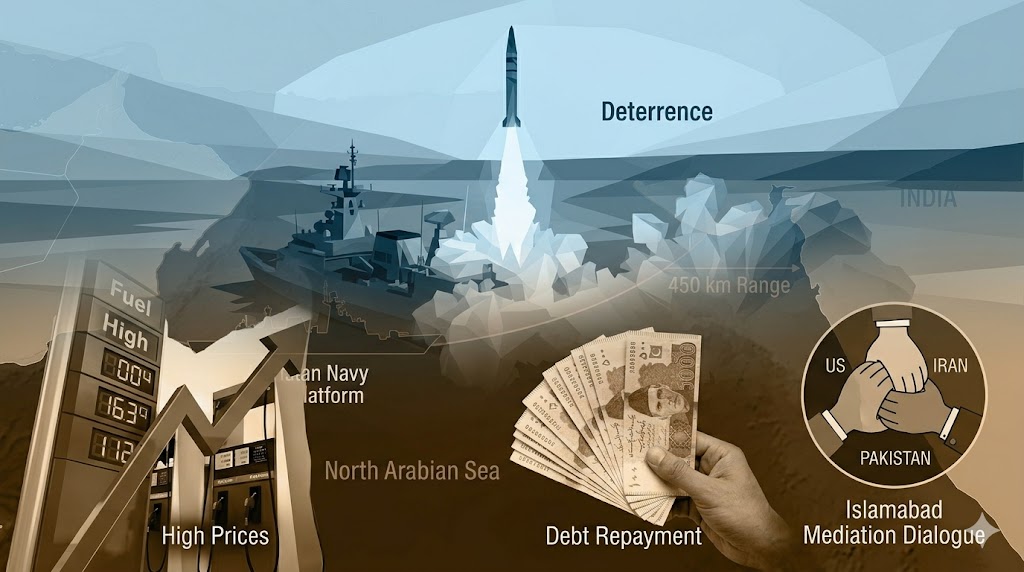
A conceptual image juxtaposing the military aspect of the test (top) with Pakistan's dual challenges of economic pressure (fuel prices and debt) and its simultaneous diplomatic role as a mediator in the US-Iran conflict.
Conclusion: Toward Stability Through Dialogue
Pakistan’s Arabian Sea missile test, framed by the revised NOTAM and observed closely by India, exemplifies the complex interplay of defense modernization, diplomatic initiative, and economic constraint. It showcases naval competence, reminds observers of enduring strategic rivalries, and occurs against a backdrop of Pakistan’s constructive mediation in the US-Iran context.
Regional security benefits when such demonstrations remain transparent and professional. Both India and Pakistan possess sophisticated command-and-control systems and crisis-management experience. The real test lies in translating technical prowess into sustained dialogue—on confidence-building, arms control, and economic cooperation.
As global energy markets stabilize and debt timelines approach, Pakistan’s leadership faces the perennial challenge of balancing security imperatives with development goals. For the broader region, the lesson is clear: credible deterrence paired with diplomatic engagement offers the surest path to stability. The April 2026 test, viewed dispassionately, reinforces deterrence without igniting new fires. Continued vigilance, measured responses, and quiet diplomacy will determine whether South Asia navigates the coming years through strength or through statesmanship.
Frequently Asked Questions
What is the primary significance of Pakistan's Arabian Sea Missile Test: Navy Power Display?
In mid-April 2026, Pakistan issued a revised Notice to Airmen (NOTAM) that temporarily closed a vast exclusion zone in the North Arabian Sea, stretching approximately 450 kilometers from key coastal points near Karachi, Ormara, Gwadar, and Sonmiani. The move, effective for April 14 and 15, immediately sparked intense speculation across defense circles.
How does this development impact International Affairs?
Many observers interpreted it as preparation for an advanced missile test—like naval in nature—conducted under operational conditions. While official confirmation from Pakistan’s Inter-Services Public Relations (ISPR) on a successful launch remains limited in public reporting, the scale of the restricted area and the timing align with routine but high-profile validation of strategic systems. This Pakistan missile test arrives at a moment of layered regional complexity.
What are the key future projections to monitor?
It coincides with Pakistan’s recent diplomatic efforts to mediate the US-Iran conflict in Islamabad and comes against the backdrop of ongoing economic pressures, including sharp fuel price hikes and looming loan repayments.