In the fast-evolving world of Indian retail, few companies have shaped consumer habits quite like Flipkart. What began as a modest online bookstore has transformed into a digital commerce powerhouse, now aggressively pushing boundaries with its speedy commerce expansion. This strategic move into hyperlocal, minutes-fast delivery isn't just about speed—it's a calculated evolution rooted in the company's foundational legacy, supported by improving financial metrics, and fortified by advanced cyber fraud readiness. As India's e-commerce sector surges toward a projected $350 billion by 2028, Flipkart's initiatives highlight resilience, innovation, and a commitment to secure, customer-centric growth.
This article delves into Flipkart's origins, its enduring legacy, the details of its speedy commerce expansion, recent annual profit trends, and how the company has built a cyber fraud-ready infrastructure. Whether you're a consumer, seller, investor, or industry observer, understanding these facets reveals why Flipkart remains a cornerstone of India's digital economy.
The Humble Origins: How Flipkart Began in 2007
Flipkart's story is one of the classic entrepreneurial grit, emblematic of India's startup boom. Founded on October 22, 2007, in Bengaluru by Sachin Bansal and Binny Bansal—unrelated IIT Delhi alumni and former Amazon employees—the company started in a two-bedroom apartment in Koramangala with a combined family investment of just ₹400,000 (about $4,700 at the time).
Initially positioned as an online bookstore, Flipkart addressed a clear gap in the market. Traditional retail was fragmented, and online options were scarce. The founders drew from their Amazon experience but adapted it to India's unique challenges: low credit card penetration, trust deficits in online payments, and complex logistics. They introduced cash-on-delivery (COD), a game-changer that boosted adoption in a cash-dominant economy.
By 2008, the platform was handling 100 orders daily. Early growth was organic, fueled by word-of-mouth and a focus on user experience. Acquisitions like WeRead in 2010 expanded its digital book offerings, while the 2012 purchase of Letsbuy brought electronics into the fold. These moves marked Flipkart's shift from niche bookseller to diversified e-commerce player.
What set Flipkart apart was its "Indianization" of global models. The team invested heavily in building its own logistics arm, Ekart, to control delivery timelines and costs. Big Billion Days sales, launched in 2014, became cultural phenomena, driving massive traffic despite occasional technical hiccups. These events not only boosted visibility but cemented Flipkart's reputation for value and scale.
By the mid-2010s, the company had raised billions in funding from investors like Tiger Global, Accel, and SoftBank. The 2018 Walmart acquisition for $16 billion was a watershed moment, valuing Flipkart at around $20 billion and providing the capital muscle for further expansion. Sachin Bansal exited, and Binny Bansal stepped down in 2018 amid personal developments, paving the way for professional leadership under Kalyan Krishnamurthy.
This origin story isn't just history—it's the bedrock of Flipkart's legacy. It instilled a culture of problem-solving tailored to Bharat, from multilingual apps to seller empowerment programs like Samarth for artisans.
Flipkart's Enduring Legacy in Indian E-Commerce
Flipkart's legacy extends far beyond its balance sheet. Often called the "Flipkart Mafia," the company's alumni have founded or led dozens of successful startups, including unicorns in fintech, logistics, and consumer tech. This ecosystem affected amplified India's startup culture, proving that one bold venture could spawn an entire entrepreneurial wave.
The company pioneered several industry standards: seamless mobile apps in regional languages, extensive seller onboarding (now over 1.1 million), and data-driven personalization. Its marketplace model empowered small businesses, contributing significantly to the "Digital India" vision. Subsidiaries like Myntra (fashion) and Cleartrip (travel) diversified offerings, while innovations such as Shopsy for social commerce and Flipkart Wholesale targeted B2B needs.
Even after the Walmart deal, Flipkart maintained operational autonomy, focusing on long-term value over short-term exits. The 2022 spin-off of PhonePe underscored its ability to nurture and scale fintech arms independently. Today, with a dominant market share in categories like electronics and apparel, Flipkart's legacy is one of trust and scale—qualities that directly fuel its current speedy commerce expansion.
This foundation of innovation and customer obsession positions Flipkart uniquely in the quick commerce race, where speed meets reliability.
A low-angle photograph capturing Flipkart's 2007 Koramangala, Bengaluru, legend beginnings, marked on the building gate, merging seamlessly with a futuristic holographic 3D map projecting hyperlocal 'Minutes' service network connections.
Flipkart Speedy Commerce Expansion: The Minutes Revolution
At the heart of Flipkart's current momentum is its speedy commerce expansion, embodied by the Flipkart Minutes service. Launched in August 2024 as a pilot in select Bengaluru pockets, Minutes delivers groceries, electronics, smartphones, and daily essentials in as little as 10 minutes. This hyperlocal model leverages a network of dark stores—compact, fulfillment-only facilities optimized for rapid picking and dispatching.
As of April 2026, Flipkart has crossed 800 dark stores, with plans to double that figure by the end of 2026—adding roughly 800 more units. The service already operates in over 70 cities and targets 250 by mid-year, with a heavy emphasis on Tier-2 and Tier-3 markets. Unlike some competitors focused solely on metros, Flipkart's strategy capitalizes on its established rural and semi-urban customer base. Reports indicate 25-30% of Minutes orders now originate from smaller towns, where orders per dark store are growing 25% month-on-month.
This speedy commerce expansion builds on earlier efforts like Flipkart Quick (90-minute delivery launched in 2020) but accelerates the timeline dramatically. Dark stores enable inventory proximity to customers, reducing last-mile costs and times. Flipkart adds approximately 100 stores monthly, a pace that underscores aggressive scaling without compromising quality.
The expansion aligns with broader market trends. India's quick commerce sector now boasts over 6,000 dark stores across players like Blinkit, Zepto, and Swiggy Instamart. Flipkart's entry intensifies competition but also raises the bar for service standards. By venturing into non-metro areas, the company avoids saturation in top cities while unlocking growth in underserved regions—leveraging its legacy logistics expertise from Ekart.
Benefits are manifold. Consumers enjoy unprecedented convenience for impulse or urgent needs. Sellers gain access to high-velocity sales channels. For Flipkart, speedy commerce expansion diversifies revenue beyond traditional e-commerce, capturing shares in high-frequency categories like FMCG. Early data shows strong traction, with the service complementing the core platform rather than cannibalizing it entirely.
Challenges remain, including maintaining profitability amid heavy discounting and infrastructure costs. Yet, Flipkart's deep pockets via Walmart and data-driven optimization—refined over 18 years—provide a competitive edge. This expansion isn't mere replication; it's an evolution of the company's core promise: making commerce accessible, reliable, and now, lightning-fast.
Financial Performance: Annual Profits and Sustainable Growth
Flipkart's speedy commerce expansion occurs against a backdrop of steady financial improvement. For FY25 (ending March 2025), the broader Flipkart India Private Limited reported consolidated revenue of ₹82,787 crore, up 17.3% year-on-year. However, net loss widened to ₹5,189 crore, driven by higher stock-in-trade purchases and finance costs amid aggressive investments.
Zooming into the marketplace arm, Flipkart Internet Private Limited posted stronger results: revenue climbed 14% to ₹20,493 crore, while net losses narrowed 37% to ₹1,494 crore. This profitability momentum in the core business reflects operational efficiencies, higher advertising income, and seller commissions—key pillars supporting expansion.
Annual profit trends show a clear trajectory toward breakeven in select verticals. Revenue growth outpaces many peers, fueled by festive events like Big Billion Days and now quick commerce contributions. Walmart's ongoing support, including fresh equity infusions, provides runway for scaling dark stores without immediate pressure.
Analysts note that while sector-wide quick commerce profitability faces headwinds from competition and discounting, Flipkart's hybrid model—blending speedy commerce with its vast traditional inventory—mitigates risks. Tier-2/3 focus further aids margins by tapping lower acquisition costs and loyal customers built over years.
Looking ahead, the 2025 domicile shift to India signals IPO preparedness, potentially unlocking further capital. With revenue crossing ₹83,000 crore milestones in recent rankings, Flipkart demonstrates that its speedy commerce expansion is not just growth-oriented but profit-accretive in the medium term. Improved losses in the marketplace arm validate strategic bets on technology and logistics.
Cyber Fraud Readiness: Safeguarding the Speedy Commerce Ecosystem
As Flipkart accelerates its speedy commerce expansion, cyber threats multiply. Increased digital transactions, app usage, and data flows heighten risks from phishing, account takeovers, and delivery scams. Yet, the company has positioned itself as cyber fraud ready through proactive, multi-layered defenses honed by its legacy of trust.
Flipkart's security framework begins with robust technical safeguards. Secure servers, encryption protocols, and advanced fraud detection systems monitor transactions in real-time. AI and machine learning—areas of active hiring—flag anomalies like unusual purchase patterns or device fingerprints. Post-incident learnings from past phishing campaigns targeting users have led to enhanced authentication, including two-factor options and biometric logins.
On the operational side, anti-fraud measures shine in logistics. Barcode security, warehouse camera tracking, and open-box delivery options minimize tampering or substitution risks during speedy fulfillment. Customers receive real-time order tracking, reducing "where is my package" disputes that fraudsters exploit.
Customer education forms a pillar of Flipkart's cyber fraud readiness. Regular alerts about phishing emails, fake affiliate schemes, and device takeover tactics empower users. The company collaborates with cybersecurity experts and issues public advisories, turning potential vulnerabilities into community vigilance. Privacy policies emphasize data minimization and retention only for legitimate purposes, with options for users to manage cookies and information.
In the context of quick commerce, where impulse buys and hyperlocal data collection rises, Flipkart integrates compliance with India's DPDP Act and global standards. Affiliate programs safeguards address past scams involving fake accounts, employing IP masking detection and behavioral analytics.
This decent, comprehensive approach to cyber fraud—neither reactive overkill nor lax—stems from Flipkart's legacy. Early trust-building via COD taught the value of transparency; today's tech stack builds on that. As dark stores proliferate, integrated cybersecurity ensures speedy commerce expansion enhances rather than erodes user confidence.
Future enhancements likely include deeper AI predictive modeling and partnerships for threat intelligence. By prioritizing cyber fraud readiness alongside growth, Flipkart not only protects revenue but reinforces its market leadership.
Challenges, Opportunities, and the Road Ahead
No expansion is without hurdles. Flipkart's speedy commerce push faces intense rivalry, regulatory scrutiny on data privacy, and the need for consistent profitability. Supply chain volatility and talent retention in a competitive job market add layers.
Yet, opportunities abound. The legacy of seller partnerships, combined with Walmart synergies, positions Flipkart to capture quick commerce's projected multi-billion-dollar slice. Financial stabilization, evidenced by narrowing losses, funds further innovation—perhaps AI-personalized speedy deliveries or expanded fintech integrations.
Ultimately, Flipkart's journey illustrates balanced progress: honoring its origins while embracing the future.
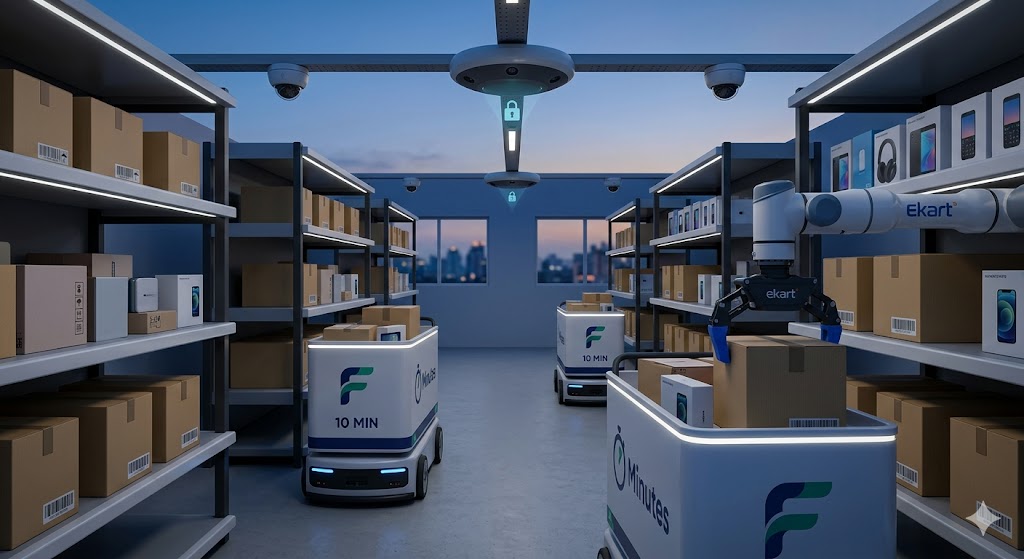
A ground-level photograph capturing autonomous 'picking carts' with generic 'Minutes' branding, optimization timers, and cyber fraud lock projected indicators, busy fulfillment within an efficient dark store facility in a non-metro city.
Conclusion
Flipkart's speedy commerce expansion through Minutes exemplifies how a company with deep roots can pivot swiftly without losing identity. From its 2007 origins in a Bengaluru apartment to leading quick commerce with 800+ dark stores and ambitious 2026 targets, the legacy remains a guiding force. Supported by growing annual revenues and narrowing losses, and anchored in cyber fraud readiness, Flipkart is poised for sustained leadership.
As Indian consumers demand faster, safer shopping, Flipkart delivers—not just packages, but confidence. The company's story continues to inspire, proving that true commerce success blends speed, security, and substance.
Frequently Asked Questions
What is the primary significance of Flipkart Speedy Commerce Expansion: Legacy & Profits?
Flipkart Speedy Commerce Expansion: Legacy, Profits & SecurityIn the fast-evolving world of Indian retail, few companies have shaped consumer habits quite like Flipkart. What began as a modest online bookstore has transformed into a digital commerce powerhouse, now aggressively pushing boundaries with its speedy commerce expansion.
How does this development impact Current Affairs?
This strategic move into hyperlocal, minutes-fast delivery isn't just about speed—it's a calculated evolution rooted in the company's foundational legacy, supported by improving financial metrics, and fortified by advanced cyber fraud readiness. As India's e-commerce sector surges toward a projected $350 billion by 2028, Flipkart's initiatives highlight resilience, innovation, and a commitment to secure, customer-centric growth.This article delves into Flipkart's origins, its enduring legacy, the details of its speedy commerce expansion, recent annual profit trends, and how the company has built a cyber fraud-ready infrastructure.
What are the key future projections to monitor?
Whether you're a consumer, seller, investor, or industry observer, understanding these facets reveals why Flipkart remains a cornerstone of India's digital economy.The Humble Origins: How Flipkart Began in 2007Flipkart's story is one of the classic entrepreneurial grit, emblematic of India's startup boom.