On April 14, 2026, Prime Minister Narendra Modi stood in Dehradun to inaugurate the much-awaited Delhi Dehradun Expressway, a project that promises to reshape travel in North India forever. This was no ordinary ribbon-cutting ceremony. Flanked by Union Road Transport and Highways Minister Nitin Gadkari, Uttarakhand Chief Minister Pushkar Singh Dhami, and Uttar Pradesh Chief Minister Yogi Adityanath, the Prime Minister described the expressway as a “great gift” not just for Uttarakhand but for the entire nation. Before the formal event, Modi offered prayers at the historic Maa Dat Kali Temple, a gesture that blended spiritual tradition with modern development.
The Delhi Dehradun Expressway is more than a highway. At approximately 210 kilometres long and built at a cost of around ₹11,868 crore, it slashes the journey from Delhi to Dehradun from a gruelling six to seven hours to a comfortable two and a half hours. For millions of daily commuters, tourists, pilgrims heading to Char Dham, and business travellers, this Delhi Dehradun Expressway inauguration marks the dawn of faster, safer, and greener mobility. But its true significance lies in how it directly tackles Delhi’s chronic traffic problems while exemplifying the Modi government’s relentless focus on world-class road and railway infrastructure.
In the sections ahead, we explore the details of this transformative project, its immediate relief for Delhi’s traffic congestion, the broader benefits for residents, and how it fits into the larger canvas of infrastructure achievements under the Modi government. From Bharatmala’s highway revolution to the modernisation of Indian Railways with Vande Bharat and Amrit Bharat trains, this article paints a comprehensive picture of progress that is changing lives across the country.
The Historic Inauguration of the Delhi Dehradun Expressway
The Delhi Dehradun Expressway inauguration unfolded with palpable excitement in Dehradun on April 14, 2026. Prime Minister Modi, fresh from his temple visit, addressed a gathering that included senior leaders and local residents. The event symbolised years of planning, execution, and vision. The foundation stone had been laid earlier, but today’s inauguration brought the full corridor to life.
Spanning four phases, the Delhi Dehradun Expressway starts at Akshardham Temple in Delhi and winds through Baghpat, Baraut, Shamli, and Saharanpur before reaching Dehradun. Phase 1 (32 km, 12 lanes) from Akshardham to the Eastern Peripheral Expressway near Baghpat opened to traffic in late 2025, already easing East Delhi congestion. Subsequent phases added six-lane stretches, seven major interchanges, over 100 underpasses, and five railway over bridges. The final stretch includes twin tunnels and an elevated flyover tailored for the terrain.
What sets this Delhi Dehradun Expressway apart is its eco-sensitive design. A standout 12-kilometre elevated wildlife corridor passes through Rajaji National Park—the second such facility in India after the one on NH-44. Equipped with six animal underpasses, it ensures safe passage for elephants, leopards, and other wildlife while minimising human-animal conflict. Advanced Traffic Management Systems (ATMS), crash barriers, service lanes for local traffic, and five toll plazas further enhance safety and efficiency.
PM Modi’s presence underscored the project’s national importance. He highlighted how the Delhi Dehradun Expressway will strengthen economic ties between the National Capital Region and Uttarakhand, boost tourism, and support pilgrims. Union Minister Nitin Gadkari, the driving force behind many such initiatives, noted the corridor’s integration with the Delhi-Mumbai Expressway and routes to Haridwar and Roorkee, creating a seamless multimodal network.
Solving Delhi’s Traffic Nightmare: How the Delhi Dehradun Expressway Delivers Relief
Delhi has long battled crippling traffic congestion, with the capital’s roads often ranked among the world’s most congested. Daily commutes stretch into hours, air quality suffers, and economic productivity takes a hit. The Delhi Dehradun Expressway directly addresses these pain points by diverting long-distance traffic away from the city’s arterial routes.
The expressway’s 17-kilometre elevated stretch within Delhi, combined with its access-controlled design, bypasses the notorious bottlenecks on the old Delhi-Saharanpur-Dehradun highway. Previously, vehicles headed to Uttarakhand crawled through Ghaziabad, Meerut, and other urban stretches, adding hours and idling emissions. Now, the Delhi Dehradun Expressway funnels through-traffic efficiently, freeing up local roads for Delhi residents.
Experts estimate that the Delhi Dehradun Expressway will reduce daily vehicle load on the Delhi-Meerut corridor by thousands, lowering pollution and accident risks. For Delhiites, this translates to quicker weekend getaways to the hills, faster business travel, and less time stuck in traffic. The project’s integration with the Eastern Peripheral Expressway and upcoming links further amplifies its impact on the National Capital Region’s mobility.
In practical terms, a family in East Delhi can now reach Dehradun in under three hours instead of battling six-hour ordeals. This not only saves fuel and time but also encourages more balanced regional growth, reducing pressure on Delhi’s infrastructure.
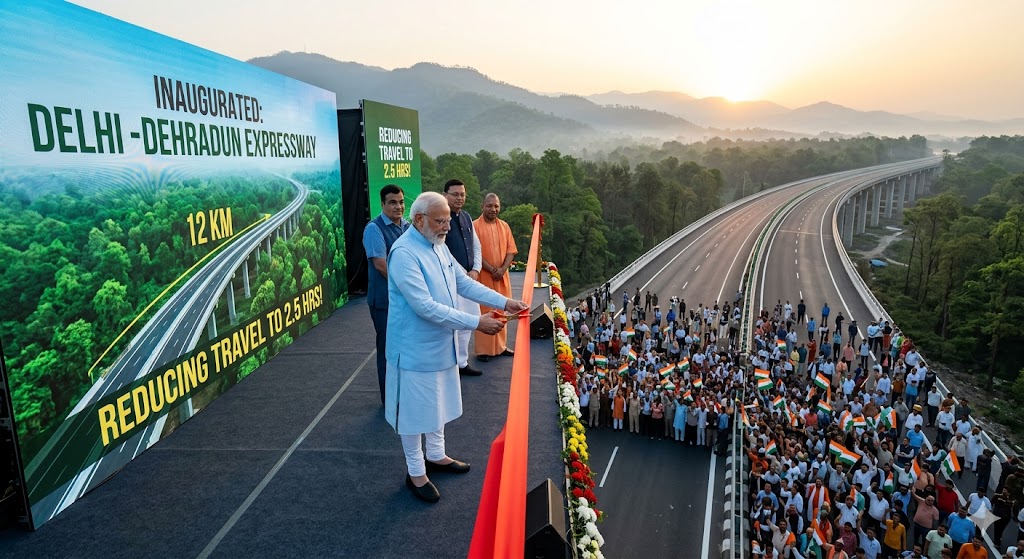
Prime Minister Narendra Modi, alongside Union Minister Nitin Gadkari and Uttarakhand CM Dhami, cuts the ceremonial ribbon in Dehradun at dawn on April 14, 2026, officially opening the Delhi-Dehradun Expressway, reducing travel to just 2.5 hours.
The Greatest Effort for Delhi People: Connectivity, Economy, and Quality of Life
For the people of Delhi, the Delhi Dehradun Expressway inauguration represents one of the most meaningful infrastructure gifts in recent memory. It is not an abstract project—it is a lifeline that brings the serene hills of Uttarakhand within easy reach while easing everyday urban stress.
Delhi residents, many of whom rely on the hills for respite from the city’s hustle, now enjoy dramatically improved access to tourist hotspots like Haridwar, Rishikesh, and the Char Dham yatra circuit. Tourism in Uttarakhand is expected to surge, bringing economic spillover benefits back to Delhi through increased trade, logistics, and job creation in hospitality and transport sectors.
Beyond leisure, the Delhi Dehradun Expressway supports commerce. Faster freight movement between the capital and the Himalayan region means fresher produce, quicker delivery of goods, and lower logistics costs—benefits that ultimately reach Delhi consumers and businesses. The expressway also creates thousands of direct and indirect jobs during construction and operation, many filled by local youth from Delhi and surrounding areas.
Environmentally, the Delhi Dehradun Expressway’s green features—tree transplantation, compensatory afforestation of over 50,000 trees, and the wildlife corridor—demonstrate a commitment to sustainable development. For Delhi, plagued by poor air quality, reduced congestion and emissions from idling traffic mark a tangible improvement in livability.
In essence, this project embodies the Modi government’s people-centric approach: infrastructure that solves real problems, enhances quality of life, and fosters inclusive growth for Delhi’s millions.
Modi Government’s Road Revolution: Bharatmala and National Highways Transformation
The Delhi Dehradun Expressway is not an isolated achievement but a shining example of the Modi government’s ambitious road infrastructure agenda. At the heart of this lies Bharatmala Pariyojana, one of the largest highway programmes ever undertaken globally.
As of February 2026, under Bharatmala, 22,223 kilometres of the 26,425 kilometres awarded have already been constructed, with the remaining stretch targeted for completion by the end of FY27. Launched in 2017 with an initial target of 34,800 kilometres, the programme focuses on economic corridors, inter-corridors, feeder routes, ring roads, and bypasses. It has decongested cities, improved access to tribal and aspirational districts, and slashed logistics costs nationwide.
The Modi government has consistently broken records in highway construction. National Highways Authority of India (NHAI) projects have multiplied, with expressways like the Delhi-Mumbai and Chennai-Bengaluru corridors progressing rapidly. The Delhi Dehradun Expressway itself forms part of the Delhi-Dehradun Economic Corridor, linking seamlessly with other major arteries.
This relentless pace—averaging over 10,000 kilometres of highways annually in recent years—has transformed India’s road network. From remote villages to bustling metros, connectivity has improved dramatically, boosting GDP, employment, and ease of doing business. The Delhi Dehradun Expressway stands as living proof of this vision: world-class infrastructure delivered on time and with environmental sensitivity.
Parallel Progress in Indian Railways: Vande Bharat, Amrit Bharat, and Future-Ready Mobility
While roads have seen explosive growth, the Modi government has equally revolutionised Indian Railways. The introduction of over 400 Vande Bharat trains by 2025 has set new benchmarks in speed, comfort, and punctuality. These semi-high-speed trains have replaced older services on key routes, offering a premium yet affordable travel experience.
Complementing this are Amrit Bharat Express trains—low-cost, non-AC sleeper services aimed at connecting pilgrimage sites and smaller towns. As of early 2026, dozens of Amrit Bharat services are operational, with more flagged off regularly by the Prime Minister himself.
A particularly exciting development for Rajasthan is the upcoming Vande Bharat Sleeper trains. India’s first dedicated Vande Bharat sleeper coach maintenance facility at Jodhpur’s Bhagat Ki Kothi is set to become operational by June 2026. This facility, costing ₹360 crore in its first phase, will support the launch and upkeep of sleeper versions of these iconic trains, promising overnight high-speed travel across Rajasthan and beyond.
Railway station redevelopment under the Amrit Bharat Station Scheme is another highlight. Hundreds of stations are being modernised with world-class amenities, improving passenger experience from small towns to major hubs. Dedicated Freight Corridors have reduced goods transit times, while plans for seven new high-speed rail corridors—announced in recent budgets—signal India’s entry into bullet-train territory.
Together, these initiatives ensure that the Modi government’s infrastructure push is multimodal, addressing both road and rail needs comprehensively.
Upcoming Road and Rail Events: Momentum Continues Under Modi Government
The Delhi Dehradun Expressway inauguration is just the latest milestone. Several road and rail projects are on the horizon.
In roads, remaining Bharatmala stretches, additional expressway phases, and ring roads around major cities are slated for completion by 2027. NHAI’s pipeline includes thousands of kilometres of new highways, with a focus on last-mile connectivity and multimodal logistics parks.
On the railway front, Vande Bharat Sleeper trains will soon ply key routes, starting with facilities in Rajasthan. More Amrit Bharat Express services, high-speed corridor groundwork, and station upgrades will roll out progressively. The government’s ₹5.4 lakh crore investment in railways by 2030 underscores a long-term commitment to modern, efficient transport.
These upcoming events—whether a new Rajasthan-linked Vande Bharat service or fresh highway stretches—continue the narrative of progress that began with projects like the Delhi Dehradun Expressway.
Long-Term Benefits: Economic Growth, Sustainability, and Viksit Bharat
The cumulative impact of the Modi government’s road and railway developments extends far beyond travel times. Economically, better connectivity lowers costs, attracts investment, and creates jobs. Environmentally, projects like the Delhi Dehradun Expressway’s wildlife corridor set standards for green infrastructure. Socially, they bridge urban-rural divides and empower aspirational districts.
For Delhi specifically, the Delhi Dehradun Expressway offers lasting relief from traffic woes while opening new opportunities. Nationally, it contributes to the vision of a developed India—Viksit Bharat—where infrastructure drives inclusive growth.
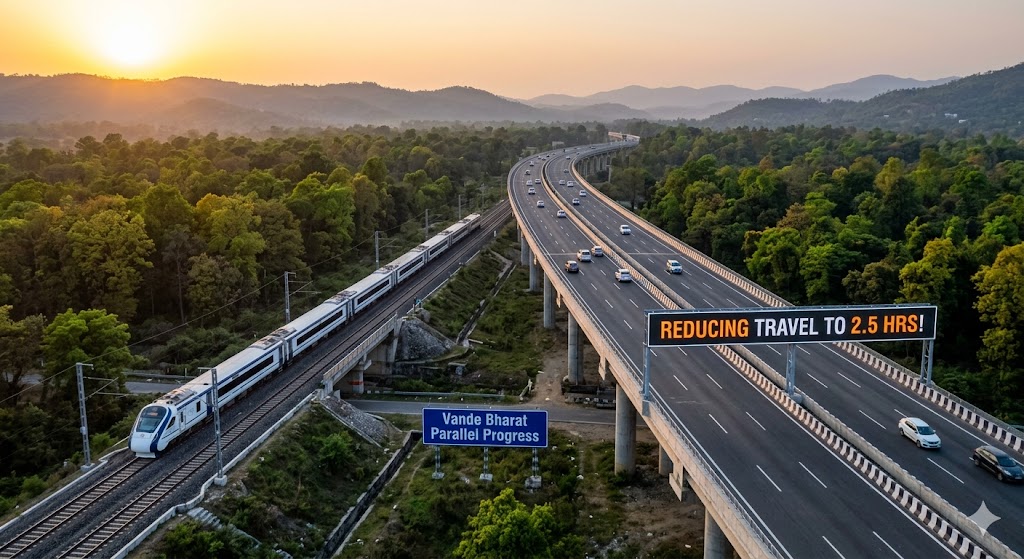
A parallel perspective near Dehradun at dusk, showing the multi-lane elevated Delhi-Dehradun Expressway flyover cutting through a lush wildlife corridor on the right, alongside a semi-high-speed Vande Bharat express train running below on modernized railway tracks, embodying the Modi government's integrated, multimodal progress.
Conclusion: A Testament to Visionary Leadership
The Delhi Dehradun Expressway inauguration by Prime Minister Narendra Modi on April 14, 2026, is more than the opening of a highway. It is a powerful symbol of a government that delivers on promises, thinks big, and puts people first. From solving Delhi’s traffic challenges to advancing national road and rail networks through Bharatmala, Vande Bharat, and beyond, the Modi government has redefined infrastructure in India.
As the Delhi Dehradun Expressway carries millions towards faster journeys and brighter futures, it reminds us that true development is measured not just in kilometres built but in lives transformed. The road ahead—both literal and figurative—looks promising under this continued momentum.
Frequently Asked Questions
What is the primary significance of "Delhi-Dehradun Expressway Inaugurated by PM Modi"?
A Landmark Moment in India’s Infrastructure JourneyOn April 14, 2026, Prime Minister Narendra Modi stood in Dehradun to inaugurate the much-awaited Delhi Dehradun Expressway, a project that promises to reshape travel in North India forever. This was no ordinary ribbon-cutting ceremony.
How does this development impact News?
Flanked by Union Road Transport and Highways Minister Nitin Gadkari, Uttarakhand Chief Minister Pushkar Singh Dhami, and Uttar Pradesh Chief Minister Yogi Adityanath, the Prime Minister described the expressway as a “great gift” not just for Uttarakhand but for the entire nation. Before the formal event, Modi offered prayers at the historic Maa Dat Kali Temple, a gesture that blended spiritual tradition with modern development.The Delhi Dehradun Expressway is more than a highway.
What are the key future projections to monitor?
At approximately 210 kilometres long and built at a cost of around ₹11,868 crore, it slashes the journey from Delhi to Dehradun from a gruelling six to seven hours to a comfortable two and a half hours.